FYI: The Morbid Fact Du Jour newsletter will be on hiatus from Friday, February 23rd through Tuesday, March 19th while the Comtesse attends to family in Catatonia. While she’s away, you can always peruse the archives here!
Please, stay morbid in my absence!
Today’s Unextricated Yet Truly Morbid Fact!
An account of the death of Sergeant Christian Taifel, Company E, 107th Ohio Infantry, 2nd Brigade, 1st Division, 11th Corps at Gettysburg during the American Civil War.
This short biography illustrates some of the complications which often arise when the researcher attempts to track down the final disposition of a Civil War soldier. In the case of Sergeant Taifel, conflicting reports are found as to his death. One, the official source, records that he died on July 18, at Satterlee Military Hospital, Philadelphia, sixteen days after being wounded in the hand on the afternoon of July 1 at Gettysburg. However, the following letter points toward a totally different set of circumstances.
Navarre, Ohio
October 3, 1885Colonel John Bachelder
Gettysburg, Pa.Dear Sir….
A color bearer of the 107th O.V.I. was shot in the wrist, the ball passing up in his arm [and] stopping near the elbow. He walked around at the 11th Corps Hospital several days and wouldn’t let the Doctors cut out the ball. I plead with him one evening when he was frying potatoes and onions to have the ball extricated. He swore he wouldn’t and the next morning he was dead. We buried him. When I was at Gettysburg in August I went to the old Spangler Farm where the 11th Corps Hospital was and young Mr. Spangler who lives there told me that the book with the names of those who were buried in the cemetery on their farm had been given to some comrade last summer and that it is now in the war dept or Pension Bureau at Washington.
A.J. Rider
Alfred J. Rider was regimental postmaster of the 107th Ohio and was twenty-three during the Battle of Gettysburg. He was the soldier who physically buried Brigadier General Lewis Armistead at the George Spangler farm shortly after his death on July 3.
Taifel was twenty-two when he died, and made a fateful decision that day. However, many soldiers’ lives were saved by refusing to suffer amputation, and just as many perished by not allowing these serious operations to be performed.
Culled from: Killed In Action
Ghastly! Civil War Gangrene Edition!
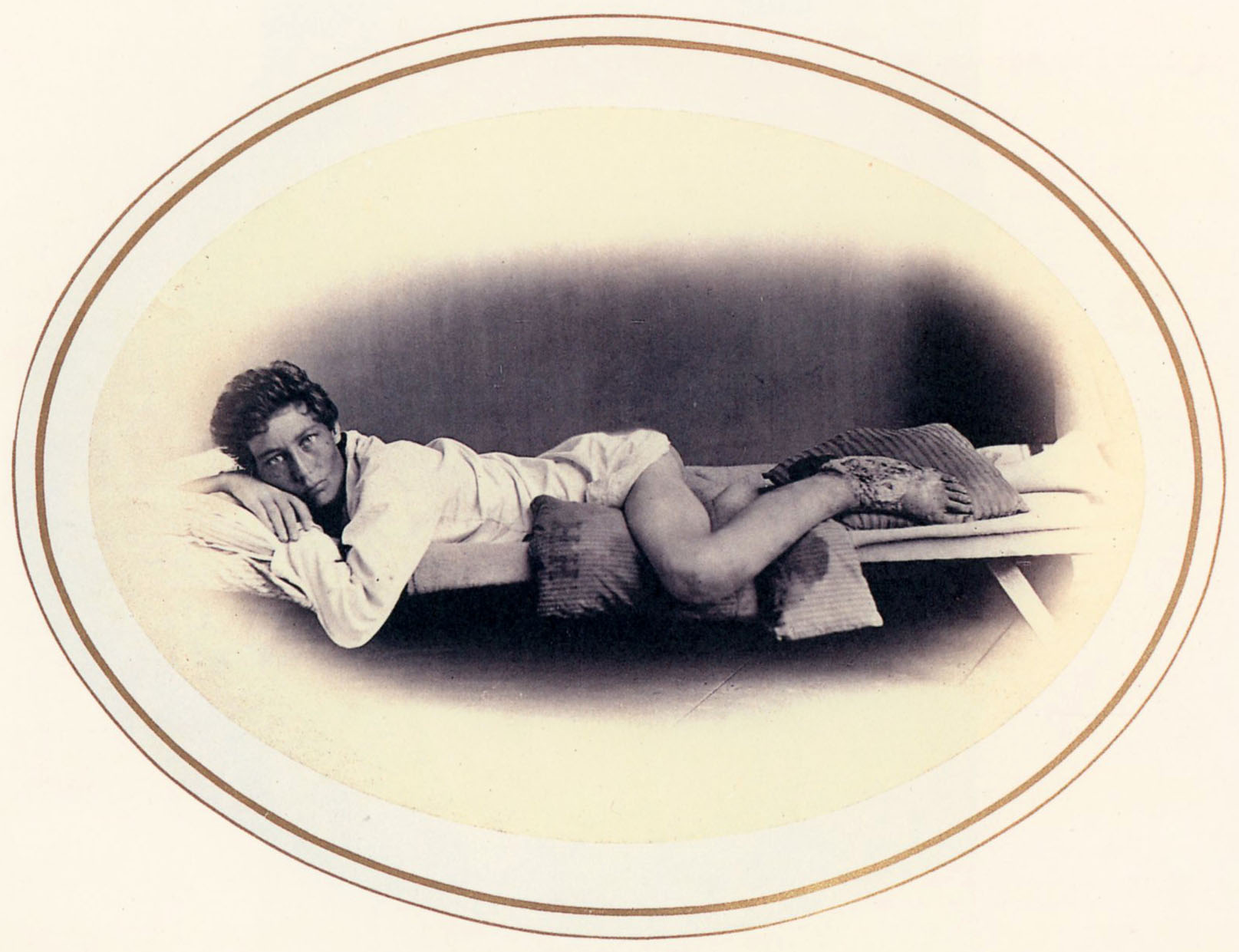
Civil War Soldier with a Gangrenous Foot, June 21, 1865
Reed Brockway Bontecou, M.D., Washington, D.C.
Albumen print, 4 1/2 x 6 1/2 in.
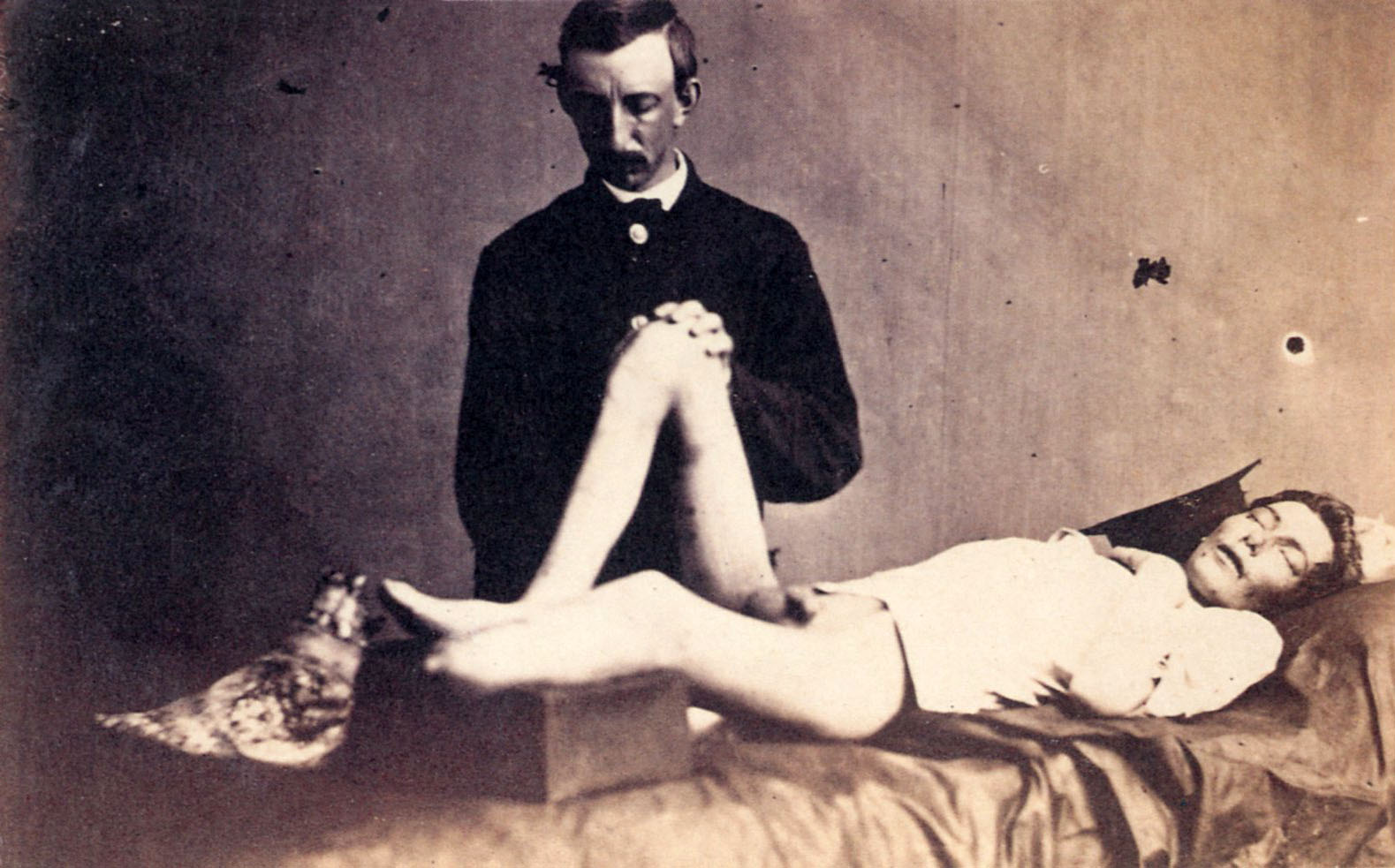
Civil War Soldier on an Operating Table with His Amputated Foot, June 21, 1865
Reed Brockway Bontecou, M.D., Washington, D.C.
Albumen print (carte-de-visite), 2 1/2 x 4 in.
The most dramatic and poignant set of medical photographs of the Civil War — indeed, one of the most important in the first half-century of medical photography — are those taken of Private John D. Parmenter, Company G, 67th Pennsylvania Volunteers.
Parmenter was wounded by a “minnie ball” on April 3, 1865, during the Battle of Amelia Springs (Virginia), only three days before General Lee surrendered. “On April 16 Parmenter was admitted to Harewood US Army Hospital with a gangrenous ulcer of the wound, and despite debridement and supportive treatment he continued to lose weight and his general condition deteriorated,” noted Dr. Bontecou (1824-1907), the surgeon in charge, who decided to operate on June 21. Using a circular incision technique, he amputated the lower third of Parmenter’s leg, propping up the specimen next to the anaesthetized youth for this remarkable picture. By July 30 the stump was healed, and Parmenter was discharged.
The first image depicts Parmenter’s gangrenous foot still attached to his body. The second is unique in that it was recorded after surgery but while the patient was still on the operating table; he is shown unconscious from the effects of general anaesthesia, his pathological specimen displayed with him and one of his physicians posed at his side.
The image is medically important because inclusion of the hospital operating table and its typical oiled cloth covering depicts the lack of sterile conditions, as the cloth usually remained unwashed between operations. (With the introduction of antisepsis by Lord Joseph Lister in 1867, hospital gangrene, the condition from which Parmenter suffered, so quickly ceased to be a medical concern that it was never bacteriologically investigated.)
This image also clearly reveals the effects of general anaesthesia, under which Parmenter did not resemble his normal self as shown in the preoperative photograph. His youthful good looks became distorted from the paralysis induced by the miraculous painkilling agent (which would have been ether or chloroform, or perhaps a combination of the two). Another photograph in the series (not shown) depicts a close-up of the amputated leg.
Culled from: A Morning’s Work: Medical Photographs from the Burns Archive & Collection 1843-1939
Andersonville Prisoner Diary Entry Du Jour!
This is the continuation of the 1864 diary of Andersonville prisoner Private George A. Hitchcock (see the archived version for all entries up until now).
Here’s today’s entry:
November 11th. Clear and cold. A recruiting officer has been in camp enticing prisoners to enlist in the rebel army. Several went from our division.
Culled from: Andersonville: Giving Up the Ghost