Today’s Cheap Yet Truly Morbid Fact!
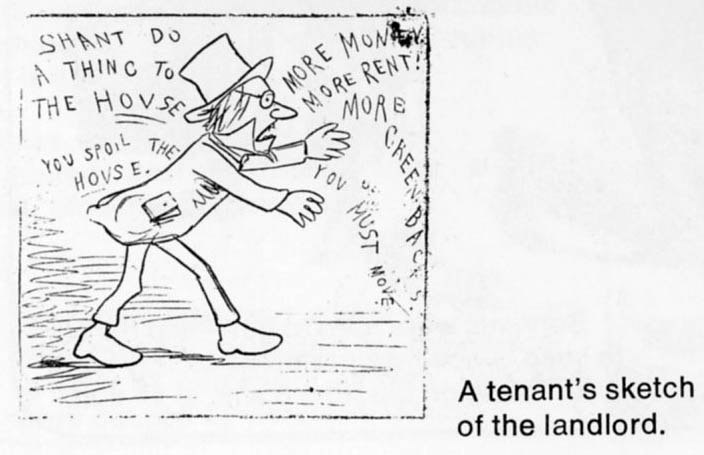
In public affection the landlord’s rating was comparable to that of the kidnapper; and the richer he was, the more likely he was to deserve it. His victim, the tenant, is today protected by the law, but in the 19th century he was vulnerable, ignorant and utterly misused.
New York’s soaring population—augmented by the continuing influx of Europeans—aggravated the housing shortage and inflated real estate values. Keen as foxes to the scent of weaker game, speculators piously came to the rescue by building the cheapest form of tenements.
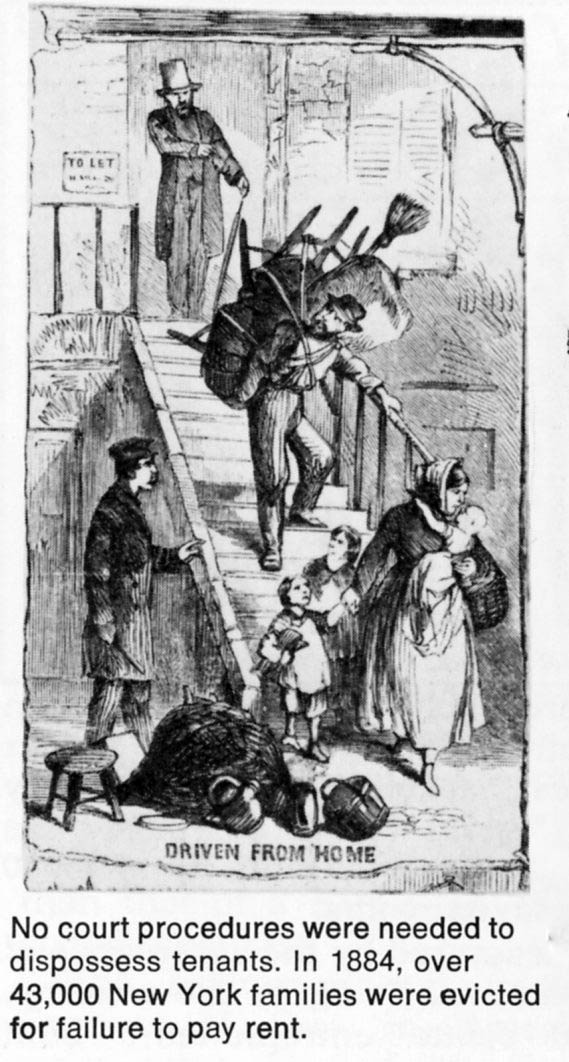
Cracked walls, sagging floors, and a total absence of fire exits were features of these neglected buildings, whose dingy over-crowded rooms drew extortionate rents. Landlords bullied poor and middle-class families with yearly rent increases and unpardonably brutal evictions. [Everything old is new again, eh? – DeSpair]
For New Yorkers who became casualties of the rent spiral the boarding house offered a solution, though not an ideal one. For $3 to $5 a week the clerk or working girl could find refuge here, along with childless couples, adventurers and ne’er-do-wells. Together they comprised a true cross section of America’s transient population—a culture of the homeless who were bound to a fixed place by neither blood nor tradition.
No invention of the Gilded Age, the boarding house had flourished before the Civil War in frontier cities and towns as a vital element in the nation’s growth. Charles Dickens, among others, missed their significance when he waspishly compared America’s rootless ways with those of the English.
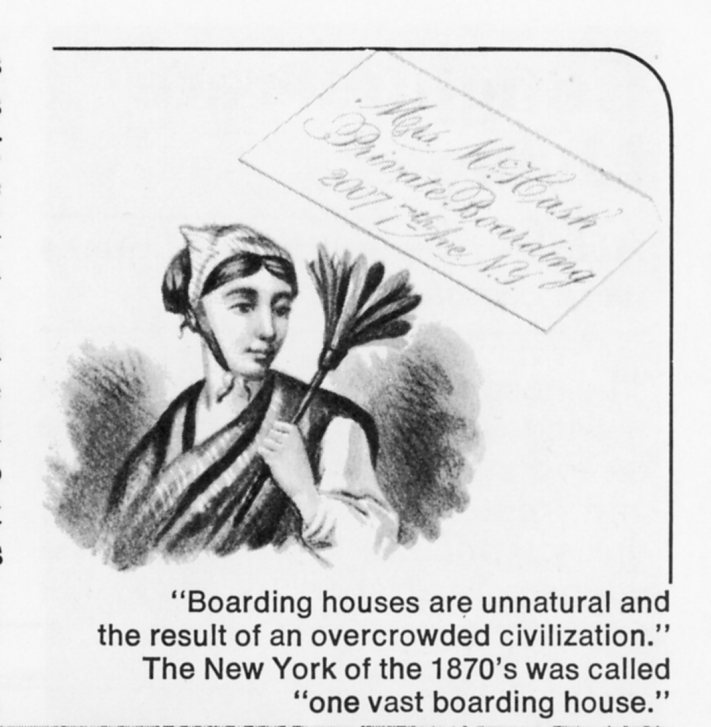
Domestic moralists saw them as a threats to Victorian rectitude that loosened family ties and encouraged sinful liaisons. No doubt these dangers existed, but for legions with meager resources the boarding house was home.
The need for the apartment house existed for many years before its evolution. The boarding house and tenement were too little; the townhouse, too much. The intense frustration of city life literally forced the development of the apartment building, which was to convert millions of Americans into “cliff dwellers.”
The flight from private dwellings began with the well-to-do, whose townhouses had become a financial burden. Richard M. Hunt created the prototype of a new style of housing in his Stuyvesant Apartments on 18th Street in New York. Contrary to dire predictions that New Yorkers would never consent to live “on mere shelves under a common roof,” this building and similar ones that followed it proved very successful. Class privilege was safeguarded by rents up to $3000 for seven rooms.
Reassured by the acceptance of communal living by the wealthy, real estate entrepreneurs built lower-rent apartment houses for the middle class. But these structures, which soon mushroomed in American cities, were little more than glorified tenements; and the style of living that was a pleasure for the rich became, in imitation, a curse to the wage earner. As a contemporary observed, “Reasonable apartments are not good, and good apartments are not reasonable.”
Families were shelved in layers, sharing floors that were subdivided into several apartments, three or four tiny rooms providing no insulation from the neighbors’ cooking smells or babies’ squallings. Garbage removal and sanitary facilities were comparably wretched and overcrowding made the buildings “more difficult to manage that n the tenement houses of the slum districts.”
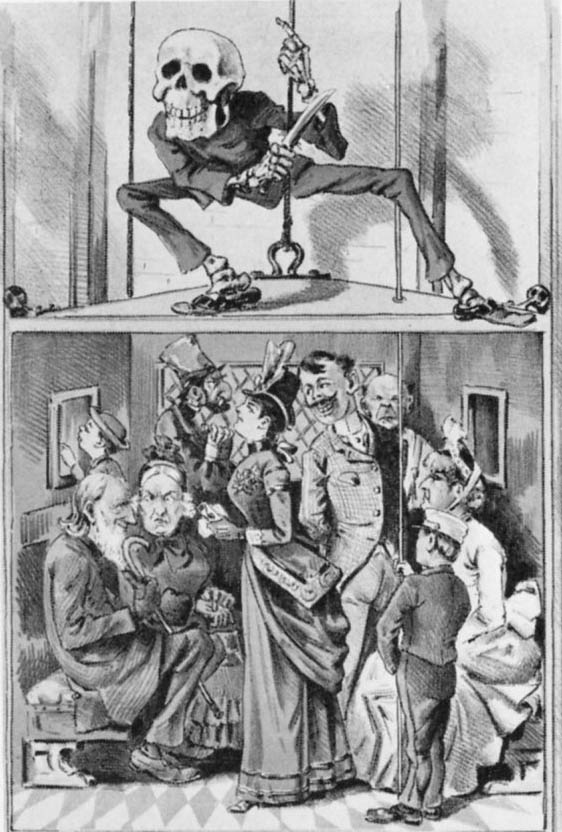
As the size and number of apartment buildings increased, so too did the danger that a fire would turn them into blazing prisons. Of course, they were not the only firetraps, but they accounted for the heaviest loss of life in the great conflagrations of the period. Between 1870 and 1906 four American cities—Chicago, Boston, Baltimore and San Francisco—burned to the ground, a record unmatched anywhere else in the world. Boston’s assessment of its yearly fire damage—$1 to $1.5 million—was ten times greater than that of a European city of comparable size.
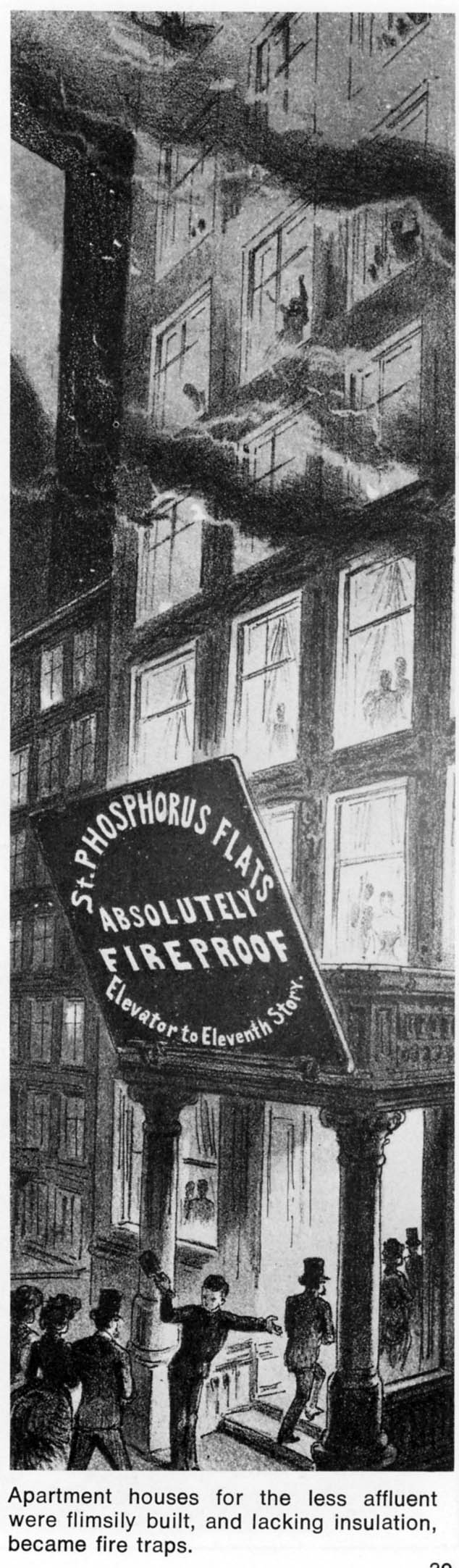
The frequency and destructiveness of fires in American cities were blamed on shoddy construction and the use of flammable materials in the construction of “fireproof” apartments. Even as late as 1904, after steel had replaced the less heat-resistant cast iron for building, 7000 lives were lost in city fires.
Nowhere is the fireman more celebrated than in the Untied States. And for sound, historical reasons.
Culled from: The Good Old Days, They Were Terrible!
Vintage Illustration Du Jour!

A woman’s face, badly affected with lesions of impetigo on the nose, cheeks and upper lip.
Culled from: The Sick Rose