First of all, I apologize for being a flaky factster lately. Personal life has been intruding – and actually in a GOOD way, for a change. I hope to get ahead on the newsletters this weekend so that gaps don’t occur again for awhile!
Secondly, before we get into today’s fact, which is culled from the book I’m currently reading (Dark Summit: The True Story of Everest’s Most Controversial Season
Now on with the fact!
Today’s Nosy Yet Truly Morbid Fact!
Tom and Tina Sjogren were a Swedish couple who tried for four consecutive years, beginning in 1996 and finally succeeding on Mary 26, 1999, to climb Mt. Everest. While each of their attempts had issues, none quite compared to the Sjogrens’ introduction to Everest in ’96. The couple had signed up with a commercial expedition helmed by Henry Todd, a charmingly garrulous Scotsman who had started running trekking and climbing expeditions on Everest’s south side the previous year. Before his climbing career, Todd was best known in connection with Operation Julie, the 1977 drug bust that recovered around six million tabs of LSD – the largest sting of its kind in English History. His subsequent conviction for trafficking narcotics netted him seven years in prison.
In 1996, the Sjogrens simply knew Todd as a cheerful voice on the phone offering them a last-minute, attractively discounted opportunity to join his expedition. They jumped but soon wished they hadn’t. During the approach, camping equipment lagged behind the climbing party. Food supplies fell short. Team members got sick. Eventually, Tom and Tina pushed ahead more or less on their own. They reasoned that if they had any chance at all, it would only improve the farther they got from the group.
By May 10 they had reached Camp Two in the Western Cwm, at 21,000 feet, and had hunkered down, listening to the radio and catching bits of news about the climbers trapped in the storm on the upper mountain. Two days later, the survivors came limping past the Sjogrens’ camp. “They looked like they were coming off a battlefield,” Tina recalled. “It was really grim.”
Many climbers were so rattled by the havoc caused by the storm that they simply pulled up stakes and left. The Sjogrens debated going home as well, but they had come this far and were still feeling strong. From Camp Two on the Nepal side, the summit was just three days away. They decided to go for it, but they couldn’t move any higher until Todd sent up oxygen and an extra mask.
“I can get it to you tomorrow,” Todd promised when they radioed down to him.
The next day an exhausted Sherpa trundled into their camp hauling oxygen and an additional mask. When they inspected the equipment, they were horrified to discover that the mask was covered in dried blood.
“It works just fine,” Todd reassured them over the radio. “I was able to recover some of the gear from the climbers who just came down. It’s Beck Weathers’s mask. Just clean it out with some snow.”
The Sjogrens were too disturbed to continue, and they bailed from the climb the next day.
“Henry did what he said he would – he got me oxygen and a mask,” Tina recalled later. “But Beck Weathers’s nose was still in it.”
Culled from: Dark Summit: The True Story of Everest’s Most Controversial Season
I love the drama of this story but I doubt its veracity. Here are photos of Beck Weathers after his rescue. It looks like his nose is still intact. Maybe a layer of skin came off? Or maybe it contained blood and Tina was just being a bit melodramatic with the story?
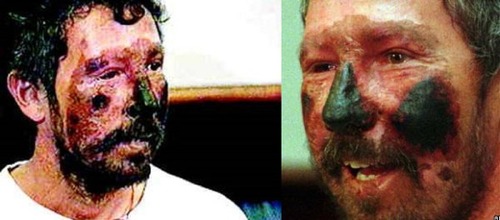
Weathers was later helped to walk on frozen feet to a lower camp, where he was a subject of one of the highest altitude medical evacuations ever performed by helicopter.[3] Following his helicopter evacuation from the Western Cwm, he had his right arm amputated halfway between the elbow and wrist. All four fingers and the thumb on his left hand were removed, as well as parts of both feet. His nose was amputated and reconstructed with tissue from his ear and forehead.[4]
http://en.wikipedia.org/wiki/Beck_Weathers