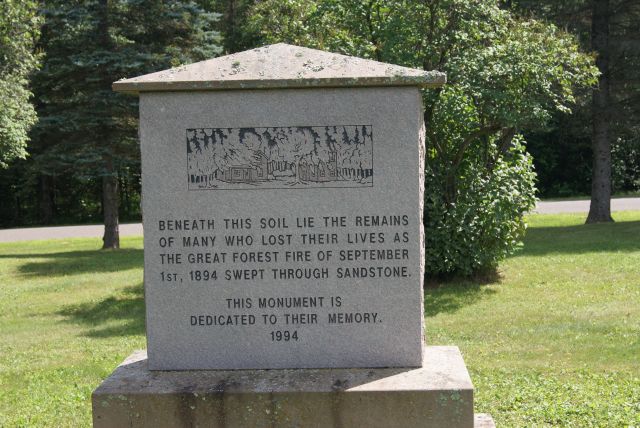
| On September 1, 1894 a huge firestorm, fed by drought conditions and dry debris left behind by lumber companies, destroyed the town of Hinckley, Minnesota, killing over 418 people. Here’s the story of the recovery of some of the victims.
Early Tuesday (September 4) at 3:00 a.m., a relief train left Duluth on the Eastern Minnesota road with a burial party assigned to comb the outlying territory for six to eight miles around Sandstone. William T. Bailey, veteran lumberman, and George E. Ash, surveyor general, were in charge of the party, and with them were thirty experienced woodsmen and three clergymen.
They arrived at Partridge at 6:00 a.m. where they dismounted and continued on foot to Sandstone. Peat was still burning and smoking, and the bent rails formed grotesque shapes over the track bed. At the Kettle River high bridge they crawled down the embankment and ferried across the river where they discovered a few more survivors who had taken shelter in the quarry office. They left clothes and food with the sufferers, then proceeded up to the top of the west bluff. As they walked through the ruins of the town, their feet would occasionally break through the black crust to the hot coals still burning beneath the surface.
The party split into two groups. One group went to the Bilado farm four miles from Sandstone where they found the blackened, bare body of fourteen-year-old Flora Bilado, who during the fire had left her mother’s side to retrieve a blanket that blew away. Her body was lying about 400 feet from the turnip patch where her mother and three other children had survived. The men nailed together a crude, wooden box, dug a grave and the clergymen said the last rites. Flora was temporarily buried on the family farm.
The second group of searchers discovered an old dried up well near the Peter Englund home which appeared to have been used for a shelter, but the heat was so intense around the structure, the men decided to leave the excavation until the following day. Wednesday they returned and began to dig. After they had cleared away the debris, one by one, bodies of men, women, and children in a horrible state of decomposition were discovered. When the bottom of the hole was finally reached, eighteen deteriorated bodies had been recovered. The odor was nauseating and the bodies were said to be “decapitated, dismembered and fairly cooked in the vapor from their own bodies.” As best they could, the men removed the disintegrating corpses, laid them out on the ground and examined them for marks of identification. Among the dead were Mr. and Mrs. Englund and their seven children. All of the deceased were put into boxes and brought to the Sandstone cemetery for burial.
In the same vicinity, another family had perished in a cellar. They were found leaning against a wall with arms clasped around each other. Before the Bailey party left Sandstone Wednesday night, they had buried twenty-three more citizens of the Sandstone area.
 SONY DSC Culled from: From the Ashes: The Story of the Hinckley Fire of 1894 |