Today’s Scattered Yet Truly Morbid Fact!
Here’s another excerpt from Minnesota 1918:When Flu, Fire, and War Ravaged the State, about the Cloquet fire that devastated much of Northern Minnesota. This is the tale of the Leppa family’s escape from the fire, and the sad fatalities at Dead Man’s Curve.
They packed what they could in suitcases, put on heavy winter coats with white cape collars, and scurried to the bank. “There sure was a lot of stuff there – trunks and bags,” Lydia said. “We were standing outside, figuring out what to do.” That’s when John Mattson, the banker, hollered for them to pile into Leonard Lofbacks’ pickup truck. Leonard had been fighting fires all day and would take them to Moose Lake.
Hanna Leppa rode in the front seat. A twenty-two-year-old schoolteacher from Ely, Ida Hiipakka, one of her students, thirteen-year-old Stella Paapanen; and Stella’s mom, Ida, crammed in the back seat with Ailie and Lydia. Some other men and boys jumped on the truck’s bed. “We were terribly frightened,” Ailie said. “the area at that time was covered with virgin timber and we could see the horizon to the south, like a sea of flame, moving very rapidly towards Moose Lake.”
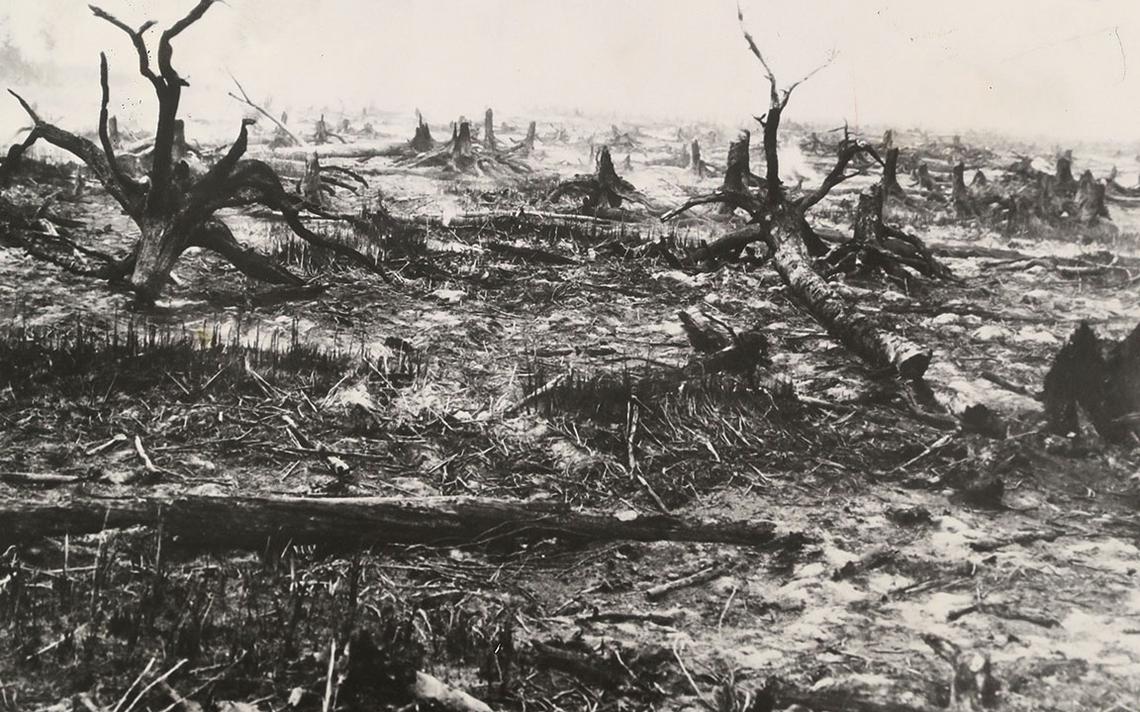
Cloquet Fire Devastation
Leonard stopped to pick up more people on the way. A Finnish woman named Aho cradled a baby in her arms. Their car had stalled, they pleaded for help. Now with ten people in the truck, Leonard floored it, “in a panic, driving at maximum speed,”: said Ailie, who wondered why he didn’t consider stopping in an open field.
At a sharp turn, known ever since as Dead Man’s Curve, the pickup rolled over and landed in a ditch. “We were all blown out,” Lydia said. Hanna Leppa’s hand was pinned between the overturned truck and the charred brush. Some men helped free her, but the hand was severely burned, leaving her in excruciating pain. Ailie, thrown against a barbed wire fence, heard her mother calling her name, “despite her own suffering.” They joined hands then – Hanna, Ailie, and Lydia, their boarder – and started running toward Moose Lake.
“We used the white capes from our coats to shield our faces and body as best we could from the fire, hot wind and flames,” Ailie said. They dashed through a nightmare. They saw Dora Beach, the fifty-two-year-old hotel owner’s wife from Kettle River, on the roadside. She was burned to death. Exhausted, Ailie stopped to rest for a moment on what she thought was s soft log. In horror, she realized the log was actually the charred body of Ralph Michaelson, her teenaged schoolmate who had been working at the store with Lydia. “You can imagine my reaction,” she said. “We were surrounded by flames and thought we were the only people alive.”
They weren’t alone, though. Car after car had piled up on Dead Man’s Curve – a turn in what is now a straightened portion of Minnesota State Highway 73 – a couple miles south of Kettle River, and only four miles west of Moose Lake. “At Dead Man’s Curve, and in the region around it, the most disastrous episodes of the great fire took place… stories of tragedy and death,” wrote Francis Carroll and Franklin Raiter in The Fires of Autumn. Unlike today’s wide, asphalt-surfaced Highway 73, the road between Kettle River and Moose Lake was a thin ribbon of dirt lined with trees and field. “It was so so narrow, in fact, that when automobiles met they had to drive up on the grass with their right wheels in order to get past each other,” according to Carroll and Raiter.
The fire roaring toward Moose Lake veiled the skinny road in thick, black smoke. That darkness “was compounded by the sharp bends in the road,” they wrote, causing a massive “pileup of automobiles on Dead Man’s Curve.” Some vehicles weaved through the dangers of the sharp corner unharmed, but all told, “about 15 or 16 automobiles, most of them overloaded with terrified people, went off the road into the rocks and burning brush,” according to The Fires of Autumn. Carroll and Raiter tallied the varied accounts and estimated between seventy -five and a hundred people died at Dead Man’s Curve – “some pinned under wrecked automobiles, some in the woods, some on the roadside.” That included a family’s car crashing with a load of children. “They hit the curve, careened off the road into the rocks and burning stumps and overturned,” Celia Kowalski recalled nearly sixty years later. “I will never forget the terrible screaming of those poor souls slowly burning to death.”
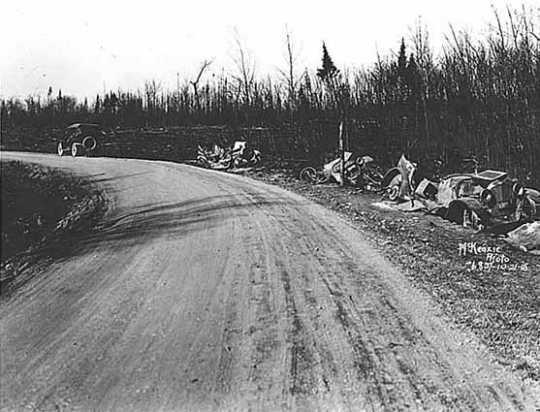
More Cloquet Fire Devastation
In the chaos, those who survived the multiple rollovers sprinted this way and that. Ailie Leppa said it was “each person for himself.” The teacher and pupil who joined Ailie in the back seat of the pickup – Ida Hiipakka and Stella Paapanen – were last seen running into the woods. Their clothes were on fire. They weren’t wearing the heavy coats that saved Ailie and Lydia. Stella’s body was recovered the next spring. Ida’s body wasn’t discovered until 1920. The only way they could identify her? A class ring she wore since graduating from Ely High School.
Culled from: Minnesota 1918:When Flu, Fire, and War Ravaged the State
Ghost Photo Du Jour!
Since the invention of the camera, people have been trying to take photographs of ghosts. What, after all, could be greater proof of a phantom’s existence than its image on film? The efforts have led mainly to failure and fakery, however. Still, sometimes an alleged ghost photo turns up with at least a persuasive provenance, if not an ironclad one. The picture presented here lays claim to being legitimate.
Miss Sybell Corbet said that she was shocked when the picture below revealed a vague figure sitting in the chair in the foreground, since the room – the Library of Wellington Henry, Viscount Combermere – had been unoccupied when she made the exposure in 1891. She was even more astonished by the figure’s resemblance to the recently deceased Lord Combermere, who was being buried on the day the photograph was taken.
But her surprise is hard to credit, since the exposure lasted an hour and she left her camera unattended during that time. The result is consistent with someone entering and sitting in the chair for half a minute. The butler insisted, however, that no one entered the room while the picture was being made.
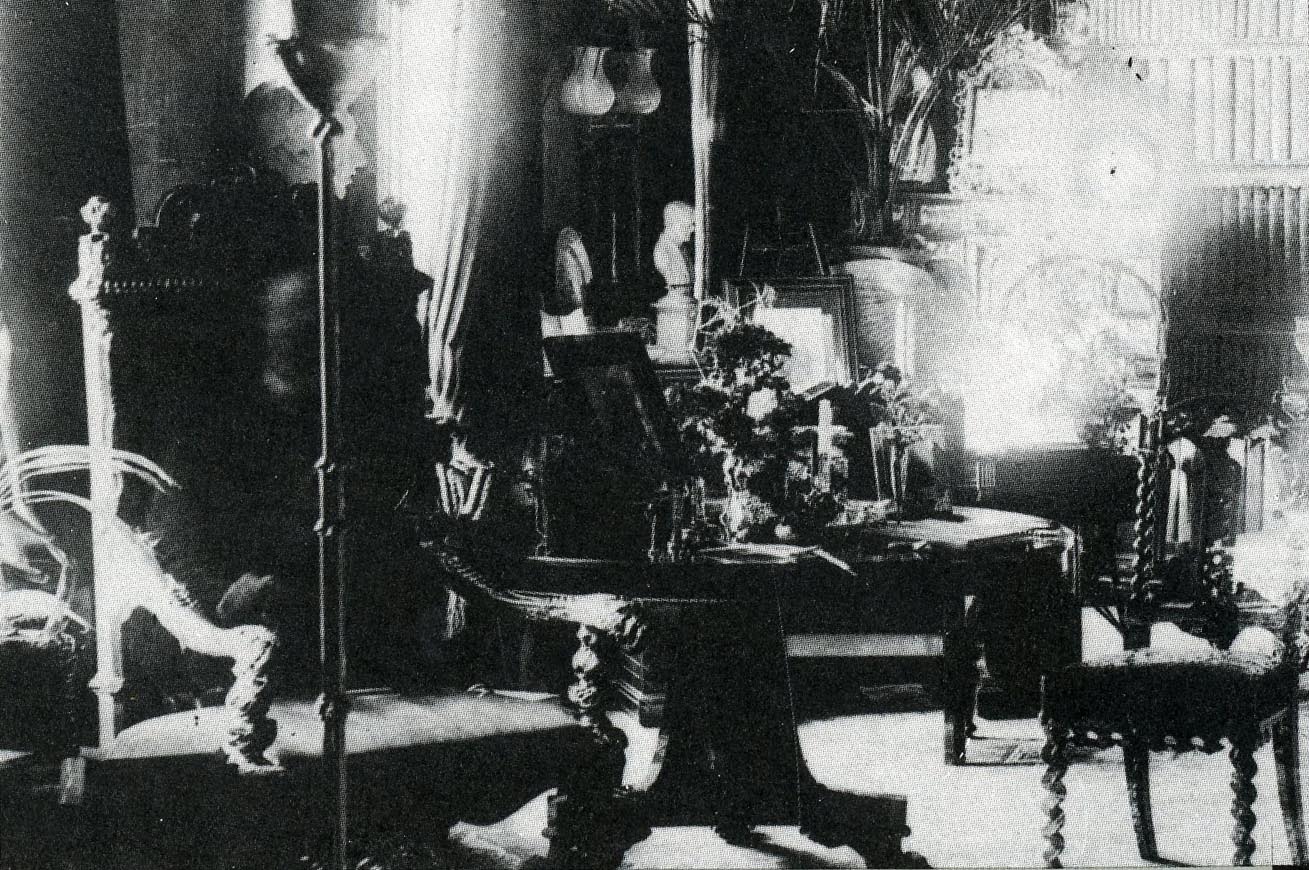
Culled from: Mysteries of the Unknown: Hauntings