Today’s Screaming Yet Truly Morbid Fact!
The New London School explosion occurred on March 18, 1937, when a natural gas leak caused an explosion and destroyed the London School in New London, Texas, United States. The disaster killed more than 300 students and teachers. As of 2021, the event is the third-deadliest disaster in the history of Texas, after the 1900 Galveston hurricane and the 1947 Texas City disaster. The following is an account of the aftermath of the disaster.
The dust cloud began to clear above Clarence Slater. Still pinned beneath the ruins of his first-floor English classroom, he looked up and was stricken with fear. Clarence was staring into the sky. He lay still, trying to calm his pounding heart. Somebody screamed, “Fire!” Adrenaline clambered into his blood stream, commanding heart, lungs, and muscle fibers to twitch and surge. Clarence tore himself free and scampered away. Small, disjointed crowds, remnants of classes bumped into one another, catching hands and stumbling through a haze of plaster powder. Joe King ran with them toward the only light they could see. They made their way out of the wrecked building even as parts of it continued to fall. Joe Watson, his mouth thick with brick dust, joined a group that climbed out onto the roof. Here, the air sang with screams, some crisp from the lawn below, others muffled and weak. The children found a stairwell that was wobbly but still standing.
Outside was a new horror.
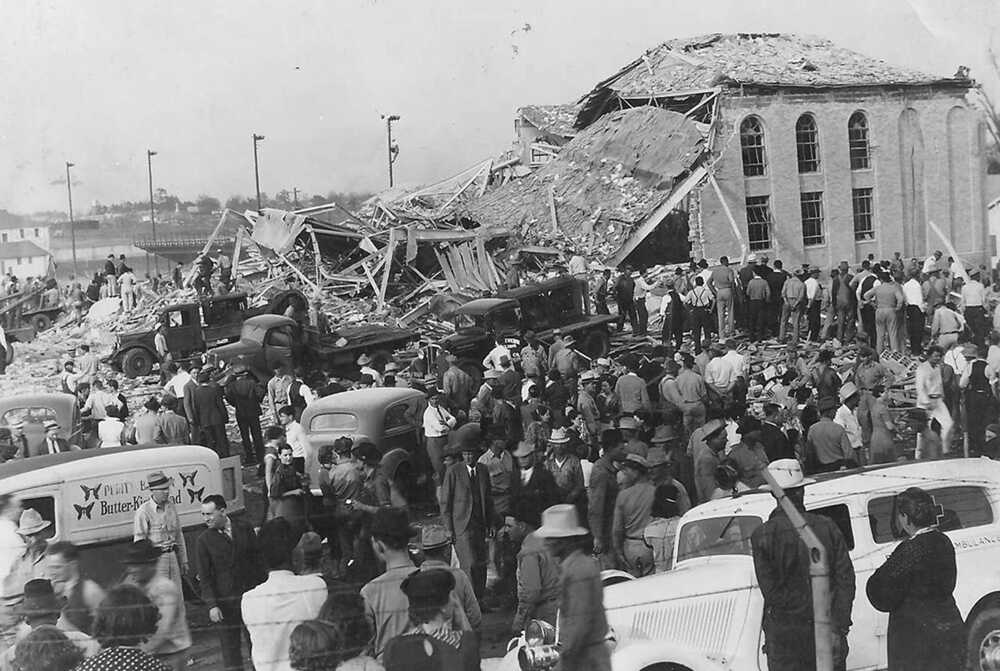 The New London explosion aftermath
King looked up and saw “the body of our neighbor’s little girl… hanging up in the wires next to the telephone pole,” he recalled. “I recognized her by the coat she was wearing.”
“There were heaps of dead bodies lying all around. It was awful. You couldn’t look anywhere without seeing a pile of dead boys and girls,” Joe Watson said. Though badly bruised, Watson would not leave. He began pulling bricks from the pile, digging into the wreckage towards the cries still ringing in his ears.
“Everybody was saying, ‘What happened? What happened?’” King said. “You could hear people hollering and crying.”
Just then, Della Westbrook arrived, panting at the chaotic scene. She had walked across campus to a lunch stand just before the explosion. “I started running across the grounds to where children were dying,” said Westbrook, the high school’s librarian. “Many already were dead. The screams and cries were horrible.”
Louise Taylor watched the last school bus shut its doors and drive off. She turned and rushed toward the ruined building. She saw the crowd from the gymnasium reach the rubble, “screaming, frantic mothers clawing with bare bleeding hands” at the wreckage.
The explosion spent itself, the debris settled, and the enormity of the tragedy began to mark its witnesses. A town had lost its future.
Culled from: Gone at 3:17
Civil War Injury Du Jour!

Photograph No. 280. Successful excision of the elbow-joint for gunshot injury.
J.T. Hertzog, a private of Company K, 4th Pennsylvania Volunteers, a German of remarkably temperate habits, having never used stimulants, tobacco, tea nor coffee, and of excellent constitution, was wounded at the Battle of Pocotaligo, October 22, 1862, by a ball which entered the right elbow joint at the outer and emerged just above the inner condyle of the humerus at the opposite side. He was admitted to Hospital #1 Beaufort, South Carolina, on October 24th. Two days subsequently the lower end of the humerus with the articulating ends of the ulna and radius were excised by Surgeon R.B. Bontecou, U.S.V., and the arm laid upon an angular splint of two parallel strips leaving an open space the whole extent, thus faciliitating approach to the wound of exit. Morphine was applied to the wound, it was covered with cerate cloth and bags of ice were directed to be kept applied. By November 1, suppuration was considerable but the tumefaction of the arm and forearm was much diminished. The lead wire sutures were removed on November 15, the wound having healed sufficiently to keep the parts in shape. On December 1st, the wound had nearly closed, there being but a slight discharge; the general condition of the patient was good and he sat up to take his food. Some days previous to December 15th, the patient had been walking about the hospital grounds, the wound was nearly healed and the elbow joint presented free mobility in every direction. On December 28, he was transferred north, the wound being healed. The excised portions of bone with the history were presented to the museum by the operator, and are No. 2023 of the surgical section. The man was discharged from the service February 24, 1863, and pensioned. On March 18, 1863, pension examiner Lewellyn Beaver reported “an open running sore.” In June, 1864, Dr. Bontecou writes that he saw his patient at Fort Wood, New York Harbor, in July, 1863, and that he had good motion of the elbow. Another report from pension examiner Beaver dated September 11, 1866, states that this man had completely lost the use of his arm. There was four inches shortening. He rated his disability total.
Culled from: Orthopaedic Injuries of the Civil War