Today’s Imaginative Yet Truly Morbid Fact!
In 17th century America, there were gendered explanations for monstrous births of all sorts; irregularities of various kinds were often attributed to maternal imagination, for example. According to Aristotle’s Master-Piece, the most popular and often reprinted medical manual in the colonies and the definitive word on all matters relating to reproduction, a pregnant woman’s unruly thoughts could cause a birth anomaly. If a pregnant woman saw a rabbit, for instance, her child might be born with a harelip (cleft lip), the manual cautioned. “Some Children are born with flat Noses, wry Mouthes, great blubber Lips, and ill-shap’d Bodies; and most ascribe the reason to the Imagination of the Mother, who hath cast her Eyes and Mind upon some ill-shap’d Creature.” Pregnant women were cautioned to steer clear of such sights, or at least to avoid staring at them.
Jane Sharp’s The Midwives Book; or, The Whole Art of Midwifery Discovered, one of the few midwifery manuals written by a woman, had also cautioned against women’s excessive imagination during pregnancy. “Sometimes the mother is frighted or conceives wonders, or longs strangely for things not to be had, and the child is markt accordingly by it,” she wrote. Sharp told a widely circulated story of a white woman who had a dark-skinned child; the woman had “lookt on a Blackmore [and] brought forth a child like to a Blackmore.” [People were such suckers back then! And BTW, I had to look it up: Blackmore= “a European style of decorative art in which dark-skinned usually male human figures are depicted in a stylized and ornate form” – DeSpair]
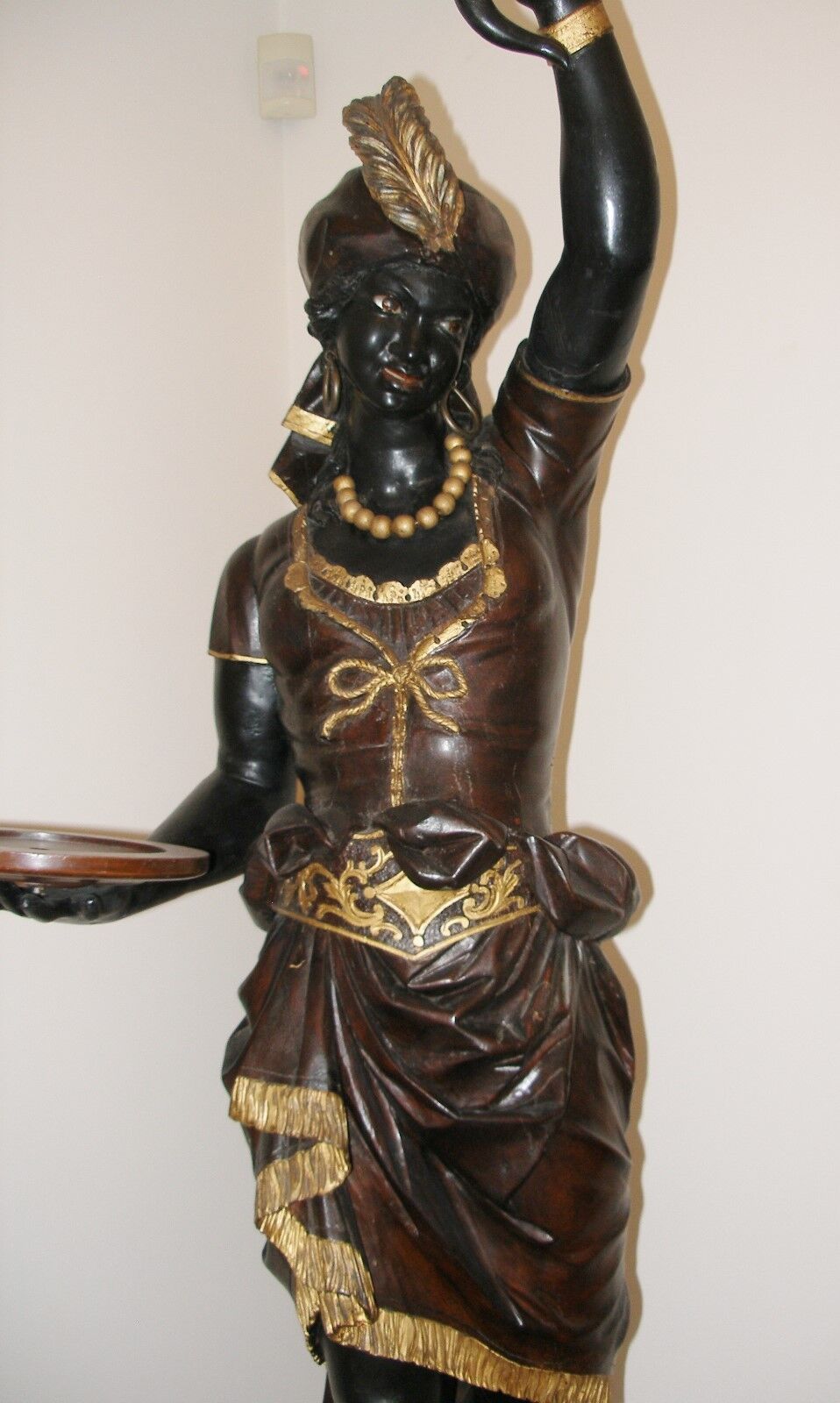
Blackmore – you ARE the father!
Like other authors, Sharp included observations from her own experience, a practice no doubt meant to persuade readers of their veracity. “One [woman] I knew,” she recalled, “that seeing a boy with two thumbs on one hand, brought forth such another.” Such births could have other explanations, to be sure, but Sharp insisted that “the imagination is so strong in some persons with child, that they produce such real effects that can proceed from nothing else; as that woman who brought forth a child all hairy like a Camel, because she usually said prayers kneeling before the image of St. John the Baptist who was clothed with camels hair.”
Culled from: Bodies in Doubt: An American History of Intersex
Asylum Inmate Deaths Du Jour!
The book Angels in the Architecture contains Accounts of the First Twenty Patient Deaths of the Northern Michigan Asylum at Traverse City between November 30, 1885 and September 30, 1886. Here are a few of the deaths:
Male, age 27, single, native of Ireland
Occupation: laborer
“[He] was a, when admitted, much demented, and in delicate physical health. His death was due to acute peritonitis, caused undoubtedly by his degraded habit of eating irritating and indigestible articles. Broom straws, the nap from the blankets, articles from the spittoons, and other filthy and disgusting material were to him choice morsels.”
Died April 11, 1886
Cause of Death: acute peritonitis
Male, age 42, single, native of Germany
Occupation: laborer
“When admitted he was suffering from dementia and advanced pulmonary disease. He presented the usual symptoms of phthisis, and died at the end of four months. The post mortem examination showed that both lungs were the seat of extensive tubercular degeneration.”
Died: April 19, 1886
Cause of Death: phthisis [Pulmonary tuberculosis – DeSpair]
Male, age 65, married, native of Germany
Occupation: farmer
“[He] was extremely demented when he came to the institution. He suffered from an attack of acute peritonitis, and died in a few days after its onset. The autopsy revealed that prior to this attack there had probably been long standing sub-acute peritoneal inflammation. The lower lobe of the right lung was also found to be inflamed.”
Died: May 4, 1886
Cause of Death: pneumonia
Culled from: Angels in the Architecture: A Photographic Elegy to an American Asylum