Today’s Dismally Shrieking Yet Truly Morbid Fact!
Seventeenth-century medical and scientific literature provides little evidence that the English people of this time worried about the dangers of premature burial. The subject of people buried alive occurs in some popular pamphlets, but these publications were notoriously fanciful and should not be taken as proof that the fear of apparent death and premature burial was widespread at this time. One of them, The Most Lamentable and Deplorable Accident [the title of my next album – DeSpair], tells the sad tale of Lawrence Cawthorn, a butcher in Newgate Market in London, who suddenly fell ill sometime in 1661. His wicked landlady, eager to inherit his belongings, saw to it that he was hastily buried. But at the chapel where Cawthorn was buried, the visiting mourners were horrified by a muffled shriek from the tomb and by a frenzied clawing at the coffin walls. When finally disinterred, Cawthorn’s lifeless body was a horrid sight: the shroud was torn to pieces, the eyes hideously swollen, and “the brains beaten out of the head.” It was concluded, “Amongst all the torments that Mankind is capable of, the most dreadful of them, and that which Nature most shrinks at is to be buried alive,” and the covetous landlady was roundly accused of having deliberately put the butcher living into the tomb. According to another pamphlet, entitled A Full and True Relation of a Maid Living in Newgate Street, attempts at rescue were similarly futile when a sixteen-year-old girl was heard to groan and cry from her four-day-old grave in a London cemetery. No seventeenth-century pamphlet was complete without a moralistic conclusion: the poor girl’s master and mistress had abused her so horribly that she had been overheard to pray that she would rather be buried alive than live in such misery; the Almighty did not tarry long before fulfilling this imprudent wish.
Much more sinister, and also more truthful, than either of these two pamphlets was News from Basing-Stoak, published in 1674, which heralded what was considered one of the most celebrated cases of premature burial of all time. Madam Blunden, a native of Basingstoke unflatteringly described as “a fat gross woman who liked to drink brandy,” one evening felt indisposed and ordered some poppy water from the apothecary. She drank most of it and fell into a deathlike stupor. Her servants sent for the apothecary who had prepared this decoction of opium, and after surveying what was left in the bottle, the apothecary pronounced that she had taken enough to not wake up for forty-eight hours and would therefore never rise again. Madam Blunden’s relatives and servants were convinced by this dubious deduction on the part of the obtuse medical attendant. Her husband, the wealthy maltster William Blunden, one of the leading citizens in Basingstoke, wanted to defer the funeral until he could return from London, but the vile smell from Madam Blunden’s huge body was so overpowering that her relations unanimously decided to have her buried the day after her presumed demise. As the coffin was set down between two stools, one of the pallbearers was heard to joke that they had probably made Madam Blunden’s coffin too short, since he had clearly seen her stir because she could not lie easy. The man was rebuked for his levity.
Two days after the funeral, some schoolboys were playing in the burial ground near the Chapel of the Holy Ghost, when they heard a hollow voice emanating from the earth near Madam Blunden’s grave. Coming nearer, they could hear the plea “Take me out of my grave!” intermixed with “fearful groans and dismal shriekings.” Terrified, the boys ran to fetch their schoolmaster, but the brutal pedagogue took no action except to reproach them severely and to thrash some of them for telling such obvious lies. The morning after, the boys were back in the churchyard and heard the same ghostly voice from underground. This time, the usher did not resort to his birch rod, but uneasily suspected that there might be something in this extraordinary story after all. He went to ask the verger to have Madam Blunden’s grave opened, but this individual refused to do anything of the kind without permission from the church wardens. This body met the same afternoon and discussed the matter at length; not until the evening was Madam Blunden finally exhumed. The body being lamentably bruised and beaten, it was presumed that the injuries were self-inflicted during the horrid struggle underground. No signs of life could be detected, but the church wardens nevertheless posted some custodians to stand watch over the grave during the night. It was a wet night, however, and these custodians left the body in the coffin, put the lid on, and went indoors. The next morning, it was seen that Madam Blunden had again revived; the winding sheet was torn off, and she had scratched herself in several places and beaten her mouth until it was covered with blood. A doctor was called, but he could only confirm that all life was gone, this time for good. There was of course an inquest after these almost unparalleled atrocities, and several individuals were held responsible for Madam Blunden’s death. But after a physician of the town (perhaps the same unwise apothecary who decanted the poppy water in the first place) had testified under oath that he had applied a looking glass to her mouth without being able to discern any breath coming from her, they were let off. The town of Basingstoke was made to pay a large fine, however, for this neglect.
In 1819, the independent Minister Joseph Jefferson made inquiries in Basingstoke whether any person alive could remember the dreadful fate of Madam Blunden. Two old ladies recalled that their ancestors had been among the schoolboys involved; they both used to say that they had heard a noise in the vault and that the bruises on Madam Blunden’s face and the dew inside the coffin had let people to conclude that she had been buried alive. Mrs. Paris, the local midwife, was blamed for having persuaded Mr. Blunden to bury his wife too hastily, the servant maid Ann Runnegar, who had handed her mistress the fatal poppy water, had lost her reason on account of the dreadful event. The ancient Holy Ghost Chapel in Basingstoke was in ruins already in Jefferson’s times, but these ruins are still standing. It is know that Madam Blunden was finally buried in the Liten burial ground close to the chapel. In 1896, the burial reform propagandist William Tebb visited the Blunden vault, which he was in some way able to identify although the inscription on the gravestone was completely obliterated. It is interesting to note that there is still a local tradition in these parts that, a long time ago, a woman was buried alive in this cemetery and that the place is haunted.
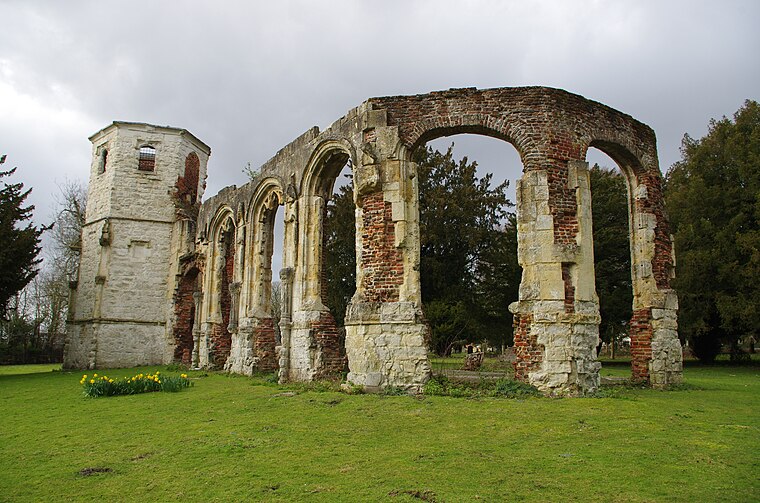
Ruins of Holy Ghost Chapel
Culled from: Buried Alive
Crime Scene Du Jour!
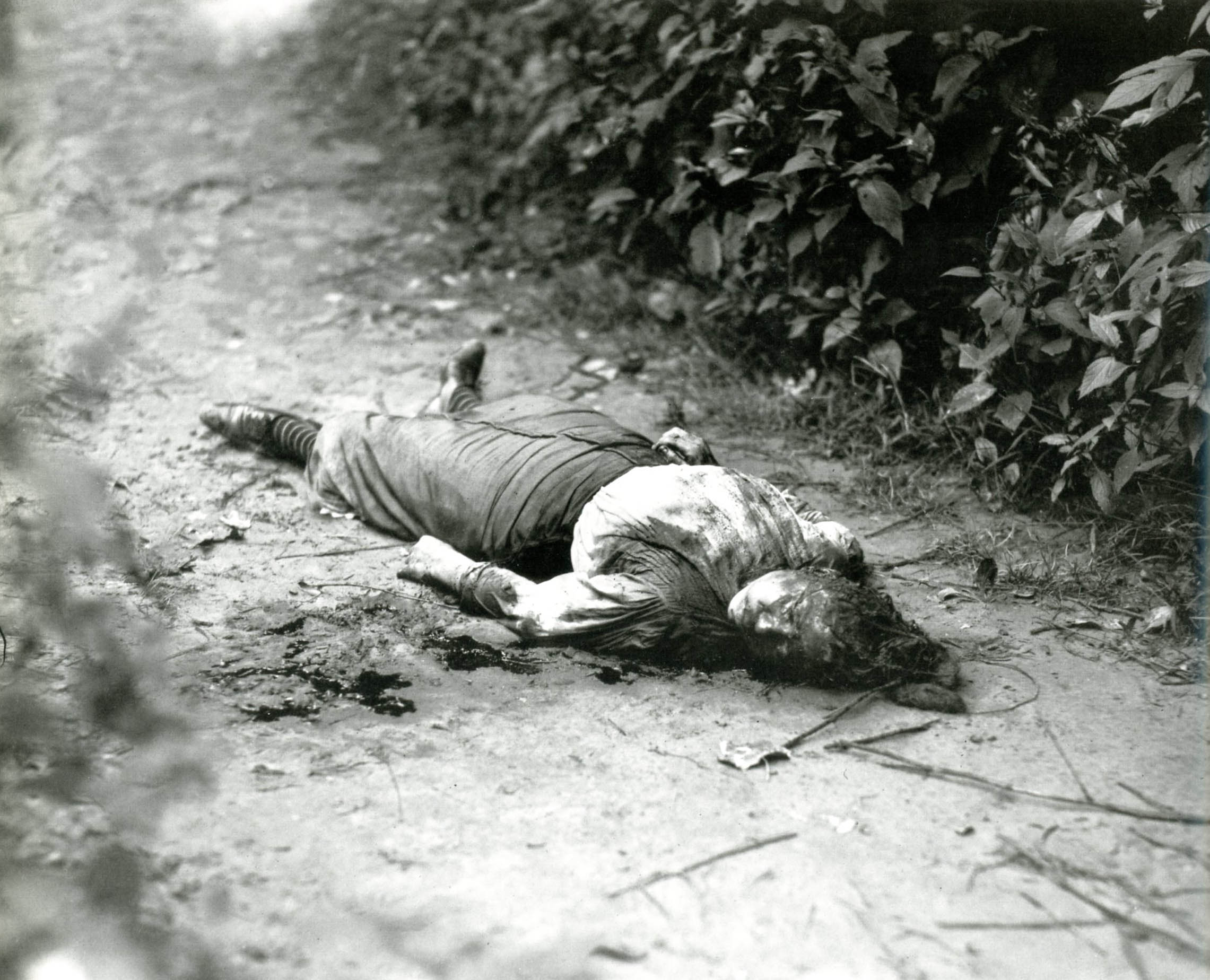
Spuyten Duyvil, at the northern tip of Manhattan, has been the site of crimes and unsettling discoveries throughout New York City history. This woman’s body was found there on August 10, 1913; nothing further is known about her.
Culled from: Shots in the Dark
“Nothing further is known about her,” my arse! Lazy journalists irk me. Doing some newspaper research I found a very interesting trail of clues leading to the arrest of her murderer.
First, I was able to uncover an article in the New York Times (August 11, 1913) that discuses the discovery of the body:
FIND WOMAN’S BODY IN INWOOD GROVE
Her Throat Cut and Head Nearly Severed from Trunk
—Not Yet Identified.
Returning from a motor boat trip shortly before midnight last night, Frank C. Allen of 2493 Valentine Avenue, the Bronx, a member of the Reliance Boat Club, stumbled across the body of a young woman in the thick wood in Inwood known as the Cold Spring Grove.
Allen had decided to take a short cut through the woods from the boathouse at the foot of West 207th Street to his home in the Bronx, and was following a familiar footpath when he fell heavily across the body. In the darkness he was not certain as to the real nature of the obstruction which lay in his path. He lit a match and beheld the body of a young woman.
The woman’s throat had been cut from ear to ear and the head had almost been severed from the body. For the space of several yards in every direction the heavy foliage and shrubbery were trodden down, making it evident that there had been a desperate struggle.
For a moment, by the flickering light of the match, the young man looked upon his ghastly find. Then, with a shriek, he burst through the dense thickets to the roadway, and, shouting hysterically at the top of his voice, made away at full speed. His yells attracted the attention of Patrolman Flynn of the St. Nicholas Avenue Police Station, who was on duty a few blocks away. He ran up to the fleeing young man, who in a few sentences informed the policeman of his discovery. Flynn persuaded Allen to accompany him back to the woods, and, after verifying the latter’s story, hastened to the nearest patrol box and summoned an ambulance from the Washington Heights Hospital.
Owing to the narrow and almost impassable roadway leading to the lonely spot in which the body lay, Dr. Shaw, who responded to the call, had difficulty in reaching the wood. It was after 12 o’clock this morning when he arrived and upon examination of the corpse, said that life had been extinct for more than an hour when Allen found the body. The hands and wrist of the woman were badly cut, showing that she had attempted to wrest the weapon with which she was done to death from her murderer. Her clothing, which was of good texture, was torn. No weapon was found nor was there anything on the body to give the slightest clue as to the girl’s identity.
The victim was apparently 25 years of age, about five feet five inches in height, and weighed about 140 pounds. She was clothed in a white waist with a blue serge skirt, black silk stockings, russet pumps, and woolen underwear. Upon the third finger of her left hand she wore a gold ring set with three blue stones. She had dark hair with blue eyes and was good looking.
Half an hour after the body was found Detective Hyam, with a score of reserves from the St. Nicholas Avenue precinct, were beating the underbrush and with lanterns were searching for some trace of the weapon or for any other clue which might lead to the identity of either the victim or the slayer, but at 1 o’clock this morning the search had been unavailing.
The police say that a group from lower Manhattan held a picnic in the grove yesterday afternoon, and that a number remained in the woods until a late hour.
***************
The story continues in the August 16, 1913 issue of the New York Times – where a suspect appears!
MURDER HUNT NETS A TENT DWELLER
An Italian Arrested in a Hospital While the Police Look Up His Record.
CAMPED AT COLD SPRING
Rescued After Hours in River, He Refuses to Give Any Account of Himself.
The Harlem detectives, who, since late Sunday night, have been following the blindtrails leading from the body of the brutally murdered woman found in Cold Spring Grove, Inwood, were interested yesterday to learn that in Washington Heights Hospital was an Italian who had been found early in the morning half drowned in the Hudson River. The fact that he had been found not far from the woods where the murder was done caught their attention; the report that he seemed frightened and reticent when a visiting priest at the hospital tried to question him interested them still more, and the news that he had made an unsuccessful attempt to escape from the hospital brought a cluster of detectives to call upon him.
He had given his name as Mariano Ferrone and his address as 341 East 204th Street. But to Acting Capt. Herlihy he said that for the past three weeks his address had been Cold Spring Grove. For that period he had been camping out in the woods there, sleeping at night under a makeshift tent and eating what fish he could catch and what other food he could beg. The detectives were amazed at this, for they had repeatedly beaten through the undergrowth of the grove searching for clues and none of them had seen him.
They Found the Tent.
Late yesterday afternoon, they made another trip to the grove and found the tarpaulin where Ferrone had said they would find it.
But further information than this, the Italian would not give.
“I will not talk,” he told Detective Caputo, who acted as interpreter. “I am afraid.”
And when the asked him of what he was afraid, he took refuge in repeating:
“I will not talk.”
While he would not talk, much of his appearance spoke for him. He was emaciated and unkempt enough to bear out the story of the life in the grove. On his shirt were found paint-stains and blood-stains. These latter were attested to by the hospital surgeons, but whether they are human blood and how old they are will be questions for determination by more thorough analysis to-day. In his pocket were found two blood-stained handkerchiefs, one of them small and edged with lace. For the same examination, Herlihy made filings of Ferrone’s finger nails, and before he left last night he took a clipping from Ferrone’s dark brown beard to see if it matched the few strands of dark brown hair found in the grip of the murdered woman’s clenched hand. This comparison, too, will be made to-day.
But still more interesting was the discovery late in the evening that Ferrone had dabbled in shoe cobbling. Soon after the murder the detectives found not far from the body a penknife and a shoe last, the latter made of iron and wood, and heavy enough to have been a formidable weapon. [I had to look it up: “A last is a mechanical form shaped like a human foot.” – DeSpair]
Armed with these two bits of possible evidence, Caputo and Detective Connelly went late last night to the East 204th Street house that Ferrone had given as his address. They found he had lived in the basement with an Italian junk dealer, Zatable by name. Zatable told them that Ferrone had brought in old, tattered shoes, mended them, sold them and thus eked out a precarious living. In June he had gone away with the announcement that he would spend the Summer “in the country.”
Shoe Last Identified.
According to the detectives, Zatable identified the shoe last as Ferrone’s. As to the knife, he said he would have to see it by daylight.
Ferrone was found clinging to a beam in Spuyten Duyvil Creek at 1 o’clock yesterday morning when Commodore Schwener of the Dyckman Yacht Club was coming in with his launch, the Ellen. The Italian had been in the water for three hours, and said he had tumbled in while fishing.
He was taken to the Washington Heights Hospital, suffering from shock and submersion, but after breakfast he felt strong enough to leave, and did so surreptitiously. He got as far as the street, when he was brought back.
He was arrested in the Washington Heights Hospital last night charged with the murder of the woman.
The murdered woman’s body has not yet been identified. The police thought they had established the identity yesterday afternoon when Gregorio Giordano of 137 Mott Street went to he Bellevue morgue, looked at the body, cried out that it was his wife, and fainted away. When he recovered, however, he changed his mind, and late last night he was sure it was not his wife. Besides, he said, he had seen her alive as late as 5 o’clock Monday morning, some hours after the body was found. She had disappeared later in the day and was gone when he came home from work.
So, it’s sounding like the woodman is the murderer, right? But… not so fast. First, we finally have an identity. Also, we have a new suspect. Culled from The Evening World, August 16, 1913:
SLAIN WOMAN IDENTIFIED BY BROTHER AND COUSINS; HER HUSBAND DETAINED
Victim of Inwood Murder They Say Was Bride of Gregorio Giordano.
CORONER UNCONVINCED
He Will Have the Witnesses View the Body Again on Monday.
The woman found murdered late on Sunday in Cold Spring Grove, near Spuyten Duyvil, was positively identified to-day by Salvatore E. Bontorno of No. 51 Elizabeth street, who said the woman was his sister, Salvatora, who four months ago became the bride of Gregorio Giordano. In addition to Bontorno, Giovanna, Salvatore and Sebastino Bontorno, cousins of the woman, and Santa Bontorno, a sister-in-law, and Giuseppe Montalto, a friend, all identified the body as that of Salvatora.
Nevertheless Coroner Winterbottom said that he was not satisfied with the identification and would take the party back to the Morgue on Monday to assure himself that they were correct. The Coroner is influenced by the fact that Gregorio himself viewed the body last night, said it was his wife, then fainted away, and when he recovered decided that perhaps, after all, it wasn’t Salvatora.
The Giordanos lived at No. 137 Mott street and the police are looking for Gregorio now. Salvatore Bontorno said that he last saw his sister at 6 o’clock Sunday night when she called at his home and stayed about ten mines, saying, as she left, that she was going for a walk with her husband, who was waiting for her outside. The next night Gregorio called to ask if he had seen anything of Salvatora, whom, he said, he had not seen all day and about whom he was worried. The police are anxious to question Gregorio, as they say he said at the Morgue that his wife had left the house early Monday morning and had been safe in bed at the time the body was found Sunday night.
MAKING ANALYSES OF BLOODSTAINS.
With the identification by the woman’s other relatives the police sought her husband. They learned that he worked on the subway excavation in Brooklyn and a dozen detectives were sent out to find him. Meantime an Evening World reporter found him at his home, where the police had not thought to look. He was taken to the Mulberry street station by Detective Murphy, who went to the house when he learned of Giordano’s presence there.
Later the man will be taken before the Coroner. He seemed to be in a daze and had nothing to say. Neighbors said that he and his wife quarreled frequently. The police are anxious to know why he told them his wife was safe in bed all Sunday night when her body was found no later than 10 o’clock Sunday night.
Prof. John H. Larkin of the College of Physicians and Surgeons is making analyses to-day of the blood-stained garments of Mariano Ferrone, the man who was picked up in the Hudson River early yesterday morning and is now a prisoner in Washington Heights Hospital, and of clippings of hair cut from his head, his mustache and beard. Prof. Larkin is making other analyses of the blood on the garments of the girl.
The police are awaiting the conclusions of the professor to see if they will warrant a charge of murder against Ferrone. Already the shoemaker’s last which was found near the murdered girl and with which it is believed her skull was fractured, bringing death, has been identified as the property of “wild man” prisoner.
To-day, too, saw what appears to be the certain identification of the murdered girl. Salvatore Bontorno, who says he is a brother of the murdered girl, and several cousins, went to the Morgue and said the girl was the wife of Gregorio Giordano, a laborer, of No. 137 Mott street. This identification is strengthened by the fact that Giordano himself identified the woman last night as his wife, Salvatora, though upon recovering from a faint in which he fell as he looked at the body he admitted that there might be some doubt. the police believe it unlikely that the woman’s brother and other relatives could all be mistaken, however.
Ferrone, according to Dr. Schorr, has a slight attack of pneumonia and also is deranged, though whether this condition is not a result of his weeks’ of exposure in the Inwood woods, aggravated by the hours he spent floating on a log in the Hudson, the doctor could not say.
When first taken to the hospital Ferrone rambled incoherently about spending five or six weeks in the woods on the upper end of Manhattan Island. Pressed to tell of what he had done in that period, a queer look came into his eyes and is said to have replied, “I’m afraid—I’m afraid to tell.”
*******
On August 19, 1913, the New York Tribune added some details:
MAY BE WOMAN’S SLAYER
Laborer Seen Near Scene of Crime, New Witness Asserts.
Whether Gregorio Giordano, husband of the woman found dead in Cold Spring Grove a week ago, will be charged with the crime will largely depend upon testimony of two persons. They said yesterday that they can positively identify an Italian laborer they met near the scene shortly after the crime was committed.
Giordano, who is a prisoner in Bellevue Hospital, has been unable to give a clear statement of his whereabouts for the last ten days. According to the detectives, Charles Muehler, a business man, living at No. 125 Vermilye avenue, was near the spot where the woman was killed shortly before she was struck down.
A possible motive for the murder was found yesterday when several neighbors told that Mrs. Giordano had been extremely jealous of her husband. She may have followed her husband to the lonely road where she was found, they said.
So at this point, the cops were confused. And then the trail grows quiet in the newspapers. However, a search through Ancestry finds a Sing Sing Prison record for one Gregorio Giordano dated October 29, 1913 which confirms his conviction and that he was going to the Death House.
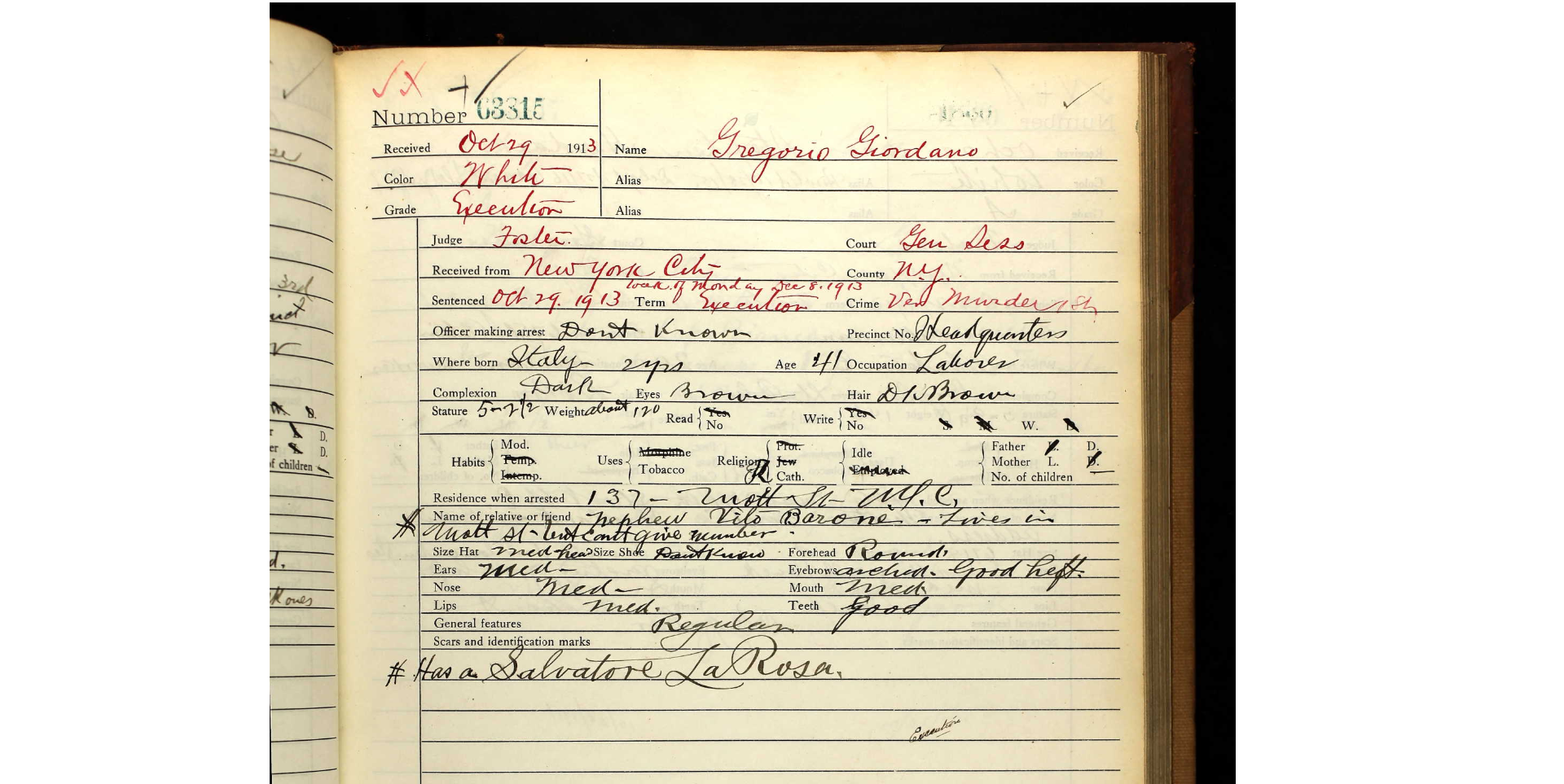
However, I have a book on Sing Sing executions and it doesn’t list his name, and I also found this little snippet from the January 23, 1915 Montgomery Times indicating that he was granted a new trial.
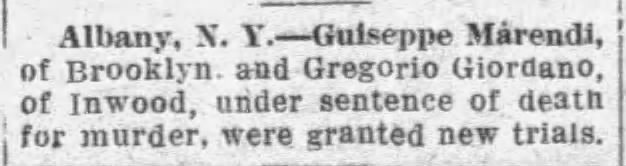
To my utter annoyance, I can’t find the result of the new trial though. If anyone can find it, please let me know and I will follow-up.