Today’s Disconcertingly Quiet Yet Truly Morbid Fact!
Pioneering 19th Century surgeon Joseph Lister (for whom “Listerine” is named) came face-to-face with dreadful conditions during his early medical studies at University College London Medical School (UCL). A central walkway split the dingy dissection room in half, with five wooden tables on either side. Cadavers were left with their incised heads hanging over the edges, which caused blood to gather in congealed puddles below. A thick layer of sawdust covered the floor, making the deadhouse disconcertingly quiet to those who entered it. “Not a sound could be heard even of my own feet… There was only that dull and rolling sound of the traffic in the streets which is peculiar to London, and which came dismally down through the ventilators in the roof,” a fellow student observed.
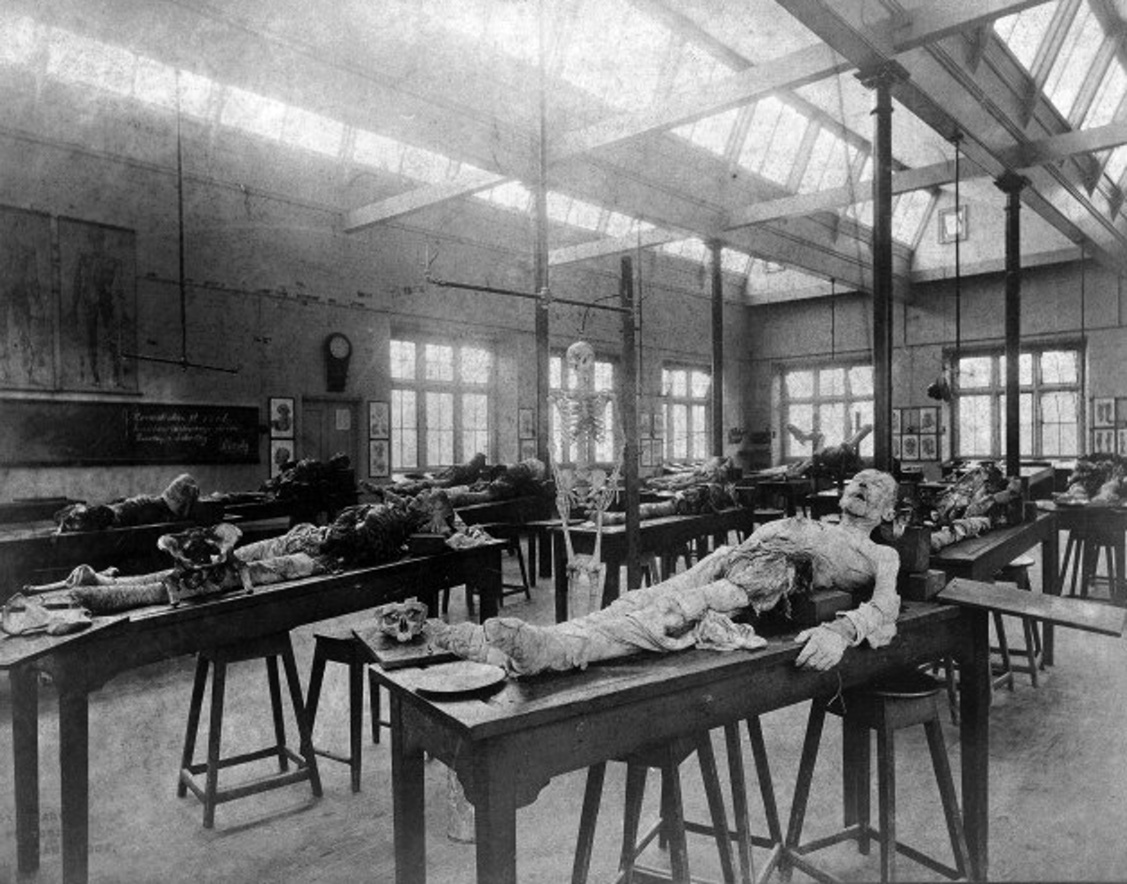
A slightly less disgusting dissecting room at Cambridge, 1888
Although UCL and its hospital were still relatively new in 1847, its dissection room was just as grim as those found in older institutions. It harbored all kinds of horrible sights, sounds, and smells. When Lister sliced into the abdomen of a cadaver—its recesses turgid with a thick soup of undigested food and fecal matter—he released a powerful mixture of fetid smells that would cleave to the inside of the nostrils for a considerable time after one had quit the scene. To make matters worse, there was an open fireplace at the end of the room, making it unbearably stuffy during the winter months when anatomy lessons commenced.
Unlike today, students could not escape the dead during their studies and often lived side by side with the bodies they dissected. Even those who did not live immediately adjacent to an anatomy school carried with them reminders of their gruesome activities, because neither gloves nor other forms of protective gear were worn inside the dissection room. Indeed, it was not uncommon to see a medical student with shreds of flesh, gut, or brains stuck to his clothing after his lessons were over.
Culled from: The Butchering Art
Malady Du Jour!
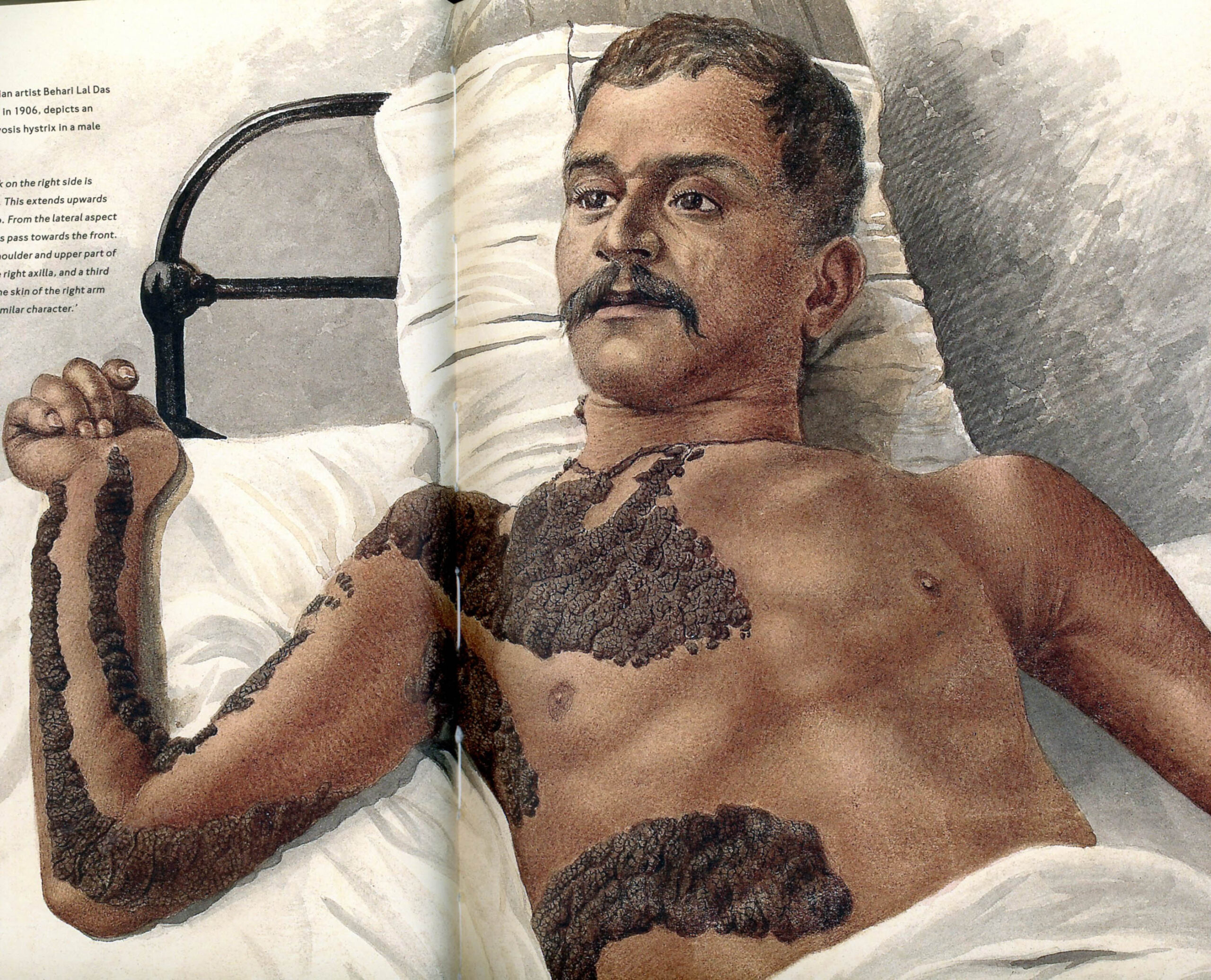
This watercolor, made by the Indian artist Beharl Lal Das in the Medical College of Calcutta in 1906, depicts an unusually extensive case of Ichthyosis hystrix in a male patient. From the case notes:
“A large part of the skin of the trunk on the right side is occupied by a black warty growth. This extends upwards to the occipital region of the scalp. From the lateral aspect of the main mass three projections pass towards the front. Of these one occupies the right shoulder and upper part of the pectoral regions, a second the right axilla, and a third the right hypochondrium. Upon the skin of the right arm are two long linear growths of a similar character.”
Culled from: The Sick Rose
I looked up this disease and it is: “a term used to describe an ichthyosiform dermatosis which is characterized by hyperkeratotic spiny scales mainly over extensor aspects of limbs with palmoplantar keratoderma and occasionally associated with deafness and neurological deficit. It is a rare autosomal dominant form of ichthyosis and very few cases are reported in literature.”
I did stumble upon THIS case. Apparently a vampire! Am I wrong?