Today’s Relatively Shallow Yet Truly Morbid Fact!
The earthquake of May 1202 that shook a very large area around the eastern Mediterranean is very well recorded. It must have become, rapidly for the time, a very notable event, for among those who wrote of it was the English historian Ralph of Coggeshall (d.1228), who says that the cities of Acre and Tyre were “overthrown”.
These cities, on the Mediterranean coast of what is now Lebanon, were among the places worst affected by the earthquake, but it was reported from Armenia to Libya, and from Sicily to Iran. In Syria, Lebanon, Cyprus, Libya and Egypt there was very severe damage. Acre and Tyre were virtually destroyed, as was the town of Safad, inland from them, and Bedegene, where “everything was swallowed up” according to Arabic accounts of the disaster.
Nablus, thought to have been near the epicenter of the quake, also suffered very badly, and strong tremors were felt in Damascus where, as in many other places, mosques collapsed, causing great terror amongst the population. There was heavy loss of life in Tripoli, where the old castle of Arqa was ruined.
The earthquake was felt through Egypt from Qua to Alexandria, and there was a long tremor reported from Cairo, where “sleeping people jumped from their beds in fear.” The quake was of unusual severity for Egypt. Cyprus also suffered badly, with many buildings destroyed and considerable loss of life. Although the quake clearly destroyed many buildings , in some reports of the disaster this may have become confused with damage already caused by Saladin’s attacking hordes only 12 years earlier.
Modern seismologists studying the quake believe it to have been relatively shallow but spread over an unusually wide area, and with a Richter scale reading of probably about 7.6, not one of the largest earthquakes by any means. Despite this, the cumulative effect was clearly catastrophic. There were strong aftershocks for several days following the major tremor.
Arabic reports speak of a million people having died. There is, of course, no way this figure can be checked. Abd al-Latif, one of the principle historians of the period, records 111,000 deaths in Cairo alone, and says that the main aftershock—which may have been almost as powerful as the principle tremor—caused the deaths of 50,000 in Nablus. However, it is known that in many places the earthquake was followed by famine and epidemics of disease, and the death toll would have been greatly increased in this way. We shall never know if this was the worst disaster ever in terms of lives lost, but it was certainly among the worst.
Culled from: Catastrophes and Disasters
Crime Scene Du Jour!
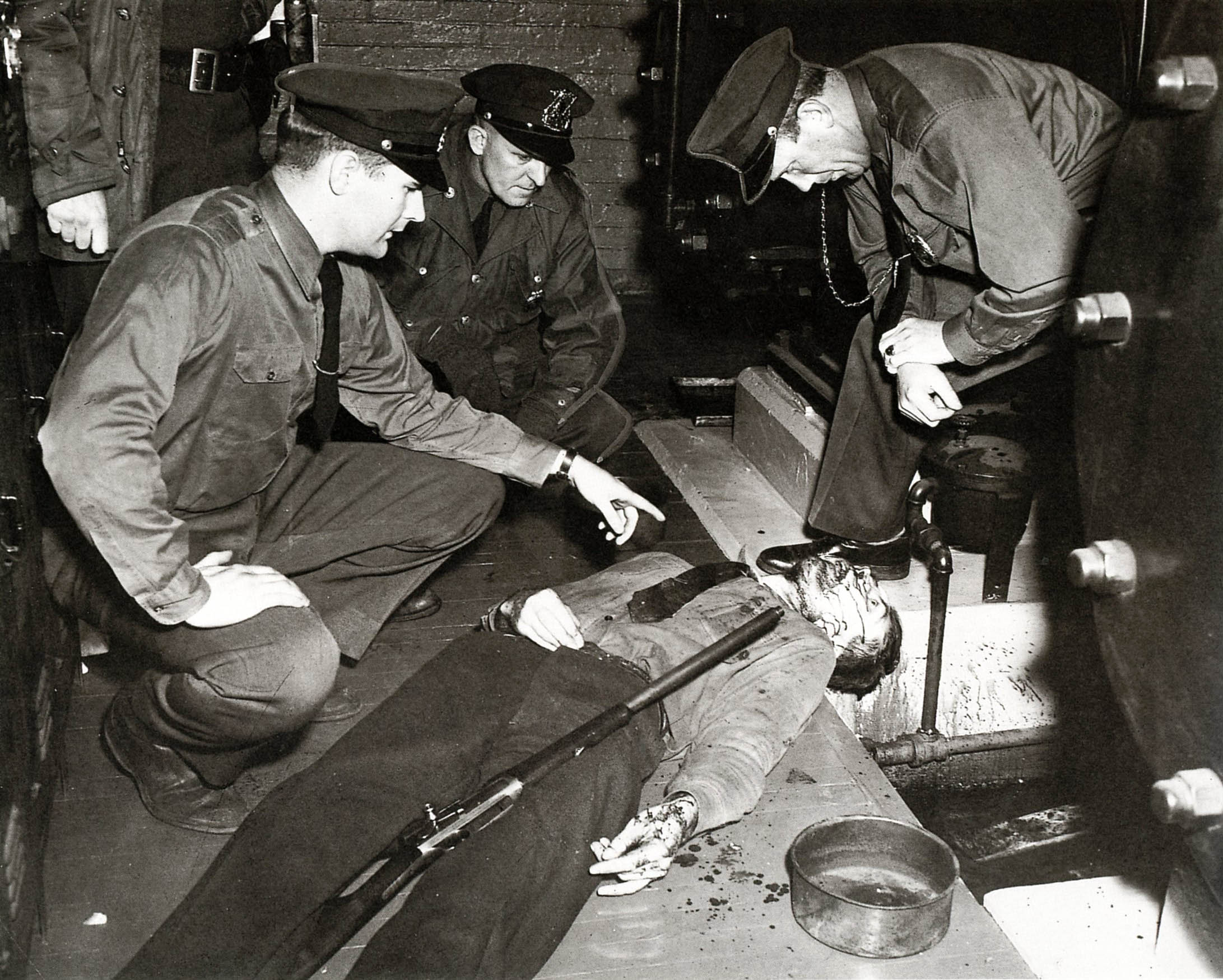
On December 9, 1948, a man named John J. Hill, a longtime employee in the power plant at the Northern Pacific Railroad’s sprawling Como shops in St. Paul, got into an argument with coworkers just before quitting time. The argument was apparently over who should clean some boilers, but behind it lay a long and troubled history of conflict. Hill, age 54, had been passed over for promotion and nursed a deep grudge.
What happened next has a familiar ring to it. Hill got out a .30 caliber hunting rifle, either from his locker or the trunk of his car, and started shooting. There were five other men in the building, and Hill killed four of them. It was St. Paul’s worst mass murder up until that time. A fifth worker escaped by ducking behind a steel post, which deflected the bullet intended for him. After his brief killing spree, Hill walked into another room, put the gun barrel under his chin, and fired.
This extremely graphic photograph of Hill, taken as three St. Paul police officers examined his body, appeared the next morning on the front page of the Pioneer Press. It was one of a dozen pictures from the murder scene printed in the newspaper that day.
Culled from: Strange Days, Dangerous Nights