Today’s Terrible Yet Truly Morbid Fact!
Ivan IV, known as Ivan the Terrible, Grand Duke of Muscovy and first Tsar of All the Russians, was born on August 25, 1530, and ascended the grand-ducal throne when three years old, on the death of his father, Vassili III, in December 1533. Threatened and neglected as a child, he seized power at the early age of fourteen. Outwardly Ivan was a typical Russian prince of his time, spending his next years in hunting, womanizing, drinking, robbing merchants, and terrorizing the unfortunate peasantry. But there was a little more to him: beneath this surface there lay a serious scholar who preferred the company of lowborn but educated clerks to that of his illiterate nobles. He chose one of the former, Alexei Ardatchev, as his most intimate adviser. On January 16, 1547, Ivan was crowned Tsar, the first Muscovite ruler to be so styled formally, basing his claim on his descent from Vladimir, grandson of the Byzantine Caesar, Constantine Monomakh. Two weeks later he married a pious and humane woman, Anastasia Zakharina-Koshkina.
In the same year a great fire destroyed almost the whole of Moscow. The Metropolitan (Archbishop) Makary took the opportunity to impress upon Ivan the sinful follies of his youth. There now opened a reign which seemed to be potentially one of the most enlightened in the history of Russia. Some kind of legal code was established; the most oppressive nobles were banished; the all-powerful Church was partially reformed; a few schools were founded in Moscow and the larger cities. Although neither a brave man nor a good general, Ivan inspired his troops with a crusading spirit, captured Kazan from the Tartar horde, and extended his empire down the Volga to the port of Astrakhan. In 1558 he turned westward against the Teutonic Knights and, by the summer of 1560, had reached Riga on the borders of Prussia.
By our standards, Ivan was no doubt a cruel despot even during these early years. By contemporary Russian and indeed European standards, he ruled wisely from 1551 to 1560. He played a vigorous part in the deliberations of his council, but allowed freedom of speech and opinion. He received petitions from all classes of his subjects: for the first and last time in Russian history, the poorest man in the country could gain access to his sovereign.
In October 1552 Anastasia gave birth to a child, Dmitri, who died when six months old. Nine months later she bore another son, Ivan, and a third, Fedor, in 1558. Probably Tsar Ivan had been infected with syphilis before his marriage. We may surmise—if only surmise—that the infant Dmitri died of congenital syphilis. Giles Fletcher in The Russe Commonwealth described Fedor, who survived Ivan the Terrible, as
… of mean stature, somewhat low and gross, of a sallow complexion, and inclining to the dropsy, hawk nosed, unsteady in his pace by reason of some weakness in his limbs, heavy and inactive, yet commonly smiling almost to laughter. For quality otherwise simple and slow witted.
He, too, was probably a congenital syphilitic.
Anastasia died in July 1560. Ivan was quite genuinely broken-hearted and he drowned his grief in a prolonged drunken debauch which started immediately after her funeral. His brain conceived the fantasy that his friend Alexei Ardatchev and his wise adviser, the monk Sylvester, had contrived Anastasia’s death by witchcraft. Both were dismissed and imprisoned. He then put to death Ardatchev’s brother, a magnificent soldier, with his twelve-year-old son; next, his friend Maria Magdalena, a widow, and her five children. On August 21, 1561, Ivan married a rich Circassian princess, but this did not stop him making a proposal of marriage to Queen Elizabeth I of England in 1563. In the same year he led an immense army to invade Lithuania. He captured the important trading city of Polotsk and seemed to have the country at his mercy. Then his martial mood passed and he returned to his debauches in Moscow, where the new Tsaitsa had given birth to a son, Vassili, who lived for five weeks.
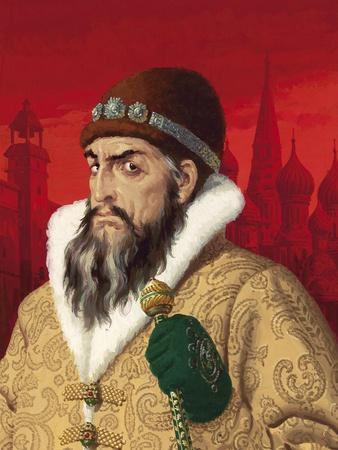
What, me terrible?
In December 1564 occurred the first incident which clearly shows that Ivan was now suffering from cerebral syphilis. Early in the morning of December 3 a number of sleighs drew up in the Kremlin Square. They were loaded with gold, silver and jewels from the palace, and with the Tsar, his wife and his two sons. Then they drove off, leaving no forwarding address. Ivan’s first message home read: “Unable to brook the treachery by which I was surrounded. I have forsaken the state and taken my way whither God shall direct.”
His bewildered nobles and bishops set out in search. They found him in the village of Alexandrov, a hundred miles north-west of Moscow, and besought him to return. Ivan consented, on condition that he was free to execute any ‘traitors’ he so desired, to live in a house outside the Kremlin, and to have a personal bodyguard of 1,000 men, the ‘opritchina’. He returned to Moscow on February 2, 1565 and the executions started on February 4. The opritchina was extended to number 6,000 bandits, and the new house became a strange monastery with the married Ivan as abbot. Three hundred of the opritchina served as monks, clad in black cassocks over their sables and cloth of gold. The day started with early matins at four in the morning and ended at eight with vespers, Ivan praying with such fervor that his forehead was permanently bruised from his prostrations. These bouts of prayer were relieved by visits to the torture chamber, conveniently situated in the cellars.
The remainder of Ivan’s reign is a sickening tale of tortures and floggings, of burnings and boilings, of all manner of hideous deaths. The dreadful vengeance for an alleged conspiracy that he exacted on the city of Novgorod, where for five weeks thousands were flogged to death, roasted over slow fires, or pushed under the ice; the executions at Moscow on July 24, 1570, when Ivan and his son Ivan themselves helped in the ghastly work, when Prince Viskavati was hanged from a gallows and sliced to death with knives while Ivan raped the widow and his son raped the eldest daughter—these are but a few of the known incidents of a reign of terror which lasted from 1565 until 1584. Ivan’s madness culminated in the slaughter of his son and heir, the Tsarevitch Ivan, whom he stabbed to death with his steel-pointed staff in a fit of murderous rage on November 19, 1581. Disappointed in his hopes of marrying Elizabeth of England, Ivan made overtures to her cousin Lady Mary Hastings and, when this offer was declined, announced his willingness to marry any kinswoman of the Queen; despite the fact that he was already married, Ivan seems to have been obsessed with the fantasy of a royal union with England. Elizabeth, probably bearing in mind the fortunes of the Russian company which had been founded under the patronage of Ivan in 1553, caused her envoy to assure him that any one of a dozen of her kinswomen would be happy to marry him. Fortunately for some innocent girl, Ivan died before the project went any further. His last days were horrible, a time of sleeplessness, terror and insanity, surrounded by soothsayers, his only relaxation the fondling of his jewels [Oooh, I say! – DeSpair] and discoursing on their curative powers. The cause of death was an apoplectic fit while setting the board for a game of chess.
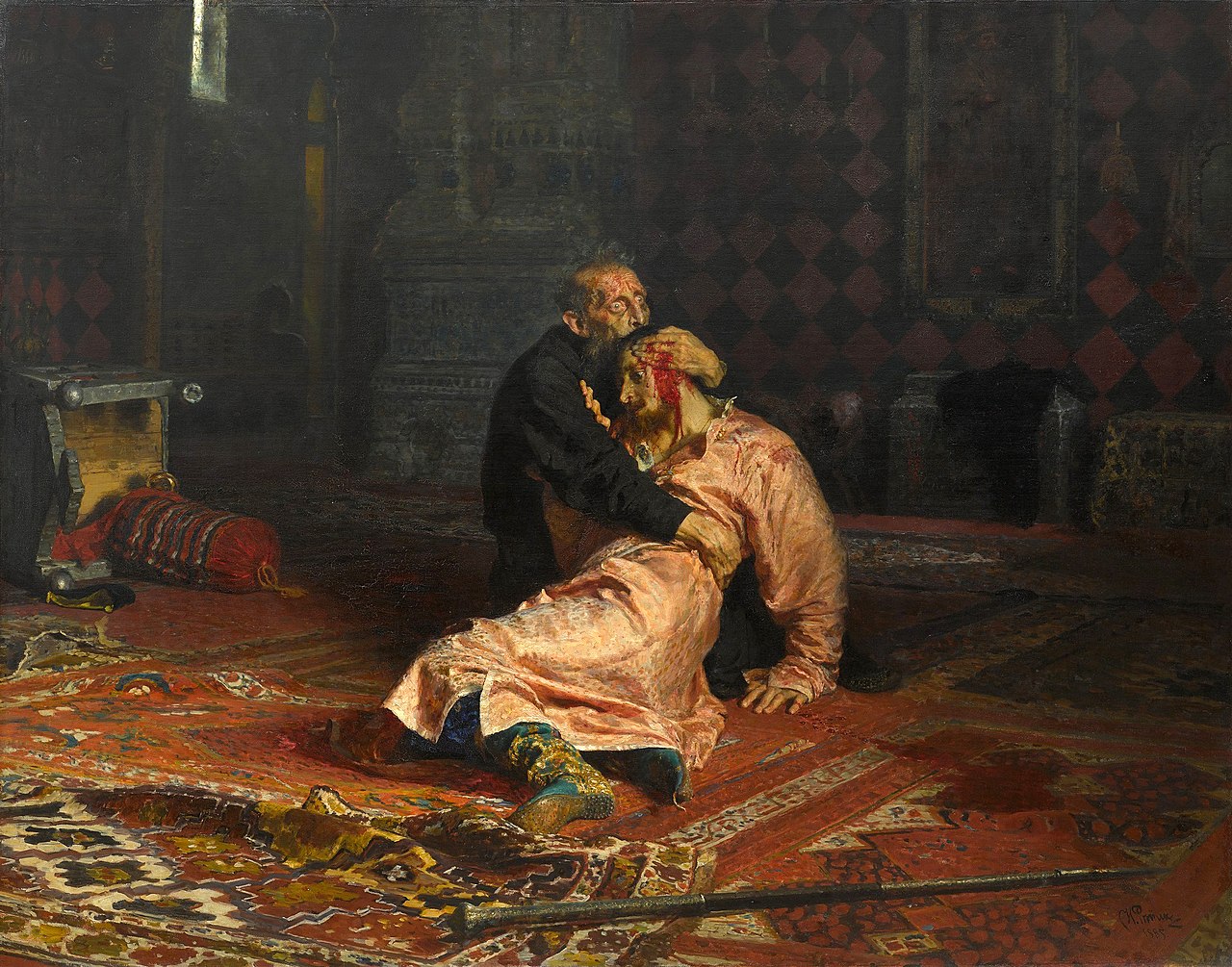
Ivan the Terrible and his Son Ivan by Ilya Repin
Culled from: Disease and History
Car Crash Du Jour!
One of my favorite books is Car Crashes and Other Sad Stories by Anaheim photographer Mell Kilpatrick. It’s a collection of car crash photos from the 40’s and 50’s, often with corpses still strewn across the enormous interior (or out of it, since there were no seat belts in those days). It combines my love of old cars with my love of morbidity and is the perfect ambulance chaser book!
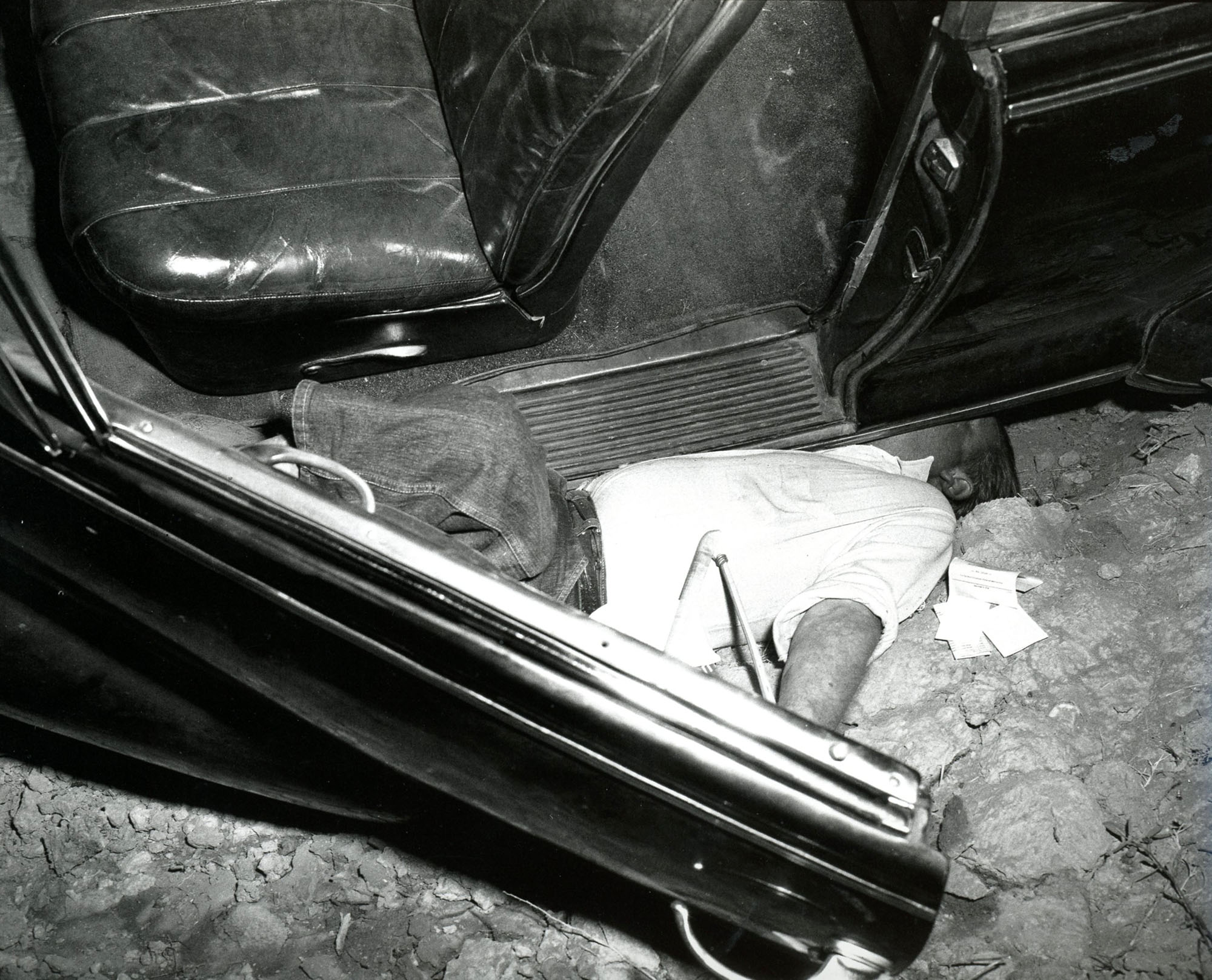
Los Alamitos & Garden Grove—fatal