Today’s Animal-Abusing Yet Truly Morbid Fact!
Snow removal is a troublesome, costly operation, but the results today are a singular success when compared with those of the 1870’s and 1880’s. In fact, the word “removal” when applied to that period grossly overstates the operation. The snow remained; it was merely shifted, if at all, a few yards.
Keeping the streets clear for the horse trolleys was the uppermost priority, and cumbersome eight-team plows banked the sidewalks with enormous heaps of snow. Often becoming stuck themselves, the plows aggravated the public’s misery by blocking the roads to other traffic. Extra horses sometimes were harnessed to free the machines, and an uproar ensued as the straining animals were lashed by their handlers and cursed by onlookers.
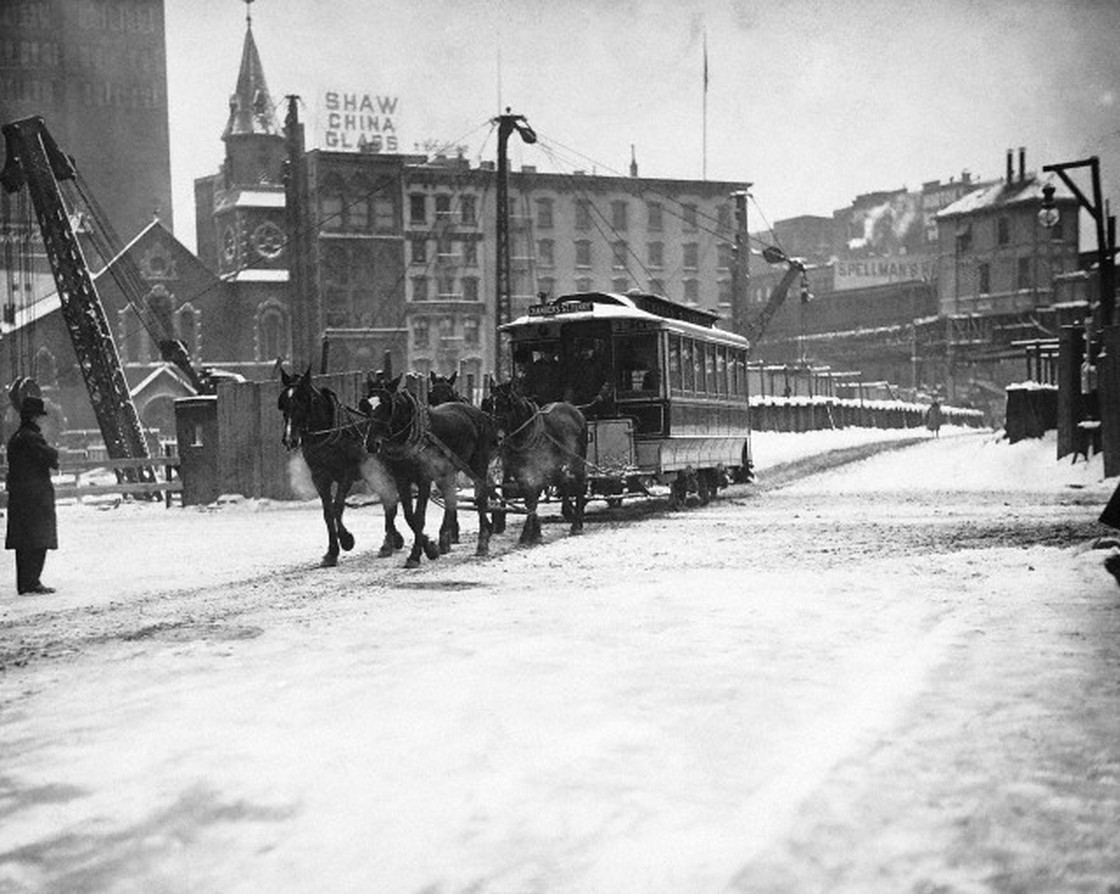
Poor Horsies
It was not uncommon for trolley passengers to disembark and push their car as its horses floundered, unable to find their footing on the icy surface. The less ambitious helped the driver whip his animals. Pedestrians could fall all they wanted to, but if a horse fell it would delay the trolley car, and that could not be tolerated. [I hate people. – DeSpair]
Culled from: The Good Old Days — They Were Terrible!
Arcane Excerpts:
Here’s a story of extrauterine birth from the fabulous Anomalies and Curiosities of Medicine by George M. Gould and Walter L. Pyle (1896):
The British Medical Journal quotes: “Pinard (Bull. de l’Acad. de Méd., August 6, 1895) records the following, which he describes as an ideal case. The patient was aged thirty-six, had had no illness, and had been regular from the age of fourteen till July, 1894. During August of that year she had nausea and vomiting; on the 22d and 23d she lost a fluid, which was just pink. The symptoms continued during September, on the 22d and 23d of which month there was a similar loss. In October she was kept in bed for two days by abdominal pain, which reappeared in November, and was then associated with pain in micturition and defecation. From that time till February 26, 1895, when she came under Pinard’s care, she was attended by several doctors, each of whom adopted a different diagnosis and treatment. One of them, thinking she had a fibroid, made her take in all about an ounce of savin powder, which did not, however, produce any ill effect. When admitted she looked ill and pinched. The left thigh and leg were painful and edematous. The abdomen looked like that of the sixth month of pregnancy. The abdominal wall was tense, smooth, and without lineæ albicantes. Palpation revealed a cystic immobile tumor, extending 2 inches above the umbilicus and apparently fixed by deep adhesions. The fetal parts could only be made out with difficulty by deep palpation, but the heart-sounds were easily heard to the right of and below the umbilicus. By the right side of this tumor one could feel a small one, the size of a Tangerine orange, which hardened and softened under examination. When contracted the groove between it and the large tumor became evident. Vaginal examination showed that the cervix, which was slightly deflected forward and to the right and softened, as in uterine gestation, was continuous with the smaller tumor. Cephalic ballottement was obtained in the large tumor. No sound was passed into the uterus for fear of setting up reflex action; the diagnosis of extrauterine gestation at about six and a half months with a living child was established without requiring to be clinched by proving the uterus empty. The patient was kept absolutely at rest in bed and the edema of the left leg cured by position. On April 30th the fundus of the tumor was 35 cm. above the symphysis and the uterus 11 1/2 cm.; the cervix was soft as that of a primipara at term. Operation, May 2d: Uterus found empty, cavity 14 1/2 cm. long. Median incision in abdominal wall; cyst walls exposed; seen to be very slight and filled with enormous vessels, some greater than the little finger. On seizing the wall one of these vessels burst, and the hemorrhage was only rendered greater on attempting to secure it, so great was the friability of the walls. The cyst was therefore rapidly opened and the child extracted by the foot. Hemorrhage was restrained first by pressure of the hands, then by pressure-forceps and ligatures. The walls of the cyst were sewn to the margins of the abdominal wound, the edge of the placenta being included in the suture. A wound was thus formed 10 cm. in diameter, with the placenta for its base; it was filled with idioform and salicylic gauze. The operation lasted an hour, and the child, a boy weighing 5 1/2 pounds, after a brief period of respiratory difficulties, was perfectly vigorous. There was at first a slight facial asymmetry and a depression on the left upper jaw caused by the point of the left shoulder, against which it has been pressed in the cyst; these soon disappeared, and on the nineteenth day the boy weighed 12 pounds. The maternal wound was not dressed till May 13th, when it was washed with biniodid, 1:4000. The placenta came away piecemeal between May 25th and June 2d. The wound healed up, and the patient got up on the forty-third day, having suckled her infant from the first day after its birth.”
Andersonville Prisoner Diary Entry Du Jour!
This is the continuation of the 1864 diary of Andersonville prisoner Private George A. Hitchcock (see the archived version for all entries up until now).
Here’s today’s entry:
August 18th. Very hot. A new rebel sergeant called our roll, who finds it difficult to red writing and in his haste does not get answers to many of the names. The rations of the supposed absentees are consequently cut off. I am down sick with diarrhea and headache. More prisoners from Sherman come in.
Culled from: Andersonville: Giving Up the Ghost