Category Archives: Sundry

Morbid Fact Du Jour for February 3, 2018

Today’s Sufferable Yet Truly Morbid Fact!

Between February, 1864 and April, 1865 it is estimated that 45,000 Union prisoners were confined in the Confederate stockade, Camp Sumter, near Anderson Station, Georgia, forever to be remembered as Andersonville. Of that number, approximately 25,000 men survived their prison experience and returned home to tell their tale of suffering. It is unknown how many survivors, with their health and lives shattered, died as a direct result of their captivity after returning to civilian life. Close to 13,000 Union soldiers did “give up the ghost” at Andersonville, and it was the ghost of Andersonville that haunted the survivors for the rest of their lives.

The following is an excerpt from the account of Harry A. Harmen, Troop A, 12th New York Cavalry, who was captured at Plymouth, N.C. on April 20, 1864.

Scattered among the crowd, and stretched out on the ground (not only here but all over the camp) were men in the last stages of disease, generally that of bowels and other kindred complaints. As the coarse food that was issued to the prisoners only aggravated complaints of this kind, which were the most prevalent, the prisoners died by the hundreds. It was such a common occurrence to see men dying  in all manner of places and conditions that it was looked upon with indifference and caused no remark; it was part and parcel of the place, and we had become so accustomed to it that we thought nothing of it.


Andersonville Prison Camp

Down by the branch at any time of the day or night men by the score could be found dead or dying. They would crawl as near to the water as they could get, and then, being too weak to get over the filth that bordered and blocked the stream, would give up in despair, after trying in vain to reach the water, being too exhausted to go back where they started from they would, after terrible suffering, give up the ghost.

The dead were picked up every morning, carried to the gate and laid out in a row, ready for the dead-wagon to draw them out. Very few bodies would be left with any clothing on them; it would be in the majority of cases be stripped from them before the breath had left the body.

Many were the fights for dead mens’ rags. It was pitiable to view the naked dead as they were pitched like cord-wood into the wagon preparatory to their ride to the deadhouse or cemetery. They were thrown indiscriminately. It was horrible to see the heads, arms and legs as they swung back and forth with the jolting motion of the wagon. This wagon was made to do double duty, for it not only carried the dead out in the morning, but it brought in our rations of bread in the afternoon, not as much as being swept out. As an appetizer I think this was a success, especially after noting the condition of the load in the morning, which certainly could be classed as perishable freight.

Culled from: Andersonville Giving Up the Ghost: Diaries & Recollections of the Prisoners


Legend Du Jour!

It’s time to step into the Supernatural World for another creepy olde legend, as culled from the Time-Life book The Enchanted World – Ghosts.

In Brittany, Death was a man known as the Ankou. Some said he was none other than the fratricide Cain, eldest son of Adam, who was doomed to roam the earth forever as a collector of human carrion. Others thought that he was the ghost of the last man to die each year, coming back to fill new graves before yielding place to his successor. Most people simply accepted him as Death.

All agreed, however, about his appearance. Tall and gaunt, often wearing a wide-brimmed hat, and sometimes manifest as a whitened skeleton swathed in a ragged shroud, the Ankou was a night-stalker, emerging when prudent folk were safely indoors. He walked the lanes of the province with a peculiar, awkward gait, his head turning stiffly from side to side with each step, scenting the air, for his eye sockets were empty. The Ankou was blind. Sometimes he carried a club or a sword, sometimes he went about with a scythe slung over his shoulder. Always he was accompanied by a cart drawn by horses or oxen, which he used to carry away those he had come to claim. This betrayed his presence. Living folk in their houses could hear through the shutters the creaking of the cart wheels and the heavy footfalls of the death bringer.

Once, it was said, the Ankou could see, an eerie flame flickered in the eye sockets. But that light was snuffed out by a being more powerful than the Ankou himself.

It happened, the story goes, that Saint Peter descended to earth and fell into step beside the Ankou and his cart. The two powerful beings walked in silence down a dirt lane bordered by hayfields. There, in the late dusk, a farmer and his servant still labored. At the sound of the cart’s creaking axle, the birds ceased their singing and the farmer dropped to the ground, attempting to make himself invisible. He motioned his servant to do the same.

The servant was a simple man, however. Like most Bretons, he had a fine musical voice, and he continued to scythe the hay, singing a gay and lilting song as loudly as he could to keep up his courage.

The Ankou brought the cart to a half, and the gaunt face turned toward the singer. ‘You will be dead in eight days,’ he said dully. But the servant only sang louder. At this challenge, the green fire blazed in the Ankou’s eyes, and he turned to his companion, ready to prove his power.

But Saint Peter defended the servant and berated the Ankou for wishing capricious death on an honest man engaged in honest labor. He wished the servant an extra measure of years. And as for the Ankou, Saint Peter struck the creature blind, putting out the light in the deathly eyes.

9

Morbid Fact Du Jour for January 22, 2018

Today’s Raging Yet Truly Morbid Fact!

On Armistice Day, November 11, 1940, the Midwest region of the United States was hit by a terrifying storm, reminiscent of the historic gales of 1913 that had wreaked havoc on the Great Lakes. On shore, raging winds toppled church steeples, telephone lines and rooftops and brought driving snow to Wisconsin, South Dakota, Nebraska, Minnesota, Iowa and Michigan. Further south, it stranded hundreds of duck hunters along the shores of the Mississippi River and was blamed for 144 deaths.


Duck Hunters in Minnesota

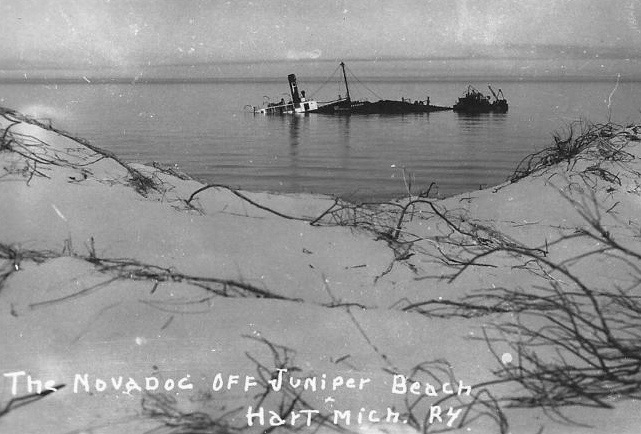
On the water, Lake Michigan bore the brunt with winds reaching as high as 124 mph. All over the lake, vessels were in trouble. On the east shore at Ludington, the car ferry City of Flint 32 was blown ashore, while a nearby fish tug Three Brothersmanaged to save seventeen men aboard the doomed Navadoc. The freighter Frank J. Peterson was beached at Hog Island, while another freighter, the Navadoc, went aground off Naubinway at the northern tip of the lake.

Among the worst disasters were the complete loss of both the 380-foot steamship Anna C. Minch and the 420-foot steel freighter William B. Davock. All hands perished – 24 on the Minch and 32 on the Davock. The Minch was found a mile and a half south of the pier at Pentwater with her mast still above water. Bodies from both ships washed up along the shore near Pentwater and Ludington, leading some to speculate that they had collided.


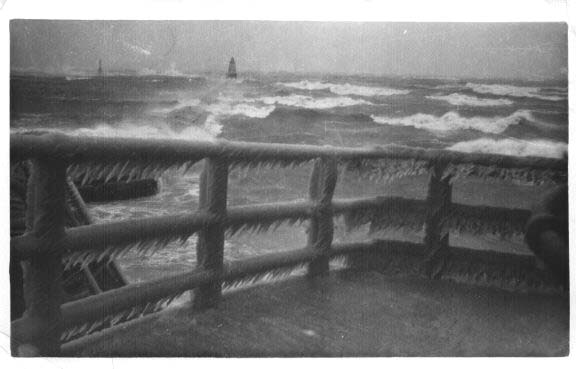
A view from the car ferry City of Flint 32

In all, 59 sailors, mainly on Lake Michigan, were lost. Because November had always been a dangerous month for shipping on the Great Lakes, the storms were given the nickname “Witches of November”.

Culled from: Disaster Great Lakes


Car Crash Du Jour!

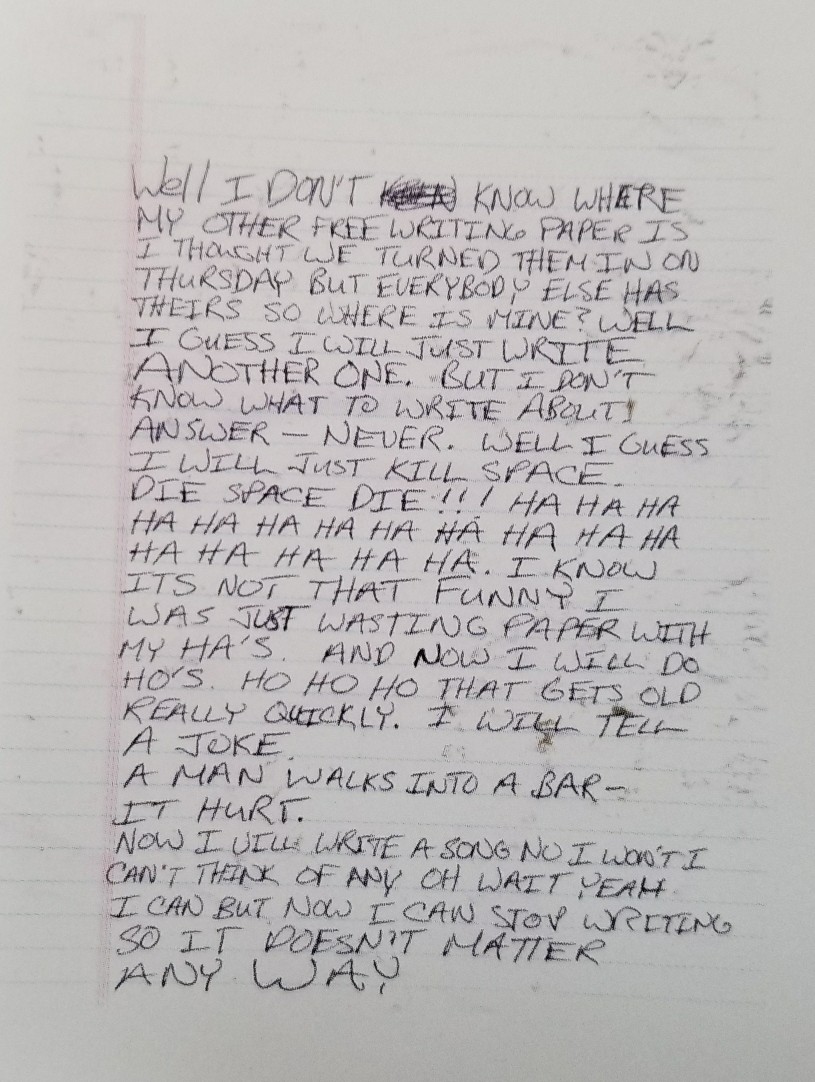
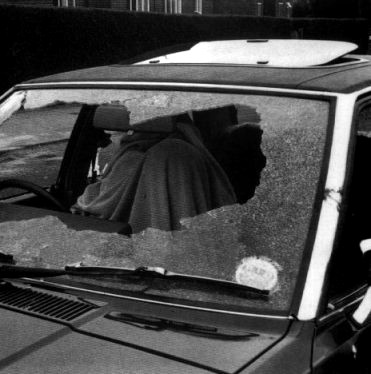
Deathsentences of the Polished and Structurally Weak is an album and booklet by Negativland. The band describes the project as “a 6 by 12 inch 64-page full-color book which comes with a 45-minute CD soundtrack.”  I’m not interested in the band Negativland, but I own a copy of this objet d’art macabre because car crashes are fascinating… and this is very similar to a project I wanted to do years ago but never got around to completing (nothing new there).  What they did was go to junkyards and look for notes left behind in the smashed cars and display them together.  Of course. you’re left wondering – did the person who wrote the note or for whom the note was intended live or die? I have no answers…  but speculating can be its own entertainment, and so I present to you this entry.

What do you think?  Fatal or no?

The Wreckage:

The Note found within:

Morbid Fact Du Jour for January 1, 2018

Today’s Special Yet Truly Morbid Fact!

Barent Becker, a farmer living in Mayfield, New York, grew tired of his wife Ann and disposed of her by following an age-old tradition. Becker prepared his specialty, stewed tomatoes, and served it to her loaded with enough arsenic to annihilate a regiment. She consumed the dish with relish and promptly died.

The farmer confessed and was hanged October 6, 1815, after he delivered a maudlin farewell to his relatives from the gallows. A special hymn, which Becker had composed, was sung.

Culled from: Bloodletters and Badmen

Sadly, I couldn’t locate the text of Becker’s farewell speech or his hymn.  Probably was crap though, right?  And, isn’t Barent Becker a great name?


A Weird New Year!

I wish you all a Morbidly Mirthful New Year!  One of my sort-of-resolutions is to try to actually send out a Morbid Fact Du Jour every jour in 2018.  Do you think I will succeed?  Only time shall tell…

Hey, look, I’m 1/1!

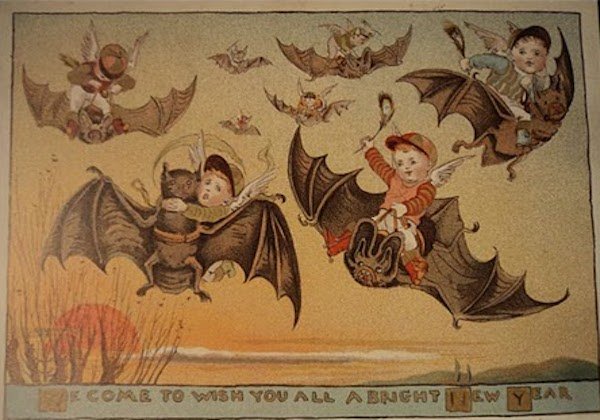
And here is a lovely collection of some of the strangest New Year’s cards.  Let’s all hope for lots of (good) strangeness in 2018!

Pigs, Bugs, and Magic Mushrooms (Vermont Deadline)

Morbid Fact Du Jour for June 19, 2017

Today’s Infested Yet Truly Morbid Fact!

During the American Civil War, osteomyelitis (infection of the bone) was treated somewhat differently by the opposing sides. Both sides used cold compresses, local debridement, drainage, and amputation to treat bone infections. However, a unique form of treatment was developed serendipitously by the South during the war. A group of Confederate surgeons, imprisoned in Chattanooga, had been denied supplies to keep their men’s wounds clean. Subsequently, maggots infested the wounds and, surprisingly, cases of osteomyelitis and gangrene were cured. After their release, the surgeons applied this method in Southern hospitals, which led to improved results. The North continued to have poor responses to treatment because they scrupulously eliminated all maggots from their soldiers’ wounds. Maggot treatment was eventually rediscovered. Maggots bred under sterile conditions were used to treat osteomyelitis during World War I and were reported to have excellent results.


Union Soldier Suffering from Osteomyelitis

Culled from: Orthopaedic Injuries of the Civil War: An Atlas of Orthopaedic Injuries and Treatments During the Civil War

Fine(ly Designed) Wine!

If you’re like me, you buy your wine exclusively based upon the quality of the label.  And there are few labels that are more enticing to me than those produced by Orin Swift.  I want them all – and I don’t even like wine very much!  Well done, Orin Swift!  Here are a few of my faves:

China Doll Rosé

Mannequin Chardonnay (which comes in a skateboard deck too):

Papillon Bordeaux Blend:

And my favorite, the absolutely stunning Cabernet Sauvignon which made me let out an audible gasp when I saw it at a liquor store in Seattle last month:

Morbid Fact Du Jour for June 18, 2017

Today’s Realistic Yet Truly Morbid Fact!

In 1872 war broke out between the American government and the Modoc tribe who lived in a rugged, desolate area near Mt. Shasta in Northern California. The Modoc War was the costliest Indian battle to the U.S. government, both in terms of financial expenditure (over $400,000) and the number of soldiers killed (73 – versus only 17 Modoc).  The Modoc Indians had been forced out of their native lands, had experienced the bad faith of white treaty makers, and had suffered constant encroachment by “American” settlers. They were driven to fight when some of the younger Modocs seceded from their tribe in a display of independence, if not desperation. After brave but mostly symbolic defiance, the Modocs surrendered, and four of them were hanged.


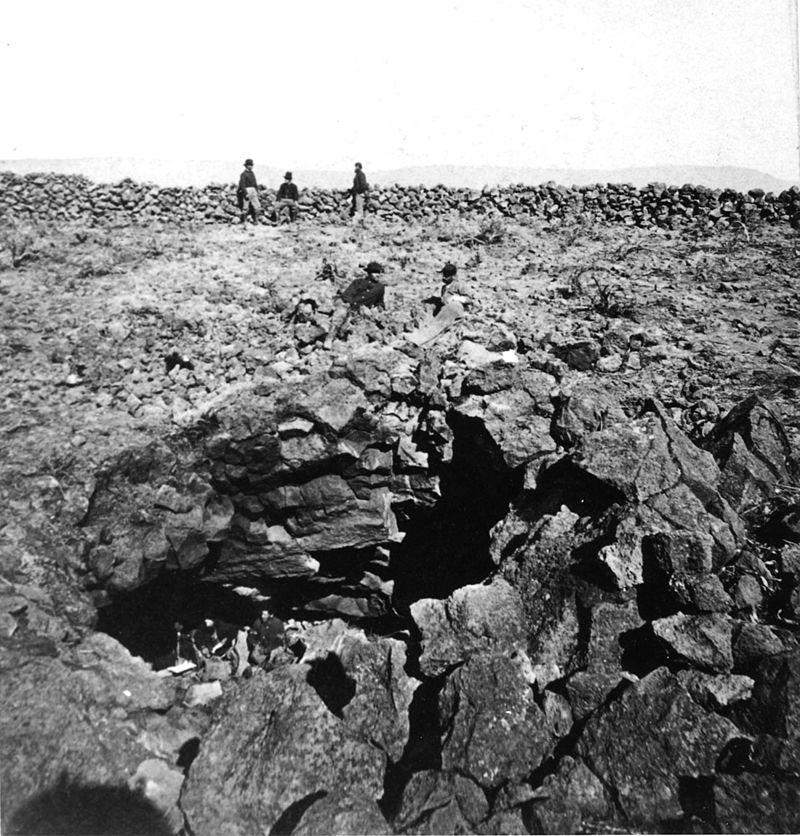
U.S. soldiers inspect Captain Jack’s cave in the Lava Bed (1873 Edward Murbridge photo)

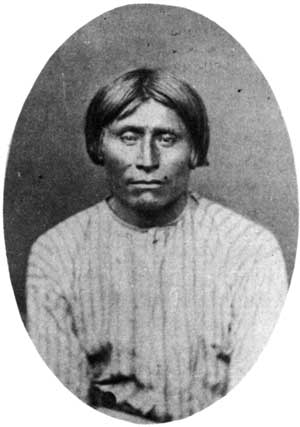
The German immigrant photographer Louis H. Heller made small, card-mounted photographs of the renegade Modoc leaders and their captors, which Carleton Watkins sold in his San Francisco gallery. These pictures reveal the Indians to be complex figures and are in no way sensationalistic. Rather, these sad, ambiguous photographs must have been made for their newsworthiness and documentary value more than for any racial stereotyping of the outlaw “wild” Indian. Captain Jack (Kintpuash), their leader, wears the modest clothing of a farmer, his hair is short, and his most distinguishing characteristic is an expression of profound melancholy.

Culled from: Police Pictures: The Photograph as Evidence   

And after death, the disrespect continued, unsurprisingly. From Wikipedia:

They severed the Modocs’ heads after the executions at Fort Klamath, sending them on October 25 by train to Washington, DC, to the Army Medical Museum for study.

In 1898, the Army transferred the skulls to the Smithsonian Institution. In the 1970s, descendants of Captain Jack learned that his skull was at the Smithsonian and appealed for its return. In 1984 the Smithsonian returned Kintpuash’s skull to his relatives, who acted as tribal representatives to receive also the skulls of Boston Charley, Black Jim, and John Schonchin, and of an unknown Modoc woman whose remains had been recovered from the Lava Beds.


And Speaking Of Heads Stored for Study…

Here’s another excerpt from Malformed: Forgotten Brains of the Texas State Mental Hospital.

3693-13-1980
Study No. 206
This label breaks from the collection’s convention with only a case number alluding to the date. This brain’s hemispheres are severely asymmetrical.

Morbid Fact Du Jour For June 14, 2017

Today’s Politically Charged Yet Truly Morbid Fact!

On the afternoon of April 15, 1920, outside a shoe factory in South Braintree, Massachusetts, security guards Frederick Parmenter and Alessandro Berardelli were engaged in transferring the company’s $15,777 payroll when two men approached. Without warning, one of the strangers opened fire, mortally wounding both guards. His partner, who wore a dark handlebar mustache, pumped yet more rounds into the helpless victims. Heaving the payroll boxes into a waiting car that contained three other men, the killers made their escape. Eyewitnesses described the gang as “Italian looking,” but of more use to investigators were the empty shells recovered from the sidewalk. All were manufactured by three firms: Peters, Winchester, and Remington.

Two days later, a stolen Buick thought to be the getaway vehicle was found abandoned in some woods. Evidence linked it to an abortive payroll robbery at another shoe factory in nearby Bridgewater the previous Christmas Eve. It was believed to have been masterminded by an Italian named Mike Boda, but when police raided Boda’s suspected hideout, he had already fled.

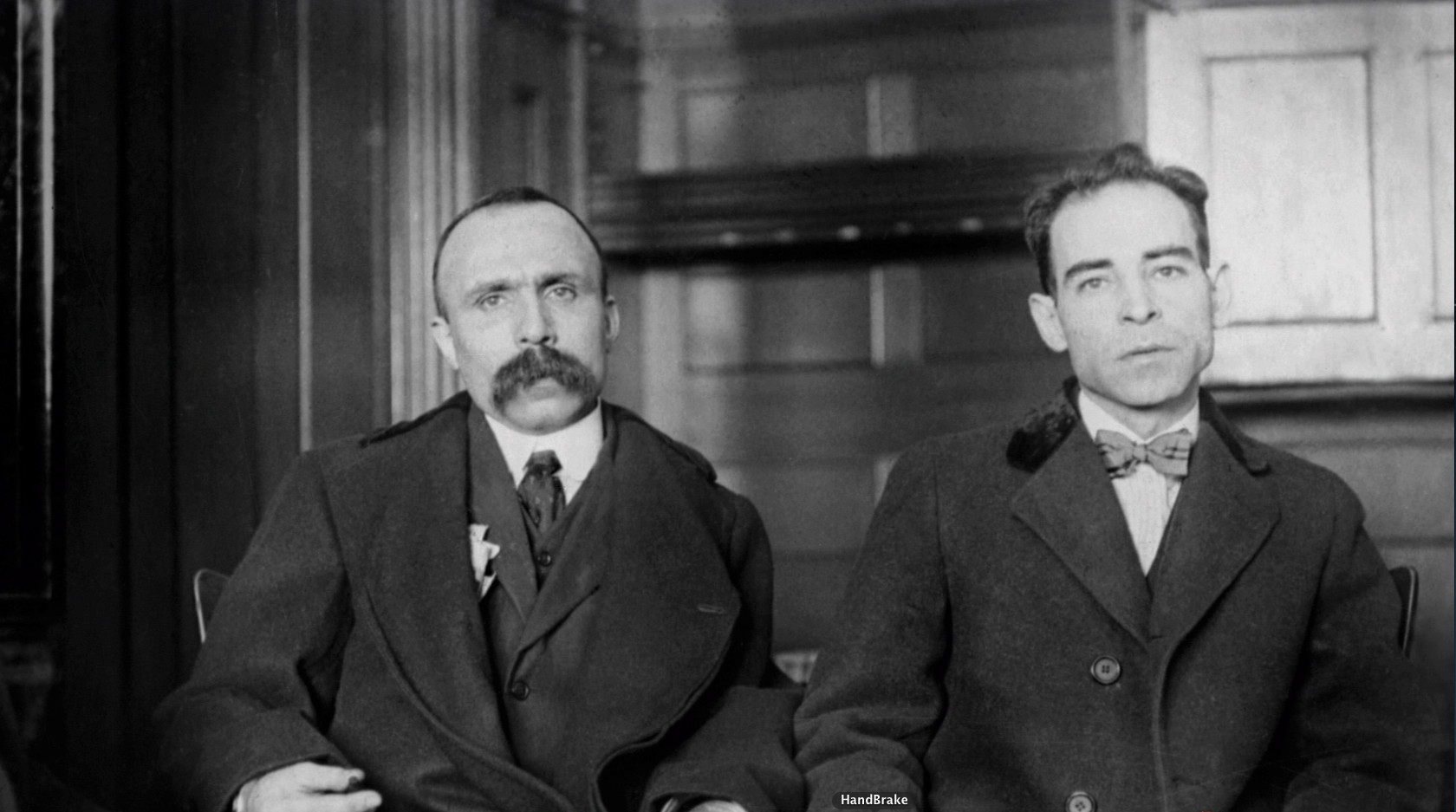
However, two other men were arrested: Nicola Sacco, twenty-nine, and his mustachioed companion, Bartolomeo Vanzetti, thirty-two. Both denied owning any guns, yet each was in the possession of a loaded pistol, and Sacco’s was a .32, the same caliber as the murder weapon. Also, Sacco was carrying twenty-three bullets, all made by Peters, Winchester, and Remington. Vanzetti was a fish peddler; Sacco – significantly – worked in a shoe factory. Both were members of anarchist cells that openly espoused violence, a fact that inflamed public opinion against them.


Sacco and-a Vanzetti.  No, wait – Vanzetti and-a Sacco.

Eleven months later, on May 31, 1921, their trial opened in Dedham, Massachusetts, amid the hysteria of America’s first “Red Scare,” a time when anyone whose politics even hinted of radicalism was considered to be dangerously subversive.  The court heard dozens of identification witnesses, fifty-nine for the prosecution and ninety-nine for the defense, a welter of testimony that produced only confusion. Similar ambiguity surrounded the question of whether Sacco’s .32 had actually fired the bullet that killed Berardelli. Whereas one prosecution expert declared that it was indeed the murder weapon, another would only concede the possibility. Two defense experts harbored no such doubts, being adamant that Sacco’s gun could not have fired the fatal bullet.

Any ambiguity raised by the gun paled in the face of one incontrovertible and damning fact: the bullet that killed Berardelli was so outdated that the prosecution’s expert witnesses could locate none like it to test Sacco’s gun – except the equally obsolete bullets from Sacco’s pockets. On July 14, 1921, the jury returned a guilty verdict, and Judge Thayer sentenced the defendants to death.

The outcome touched off a firestorm of protest. Around the globe, left-wing parties lionized Sacco and Vanzetti, portraying them as innocent victims of capitalist justice.

In June 1927, a committee appointed to review the case contacted the man who would become America’s leading firearms expert, Calvin Goddard, at the Bureau of Forensic Ballistics in New York. Armed with two recent inventions, the comparison microscope and the helixometer, Goddard traveled to Dedham. The helixometer, invented by physicist John H. Fisher, was a hollow probe fitted with a light and a magnifying glass for examining the insides of gun barrels. With defense expert Augustus Gill acting as witness, Goddard fired a bullet from Sacco’s revolver into cotton wool, then placed it beside the murder bullet on the comparison microscope. The outcome was unequivocal – the murder bullet had been fired from Sacco’s revolver. Gill, peering through the microscope, had to agree. He exclaimed, “Well, what do you know about that?” When his fellow defense expert, James Burns, also changed his opinion, Sacco and Vanzetti’s last hopes were dashed. On August 23, 1927, over worldwide protests, they died in the electric chair.


Death masks of Sacco and Vanzetti.  As my mother’s Italian friend used to say, “Nana babies!”

Culled from: The Casebook of Forensic Detection


Aztec Death Whistle*

Leave it to those clever Aztec kids to come up with a whistle that can recreate the sound of your favorite horror movie scene at will!  And to make it so damned pretty too!  We all want one, right?  (Thanks to Marco for the link.)

The Horrifying Sound of an Aztec Death Whistle

* Death Metal Band Name???

Morbid Fact Du Jour for March 28, 2017

Today’s Deadly Yet Truly Morbid Fact!

August 17, 1987 was a bright warm sunny day.

In the Berkshire, England market town of Hungerford, Sue Godfrey packed a picnic and her two children into her car and headed for nearby Savernake Forest.

In another street in Hungerford, 27-year-old Michael Ryan also decided to have a day out in Savernake Forest.

But instead of a picnic, he packed his car with something deadly. It was his brand new Chinese copy of the AK 47 assault rifle.

For good measure, gun nut Ryan put in an American M1 carbine, and a fully-loaded Beretta .38 calibre semi-automatic pistol.


Michael the Maniac

It was the start of Britain’s worst gun massacre. By the end of the day 16 people were dead and several others were wounded by bullets as Ryan rampaged through the area shooting people at random.

Ryan arrived at the car park at the forest entrance at about midday, just as Sue Godfrey was putting her children into the car ready to leave.

He pointed his Beretta at her, marched her into the trees, and pumped 10 bullets into her back, killing her instantly.

Half an hour later at a service station between Savernake and Hungerford, the cashier watched a man driving a red Vauxhall Astra fill up with fuel, fill a petrol can, and then approach the pay window.

Ryan levelled a gun at the cashier and opened fire through the glass. She dived for cover and escaped death by a centimetre as a bullet smashed the plate glass and zipped through her hair.

Ryan then entered the shop and tried to shoot the cashier.

But the gun clicked empty. He turned on his heel and left.

The trembling cashier dialed 999. It was the first police knew about what was unfolding.

Ryan headed to the home he shared with his mother. He piled survival gear into his car, doused the house with petrol, and set it ablaze.

He got into his car but it would not start. Furious, Ryan pumped five bullets into it causing it to ignite.

Neighbour Roland Mason was in his back garden and came out to the front to see what the commotion was. Ryan riddled him with bullets.

Then he shot dead Mason’s wife Sheila. With a bandolier of ammo across his chest and wearing black combat clothes, Ryan walked down the road and shot pensioner Margery Jackson and 14-year-old Lesley Mildenhall, wounding them both severely.

Around the corner he met Ken Clements out with his three children. Ryan murdered him on the spot.

PC Roger Brereton was the first police officer on the scene. He swung his patrol car into South View but he had no chance. Ryan raked his car with machine gun fire killing him instantly.

Ryan was strafing houses on both sides of the street, stopping only for a moment to put fresh clips of ammunition in his guns.

Linda Chapman and her daughter Alison came into view. Ryan peppered their car wounding them both, but they managed to drive away.

Ryan then spotted retired Abdul Khan mowing his lawn and killed him with his AK 47.

Police firearms teams were speeding to Hungerford but they were too far away to stop his killing spree.

Alan Lepetit was on his way home for lunch when he was shot and wounded, but he survived.

An ambulance arrived and was turning into South View when Ryan shot it up. Firefighters coming to tackle the blaze at Ryan’s own home ducked as their fire engine took several hits.

The fire had now engulfed three more houses.

George White was giving a lift home to Ivor Jackson, who didn’t know Ryan had already murdered his wife Margery.

As they approached the scenes of chaos Ryan shot White dead through the windscreen. His car went out of control and rammed the back of PC Brereton’s car with the officer dead behind the steering wheel.

At that moment Ryan’s mum Dorothy came home from shopping. As she surveyed the carnage, the son she doted on shot her dead.

Francis Butler was walking his dog in a park when Ryan shot him dead. Then he shot at Andrew Cadle but missed. He tried again, but the M1 jammed and Ryan threw it away in disgust.

But he still had the AK and the pistol. Minicab driver Marcus Barnard was shot in the head and died.

Then he opened fire on John Storms, Douglas Wainwright, Eric Vardy and Sandra Hill.

Wainwright and Vardy were killed outright. Storms and Sandra Hill were badly wounded with multiple gun shot wounds.


The body of Douglas Wainwright.

Sandra Hill was rescued by an off-duty ambulance man and a soldier who carried her to a doctors’ surgery, but she died before she got there.

Ryan had now reached Priory Road. He smashed open the front door of number 60 and shot dead 66-year-old Victor Gibbs. The pensioner tried to save his wife Myrtle who was in a wheel chair, but the bullets ripped through his body and killed her too.


Victor Gibbs who died trying to protect his wife.

With police using loudhailers to warn residents to stay indoors, Ian Playle encountered a police roadblock, but he knew another way to his home in Priory Road.

When he got there, he died in a hail of shots.

George Noon was standing outside 109 Priory Road when he saw Ryan standing outside the John of Gaunt school.

Ryan saw him and killed him with two shots then entered the empty school.

By now armed police had the area surrounded.

Sergeant Paul Brightwell shouted to Ryan from behind a wall. They had a conversation. Ryan sounded calm and lucid, but kept asking the officer how his mother was.

Police marksmen could not see Ryan to get a clear shot at him. He was sitting on the floor below a window.

Suddenly Ryan threw his AK47 out of the window. Then there was a single shot from the Beretta. Ryan had taken his last life – his own.

Culled from: The Mirror


Morbid Quote Du Jour!

“Why not seek death of one’s own free will, asserting one’s right to choose, giving it some significance instead of passively letting it happen? Why not? In short, because one thinks – and I speak for myself – that there is plenty of time. So the day of natural death comes, and we have missed the great opportunity of performing, for a specific reason, the most important act in life.”

– Cesare Pavese (1908-1950)

Morbid Fact Du Jour For October 25, 2016

Today’s Scalded Yet Truly Morbid Fact!

During the 1930s, four persons died in Yellowstone hot springs, and numerous others were injured.  Little Joy Myrlene Hanny, age three, of Firth, Idaho, was traveling with a group of seventeen persons who stopped at Biscuit Basin on July 13, 1932. At 1:45 p.m., while the group watched Jewel Geyser spouting its beautiful fountain twenty-five feet high, Joy was momentarily unsupervised. When the geyser erupted, Joy and her mother jumped back in surprise. The mother heard her child scream, looked down and saw the little girl immersed all the way up to her neck. She had stepped backwards into a small nearby hot spring, and was scalded “very severely.”

Although party members quickly pulled her out, Joy Hanny died the following night at the Mammoth hospital. The pool was measured at 150 degrees Fahrenheit, not hot enough to cause instant death but hot enough to cause excruciating pain for thirty hours prior to death. The spring into which Joy Hanny fell was described as being three feet long, two feet wide, and about two feet deep. It was located about thirty feet south of Jewel Geyser, and may have been present Shell Spring.


Jewel Geyser: Mesmerizing Indeed!

Culled from: Death In Yellowstone: Accidents and Foolhardiness in the First National Park


Real-Time Disaster

Here’s a fascinating real-time animation of the sinking of the Titanic. If you don’t have the patience to wait it out (as I didn’t), you can fast forward towards the end and listen to the screams of the invisible minions plunging to their doom!  (I sound entirely too enthusiastic about it, don’t I?)
Titanic sinks in REAL TIME - 2 HOURS 40 MINUTES
The Slow Farewell

Morbid Fact Du Jour for October 5, 2016

Today’s Swindled Yet Truly Morbid Fact!

Johann Otto Hoch or John Schmidt as was his most accepted birth name, was born in 1863 in Birgen, Russia or in 1855 in Horrweiler, Germany.  He had numerous aliases although John Hock was the one he maintained through his execution.


Johann Hoch – Ladykiller

He purportedly came to the United States in 1883 with his first wife (that we know of) Annie.  What followed was almost 25 years of bigamy and murder.  He became infamous for poisoning his wives shortly after taking their money and earned the nickname “The Bluebeard Murderer” after the French folktale published in 1697 in which “Bluebeard” murders his wives.

He wed over 50 wives illegally and bilked them out of different amounts of money but murdered anywhere from a confirmed 15 to upwards of 30.

He was finally tried and convicted of only one murder and that was his second to last wife, Maria Walcker-Hoch who lived with him at 6430 Union Avenue.   He supposedly married Maria Walcker on December 10, 1904 in Chicago and almost exactly one month later on January 11, 1905 she was dead of Nephritis or inflammation of the kidneys.  Within five days he married Maria’s sister, Emilie Fischer from Joliet.  Three days later Hoch fled with $750 and Emilie reported him to the police as a swindler and bigamist.  The police became suspicious and had Emilie’s sister exhumed and they found 7.6 grams of arsenic in the body.

Hoch was indicted for bigamy and an arrest warrant was issued.  Hoch had made the mistake of asking his landlady, a Mrs. Kimberly, in New York to marry him within 24 hours of meeting her.  She contacted the police suspecting him to be Hoch and he was subsequently arrested and extradited back to Chicago where he was charged with the murder of Maria Walcker-Hoch.

The trial started April 19, 1905 and Hoch was convicted of murder on May 20th.  His original death by hanging was scheduled for June 23, 1905. Hoch had avoided the hanging a number of times while in custody.  Governor Deneen granted him a reprieve until July 28th.  Within an hour of his hanging he was given another reprieve until August 25th.  Before the August 25th date, the Illinois Supreme Court agreed to hear his case but on December 15th handed down its verdict which supported the lower court’s ruling.  The Supreme Court set his date of Execution to be February 23, 1906.

On the date of Hoch’s execution his attorney, Frank D. Comerford, attempted to make an appeal to the Federal Court on the basis that Hoch’s 14th Amendment rights had been violated because his wife was purportedly coerced by authorities to testify against her husband and commit perjury  (Of course she and 49 others were not his legal wives) Judge Landis denied his petition for a writ.

One day before his execution Hoch was moved to the Death Chamber of the County Courthouse and Jail (Now Courthouse Place Office Building) where he woke up and ate his breakfast sparingly.  He received several visitors on that day.  His first visitor at 9am was his spiritual advisor F.W. Schlechte.  He met the Reverend Schlechte with a military salute and they studied the Bible for about an hour.  His next visitor was a very strange young man who introduced himself as a hypnotist and medical student.  The “hypnotist” had slipped past the guards and told Hoch, “Look into my eyes”.  Hoch told the guards that he was a “crank” and only managed to make him tired.  The crank was removed.  His last visitor was his latest wife Emilie Fishcer-Hoch.  He bid her a fond farewell at about 6pm and retired with a cigar which he smoked until it burned his fingers.  He then reclined in his bed but according to guards did not sleep.

He was supposed to die sometime between 10am and 11am on the 23rd but Jailer Whitman postponed it to as long as 2pm as they waited for Judge Landis’s decision.

Upon hearing that Landis had refused a writ of habeas corpus the death warrant was read to Hoch who stepped up to the gallows at 1:32pm.  His final words were, “Oh Lord, our Father, forgive them all.  They know not what they do.  They hang an innocent man.  I am innocent.  Goodbye.”

The trap was dropped and Hoch died of a broken neck almost instantly.  The body was lowered and handed off to undertaker Ernst Matz.  (The Matz Funeral Home is still in operation)

Meanwhile it seemed that no cemetery wanted to allow a murderer to be buried on their property.  Even Waldheim that accepted a number of the anarchists from the Haymarket riots (Spies, Parsons, Engel and Fischer) refused.  In fact officials from Waldheim stated that the burials of the anarchists had brought such unpleasant notoriety to their cemetery that under no circumstances would they ever allow another body of a person executed for a crime to be buried in their cemetery.

Shortly before noon on February 24, 1906 Hoch’s body was interred in the potter’s field of the Dunning Asylum and Poor Farm in an unmarked grave.

Culled from: Chicago Now


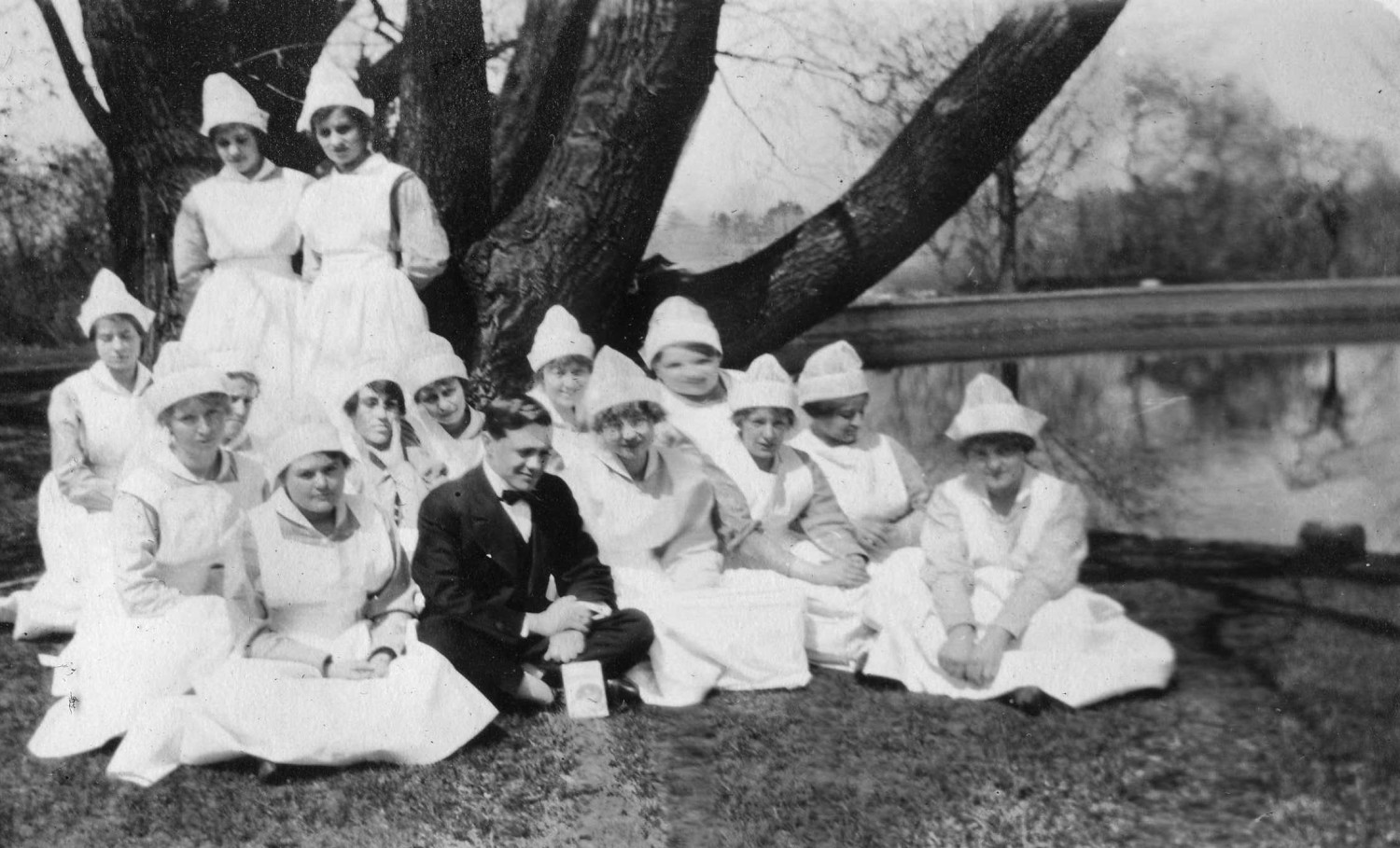
Northern Michigan Asylum Attendant Floor Nurse Duties – 1886

The following is a list of the attendant floor duties for the Northern Michigan Asylum (aka Traverse City Asylum) in 1886 as culled from the book Angels in the Architecture.

1. Daily sweep and mop the floor of your ward; dust the patients’ furniture and window sills.

2. Maintain an even temperature in your ward by bringing in a scuttle of coal for the day’s business.

3. Light is important to observe the patients’ condition. Therefore, each day fill kerosene lamps, clean chimneys, and trim wicks. Wash the windows once a week.

4. The nurse’s notes are important in aiding the physician’s work. Make your pens carefully; you may whittle nibs to your tastes.

5. Each nurse on day duty will report every day at 7 a.m. and leave at 8 p.m. except on the Sabbath, on which day you will be off from noon to 2 p.m.

6. Graduate nurses in good standing with the Director of Nurses will be given an evening off for courting purposes, or two evenings a week if you go regularly to church.

7. Each nurse should lay aside from each payday a goodly sum of her earnings for her benefits during her declining years so that she will not become a burden. For example, if you earn $30 a month, you should set aside $15.

8. Any nurse who smokes, uses liquor in any form, gets her hair done at a beauty salon, or frequents dance halls will give the Director of Nurses good reason to suspect her worth, intentions and integrity.

9. The nurse who performs her labors and serves her patients and doctors without fault for five years will be given an increase of five cents a day, providing there are no hospital debts outstanding.