Today’s Defiled Yet Truly Morbid Fact!
On Monday evening, June 25, 1906, thirty-five-year-old Harry K. Thaw, the wealthy heir to a Pittsburgh steel fortune, drew a revolver from under his coat. He fired it at point-blank range into the head of renowned American architect Stanford White, age fifty-one, during a performance of Mam’zelle Champagne on the rooftop stage at the original Madison Square Garden (which, coincidentally, Stanford had designed). Of Thaw’s crime, there was no doubt. There were dozens of eyewitnesses – including his beautiful young wife, Evelyn Nesbit, who exclaimed in the aftermath, “Oh Harry, what have you done?”
Thaw was apprehended within moments by Patrolman Anthony Debes, whose foot post covered Madison Square Garden. At the Nineteenth Precinct, Thaw initially provided the desk sergeant with a false name, but before long his identity was discovered, and the lurid details behind his crime became front-page news.
His wife, Evelyn Nesbit, was, by age sixteen, New York City’s most famous model. Photographs of her dressed in skimpy virginal attire, with auburn hair cascading down her bare shoulders, began to appear on penny postcards and in national periodicals. Her innocence and beauty captivated millions of men and one in particular, Stanford White, who had a penchant for virtuous adolescent girls and a wallet large enough to attain them. His first spotted her performing a bit part in a Broadway musical. Since Evelyn was a minor, White befriended her mother. He convinced Mrs. Nesbit that he only had her daughter’s best interests in mind and began to shower her with gifts. Evelyn soon became smitten by her much older, married benefactor, whom she affectionately called “Stanny”.
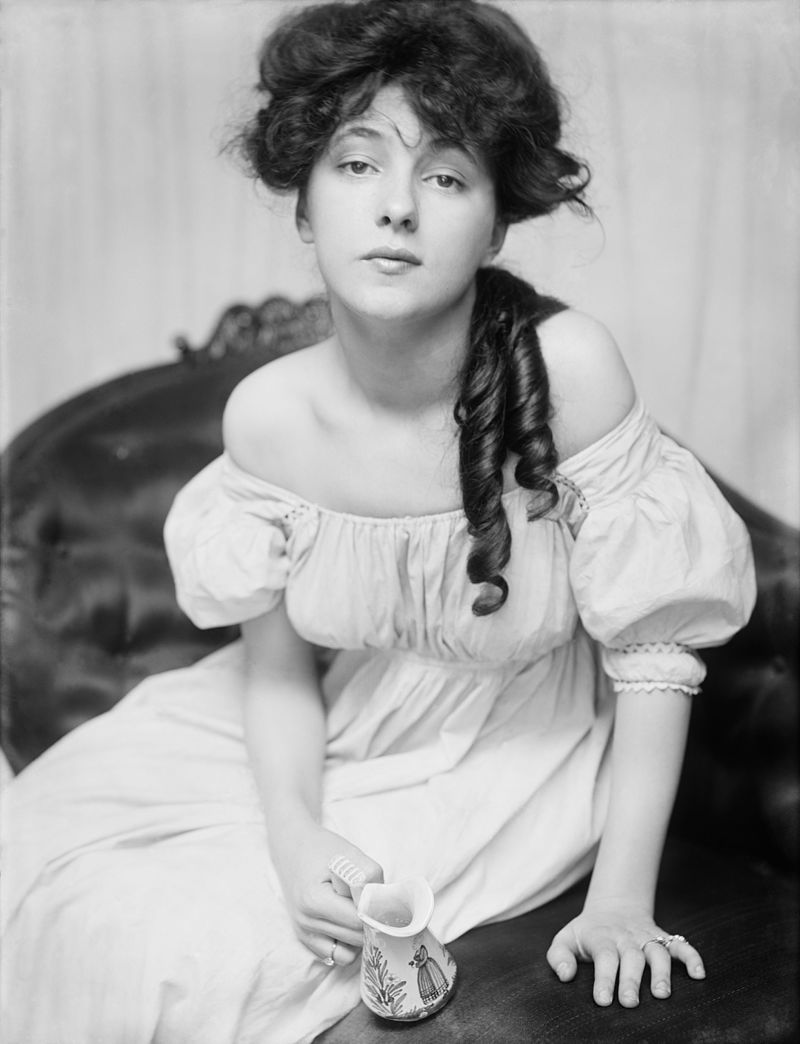
Evelyn Nesbit: the Original “Gibson Girl”
Meanwhile, Harry K. Thaw, a younger and more wealthy suitor, began vying for Evelyn’s attention. Thaw wanted desperately to marry her. When White learned of their budding relationship, he warned Evelyn that Thaw had experienced several psychotic episodes in the past that his family fortune had made disappear. But Thaw kept that side of himself hidden from Evelyn. Shortly before her eighteenth birthday in 1903, he squired on her, along with her mother actiing as a chaperone, on a grand tour of Europe. Thaw’s plan was to get Evelyn away from White to determine the extent of their romantic involvement.
Halfway through the monthlong sojourn he persuaded Mrs. Nesbit to return home. When she did, he rented a secluded castle for himself and Evelyn in the German countryside. Once they were alone, Thaw convinced Evelyn to open up about her relationship with White. She reluctantly admitted that White had taken her virginity during a night of heavy drinking. Thaw became so unhinged by her disclosure that he violently raped her. In the months that followed their return to America, Thaw begged Evelyn to forgive him and that he was a changed man. She finally believed him. The two were married in April 1905 and settled down in his family mansion in Pittsburgh. Although they were far away from New York City, Thaw could not get past the fact that White had defiled his bride. He began to formulate a plan to make White pay for what he had done.
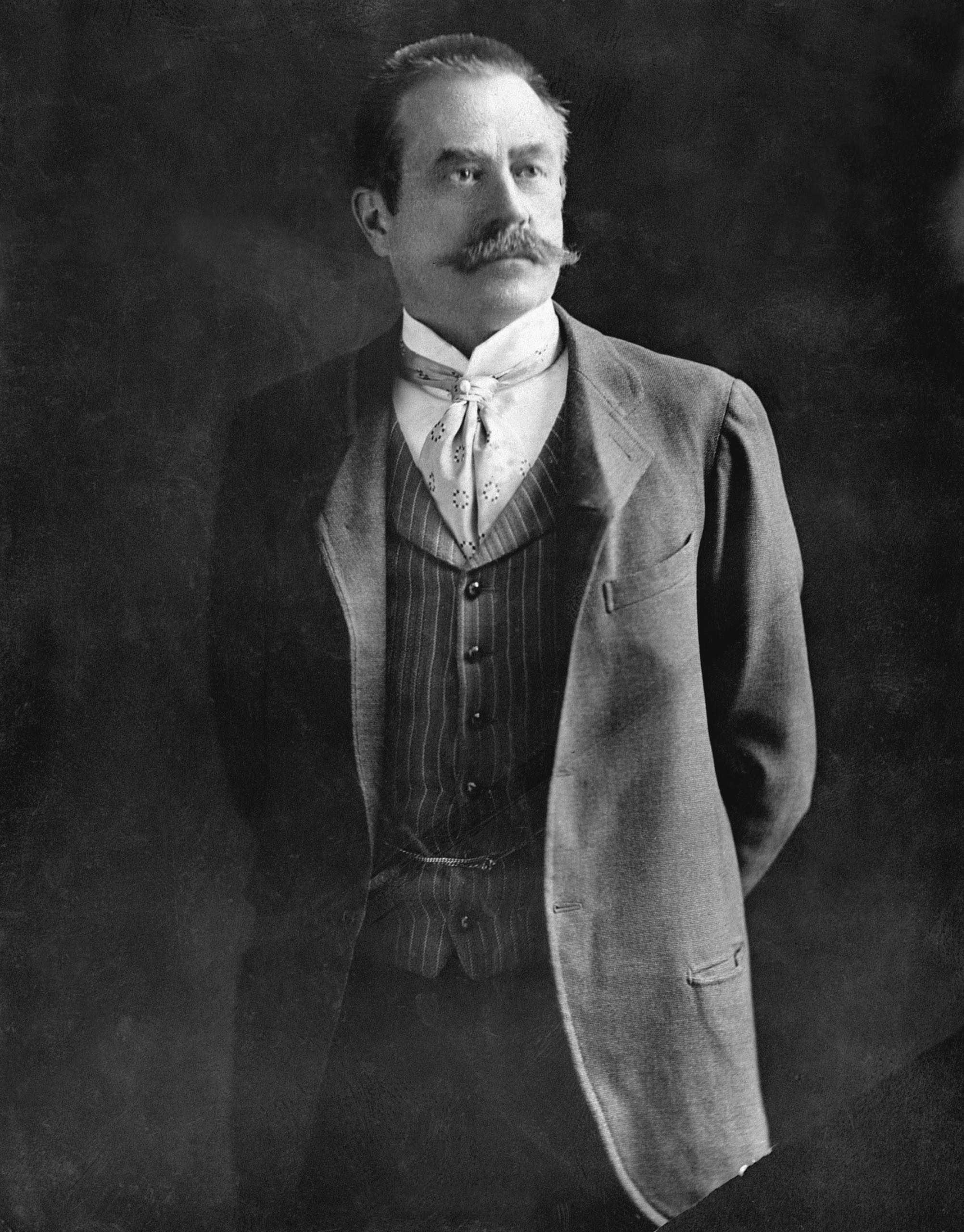
Stanny
Thaw took to carrying a pistol, ostensibly for his own protection, but he had other ideas for it. He made arrangements to take Evelyn on a voyage to Europe in the summer of 1906. The night before boarding the ocean liner, Thaw agreed to take Evelyn to see a new show at Madison Square Garden. A combination of happenstance and bad timing put White and Thaw on a collision course that evening. Thaw noticed White’s arrival and immediately excused himself. The chorus had just finished singing the song “I Could Love a Thousand Girls” when Thaw walked up behind White and fired his revolver three times. White keeled over on the table. Silverware and wineglasses crashed to the floor. During the pandemonium, Thaw casually made his way to the elevator, where he was arrested by Patrolman Debes.
Thaw pleaded not guilty by reason of insanity. He was remanded to the Tombs prison, where his wealth insured that he would dine on stake from Delmonico’s washed down with the finest Scotch money could buy.
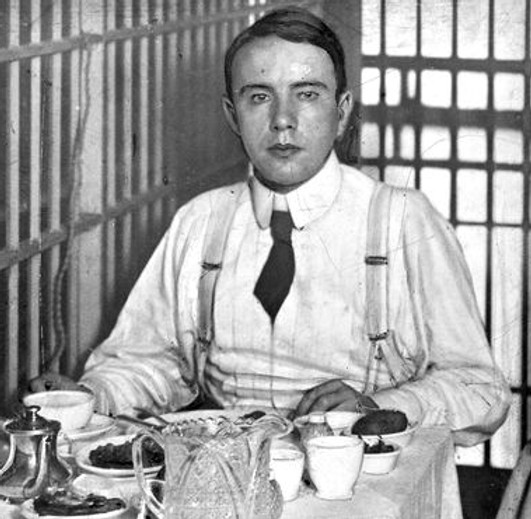
Rich bastard Harry serving “hard” time
The newspapers proclaimed Thaw’s 1907 murder trial “the Trial of the Century.” The star witness was his beautiful wife, Evelyn. The entire country was riveted to her testimony; unbeknownst to most of them, Thaw’s mother had made financial arrangements with Evelyn to insure she portrayed her schizophrenic son in the best possible light. The first trial resulted in a hung jury, the second in a verdict of not guilty by reason of insanity. Thaw spent the next several years in a sanitarium, where he enjoyed regular conjugal visits with Evelyn. Security was so lax that at one point he escaped and made his way to Canada. Eventually he was captured and returned to the United States.
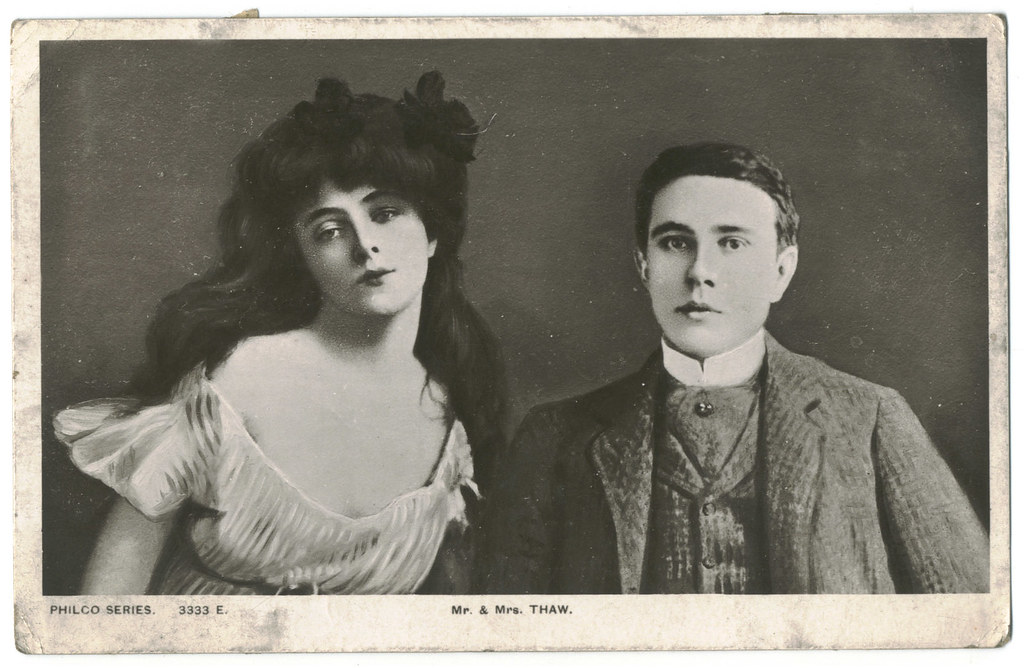
On July 15, 1915, his lawyers finally won Thaw’s freedom. One of the first things he did upon his release was divorce his wife. Thaw would go on to thave many run-ins with the law. As for Evelyn, her ex-husband’s penny pinching ways made her life miserable. Before she passed away in 1967 at the age of eight-one, Evelyn told a reporter, “Stanny was lucky he died. I lived.”
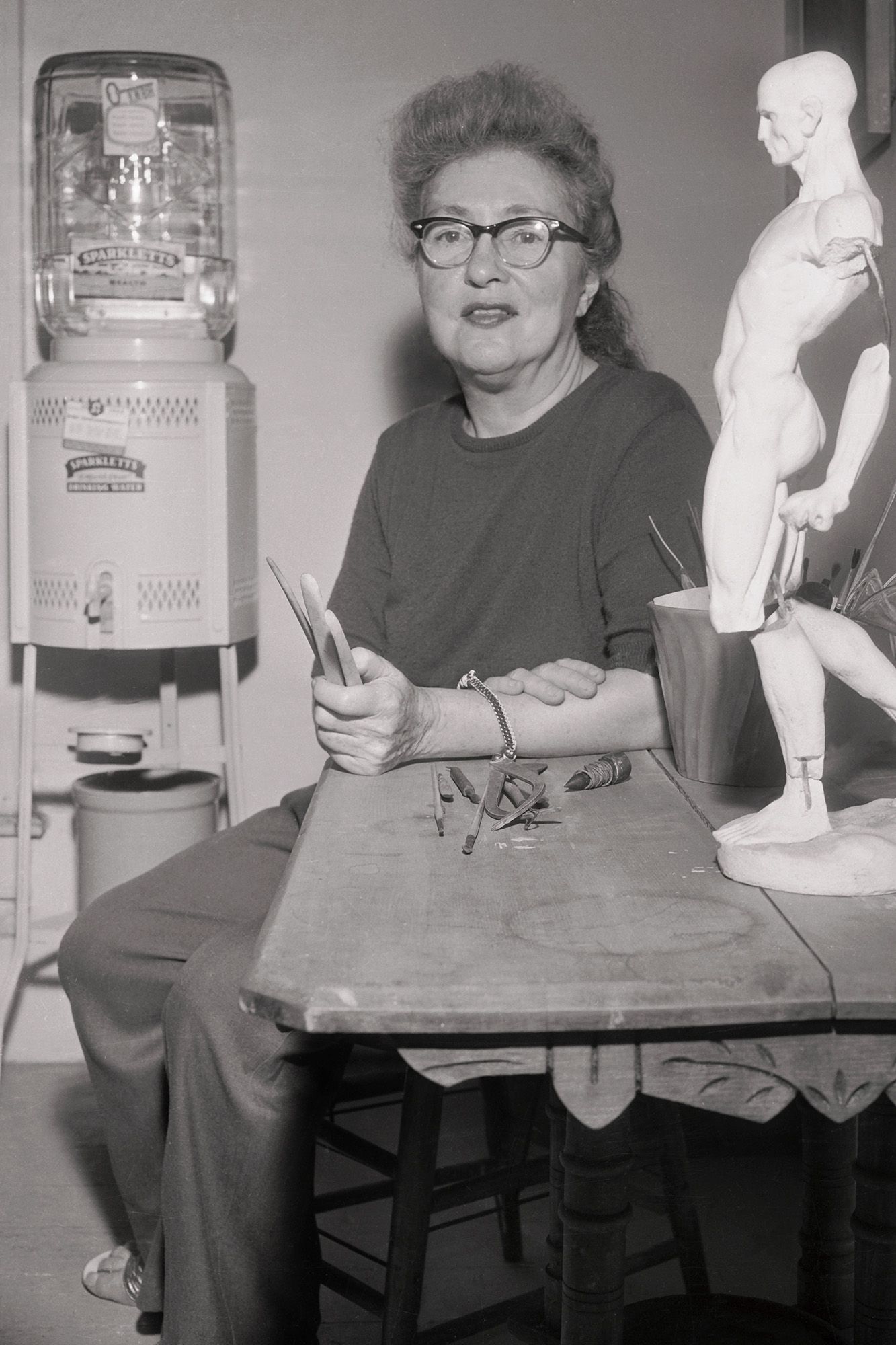
Elderly Evelyn
Culled from: Undisclosed Files of the Police
Minneapolis Tragedy Du Jour!
So I was getting ready to share an excerpt from Murder Has a Public Face by Larry Millett, a collection of crime and punishment photos in the Speed Graphic camera era taken in the St. Paul, Minnesota area, when I realized this sad story happened in my very own neighborhood! Here’s the tragic tale:
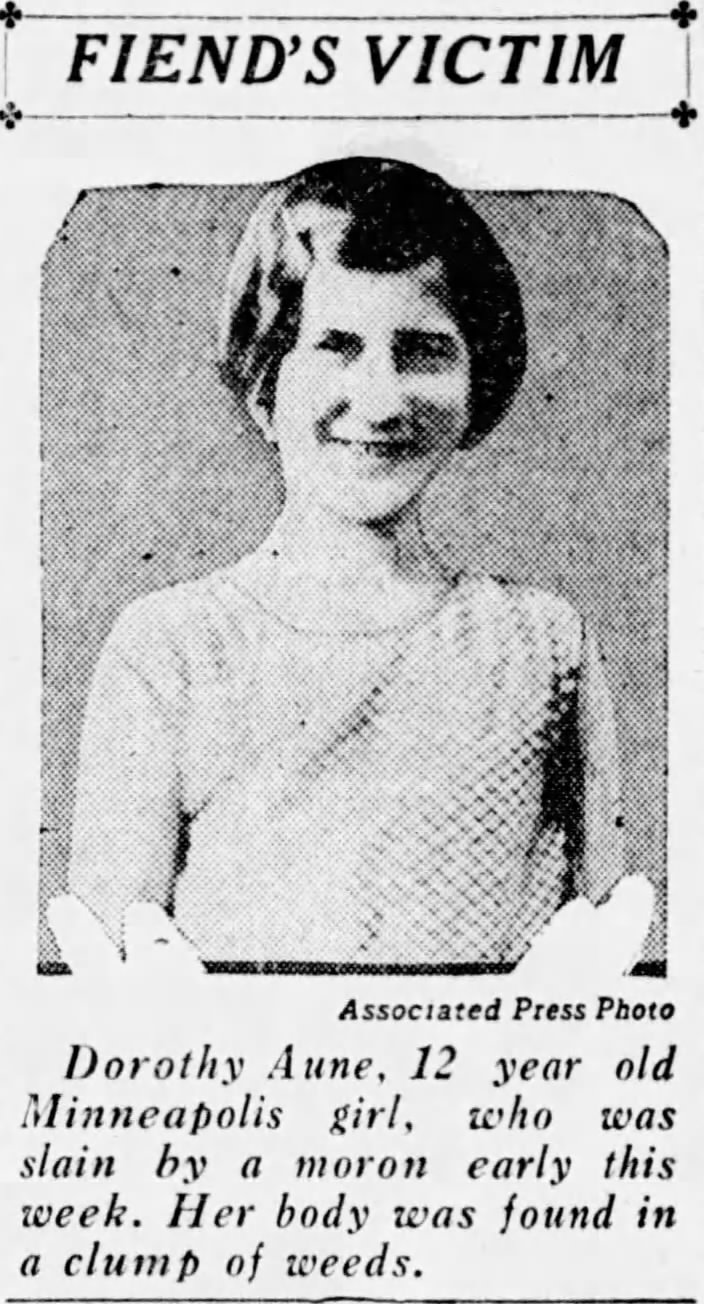
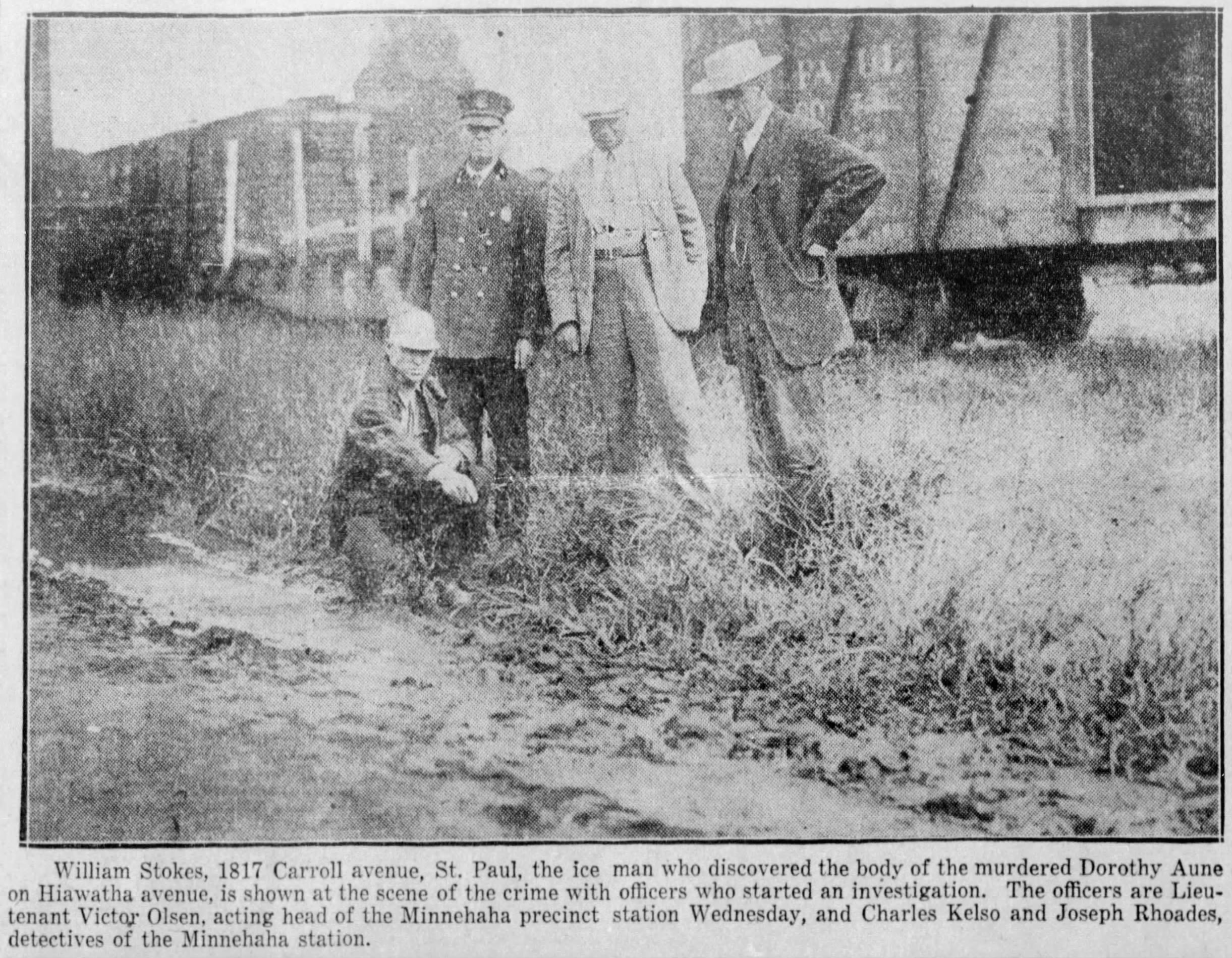
The 1920s in the Twin Cities ended with a wrenching murder case that preoccupied the press and the public for weeks. The victim was 12-year-old Dorothy Aune, whose body – wrapped in two gunnysacks and bound with rope and wire – was found on August 14, 1929, along railroad tracks near Lake Street and Hiawatha Avenue in Minneapolis. The girl, who lived nearby, had disappeared the previous evening after leaving home to walk to a corner grocery store. Somewhere along the way, she was kidnapped, raped, and strangled to death, after which her body was dumped along the tracks, where two icemen making their rounds discovered it at 6:30 in the morning.
Police and onlookers at scene of Dorothy Aune’s murder, Pioneer Press, Aug. 15, 1929Both Minneapolis and St. Paul newspapers covered the murder at great length, highlighting their stories with numerous photographs showing the crime scene, members of Aune’s family, and police investigators at work. The Minneapolis Tribune immediately offered a $1,000 reward for information leading the murderer’s arrest while voicing its outrage over the brutal crime: “The slaying of this 12-year-old girl was conceived in the heart of a fiend, and was executed with a bestial, cowardly ferocity which has sickened and depressed the entire city.” Despite a massive police dragnet that harvested scores of suspects, the crime was never solved.
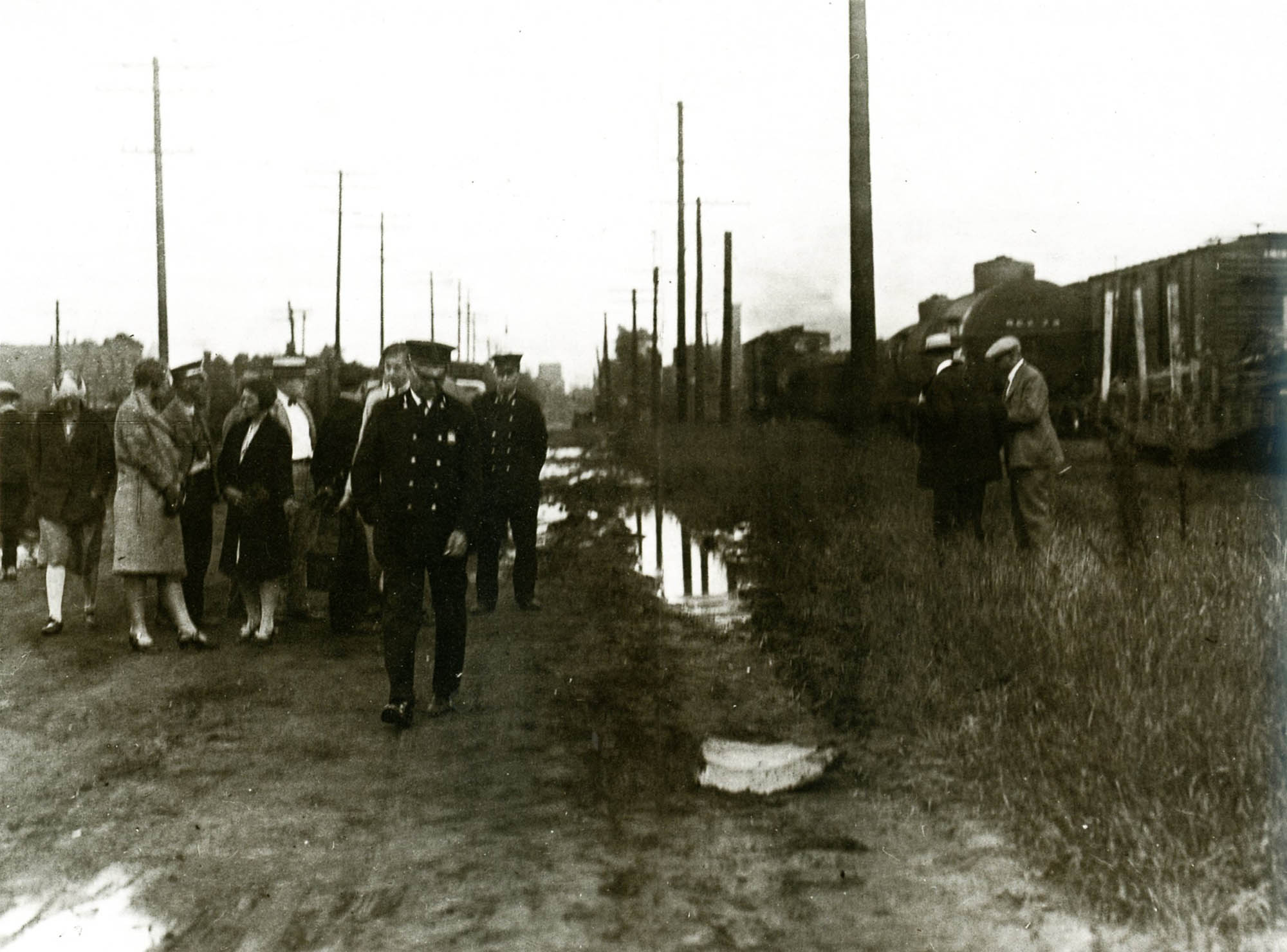
I did some research and found some additional photos of…
Poor Dorothy
Where her body was discovered:
Dorothy’s Home:
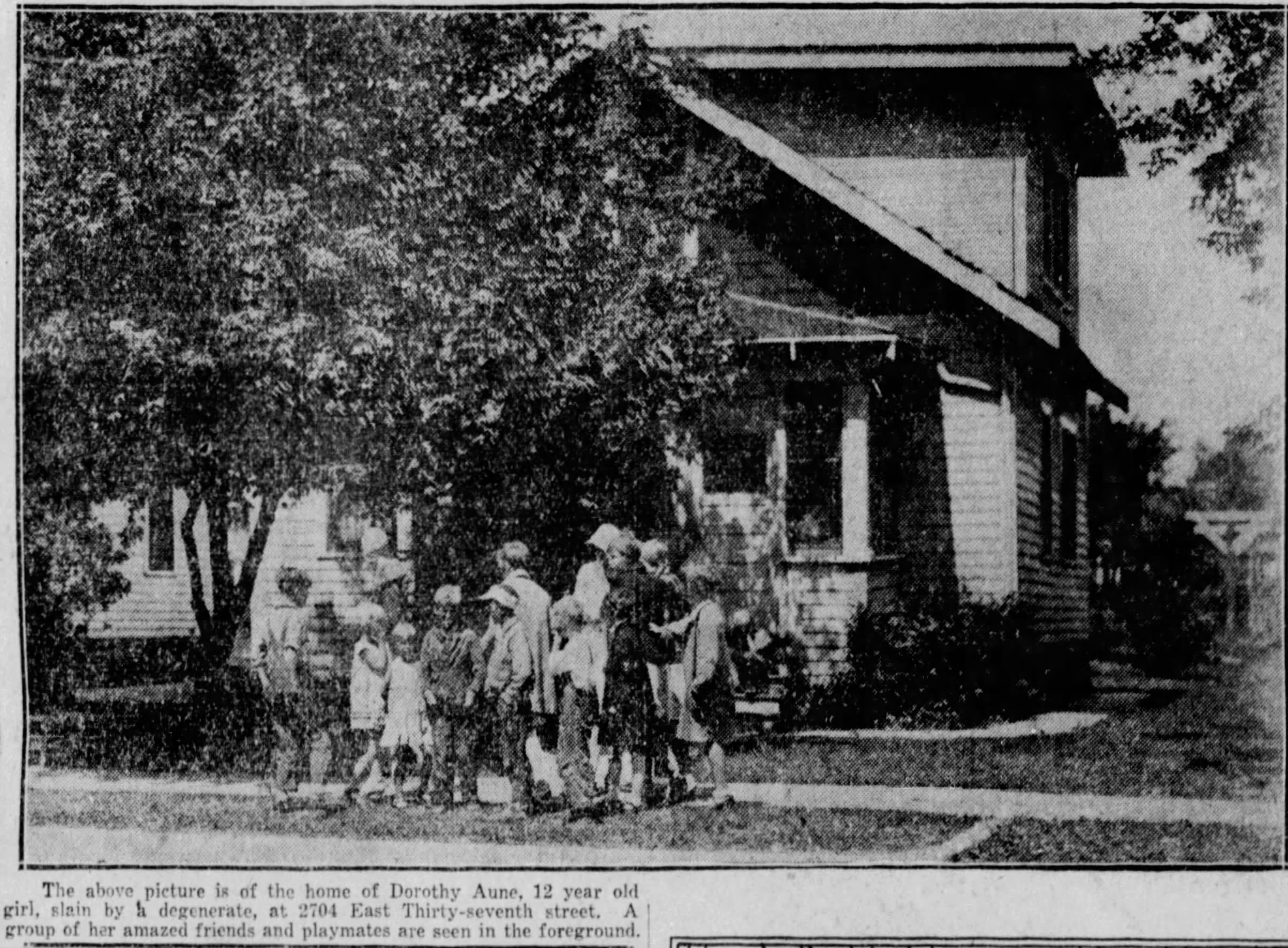
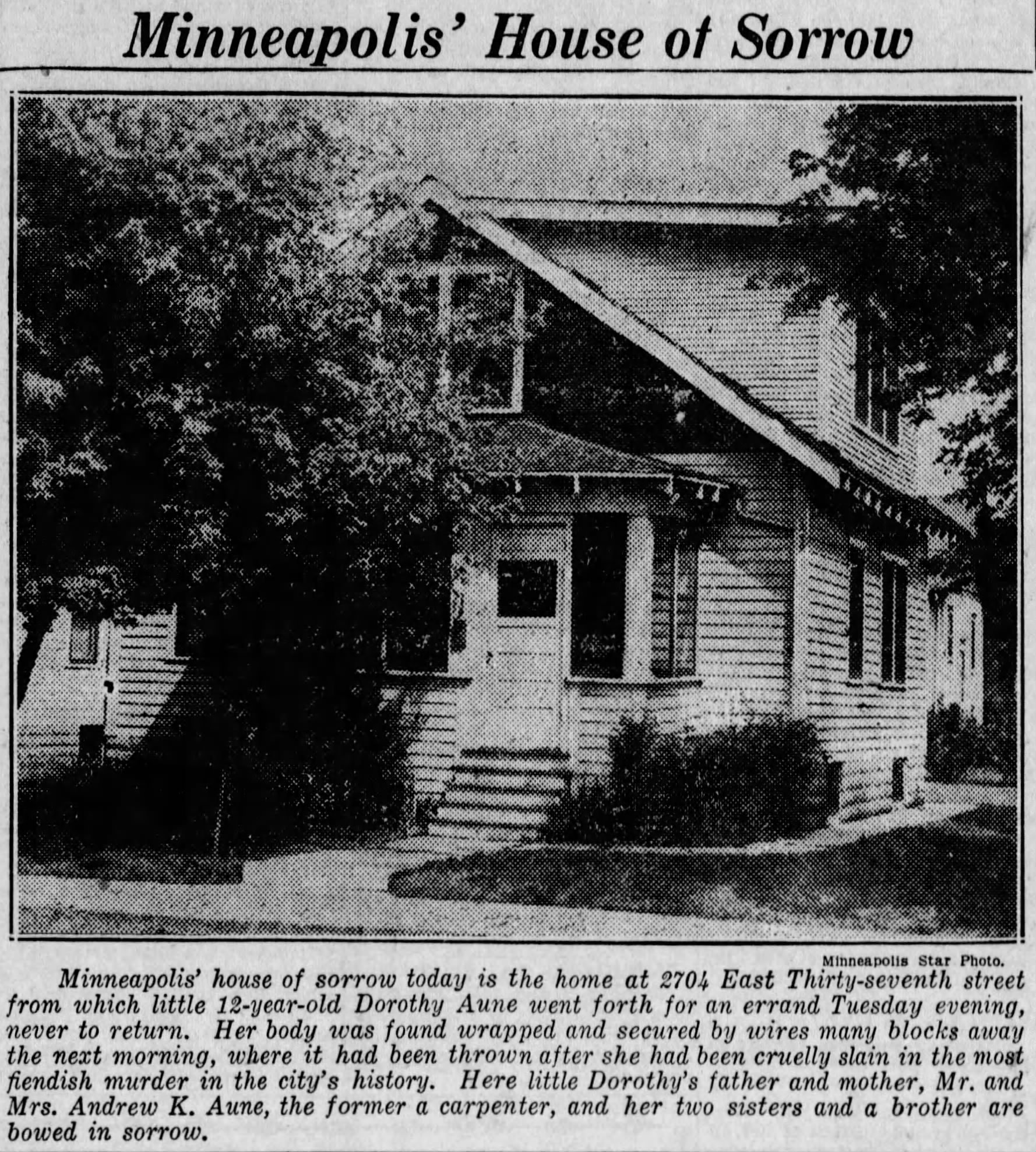
And a map of the body location:
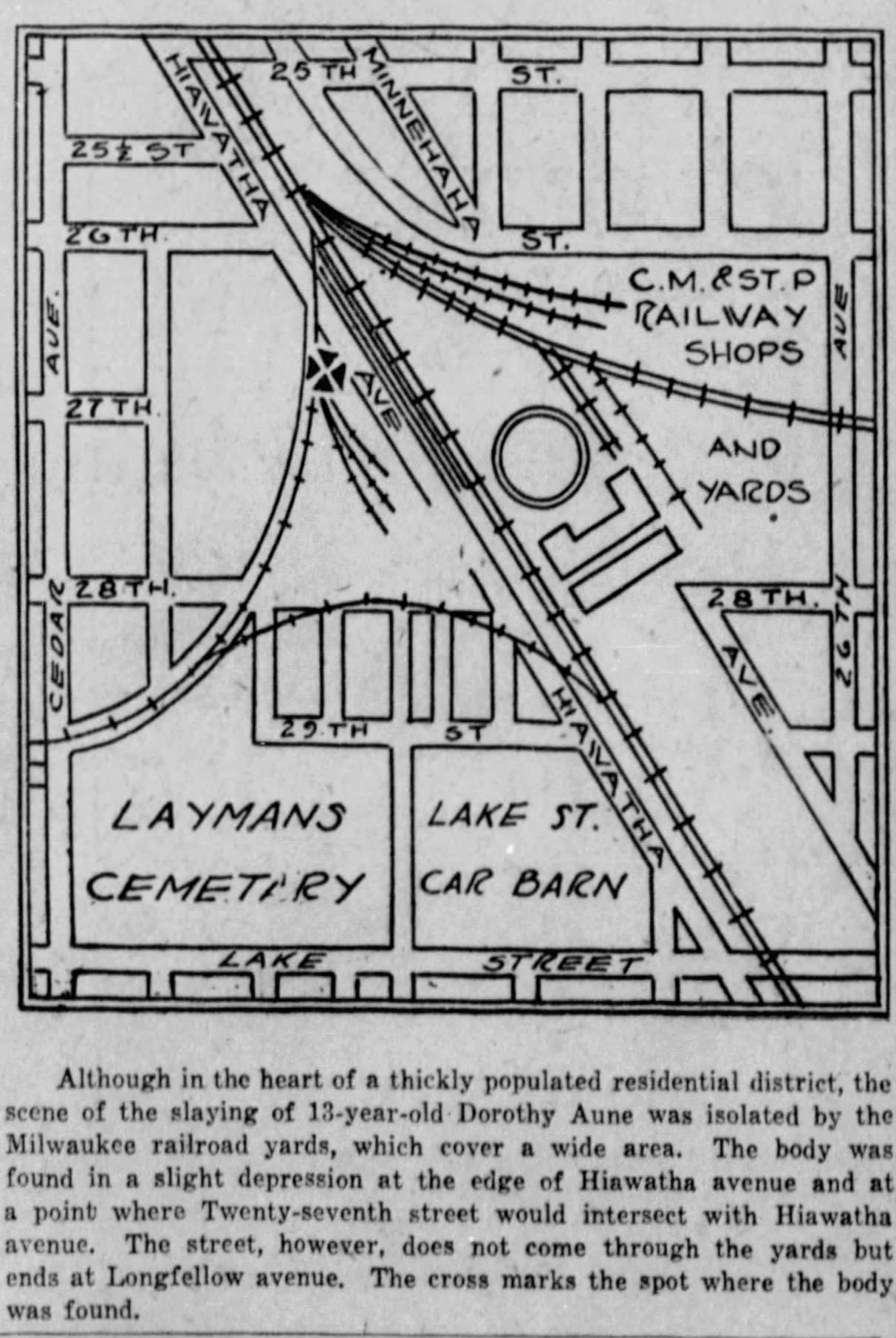
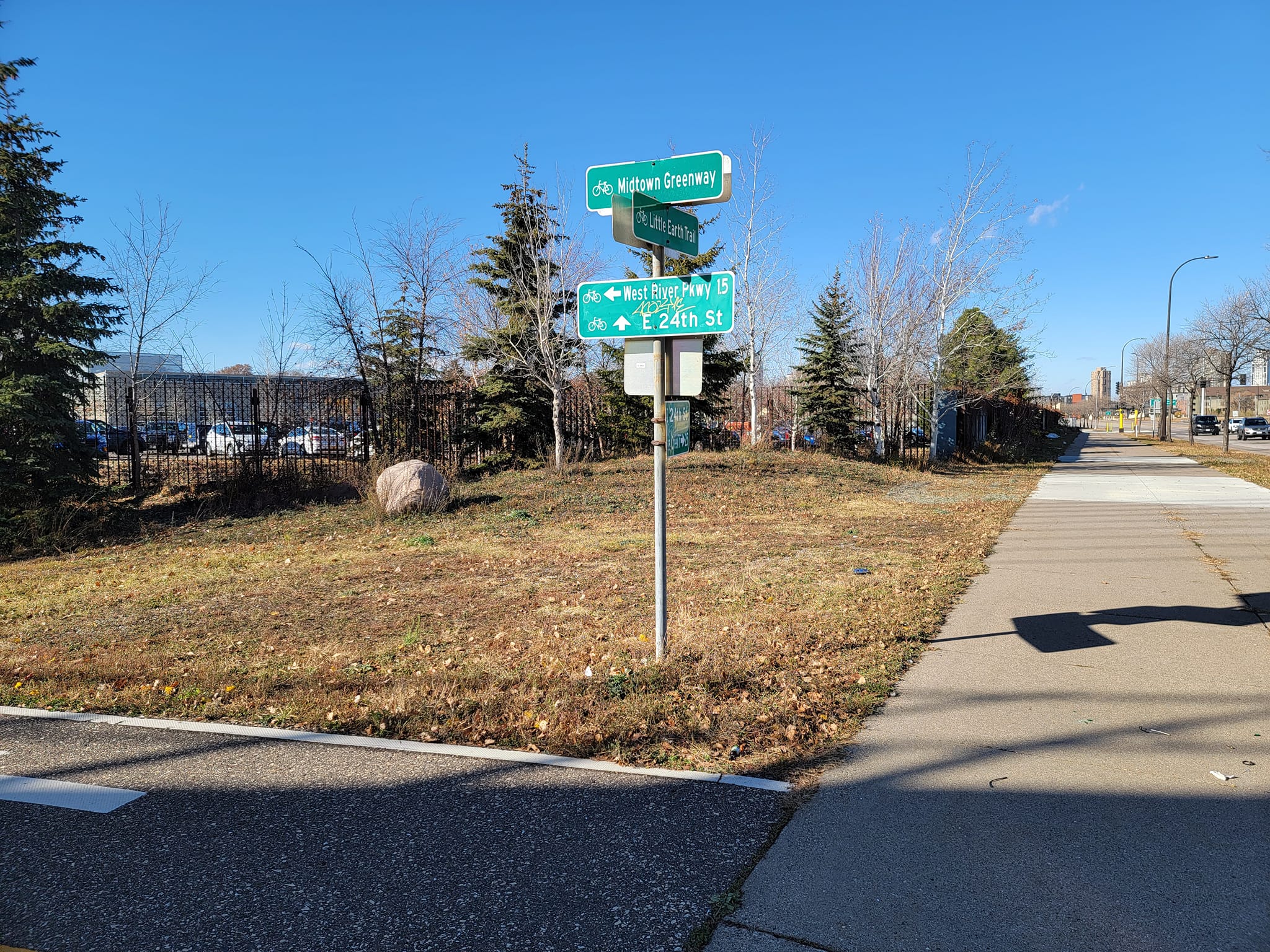
So about a month ago or so, I decided to walk a few blocks to Dorothy’s home and then, using the map provided, I tried to find the site where her body was found. It wasn’t so easy because so much has changed since Dorothy’s day. For one thing, the railroad tracks are long gone and a bicycle path marks that area now. I feel pretty confident that I was able to find the approximate location where Dorothy was sadly dumped all those years ago.
Dorothy’s house as it looks today. It really hasn’t changed much.

Another angle:

The area where Dorothy’s body was found – possibly near where that rock is now found (perhaps it’s marker?) Hundreds of bicyclists pass by this area every day during warm months. I wonder how many know about Dorothy? Not many, I’d reckon.

Dorothy would’ve been my aunt. My mom was her sister. She told me, they were both sent to get dinner. My mom went for bread, Dorothy to the butcher. Mom came home Dorothy didn’t.
I did know my other aunt Silvia and uncle Alef. I was told my grandpa Andrew lived with us in Bloomington til he died on my 3rd birthday in ’64. I don’t remember him, sadly.
I’m sure the world lost a wonderful human being because they were all the salt of the earth.