Today’s Leaning Yet Truly Morbid Fact!
For weeks, employees at the Western Electric Company of Chicago had been buzzing about the Hawthorne Club picnic and excursion to Michigan City, Indiana. The trip was an annual event for the nine thousand employees, and for several weeks the Hawthorne Club newspaper, the Jubilator, had been asking, “Are you all ready for the big event? Get your tickets early… children under five free!” There would be tug o’wars, sack races, baseball games, and a large parade with floats including one with a scene showing the linking of New York to San Francisco by telephone line (the company had manufactured the equipment for the line).
Six boats had been hired: the Theodore Roosevelt, the Petoskey, the Racine, the Rochester, the Maywood and the Eastland. By 6:30 a.m., on Saturday, July 24, 1915, five thousand picnickers had already arrived at the docks.
The crew of the 275-foot (83m) Eastland had only managed a few hours of sleep as they had been busy cleaning the boat after a moonlight cruise, but shortly before 7 a.m., the boat was ready. Luman A. Lebdell and Hurdus G. Oakley manned the single gangplank, counting the passengers as they embarked. (The Eastland was certified for 2,570 people.) As more people hurried on board, the vessel began to list to starboard, which was closest to the dock (a normal occurrence during boarding). Chief Engineer Joseph M. Erickson ordered the port ballast tanks filled until the vessel could right itself, but soon after, the Eastland began to list to port and so the starboard tanks were partially filled. By the time the Eastland had reached capacity, the list had increased to 15 degrees. For a few short minutes, the vessel leveled off, only to tilt again. All the while, Erickson was ordering the ship’s ballast tanks to be alternately filled and emptied in an effort to stabilize the vessel.
On the Clark Street bridge Mike Javanco, returning from market with a wagon full of vegetables, spotted the listing Eastland and shouted to the passengers, “Get off, the boat’s turning over!” The crowd just laughed. On the dock, Harbormaster Adam F. Weckler also saw the list and yelled up to the captain, “Are you ready captain?”
By 7:23 a.m. the list had worsened and passengers were directed to move to starboard away from their port side view of the river. The Eastland stubbornly continued to lean – 25 degrees, then 30, then 45, as chairs, picnic baskets, and other items slid all over the decks. The crew realized the danger and many reportedly leaped from the Eastland to the dock. From the starboard bridge Captain Pedersen yelled, “Open the inside doors and let the people off!” The passengers began to panic. Many pulled themselves up to the starboard side and made their way down gangways or any other possible exit but for most passengers it was too late. At 7:30 a.m. the Eastland rolled on its side, spilling hundreds of screaming picnickers into the water and trapping hundreds more below deck. A few hundred passengers had managed to climb over the starboard rail and were safe on the exposed underside of the Eastland.
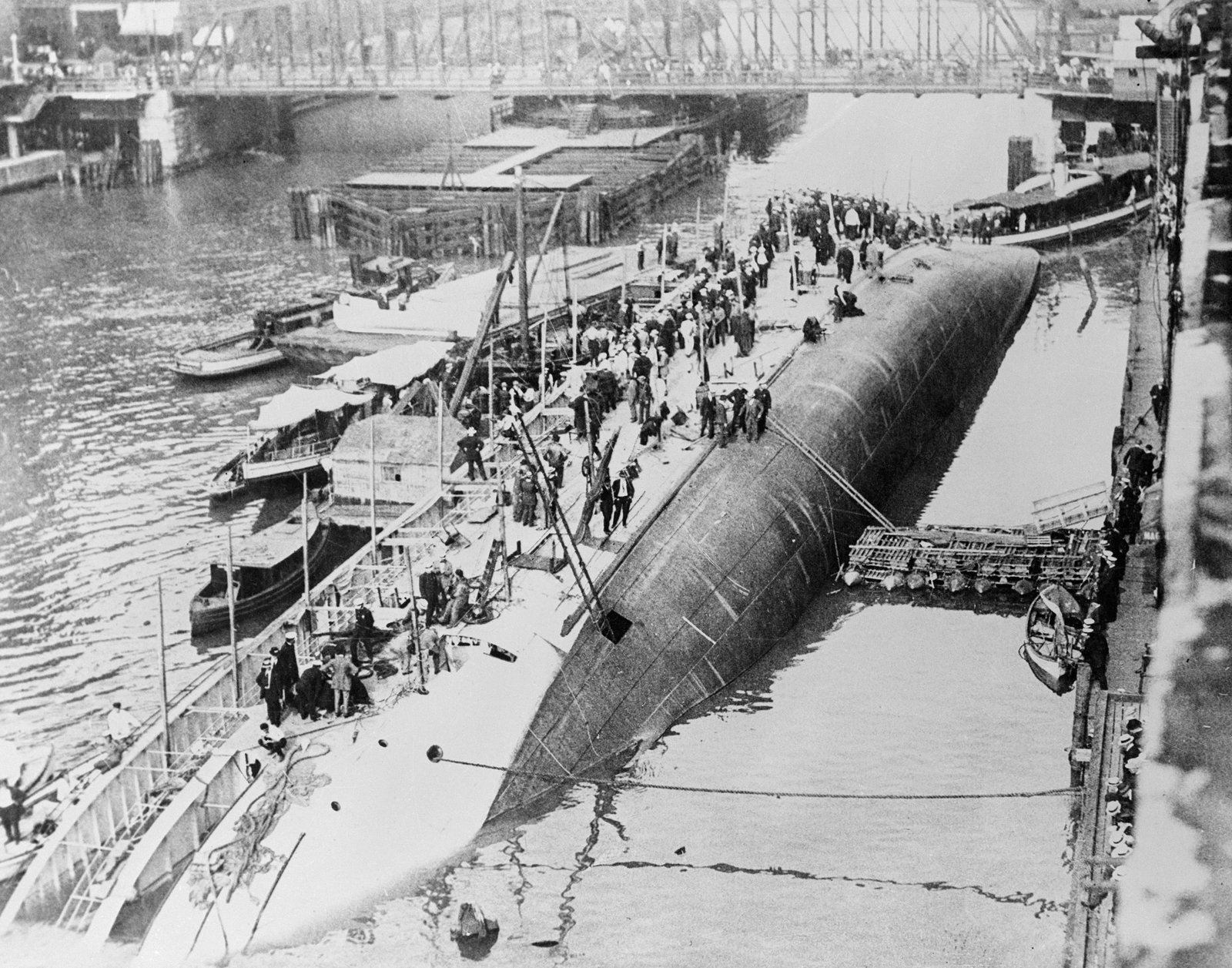
The Eastland
One eyewitness described the scene:
“I shall never be able to forget what I saw. People were struggling in the water, clustered so thickly that they literally covered the surface of the river. A few were swimming; the rest were floundering about, some clinging to a life raft that had floated free, others, clutching at anything they could reach – bits of wood, at each other, grabbing each other, pulling each other down, and screaming! The screaming was the most horrible of all.”
Those on shore sprang into action and threw pieces of wood and crates – anything that would float – into the river. Firefighters, the Coast Guard, police officers and nearby boats pitched in to haul people out of the water.
Those trapped inside the Eastland’s hull could be heard pounding against the hull in desperation. Rescuers used blowtorches to cut holes for the terrified passengers. Forty escaped from one such hole.
Soon the rescuers had to turn to the grisly business of recovering bodies. Numbered tags were attached to each body with information such as gender, approximate age, and a description of their clothing. The nearby Second Regiment Armory (which later became Oprah Winfrey’s Harpo Studios, now demolished) was turned into a temporary morgue and by 11 p.m. the crowd of inquisitive spectators had grown so large that it blocked the entrance to the armory. A frustrated Coroner Hoffman climbed a stepladder and shouted, “In the name of God, I ask you to go away and let those seeking relatives and friends come in and identify their dead.” Five hundred and twenty-six bodies were recovered that night. The toll eventually reached 844 (some reports say 835).
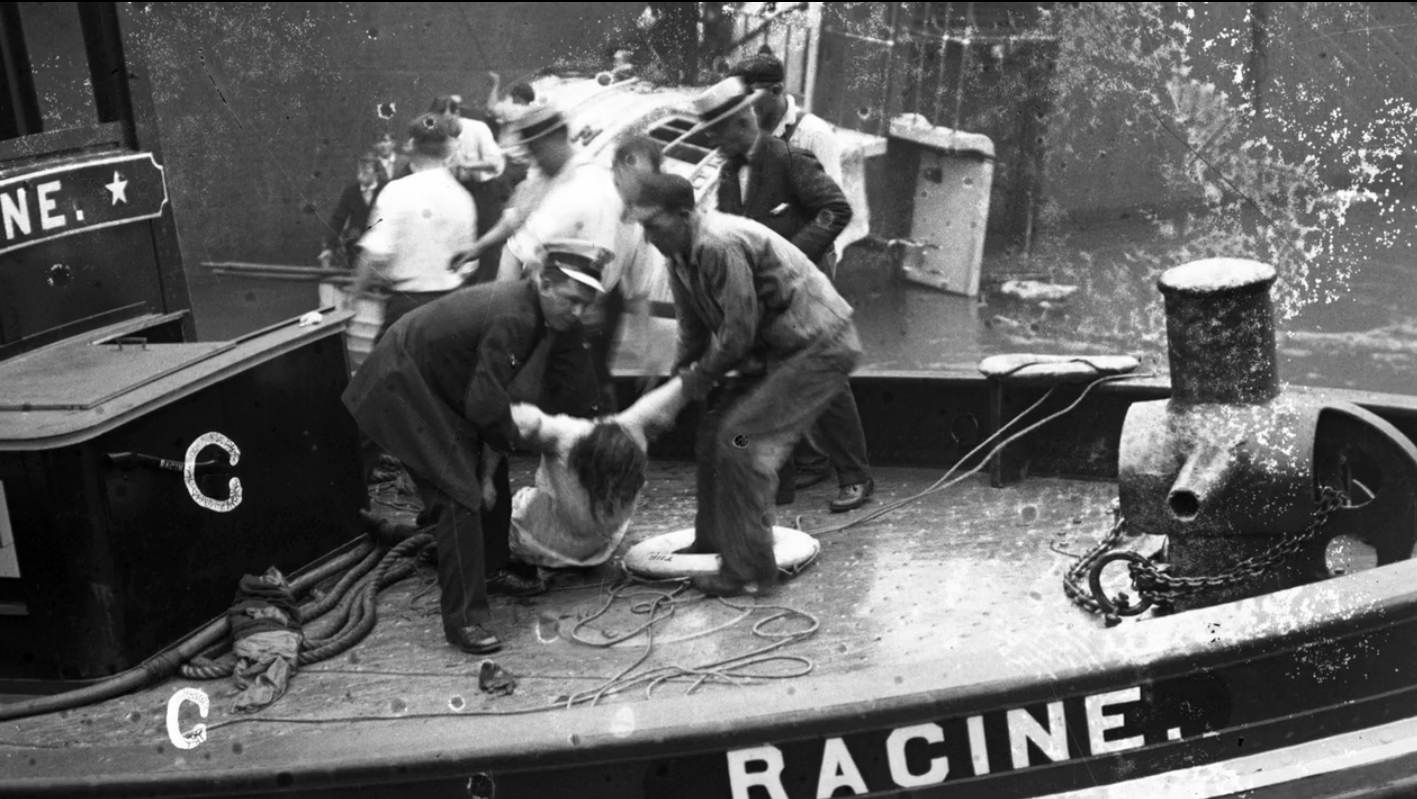
Recovering Bodies from the Eastland
The Chicago media was struck by the story of No. 396, a small unidentified boy who lay in the morgue, unclaimed, “Who is the little feller?” they asked. Not until eight days after the accident was the boy finally identified as Willie Novotny. Willie’s grandmother had been in a state of shock at the deaths of her daughter, son-in-law and eight-year-old granddaughter Mamie and had failed to notify the authorities that there was still one Novotny missing – Willie.
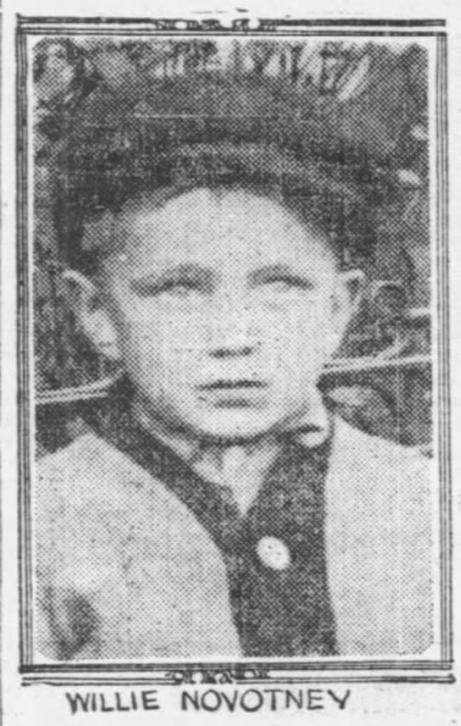
The “Little Feller”
The public outcry over the capsizing was quick and furious. Captain Pedersen and the first mate were placed under arrest at the scene and on their way to City Hall an angry mob assaulted them, despite a police escort of twenty men. Separate investigations by city, state, and federal authorities began almost immediately.
They found that the Eastland was well known in the industry for having a recurring problem with listing. John Devereaux York, a naval architect from Chicago, had warned authorities in a letter two years earlier, “You are aware of the condition of the S.S. Eastland and unless structural defects are remedied to prevent listing… there may be a serious accident.”
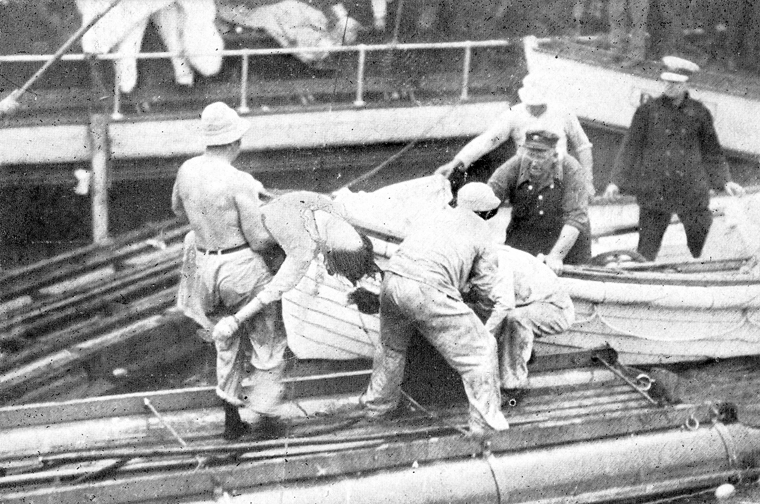
Additional bodies from the Eastland
There was also the question of the boat’s certification. On July 2, 1915, the Eastland had been issued temporary certificate for 2,570 people, an increase from the 2,253 passengers it was certified to carry on June 15 of the same year. Robert Reid, the Federal Inspector of Hulls for Grand Haven, explained that the certificate had been issued after a call from William H. Hull, the vice-president of the Indiana Transportation Company, owners of the Eastland. Reid came under intense scrutiny by the newspapers, which accused him of issuing the certificate because of his close friendships with some employees in the Indiana Transportation Company. After all, they pointed out, Reid’s son-in-law was Joseph M. Erickson, the chief engineer on the Eastland.
The Hawthorne Club and Western Electric Company were also criticized, although they could not have foreseen the disaster. They were accused of a “hard sell” campaign to sell tickets for the excursion. Anthony Thies, who lost two daughters, said, “I begged them to stay home but Anna told me she would lose her job if she didn’t go. She said the foreman of her department had warned her that unless she and Agnes went, their names would be scratched from the payroll.” Other grieving family, friends and survivors told similar stories.
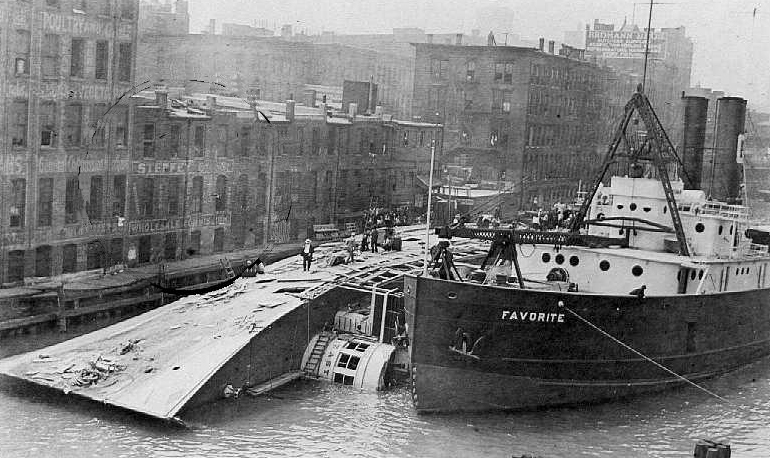
The Eastland
Meanwhile, the various inquests argued over who had jurisdiction in the accident. At the time, maritime law only allowed for damages to be claimed up to the value of the hull. The Eastland was sold for $46,000 at auction in December. This sum would be divided among nearly one thousands claimants when the final decision was handed down by the United States Circuit Court of Appeals in August 1935, twenty years after the accident. They concluded that the company “was liable only to the extent of the salvage of the vessel; that the boat was seaworthy; that the operators had taken proper precautions and that the responsibility was traced to an engineer who neglected to fill the ballast tanks properly.”
Culled from: Disaster Great Lakes
Crime Scene Du Jour!
Weegee was the pseudonym of Arthur Fellig (June 12, 1899 – December 26, 1968), a photographer and photojournalist, known for his stark black and white street photography. Weegee worked in Manhattan, New York City’s Lower East Side as a press photographer during the 1930s and ’40s, and he developed his signature style by following the city’s emergency services and documenting their activity. Much of his work depicted unflinchingly realistic scenes of urban life, crime, injury and death.
Here’s a photo from the book Weegee’s New York: Photographs, 1935-1960
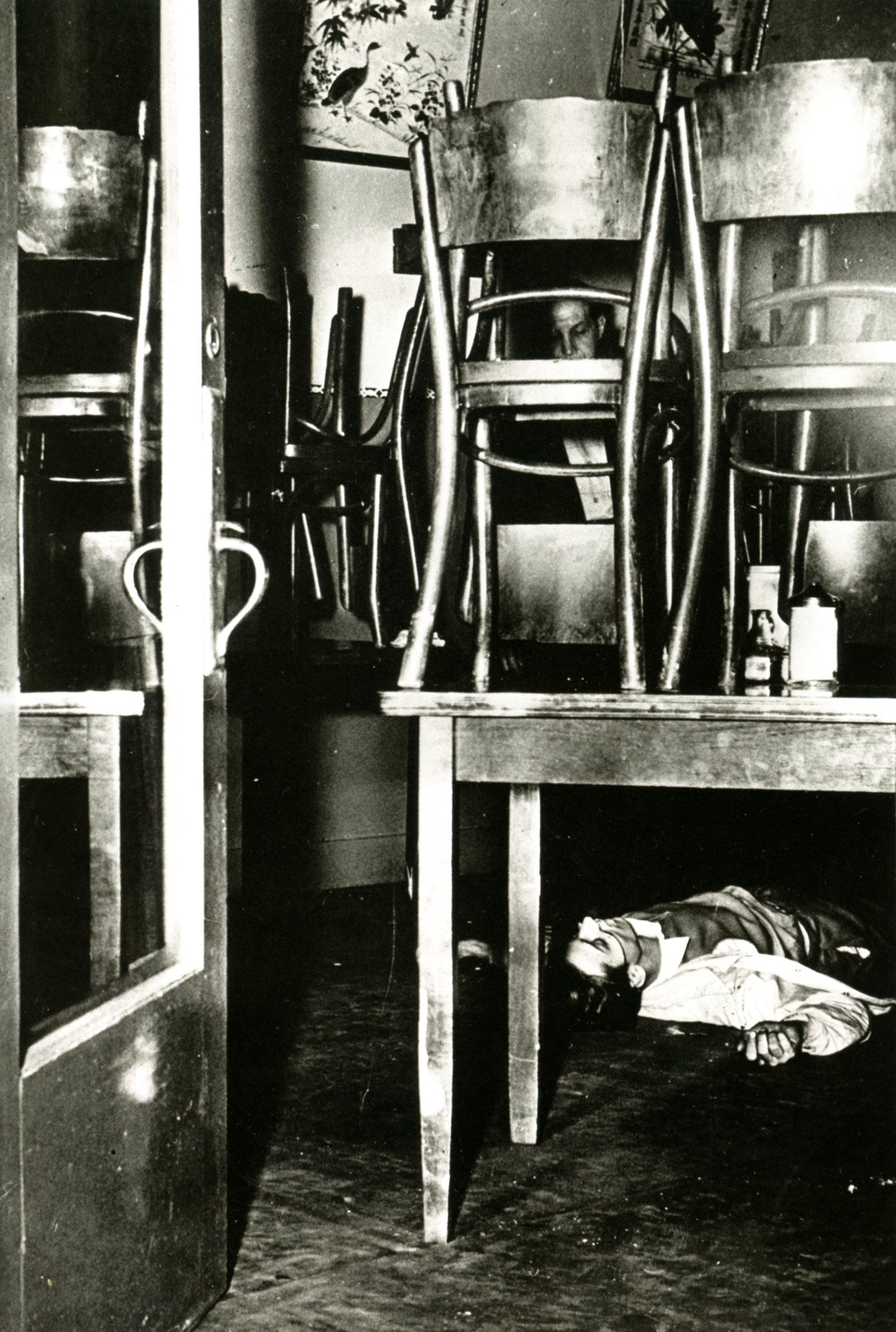
Dead man in a restaurant