Today’s Forgiven Yet Truly Morbid Fact!
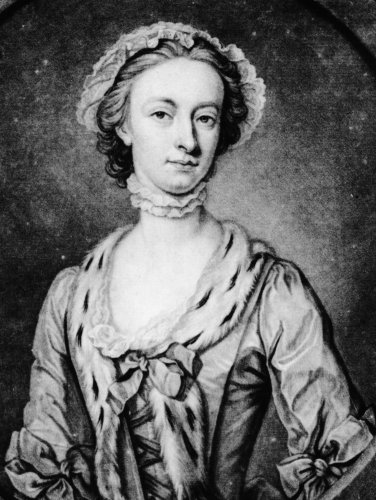 Mary Blandy, born in 1720, was the only child of Francis Blandy, attorney-at-law and town clerk of Henley-on-Thames in Oxfordshire, England. Although it was known that she would bring a dowry of £10,000, she was still unwed at 26. Then she met lieutenant William Henry Cranstoun who charmed her and with whom she fell hopelessly in love. When the Blandy’s were told that he already had a wife and child in Scotland he replied that the woman was lying and that she had no claim on him, and that this would be confirmed by a court case he was bringing against her. Indeed he even persuaded his wife to write a letter under the maiden name of Murray to the effect that they were not married. She did this thinking to help her husband who had told her that his being married was a bar to his promotion in the army, and that for the time being he wished to appear to be single. He showed this letter to Mary and her parents who took it at face value and even allowed Cranstoun to live with them. Unfortunately for Cranstoun, the Scottish courts in March 1748 upheld the woman’s claim to be married to him although he managed to keep this from the Blandys for two more years, during which time Mrs. Blandy died.
Eventually Francis Blandy decided he wanted nothing more to do with Cranstoun, who returned to Scotland, from where he sent Mary packets of arsenic trioxide, which he labelled ‘powders to clean Scotch pebbles’ and telling her to put some in her father’s food because he said it would change her father’s opposition to their relationship. She may well have first done this in November 1750, putting some in his tea, but it only made her father ill; in June the following year, on receipt of more powder from Scotland, she tried again, making her father very ill but he again recovered. In August she added a larger dose of the powder to his gruel (oatmeal and milk) and again he was taken ill, this time fatally so; a servant who also ate some of the food was also made very ill. Francis now realized that his daughter had poisoned him and that he was dying; he expired on the 14th of that month but not before he tried to save his daughter by saying that he forgave her.
When the townspeople of Henley learned what Mary had done a mob appeared menacingly outside the Blandy residence and she had to flee to the safety of the Angel pub where the landlady gave her shelter. Mary was arrested on August 17 and imprisoned in Oxford Castle. She was put on trial on Tuesday, March 3, 1752, and this lasted almost 12 hours. At the end of that day the jury did not feel the need to retire to reach a verdict but delivered it then and there: guilty. Mary was duly convicted and hanged but not before pleading for extra time in order to write her own version of events: Miss Mary Blandy’s Own Account of the Affair Between Her and Mr. Cranstoun. Clearly she was an odd young woman and maybe she was always a little naive. She seemed unnaturally cool and calm even as she approached the gibbet, asking the hangman not to hang her too high ‘for the sake of decency’ and indeed a large crowd had turned out to witness her execution. But hang her high he died on April 6, 1752.
As for Cranstoun, he fled to France, but he had not long to live: in November 1752 he went down with a fever and he died on the 30th of that month.
Culled from: The Elements of Murder
