Today’s Glandular Yet Truly Morbid Fact!
Serge Abrahamovitch Voronoff (July 10, 1866 – September 3, 1951) was a French surgeon of Russian extraction who gained fame for his technique of grafting monkey testicle tissue onto the testicles of men for purportedly therapeutic purposes while working in France in the 1920s and 1930s. The technique brought him a great deal of money, although he was already independently wealthy. As his work fell out of favour, he went from being highly respected to a subject of ridicule. Other doctors, and the public at large, quickly distanced themselves from Voronoff, pretending they had never had any interest in the grafting techniques. By the time of his death in 1951 at the age of 85, few newspapers noted his passing, and those that did acted as if Voronoff had always been ridiculed for his beliefs.
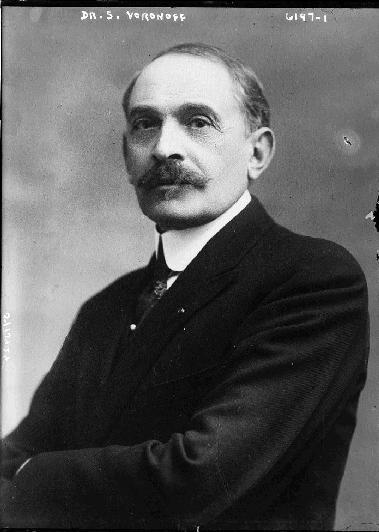
Serge Voronoff, Himself.
In the late nineteenth century and early twentieth century, trends in xenotransplantation included the work of Charles-Édouard Brown-Séquard. In 1889, Voronoff injected himself under the skin with extracts from ground-up dog and guinea pig testicles. These experiments failed to produce the desired results of increased hormonal effects to retard aging.
Voronoff’s experiments launched from this starting point. He believed glandular transplants would produce more sustained effects than mere injections. Voronoff’s early experiments in this field included transplanting thyroid glands from chimpanzees to humans with thyroid deficiencies. He moved on to transplanting the testicles of executed criminals into millionaires, but, when demand outstripped supply, he turned to using monkey testicle tissue instead.
In 1917, Voronoff began being funded by Evelyn Bostwick, a wealthy American socialite and the daughter of Jabez Bostwick. The money allowed him to begin transplantation experiments on animals. Bostwick also acted as his laboratory assistant at the Collège de France in Paris, and consequently became the first woman admitted to that institution. They married in 1920.
Between 1917 and 1926, Voronoff carried out over five hundred transplantations on sheep and goats, and also on a bull, grafting testicles from younger animals to older ones. Voronoff’s observations indicated that the transplantations caused the older animals to regain the vigor of younger animals. He also considered monkey-gland transplantation an effective treatment to counter senility.
His first official transplantation of a monkey gland into a human took place on June 12, 1920. Thin slices (a few millimetres wide) of testicles from chimpanzees and baboons were implanted inside the patient’s scrotum, the thinness of the tissue samples allowing the foreign tissue to fuse with the human tissue eventually. By 1923, 700 of the world’s leading surgeons at the International Congress of Surgeons in London, England, applauded the success of Voronoff’s work in the “rejuvenation” of old men.
In his book Rejuvenation by Grafting (1925), Voronoff describes what he believes are some of the potential effects of his surgery. While “not an aphrodisiac”, he admits the sex drive may be improved. Other possible effects include better memory, the ability to work longer hours, the potential for no longer needing glasses (due to improvement of muscles around the eye), and the prolonging of life. Voronoff also speculates that the grafting surgery might be beneficial to people with “dementia praecox”, the mental illness known today as schizophrenia.
Voronoff’s monkey-gland treatment was in vogue in the 1920s.. The poet E. E. Cummings sang of a “famous doctor who inserts monkeyglands in millionaires”, and Chicago surgeon Max Thorek, for whom the Thorek Hospital and Medical Center is named, recalled that soon, “fashionable dinner parties and cracker barrel confabs, as well as sedate gatherings of the medical élite, were alive with the whisper – ‘Monkey Glands’.”
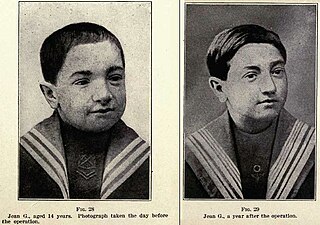
14-year-old boy after having an ape thyroid gland grafted onto his own; and same boy at age 15. From Serge Voronoff’s book Life: A Study of the Means of Restoring (1920)
By the early 1930s, over 500 men had been treated in France by his rejuvenation technique (including Voronoff’s younger brother Georges), and thousands more around the world, such as in a special clinic set up in Algiers. Noteworthy people who had the surgery included Harold McCormick, chairman of the board of International Harvester Company. To cope with the demand for the operation, Voronoff set up his own monkey farm on the Italian Riviera, employing a former circus-animal keeper to run it. French-born U.S. coloratura soprano Lily Pons was a frequent visitor to the farm. With his growing wealth, Voronoff occupied the whole of the first floor of one of Paris’s most expensive hotels, surrounded by a retinue of chauffeurs, valets, personal secretaries and two mistresses.
Voronoff’s later work included transplants of monkey ovaries into women. He also tried the reverse experiment, transplanting a human ovary into a female monkey, and then tried to inseminate the monkey with human sperm. The notoriety of this experiment resulted in the novel Nora, la guenon devenue femme (Nora, the Monkey Turned Woman) by Félicien Champsaur. In 1934, he was the first to officially recognize scientific work done by Greek Professor Skevos Zervos.
Voronoff’s experiments ended following pressure from a skeptical scientific community and a change in public opinion. It became clear that Voronoff’s operations did not produce any of the results he claimed.
In his book The Monkey Gland Affair, David Hamilton, an experienced transplant surgeon, discusses how animal tissue inserted into a human would not be absorbed, but instantly rejected. At best, it would result in scar tissue, which might fool a person into believing the graft is still in place. Interestingly, this means the many patients who received the surgery and praised Voronoff were “improved” solely by the placebo effect.
Part of the basis of Voronoff’s work was that testicles are glands, much like the thyroid and adrenal glands. Voronoff believed that at some point, scientists would discover what substance the testicular glands secrete, making grafting surgery unnecessary.
Eventually, it was determined that the substance emitted by the testicles is testosterone. Voronoff expected that this new discovery would prove his theories. Testosterone would be injected into animals and they would grow young, strong, and virile. Experiments were performed, and this was not the case. Besides an increase in some secondary sexual characteristics, testosterone injections did little. Testosterone did not prolong life, as Voronoff expected. In the 1940s, Dr. Kenneth Walker, an eminent British surgeon, dismissed Voronoff’s treatment as “no better than the methods of witches and magicians.”
Culled from: Wikipedia
Vintage Cocktail: The Monkey Gland
|

|
|