Sorry I disappeared for a week without explanation. It wasn’t anything dire – I was just negligent in sending out the notification that I would be away on vacation. I blame it on the ever-encroaching dementia.
Today’s Laughing Yet Truly Morbid Fact!
Kuru is an incurable degenerative neurological disorder endemic to tribal regions of Papua New Guinea. It is a type of transmissible spongiform encephalopathy, caused by a prion (an infectious agent composed entirely of protein) found in humans. It is now widely accepted that kuru was transmitted among members of the Fore tribe of Papua New Guinea via funerary cannibalism.
The following is a description of kuru and the cannibalism from the book The Tale of the Dueling Neurosurgeons: The History of the Human Brain as Revealed by True Stories of Trauma, Madness, and Recovery.
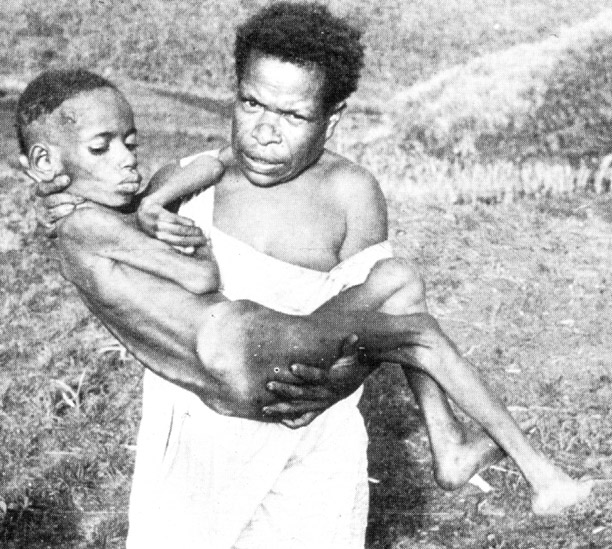
Toward the end the victims laughed frantically, explosively, on the slimmest pretense, laughed so hard they’d fall over and sometimes almost roll into the fire. Until that point their symptoms – lethargy, headaches, joint pain – might have been anything. Even when they began to stumble about and had to flail their arms in a herky-jerky dance to stay balanced, even those tics might be explained away as sorcery. But laughing could only mean kuru. Within months of the first symptoms, most kuru victims – predominately women and children in eastern Papua New Guinea – couldn’t stand upright without clutching a bamboo cane or stake. Soon they couldn’t sit up on their own. When terminal, they’d lose sphincter control and the ability to swallow. And along the way, many would start to laugh – laughing reflexively, senselessly, with no mirth, no joy. The lucky ones died of pneumonia before they starved. The unlucky ones were whittled down until their ribs pushed through their skin and the women’s breasts hung deflated.
After a few days of mourning, the local women raised the victim on a stretcher of sticks and bark, and gathered in a secluded bamboo or coconut grove distant from the men. Silently, they started a fire and greased themselves with pig fat to protect against the insects and the nighttime cold of the mountain highlands of Papua New Guinea. They laid the body on banana leaves and began sawing each joint, fraying the cartilage with rock knives. Next they flayed the torso. Out came the clotted heart, the dense kidneys, the curlicue intestines. Each organ was piled onto leaves, then diced, salted, sprinkled with ginger, and stuffed into bamboo tubes. The women even charred the bones into powder and stuffed that into tubes; only the bitter gall-bladder was tossed aside. To prepare the head they burned the hair off, gritting through the acrid smell, then hacked a hole into the skull vault. someone wrapped her hands in fern leaves and scooped out the brains and still more bamboo. Their mouths watered as they steam-cooked the tubes over warm stones in a shallow pit, a cannibalistic clambake. In dividing up the flesh, the victim’s adult relatives – daughters, sisters, nieces – claimed the choicer bits like the genitals, buttocks, and brain. Otherwise, people shared most everything, even letting their toddlers partake in the feast. And once they started feasting, they kept stuffing and stuffing themselves until their bellies ached, taking leftovers home so they could binge again later.
The tribe never named itself, but explorers called them the Fore (For-ay), after their language. In Fore theology, consuming someone’s body allowed his or her five souls to enter paradise more quickly. Moreover, incorporating their loved ones’ flesh into their own flesh comforted the Fore, and they considered this more humane than letting maggots or worms disgrace someone. Anthropologists noted another, more prosaic reason for the feasts. For food, the Fore mostly gathered fruits and vegetables and scraped a few kaukau (sweet potatoes) out of the poor, thin mountain soil. A few villages kept pigs, and hunters speared rats, possums, and birds, but the men usually hoarded these spoils. The funeral feasts let women and children gorge on protein, too, and they especially enjoyed eating kuru victims. Kuru left people sedentary, unable to walk or work, and those who died of pneumonia (or were euthanized by smothering before they’d starved), often had layers of fat.
A young kuru victim:
Arcane Excerpts: Polluting Oneself Edition

Here’s an illuminating excerpt from What A Young Boy Ought To Know (1897) by Sylvanus Stall. The chapter is entitled, “The Manner in Which the Reproductive Organs are Injured in Boys by Abuse”.
“… I desire… to call your attention to some remarkable similarities and differences in the body of man and those of other animals. Now, if you get down upon your hands and knees upon the floor, you will notice that there is a great likeness in the form of your body and the form of the body of a horse, or cow, or dog, and all four-footed animals. When in this position you will see that your arms and hands, in a large measure, correspond to their forelegs and feet. In some, as with the dog and cat, the small extensions, or toes on their feet, correspond also with the fingers and toes upon your hands and feet. With others, as in the case of the horse, the fingers and toes are gathered into one foot, and the nails, which are on the ends of your fingers and toes are enlarged and gathered into one thick nail, which forms the hoof of the horse, or the double hoof of the cow.
“Now if you stand on your feet, and pass your arms behind you, and hold them pretty well up on your back, you will see that the form of your body in that position resembles the form of the body of a bird; your legs and feet corresponding to their legs and feet, and your arms corresponding to their wings. The study of such similarities learned men call the study of comparative anatomy. So you see that there is some similarity between the construction of our bodies and the construction of the bodies of other animals.
“But there is one particular in which the human body differs from all the others. Man is the only animal to whom God has given a perfect hand. Even with our intellectual endowment, if God had not given us our hands it would have been physically impossible for man to have risen much above the level of the lower animals, but with his hands man prepares his food, compounds his medicine, manufactures his clothing, builds houses in which to live, writes books, prints papers, constructs all kinds of machinery, builds railroads and great steamships with which he can outdo even the birds in their flight. With all these things God is doubtless well pleased.
“But because of the evil in man’s mind and the wickedness in his heart he also uses his hands to inflict pain and injury upon his fellow-man. He constructs great cannons, and gunboats, and other instruments of death with which he destroys his fellow-man in battle. Moved by the wickedness in his heart, and encouraged and helped on by Satan and others who are wicked like himself, man uses his hands to accomplish many things which are very displeasing in the sight of God.
“But, strange to say, man is possibly the only animal which persistently pollutes and degrades his own body, and this would not have been easily possible to him if God had not given him hands, which He designed should prove useful and a means of great help and blessing to him in his life upon the earth.
“In order that the hand might not be used for degrading his own body, or for the injury of his fellow-men, God endowed man with wisdom, with a moral sense, and with conscience, so that his hands should be to him a source of help and blessing, and not a means of defilement and injury and thus prove a curse.”
I don’t have the heart to tell Sylvanus that it’s actually pretty common for other animals to defile and pollute themselves…
A great book on an interesting time in New Guinea is “Road Belong Cargo”. The cargo cult is a fine reaction to consumer society. Like many movements that shape the world, it was an idea by one pretty strange guy. I’m hoping it’s all true and praying for xmas gifts to land ( by drone?) at my loved ones homes right now, delivered by god-manup himself! Kuru has fascinated me since I heard of it years ago. I had a sailboat named “Kuru” for 15 years or so. What better name for a boat than “Laughing Sickness”?