Today’s Doubled-Up Yet Truly Morbid Fact!
This gruesome chestnut was culled from the June 6, 1877 issue of The McHenry Plaindealer (McHenry, Illinios).
DRAGGED TO QUICK DEATH.
Particulars of the Calamity at the Launching of the Steamer Saratoga, at Chester, Pa.
(Gleaned from the Philadelphia papers.)
The launching was to take place at 9 o’clock. The beautiful weather had drawn an immense concourse of spectators to the ship-yard. On the vessel were Capt. Sandberger, who is to command her, Capt. Curtis, who is to command her mate, the Niagara, which was launched a few weeks ago; an agent of the owners; Miss Fountain, who was to christen the vessel, and two citizens of Chester. Below were forty workmen, to whom was confided the labor necessary to effect the launch. At a little distance away, on an eminence from which he might command the whole scene, stood Mr. John Fountain, the superintendent of the yard. The ship is held upon the stocks by means of two stout oak planks securely fastened upon a cradle, or series of cradles, conforming to the shape of the hull. The cradles are held together by a long chain passing under the keel. At the prow there are two planks, intended to retard the launch after all other obstructions are removed. Two other boards, that show by their parting when the ship begins to move, are called the tell-tale; one of these is fast to the stocks and the other to the ship. The very warm weather melted the grease on the hull and cradles sooner than was expected. Mr. Fountain suddenly observed that the tell-tale boards were parting, and this meant that the ship was pulling. The superintendent knew that the momentum gained by the slightest movement would make it impossible to stop the launch; so orders were at once given in a loud voice to stand from under before he gave the order to cut loose the last stays. At the same time the men at the saws were ordered to cut the planks holding the cradles, as, if this was not done promptly, the movement of the ship would wrench the bolts from their sockets, and there would be danger of the vessel, frame and all, toppling over. The two planks were sawed, and the vessel glided into the water with the velocity of lightning. Miss Fountain raised the bottle of Saratoga water prepared for the christening, and was about to break it over the bow, when a scream arose, and terrified beyond measure, she dropped it overboard.
The ways were now clear, and, as the screams that terrified Miss Fountain reached the ears of the spectators, their eyes were greeted by a sickening sight. The great chain holding the cradles was dragging along in the wake of the ship, carrying in its folds men, iron bars and wooden blocks. One man was cut in half; another was mashed beyond recognition; others were limbless; some were carried into the water with the vessel. A scene of great confusion followed. The bell of the yard was rung, and in the course of a few minutes the news spread all over the city and brought a crowd of women and children to the gates, clamoring for admission.
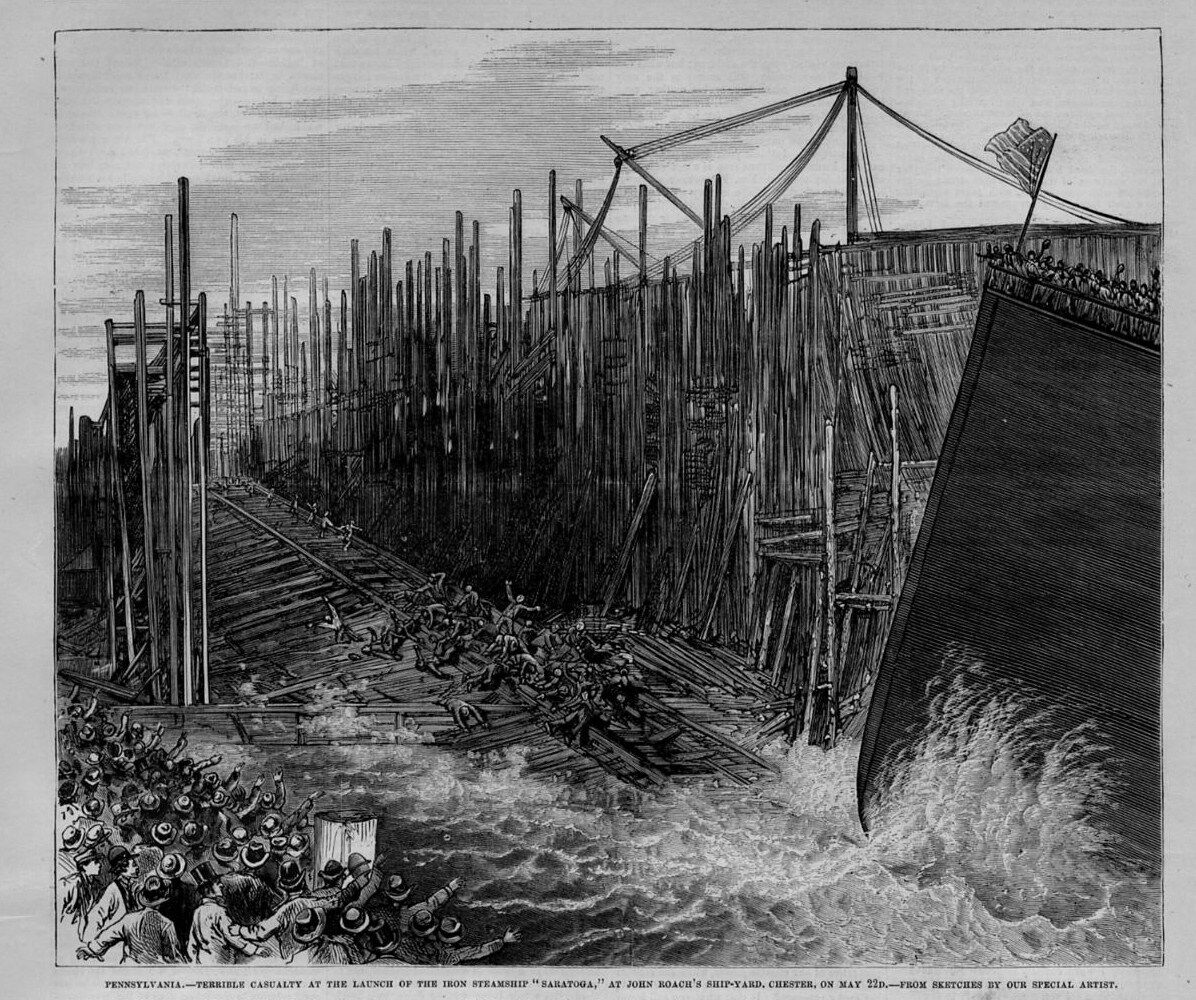
The workmen devoted themselves to the extrication of the killed and wounded from the debris of the stocks. Seven dead bodies were soon recovered and identified with more or less certainty.
John Nelson was completely doubled up. The back part of his head was torn off, and one ear was gone. The head was cut off and was hanging to the body by a slight ligament. The arms were cut off and were hanging on the clothing, and the lower part of the body was crushed. He was identified only by the brass tag which is given to each of the workmen when they enter the yard in the morning, and the number on which corresponds with a number opposite the names on the books of the firm. Nelson was a single man. The injuries of the men were principally below the breast, and the bodies and legs were badly torn, in some instances the limbs having been torn out from the sockets.
Several of the deceased have left large families. All the killed and wounded were workmen employed in the yard, having formed part of a gang of about fifty men who knocked the blocks from under the keel of the vessel preparatory to the cutting asunder of the fastenings at the bow, by which act the vessel was liberated, and sent sliding down her greasy way and into the river.
Ghastly!

September 14, 1904.
Paris, France
The autopsy of Valentine Botelin.
Mme Botelin was found dead in the streets of Paris, with an obvious head injury. During autopsy she was cleaned and three distinct bullet holes could be seen. Her case appears to be unsolved.
Culled from: HorrorHistory.Net
I’m always amazed at how graphic the newspapers of the time were! Who writes about limbs being torn off and heads being attached only by a bit of ligament these days?
It’s why I love them!