Today’s Makeshift Yet Truly Morbid Fact!
John and Charles Ruggles were born in 1860 and 1871, respectively, to prosperous parents near Woodland in Yolo County, California. Their father Lyman had immigrated to California during the Gold Rush in 1850 and worked the mines until he realized that there was more money to be made as a farmer. The hordes of people tromping around California needed to eat, and the restaurants that popped up all over the state needed fresh produce and meat. In time, Lyman was elected to the Yolo County Board of Supervisors. Having an eye for opportunity, he started farming in Tulare County and eventually acquired over four hundred acres of prime farmland.
Young John was sickly, and so his father sent him to live in Stockton, closer to his doctor. John’s physician, E. A. Stockton, gave him a job as a stock tender on his ranch. John Ruggles had shown no inclination toward criminal behavior, but on October 31, 1878, he unexpectedly attempted to rob a couple who were out for a stroll. The man he tried to rob pulled out a revolver and fired five shots, hitting John in the back. Although seriously wounded, John surrendered to the police immediately; he quickly recovered and was tried and convicted for robbery and assault. He was sent to San Quentin prison for seven years.
Lyman Ruggles was distressed about his son’s surprising crime and imprisonment. No sooner had the prison doors slammed behind John Ruggles than old man Ruggles started a campaign to get his son pardoned, which no doubt included large donations to the governor’s campaign chest. Dr. Stockton wrote that he had been treating John for sex addiction and that John was nearly an imbecile when he committed the crime.
Governor George C. Perkins pardoned John Ruggles after he had served fourteen months in San Quentin. He was placed in the custody of his parents, and he seemed to go straight, working hard on his father’s farm, eventually buying several parcels of property near the town of Dinuba. By 1887, he was married and had a daughter, but luck was something that was always just out of reach for John Ruggles. His wife took ill and died in 1889, devastating Ruggles. Unable to care for a young child, he left his daughter with relatives. With little to live for, he neglected his crops, spending his time hunting and living off the land in the Sierra Nevada mountains.
In 1892, John’s little brother Charlie came to visit his brother in the mountains. Charlie had just come back from the goldfields in Shasta County where, instead of panning for gold, he had allegedly robbed sixteen stagecoaches in the area with a buddy, Arizona Pete.
After listening to Charlie’s tales of his stagecoach robbing exploits, John couldn’t resist hitting the outlaw trail with his little brother. He leased out his farm to a neighbor and rode north, stopping first in San Francisco for a little merrymaking.
On May 10, 1892, the Ruggles boys robbed the Weaverville stage, but the take was small. However, they decided to wait a few days before trying another robbery, while scoping out a new location where the road topped out over a hill, five miles north of Redding. It was a perfect place to stage a holdup, because not only would the coach be traveling slowly as it reached the top of the hill, but the horses would be tired.
The brothers stopped the stagecoach and demanded that the driver throw down the Wells Fargo boxes. As the second box hit the ground, simultaneous gunshots rang out and Charlie Ruggles was hit with buckshot fired by a guard riding in the coach with the passengers. More shots rang out, and the air was filled with gunsmoke and the dust kicked up by the panicked horse team. The passenger named George Suhr was hit by buckshot, as was the driver, Johnny Boyce. The guard, Amos “Buck” Montgomery, was also seriously injured and bled profusely inside the coach.
John Ruggles was shocked that this second holdup had gone so wrong. He ran up to the coach and fired his revolver into the already wounded Buck Montgomery’s back. Immediately thereafter, Johnny Boyce regained control over his team, and he drove hell-bent for leather out of the area.
John ran to his brother Charlie who was reeling from his wounds. He had been shot in the face and was covered in blood. Believing that Charlie was as good as dead, John grabbed the money, said goodbye to his little brother, and fled the scene.
Charlie was soon found by a posse and was taken for medical attention. He had been struck by thirteen pieces of buckshot, with the most serious wounds knocking out some teeth and exiting his neck.
Charlie refused to tell the authorities who his partner was, but Wells Fargo detective John Thacker quickly figured it out and was soon on his way to see Lyman Ruggles, who was now managing a warehouse in Traver. Lyman caught the next train to Redding and visited his son in jail, where Charlie admitted that his partner was his brother, John. An eleven hundred dollar reward was put on John’s head.
John worked for a farmer for a few days and then ended up in his old hometown of Woodland, where the locals immediately recognized him. While he was eating a meal at the Opera Restaurant, Deputy Sheriff Wyckoff walked in, sat down at the table next to John, and leveled his pistol at the outlaw’s head. Following a brief and inconsequential struggle, John was on his way to the Redding jail.
At the Redding jail, John was joyously surprised when he discovered that his little brother was not dead. They had a tearful reunion behind bars.
When they went on trial on July 28, the pair’s strategy was to implicate the late Buck Montgomery as a collaborator in the robbery. This disgusted the people of Redding, as many of them had known Montgomery, and many had attended his funeral. There was talk of forming a lynching party and a scathing editorial printed in the Republican Free Press did nothing to help calm the situation.
In the early morning hours of Sunday, July 24, a group of masked men entered the jail and broke into the prisoners’ cells. John tried to take all the blame for the crime to save Charlie, but the lynch mob showed no sympathy to the elder brother’s final pleas. They hung the Ruggles brothers from a makeshift gallows near Erter’s blacksmith shop. The purple faces of the brothers twisted slowly in the wind, greeting the townspeople of Redding on their way to church.
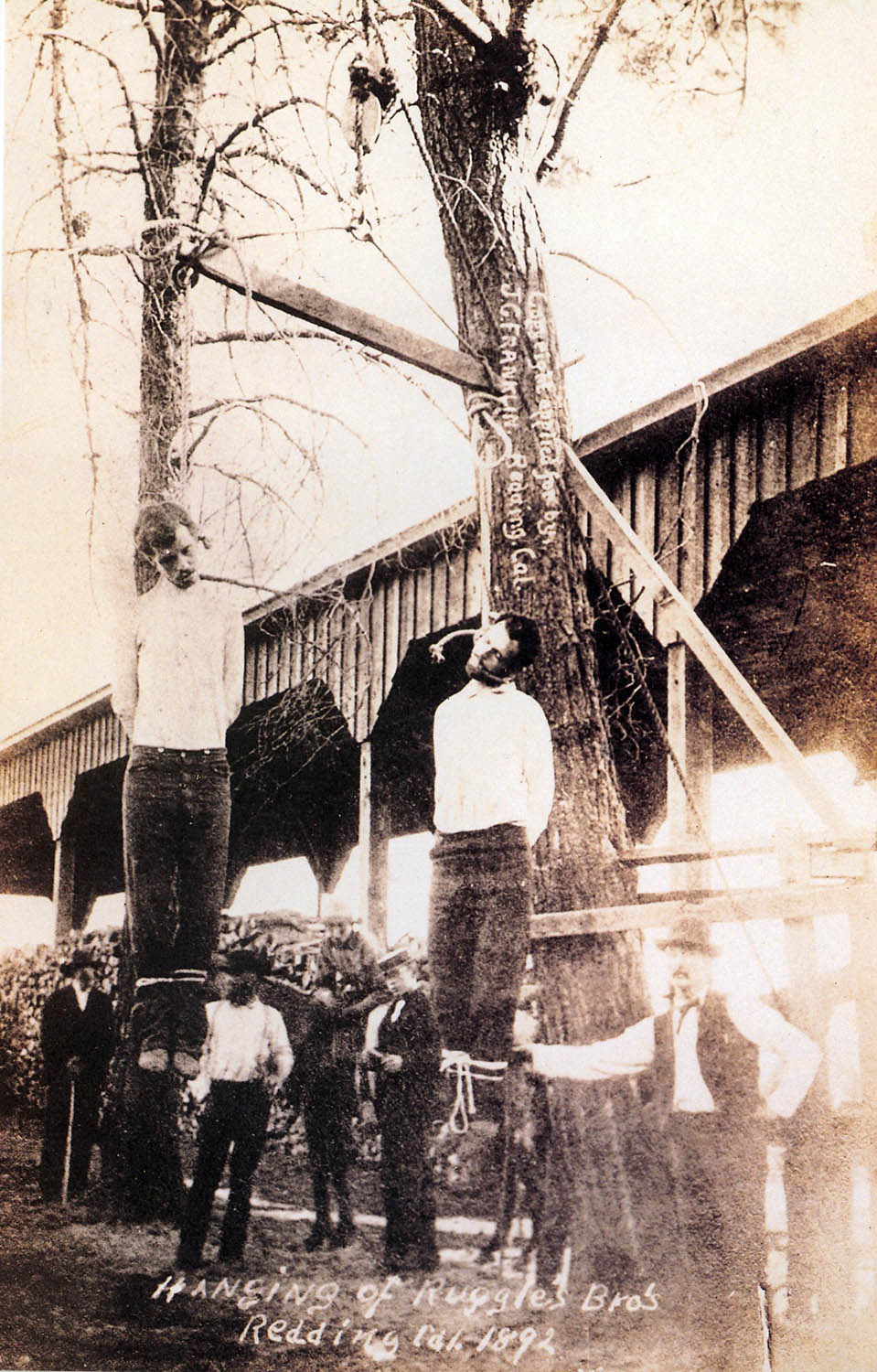
The lynching of John D. and Charles Ruggles, July 24, 1892, Redding, California.
Culled from: California Justice: Shootings, Lynchings and Assassinations in the Golden State by my good friend David Kulczyk
Deformity Du Jour!

Deformed Skeleton Due to Rickets
Catalogue des pièces du Muée Dupuytren, 1879
This photograph is of a rickets skeleton specimen at Paris’s Musée Dupuytren. The deformities of the skeleton were a phenomenon that fascinated physicians, and skeletal remains of patients with the extremes of disease were preserved in various anatomical collections. Rickets was first described by Daniel Whistler, MD, (1619-1684) in his doctoral thesis at Leiden, Netherlands, in 1645. Just four years later, Arnoldus Bootius, MD, (1600-1653), noted the widespread presence of rickets in Ireland. Francis Glisson, MD, (1597-1677) provided an accurate account of the condition and is frequently given credit for its discovery. In 1650, he published De rachitide sive morbo puerili, qui vulgo. While Glisson was not the first to describe rickets, in this publication, he gave the first description of scurvy. A major step in the management of the disease was the 1824 report of D. Schutte, MD, who recognized the value of cod liver oil in treatment. About a century later, in 1919, Kurt Huldschinsky, MD, (1883-1940), developed the use of ultraviolet light to treat rickets. Around the same time, 1918-19, Sir Edward Mallanby proved rickets to be a dietary deficiency disease, curable with a proper diet. During the twentieth century, scientists revealed the metabolic, physiologic, and genetic causes of the disease.
Culled from: Stiffs, Skulls and Skeletons
In The Simpsons episode Who Shot Mr. Burns? (Part Two), Homer is approached by several other men who set out to tear down Mr. Burns sundial. Homer joins them, lamenting the rickets he has developed thanks to the lack of sunlight in Springfield. :b