Category Archives: Ghastly!

MFDJ 04/24/24: Family Witch Affairs

Today’s Amply Illustrated Yet Truly Morbid Fact!

The way in which family relationship triggered witchcraft charges is amply illustrated in Offenburg, a strongly Catholic free city near Strasbourg. Five mother-daughter groups, three mother-son, one father-son, one husband-wife-son, and two groups of three generations of women suffered from trials. In Offenburg and the immediate vicinity, 102 persons were killed and one banished between 1557 and 1630. Reaction to witches was vicious from the start: in 1557 two women were burned alive, and a confession was often extracted by placing the accused in the witch chair, a metal seat heated from beneath. One woman died from torture; another had her right breast torn by hot pincers; still another committed suicide in prison; a fourth went mad.

Culled from: Witchcraze: A New History of the European Witch Hunts


Crime Scene Du Jour!


MOB HIT IN A STORE

Extortion and “protection” were routine businesses of organized crime. Resisting efforts to cooperate with the mob resulted in brutal beatings or simply murder, as seen here. It usually took only one example for a string of other businesses to cooperate with organized crime enforcers. After orchestrating perhaps as many as a thousand murders, Louis “Lepke” Buchalter, the head of Murder, Inc., was convicted and executed for orchestrating the 1936 murder of Brownsville candy store owner Joseph Rosen. Rosen had been a former garment industry trucker and had refused to cooperate with “Lepke” and Jacob “Gurrah” Shapiro in their labor racketeering business. They controlled the trucking industry, the life-blood of the garment district. Rosen gave up trucking and opened a candy store in exactly the wrong place: Brownsville, home of Murder, Inc. He remained defiant of “Lepke” and paid with his life. This was a classic hit—a shot to the head.

Other hit men, such as Abe “Kid Twist” Reles, perfected the icepick into the ear murder technique, perforating the brain. This was usually administered to a victim in a car who was held down by accomplices. The ice pick wound often fooled coroners, who thought the victim had had a cerebral hemorrhage.

Culled from: Deadly Intent

MFDJ 04/17/24: The Madcap Laughs

Today’s Madly Laughing Yet Truly Morbid Fact!

Normally Thomas Boise was only a common drunk whose antics in Wood County, West Va. served to annoy local residents. One night in 1864, however, Boise, while in the company of Mortimore Gibbony and Daniel Grogran, drank himself into a rage and, following a chance remark, shot Abram Deem, a local farmer.

The three men were tried; Gibbony escaped. Boise and Grogan were scheduled to hang in Parkersburg, West Va., but a curious problem developed. Each prisoner argued passionately with the sheriff that the other should be hanged first. The sheriff attempted to hang them both at the same time but the rope broke. Grogan, yelling he had a right to watch Boise die, was then hanged first while his partner laughed madly. Gibbony was apprehended later and hanged.

Culled from: Bloodletters and Badmen


Car Crash Du Jour!

One of my favorite books is Car Crashes and Other Sad Stories by Anaheim photographer Mell Kilpatrick. It’s a collection of car crash photos from the 40’s and 50’s, often with corpses still strewn across the enormous interior (or out of it, since there were no seat belts in those days). It combines my love of old cars with my love of morbidity and is the perfect ambulance chaser book!


Los Alamitos & 17th, 2 fatals

MFDJ 04/15/24: Murdered for Being Successful

Today’s Insolent Yet Truly Morbid Fact!

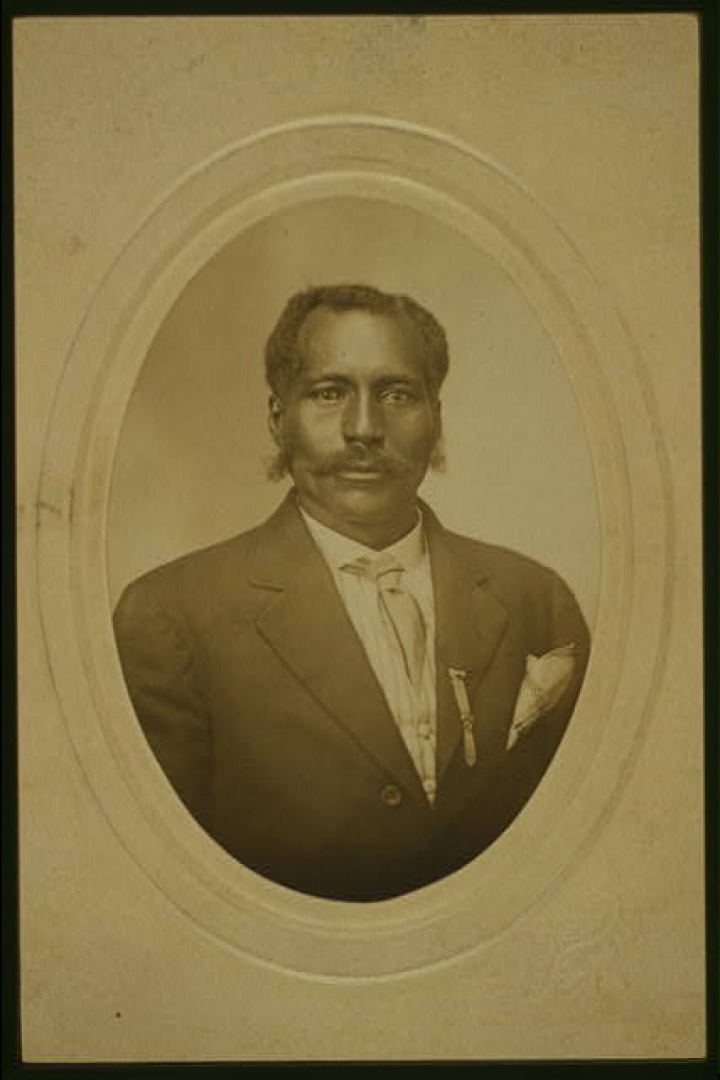
Some lynchings took place for no other apparent reason than to bring down a black person who had managed to achieve a measure of economic success. Anthony Crawford, born of slave parents in 1865, had become a substantial landowner and farmer in Abbeville, South Carolina. He had twelve sons and four daughters, most of them living nearby. As a secretary of the local African Methodist Episcopal Church, he was a pivotal figure in the black community. Few blacks—or whites—had done more to embrace the gospel of self-help. “Anthony Crawford’s life and character,” one observer noted, “embodied everything that Booker T. Washington held to be virtuous in a Negro.” On October 21, 1916, Crawford came to town to sell his cotton. He exchanged harsh words with a local white businessman over the offering price. When a store clerk wielding an ax handle went after Crawford, he backed away only to be arrested and placed in jail, securing him initially from a white mob angry over his reported insolence. “When a nigger gets impudent we stretch him out and paddle him a bit,” the store manager boasted. The president of the National Back of Abbeville concurred, “Crawford was insolent to a white man and he deserved a thrashing.”


Anthony Crawford

Released on bail, Crawford was headed toward the gin, where his cotton was waiting. The white mob quickly regrouped and attacked him. Crawford resisted, injuring one of the whites, but the men finally overpowered him and kicked him until he had lost consciousness. The sheriff persuaded the mob to permit him to regain custody of Crawford. From his cell, Crawford was heard to say, while spitting blood where they had kicked out his teeth, “I thought I was a good citizen.” By not displaying “the humility becoming a ‘nigger’,” however, he had become vulnerable. When a false rumor circulated that Crawford might be moved to another jail, thee mob mobilized again and easily entered the jail. After shoving Crawford’s broken body down three flights of stairs, they mutilated him, dug their heels into his upturned, quivering face, tied a rope around his neck, and dragged him through the streets of the Negro quarter as a warning. Finally, they hung him to a pine tree and emptied their guns into his body. Dutifully, the coroner convened a jury, which quickly reached the verdict that Anthony P. Crawford had come to his death at at the hands of parties unknown to the jury. A subsequent citizens’ meeting ordered the remainder of the Crawford family to leave town within three weeks.

A leading South Carolina newspaper had little difficulty in ascertaining the principal reason for Crawford’s murder. “Crawford was worth around $20,000 and that’s more than most white farmers are worth down here. Property ownership always makes the Negro more assertive, more independent, and the cracker can’t stand it.” The citizens of Abbeville, regardless of class, demonstrated by their action—and inaction—not only extraordinary cowardice but also their own complicity in the crime. Pointing to the tree where Crawford was hanged, a resident remarked, “I reckon the crowd wouldn’t have been so bloodthirsty, only it’s been three years since they had any fun with the niggers, and it seems though they jest have to have a lynching every so often.”

Culled from: Without Sanctuary: Lynching Photography in America

Lynching Photo Du Jour


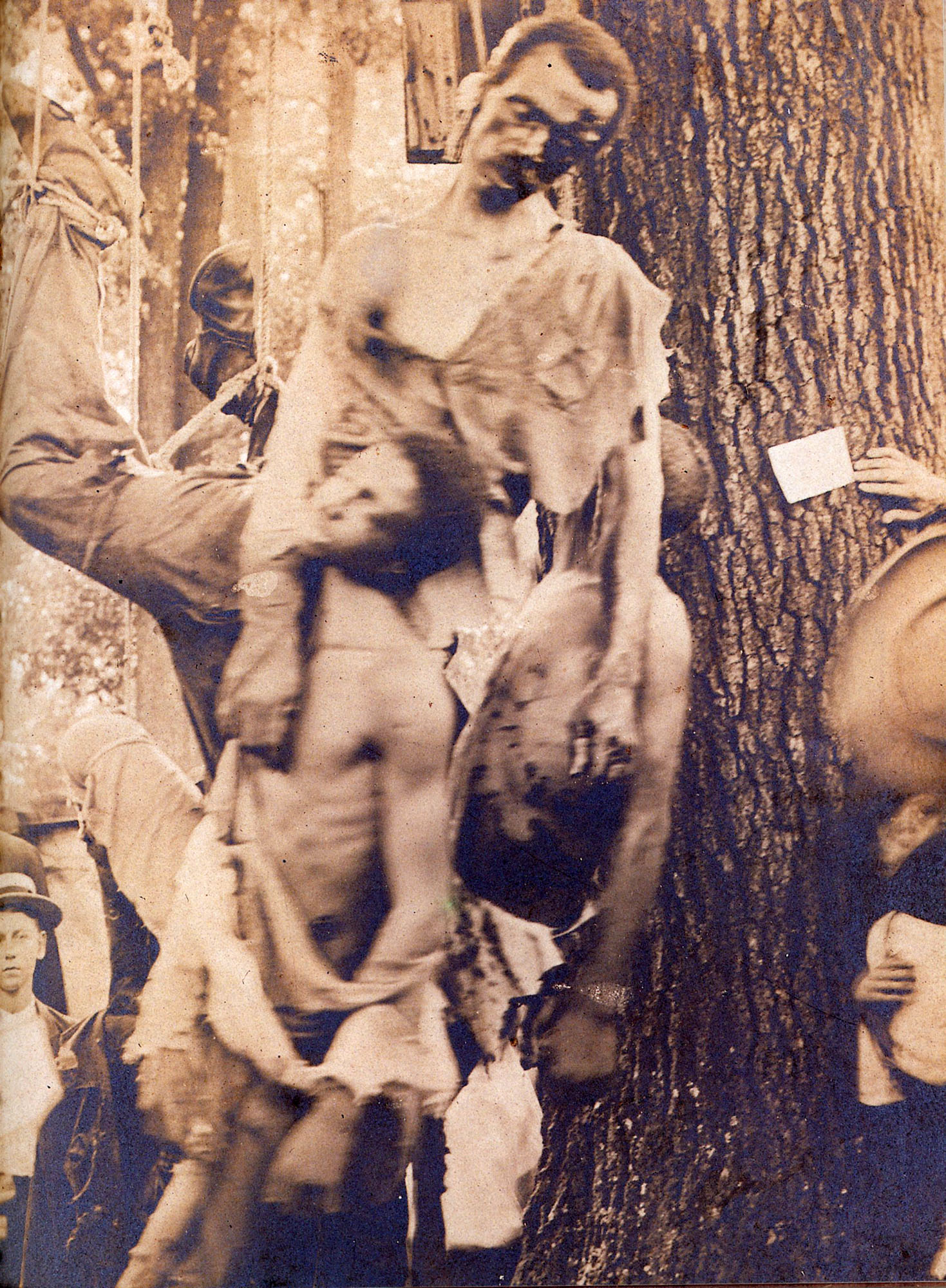
The lynching of three African American males
August 6, 1906, Salisbury, North Carolina

Culled from: Without Sanctuary: Lynching Photography in America

Andersonville Prisoner Diary Entry Du Jour!

This is the final entry of the 1864 diary of Andersonville prisoner Private George A. Hitchcock (see the archived version for all entries up until now).  Hope you enjoyed his journey!

Here’s today’s entry:

December 10th. After an all-night ride, with some sleep, reached Charleston at eight o’clock in the morning, and left the cars in the lower part of the city near the mouth of the Ashley River. The day was cold and cloudy, and a dense mist hung over the harbor. We were kept a large part of the day on a wharf, waiting for the fog to clear away, exposed to the piercing winter’s wind as it blew in from over the harbor. By the middle of the afternoon the mist had lifted, and at four P.M. we were transferred to a small steamer and sailed down the harbor. Passing the many points of interest which, under ordinary circumstances, would have commanded the closest attention of all, at this time all eyes were peering with intensest gaze out into the thick haze which hung over the harbor. At last old, ragged Fort Sumter came in view, and as we passed under its ruined, battered walls, all eyes for a moment turned toward that historic pile. Then the boat’s speed slackened, and swung slowly around so that the gaze of the prisoners, who were confined on the stern of the vessel, suddenly took in the sight before them. There, high before us, only a few yards away, lay the majestic steamer “City of New York,” from whose topmast waved the grand old Stars and Stripes. The scene which follows beggars description. Men shouted and cheered, laughed like idiots, and cried like babies. Men stood with their eyes riveted on that flag as if dreaming; others danced or grasped each other, and all acted like madmen.

Transferred and exchanged! the fulfillment of “hopes long deferred.”

And I’m sure you want to know what happened to George after the war?

He worked as a clerk in a publishing office in Cincinnati, Ohio but at the time of his marriage to Elizabeth Phelps Lowe (1841-1905) in October, 1868, he was living in Fitchburg, Massachusetts.  They had 2 children. His first child was born in Fitchburg in 1873.  From 1880 to at least 1900 he was an express messenger there.  He died on November 3, 1915.

Here’s his Find-A-Grave entry.

Culled from: Andersonville: Giving Up the Ghost and Antietam on the Web

MFDJ 04/07/24: Dropping the Hammer on the East Face

Today’s Clumsy Yet Truly Morbid Fact!

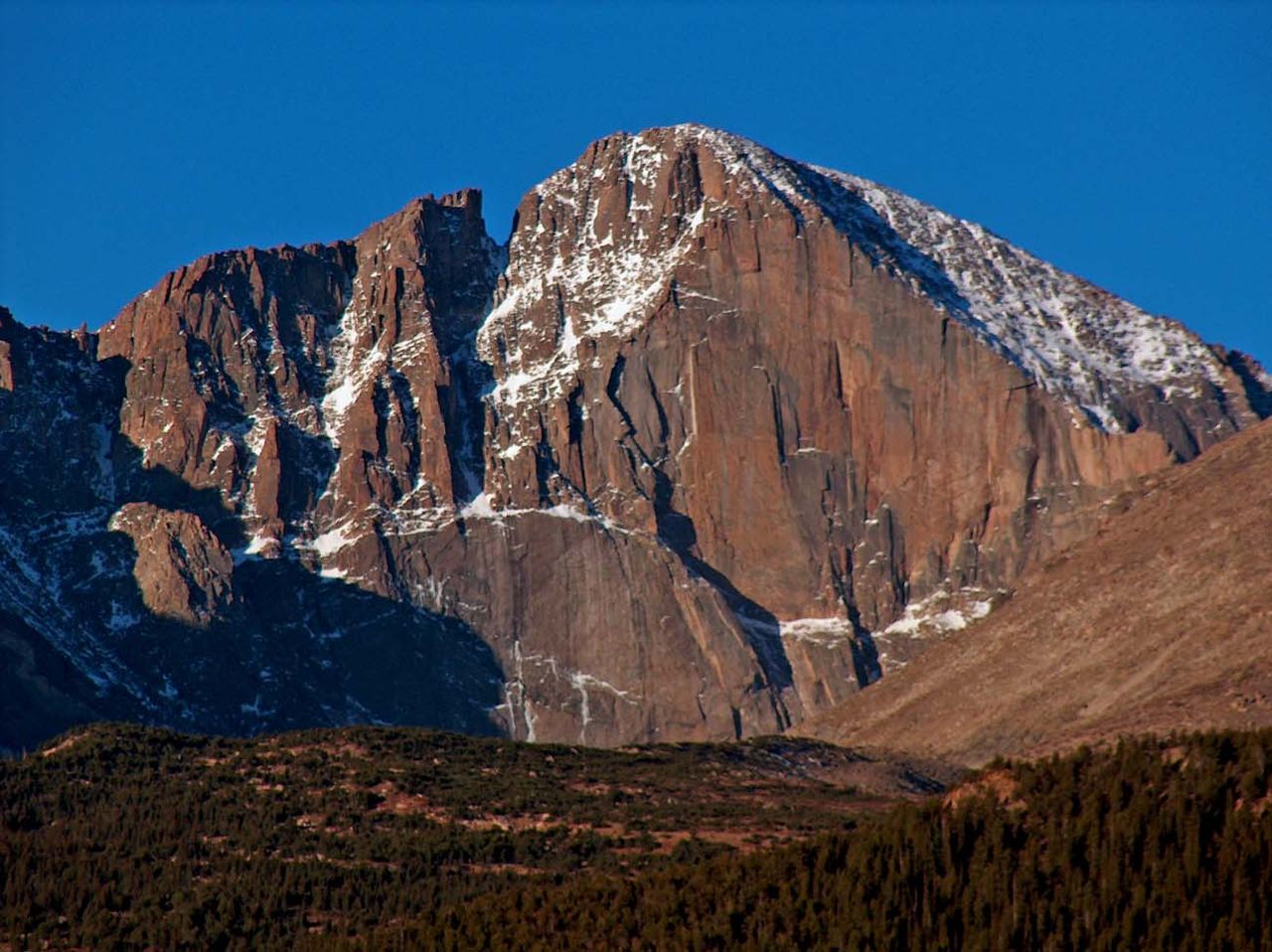
Before Doppler radar gave meteorologists the ability to create detailed forecasts of weather systems as they crossed the country, mountain climbers had to rely on predictions published in newspapers and their own instincts to keep from being caught in storms. These rudimentary tools usually provided enough information to keep climbers from venturing out into dangerous thunderstorms or early-season snows. Most mountaineers in the Rocky Mountains stayed off of fourteeners like Longs Peak when winter gales dominated the landscape, saving their enthusiasm for the late-spring and summer months. Even summer, however, can turn against a climber on Longs Peak, transforming a sunny day into a freezing torrent in the space of an hour.


The East Face of Longs Peak.  Doesn’t it look like fun?

Gerald Clark, 30, encountered just such a day on August 7, 1939. A commercial photographer from Denver, he had scaled Longs Peak’s East Face five times before this, bringing all the equipment necessary to do this as safely as possible. He began to scale the wall with his friends, Eddie Watson, 23, and Edmund Cooper, 32, but at about 2:20 p.m., he dropped the hammer he used to drive pitons into the rock. Without the ability to insert more pitons, he could not go up any farther. Worse, it had begun to rain—hard.

Watson and Cooper both had ample experience climbing mountains, including Longs Peak, which Cooper had ascended no less than eight times before this. Watson had made his first climb of the East Face the previous New Year’s Day. They knew enough to realize that while Clark had reached an overhanging rock before he dropped his hammer, they couldn’t make it to the same place with the sudden change in the weather.

“Cooper was in the lead when we started,” Watson told the Grand Junction Daily Sentinel. “He tried for an overhanger, but couldn’t make it. He came back and he and I agreed it couldn’t be made in the rain that was falling then. Cooper and I wanted to turn back, but Clark wanted to try it. He took the lead and made it over the overhanger.”

Watson and Cooper called to Clark to come back. “He kept going up in the Chimney and kept calling back to us for more rope… He didn’t hear us, or pretended not to, and kept on going, calling for more rope until there was only a few feet left.”

By this time, they knew that their friend had gone too far, but they had a responsibility to make sure he was safe. “Cooper and I started then to try to get [to] another overhanging ledge to one side,” Watson said. “The ledge was nothing less than a waterfall then, with the rain pouring down. It was impossible to get a handhold.”

Then Clark dropped his hammer.

“We called up to Clark. He couldn’t go any further up and he couldn’t start back down because he couldn’t drive a petane [sic]. We decided Cooper and I should go back for help. All three of us started calling for help but got no answer. There were some people on the peak, but they must have thought we were fooling.”

By this time, snow and sleet had started to fall along with the rain. Watson and Cooper managed to get the attention of a guide on the East Face—none other than Walter Keiner, who completed a legendary climb of the East Face in winter with Agnes Vaille in 1925. Kiner was on the mountain with a party from the Colorado Mountain Club, but when the two men conveyed to him that Clark was truly in trouble, he took his party back down the mountain and called for help.

“Cooper and I climbed down,” Watson said. “Cooper took a rope and went up to Broadway, the trail above the Chimney.”

Taking the easier route up the East Face to connect with Clark seemed like a good idea, but once he reached Broadway Ledge, he knew that he could not get the additional rope Clark needed before dark. A recue party, including Ranger Ernest Field and two climbing experts from Denver, Bob Boyd and Bob Lewis, started up the north face at about the same time, hoping to reach Clark from above as well. Cooper moved quickly to join them. Chief ranger J. Barton Herschler took charge of the rescue operation, establishing a base camp at Chasm Lake.

“They told me to go to the Boulderfield,” said Watson. “I waited there for news.”

By this time, the wind had picked up as well, and Clark, clad only in a cotton flannel shirt and denim pants, remained trapped on a ledge as water poured down the mountain and directly over him. As hail mixed with the snow, conditions became too hazardous for Ranger Field and his part to begin to climb down the East Face to reach Clark. A long afternoon of bad weather and biting cold had given away to night, and darkness set in on the mountain. Clark had no choice but to spend the night on the exposed ledge.

Watson went back up the Longs Peak trail at first light and reached Chasm Lake. He found Ranger Field and his party, who had spent the night on a wide ledge, coming down the East Face of the mountain toward Clark as snow and sleet continued to swirl around them. He also met Ranger Paul Hauk at Chasm Lake, on his way to assist. Watson and Hauk started up the East Face from the base.

Where exactly Clark had spent the night, however, was a mystery to the rangers and climbers on their way to help him. “Clark was so much hidden by the storm and the rough that the rescuers could not find him after they started down after dawn,” the Associated Press reported. They called to Clark, telling him to throw out his pack to they could see where he was. “He tossed out his pack then,” said Cooper.  For the moment, at least, he was still alive and conscious.

Finally Field’s party reached Clark, and determined in minutes that he was suffering from hypothermia and could not use his muscles to assist in his own rescue. He lost consciousness as they began lowering him down with a rope to Kiener’s Route, where Watson and Hauk were waiting. It took a total of five hours to move Clark down 1,500 feet from the ledge to the rescue camp rangers had established at Chasm Lake, working in small increments. Rescuers on the ground had called park headquarters for blankets, stimulants, a stretcher, and an ambulance to wait at Longs Peak campground, and eighteen Civilian Conservation Corps enrollees made their way to the rescue camp to help carry Clark five miles on stretcher to the campground and ambulance.

In all, Clark had spent twenty hours on the ledge.

“Clark was still alive when we lifted him on down,” said Watson, “but he was gashed on the head. He must have been hit by a rock while Field and Boyd and Lewis were letting him down.”

By the time he reached Mills Glacier, however, Clark’s life had all but ebbed away. Artificial respiration could not save him.

Coroner Orville Miller in Larimer County completed the autopsy and determined that that the cause of death was exposure—what we now call hypothermia. The gash on his head was only a scalp wound.

Culled from: Death in Rocky Mountain National Park


Dissection Photo Du Jour!


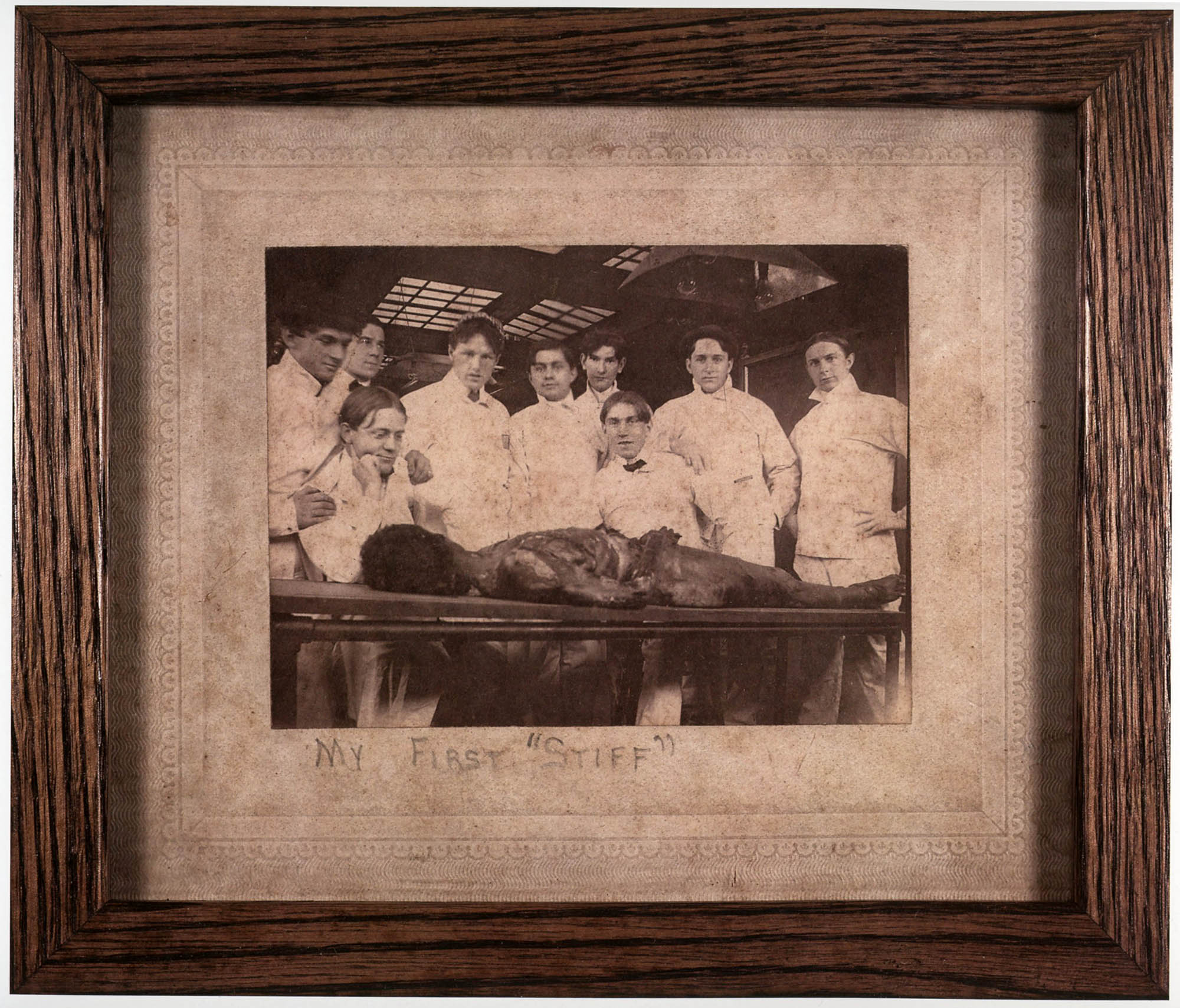
My First “Stiff”
Unidentified medical school, circa 1910

Nine medical students proudly pose around their cadaver. The photograph was framed, indicating it hung on a medical student’s wall as a proud statement and visual record of his entering the medical profession.

Culled from: Stiffs, Skulls, and Skeletons


Andersonville Prisoner Diary Entry Du Jour!

This is the continuation of the 1864 diary of Andersonville prisoner Private George A. Hitchcock (see the archived version for all entries up until now).

Here’s today’s entry:

December 3d. Roll-call and wood rations were omitted “on account of the return of a large number of paroled sick,” though we don’t see the relation of cause and effect. I traded a map of the seat of war for a mess of sweet potatoes.

Culled from: Andersonville: Giving Up the Ghost

MFDJ 04/05/24: Thallium Bait

Today’s Inescapable Yet Truly Morbid Fact!

For several years, starting in the late 1920s, the State of California had used grain poisoned with thallium bait to eradicate ground squirrels in its southern coastal counties. As state wildlife officials discovered, the plan worked, except that it also killed animals that ate the poisoned squirrels—civets, coyotes, weasels, foxes, red-tailed hawks, golden eagles, turkey vultures—as well as any creature unfortunate enough to find leftover bait, which included mourning doves, quail, rabbits, pheasants, five species of wild geese, meadowlarks, skunks, rats, ravens, three species of sparrow, three species of woodpecker, kangaroo rats, juncos, white-footed mice, pet cats and dogs, domestic chickens, sheep, and cows.


Vintage Thallium Ant Poison

The program was finally discontinued after a group of field workers used a sack of grain found in a grower’s barn to make dinner. It turned out to be a sack of thallium bait. Seven of the workers died, and more than a dozen others survived but suffered partial paralysis and the tell-tale, inescapable hair loss.

Culled from: The Poisoner’s Handbook

Post-Mortem Portrait Du Jour!


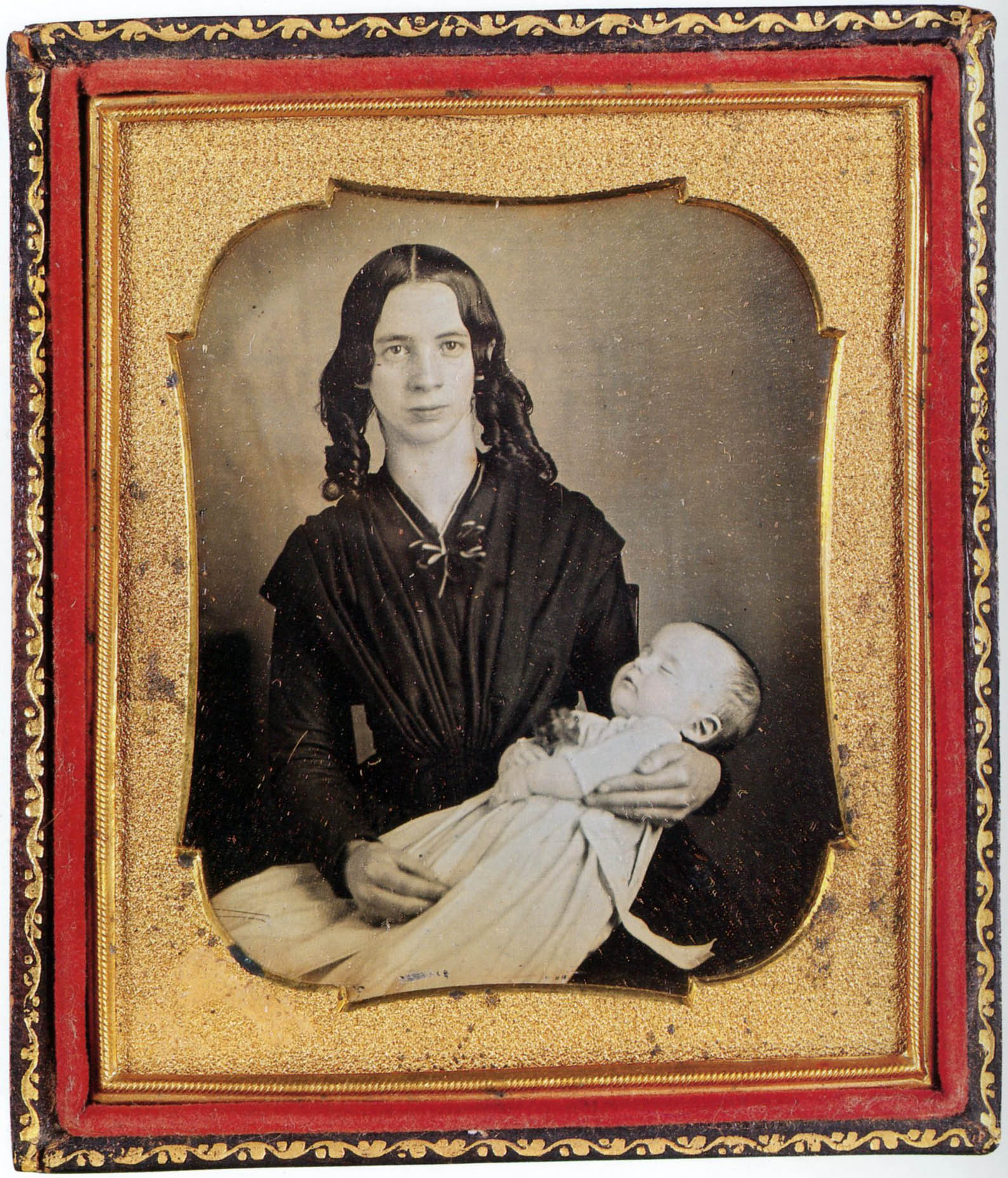
MOTHER IN COUNTRY DRESS CRADLES HER INFANT
Ambrotype 1/6 Plate, Circa 1860

Culled from: Sleeping Beauty III

Andersonville Prisoner Diary Entry Du Jour!

This is the continuation of the 1864 diary of Andersonville prisoner Private George A. Hitchcock (see the archived version for all entries up until now).

Here’s today’s entry:

December 1st. All the prisoners were moved to one side of the creek, and then the entire camp made to move back to the other side again, being counted as they passed across the little bridge. A lot of “galvanized Yanks”–turncoats–were sent back into camp by the rebels for fear they would escape to our army.

Culled from: Andersonville: Giving Up the Ghost

MFDJ 04/04/24: Seemingly Kind Nazi Doctors

Today’s Seemingly Kind Yet Truly Morbid Fact!

Nazi doctors and others involved in the reception process at Auschwitz varied greatly in their tone. A survivor, whose work gave him the run of the camp, explained that “they [the Nazis] were psychologically very [well] prepared for every situation,” so that at times “the doctor was very friendly to the people… asking, ‘How are you?’ and, ‘What occupation [do] you have?'” When an arriving inmate mentioned illness, looked weak, or was too young or too old, the same doctor made the decision to send him or her to the gas chambers. This survivor went on to tell of an incident (described to him by members of the Sonderkommando*) when a doctor appeared in the room outside the gas chamber where prisoners had to undress, noted a broken glass on the floor from shattered eyeglasses, and told the people there, “Please be careful that you… [don’t] injure your[self].” The survivor’s conclusion: “So they [the Nazis] were, to the last moment… using [the] hoax.”


New arrivals at Auschwitz being sorted 

He went on to list the series of steps in SS doctors’ involvement in the killing: first, the chief doctor’s assignments to his subordinates concerning duty schedules and immediate selections policies; second, the individual doctor’s service on the ramp, performing selections “in a very noble [seemingly kind] manner”; third, the doctor riding in the ambulance or Red Cross car to the crematoria; fourth, the doctor ordering “how many  [pellets] of gas should be thrown in… these holes from the ceilings, according  to the number of people, and who should do it… There were three or four Desinfektoren“; fifth, “He observed through the hole how the people are dying”; sixth, “When the people were dead… he gave the order to ventilate… to open the gas chamber, and he came… with a gas mask into the chamber”; seventh, “He signed a [form] that the people are dead… and how long it took”; and eighth, “he… observed… the teeth… extraction [from] the corpses.” This was the survivor who concluded that “the killing program was led by doctors—from the beginning to the end.”

Culled from: The Nazi Doctors

Sonderkommando:  groups of prisoners forced to perform a variety of duties in the gas chambers and crematoria of the Nazi camp system.

And they extracted the teeth for the gold fillings, in case you were wondering.


Post-Mortem Portrait Du Jour!

FATHER GAZES AT CHILD
Engraved in Plate: A. Le Blondel Lille
Daguerreotype 1/4 plate, tinted, circa 1850

This daguerreotype is generally considered the most artistic of all postmortem images. At the time of its purchase, mid-1980s, it was one of the world’s most expensive daguerreian images. It is a master photograph by any standard. The lighting resembles that of an old master painting: the subtle tinting of the child’s face and the blanket and the shadowed position of the father have the attributes of fine art. The dark room further shrouds the father, helping create an atmosphere of mourning. The tented sheets above the bed makes this a forerunner of the “Sleeping Beauty” type of postmortem imagery that had become popular by the turn of the century. We can easily feel how precious this lost child was to her father. Through the photographer’s eyes, a powerful mourning and bereavement memorial was created.

Culled from: Sleeping Beauty II


Andersonville Prisoner Diary Entry Du Jour!

This is the continuation of the 1864 diary of Andersonville prisoner Private George A. Hitchcock (see the archived version for all entries up until now).

Here’s today’s entry:

November 30th. Had the chills last night and lost my sleep. Jim Miller was admitted to the hospital. Bathed in the creek. Rations of a pint and a half of meal, with beans and salt.

Culled from: Andersonville: Giving Up the Ghost

MFDJ 04/03/24: Burke & Hare

Today’s Ghoulish Yet Truly Morbid Fact!

Dissecting cadavers has long been a critical part of medical training.  [As readers of this blog well know! – DeSpair]  Nowadays, thanks to the practice of voluntary body donation, there is a plentiful supply of corpses for med school anatomy classes. Things were different in eighteenth-century Britain, when the only corpses that could be legally used for teaching purposes were those of executed criminals. Despite the staggering number of crimes that could send a felon to the gallows then—everything from pickpocketing to poaching to writing a threatening letter—surgical instructors still found themselves with an acute shortage of freshly dead human specimens.

To meet the demand, a new breed of entrepreneurs sprang up, practitioners of what one scholar has called “the foulest trade in human history.” Commonly known as body snatchers or resurrectionists, these enterprising ghouls would sneak into a churchyard at night, dig up a recently buried coffin, pry open the lid, extract the corpse, and—after restoring the grave to its former condition—deliver their plunder to one of their regular medical school customers.

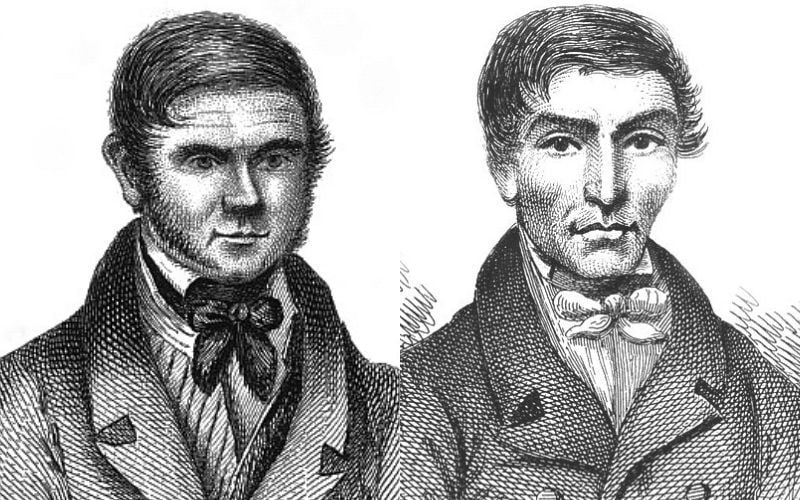
Though the names of virtually all these professional corpse thieves have been lost to history, two men have entered legend as the most infamous of British resurrectionists: William Burke and William Hare. As it happens, they weren’t grave robbers at all. They were what we now call serial killers.
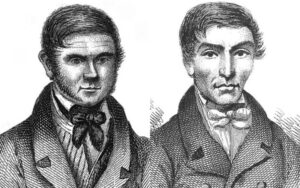

Burke & Hare

A native of County Tyrone, Ireland, William Burke was born into a family of poor but respectable tenant farmers in 1792. At nineteen, he became a soldier, serving as a private in the Donegal militia for five years. At some point during that time, he married and had two children with a woman named Margaret Coleman, only to desert his wife and offspring a few years later after leaving the army.

Immigrating to Scotland, he found employment as a canal worker and took up with a part-time sex worker named Helen “Nelly” McDougal, who became his common-law wife. Not long afterward, the couple relocated to Edinburgh, where Burke soon made the acquaintance of the man whose name would forever be linked to his own in the annals of infamy.

Born in 1807 and raised (in the words of his earliest biographer) “without any education or proper moral training,” William Hare spent his early adulthood as a farm laborer in his native Ireland. In contrast to Burke—who impressed all who knew him with his easygoing charm—Hare, according to one contemporary, possessed “a ferocious, violent, quarrelsome” disposition and was given to particularly brutish behavior when he was drunk, as was often the case. Like Burke, he came to Scotland to work on the new canal linking Edinburgh to Glasgow and ended up boarding at a tenement lodging house run by a man named Logue and his wife, Margaret. When Logue died, Hare lost no time taking his place both in Margaret’s bed and as landlord of the squalid doss-house, where, in autumn of 1827, Burke and McDougal came to live.

The commercial partnership that would earn Burke and Hare everlasting notoriety began in November 1827 with the passing of an elderly lodge owner named Donald, who died owing Hare £4 of back rent. In those years, Edinburgh was the country’s leading center of medical education. To recover the debt, Hare hit upon the idea of selling the old man’s corpse to one of the city’s many anatomists. Promised a share of the proceeds, Burke helped his friend convey the cadaver to the school of celebrated surgeon, Dr. Robert Knox, where they received the handsome sum of £7 10s—more than $300 in today’s currency—and were told that they were always welcome to return “when they had another [body] to dispose of.”

Disinclined to engage in the difficult, dirty, and dangerous business of grave robbing, the two reprobates hit on another, less strenuous method of obtaining marketable human corpses: “wholesale murder.” Their first victim was an elderly lodger named Joseph who had fallen ill with typhus. Afraid that having the contagious old man on the premises might scare off potential customers, Hare once again enlisted Burke’s assistance. After feeding Joseph enough whiskey to put him in a stupor, the two made short work of him, one pressing a pillow to his face while the other lay across his chest. This time, Knox forked over £10 for the corpse. At no point, either then or thereafter, did the doctor inquire as to the provenance of the goods he was paying for.

Though the facts remain murky, another ailing inmate of the boardinghouse, an Englishman in his forties, appears to have been the next victim. Most historians of the case believe that, in dispatching this individual, the two murderers perfected the smothering technique that would come to known as “burking”: Hare would press his hands over the person’s mouth and nose while Burke lay across the upper body.

Having exhausted their supply of sick lodgers, the pair went out trawling for victims. The first to fall into their clutches as an elderly peddler, Abigail Simpson. Encountering her in a pub, Hare lured her back to his premises, where he and Burke plied her with whiskey. Once fallen into a stupor, she was smothered, stripped, stuffed into a tea chest, and carted off to the offices of the uninquiring Dr. Knox.

Over the next six months—between April and October 1828—the two fiends (as they would soon be branded in newspapers throughout the United Kingdom) would murder an additional thirteen people.

The atrocities of the ghoulish pair climaxed, appropriately enough, on Halloween 1828. By then, Burke and McDougal were residing at a different lodging house, run by a couple named Broggan. That morning, burke was enjoying his morning dram of whisky in a neighborhood pub when an elderly beggar-woman wandered in, asking for alms. Sizing her up as easy prey, Burke treated her to a drink and struck up a conversation. Before long, the old lady happily accepted his invitation to come stay at his lodgings.

Leaving her in the company of his wife, Burke sought out Hare at a nearby tavern and informed him that he had found fresh meat for Dr. Knox’s dissection table. He then returned to his rooms, where, in preparation for the murder, he persuaded the other lodgers, a couple named Gray and their child, to spend the night elsewhere. Once the Grays were gone and Hare was on the scene, the two dispatched the old lady by their usual method and stuffed her corpse beneath a heap of straw at the foot of a bed.

The following morning, Mrs. Gray returned to the rooms to fetch a pair of her child’s stockings, looked under the straw, and was horrified to see the old lady’s dead body, stripped of its clothing, blood leaking from her mouth. By the time officers arrived at the Broggans’ boardinghouse, however, the two serial murderers had already delivered the corpse to Dr. Knox, where it was later found by police. Burke and Hare were promptly taken into custody.

Betrayed by Hare—who, to save his own skin, agreed to turn King’s evidence and testify against his accomplice—Burke was tried for murder, convicted, and condemned to the gallows. Upon his sentencing, it was clear to Burke that his ultimate fate would be nothing less than an act of poetic justice. His hanged body, the presiding judge declared, would “be publicly dissected and anatomized.”

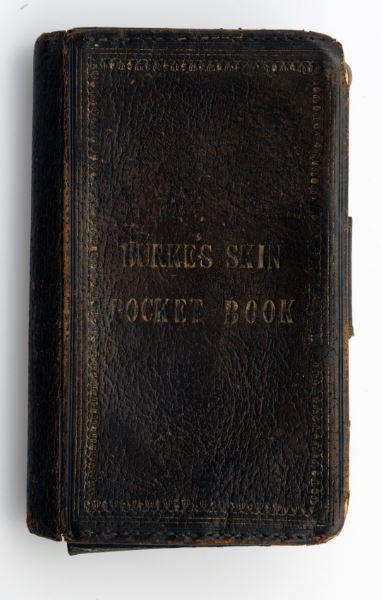
An estimated twenty-five thousand people turned out for his hanging on January 28, 1829. It took Burke about ten minutes to die. In accordance with the court’s wishes, his body was then dissected before a standing-room-only audience of medical students. The following morning, the corpse was placed on public exhibition. By the end of the day, thirty thousand eager citizens had filed through the anatomy hall for a glimpse of ghastly remains. The cadaver was then stripped of its flesh and the skeleton given to the University of Edinburgh. Some of the skin was tanned and fashioned into various ghoulish artifacts, including a wallet, a calling-card case, and the binding of a book.
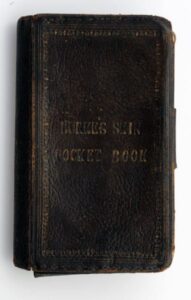

Don’t Judge a Book by Its Cover!

Granted immunity from prosecution, William Hare was set free, much to the outrage of the public. With an infuriated mob clamoring for his blood, he slipped out of Edinburgh, made his way south to Carlisle, and vanished from the historical record.
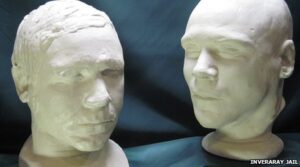

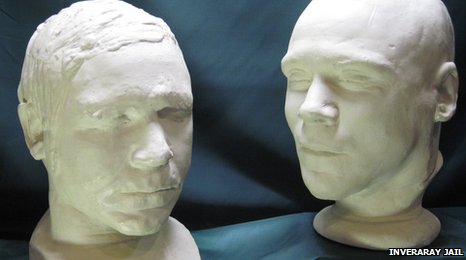
Death mask of Burke, Life mask of Hare

Culled from: Murderabilia


Post-Mortem Portrait Du Jour!
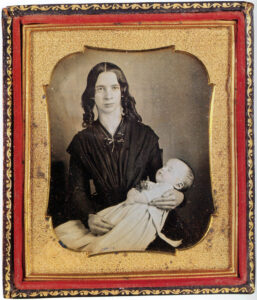

MOTHER HOLDING HER DEAD CHILD
Anonymous
Circa 1845-1855

Culled from: Sleeping Beauty I

Andersonville Prisoner Diary Entry Du Jour!

This is the continuation of the 1864 diary of Andersonville prisoner Private George A. Hitchcock (see the archived version for all entries up until now).

Here’s today’s entry:

November 29th. I bought some straw with a borrowed $5 confederate scrip; and mended my clothes, which are in a miserable condition: the sleeves of my blouse and shirt are almost entirely gone, showing some skeleton arms, the backs of both garments are as thin as gauze, while my pants are worn from the knees down, entirely away, and my cap is two simple pieces of cloth sewed together. I was detailed to go out for wood. Rations of a pint and a half of flour and a splinter of green gum-wood. More prisoners came from Millen.

Culled from: Andersonville: Giving Up the Ghost

MFDJ 04/01/24: Witch Finder General

Today’s Self-Proclaimed Yet Truly Morbid Fact!

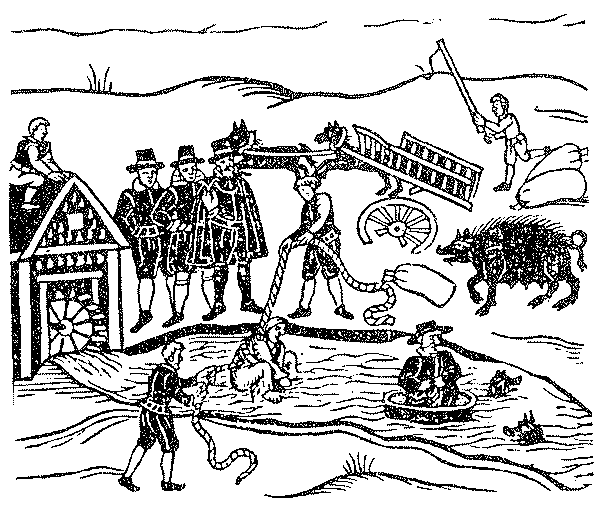
The nearest approach to the torture of witches in England came in the years 1645 to 1646, when Matthew Hopkins, the self-proclaimed ‘Witch Finder General,’ carried out his inquiries in East Anglia. Hopkins’s favorite method of extorting confessions was the ‘swimming’ of witches. He took his justification from the Demonology (1597) of James VI of Scotland (subsequently James I of England):

So it appears that God hath appointed, for a supernatural sign of the monstrous impiety of the witches, that the water shall refuse to receive them in her bosom, that have shaken off them the sacred water of baptism and willfully refused benefit thereof.

The procedure involved tying the right thumb to the left big toe, and immersing the witches in water. If they floated, they were guilty. If they sank, they were innocent — but they very likely drowned.


The Swimming of Witches

In the summer of 1645, an English parliamentary commission condemned the practice and Hopkins was forced to find other methods. He resorted to forcing his prisoners to sit cross-legged on a stool for many hours, or making them continue to walk about their cell for four or five days without sleep. One of his victims was a 70-year-old parson, Rev John Lowes. A succession of Hopkins’s assistants:

… kept him awake several nights together, and ran him backwards and forwards about the room until he was out of breath. Then they rested him a little and then ran him again. And thus they did for several days and nights together, till he was weary of his life and was scarce sensible of what he said or did.

In this state, it is not surprising that Lowes confessed to making a covenant with the Devil, bewitching cattle, and sinking a ship off Harwich.

Hopkins was particularly taken with the idea of the Devil’s mark, and ‘discovered’ many witches by pricking them with a bodkin on a mole, birthmark, or scar to see whether they bled or cried out in pain. During Hopkin’s 18 months as  professional witch-finder, demand for his pricking services was so great that he and his partner, John Stearns, hired four assistants to go from village to village and seek out likely victims,. It seems probable that they made use of a fake bodkin with a spring-loaded handle, into which the blade slid as it was apparently forced into the alleged witch’s flesh. Hopkins was compelled to retire in the summer of 1646, and died of tuberculosis within the year.


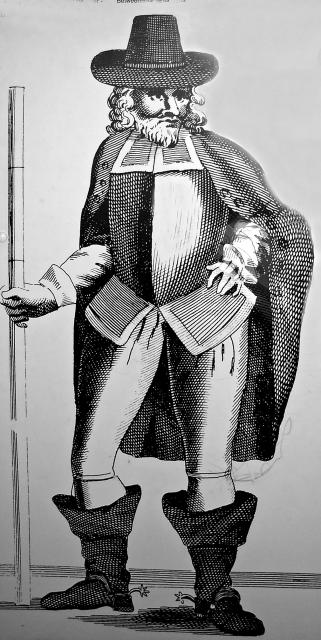
Matthew Hopkins, What a Prick!

Culled from: The History of Torture

Vintage Crime Scene Du Jour!


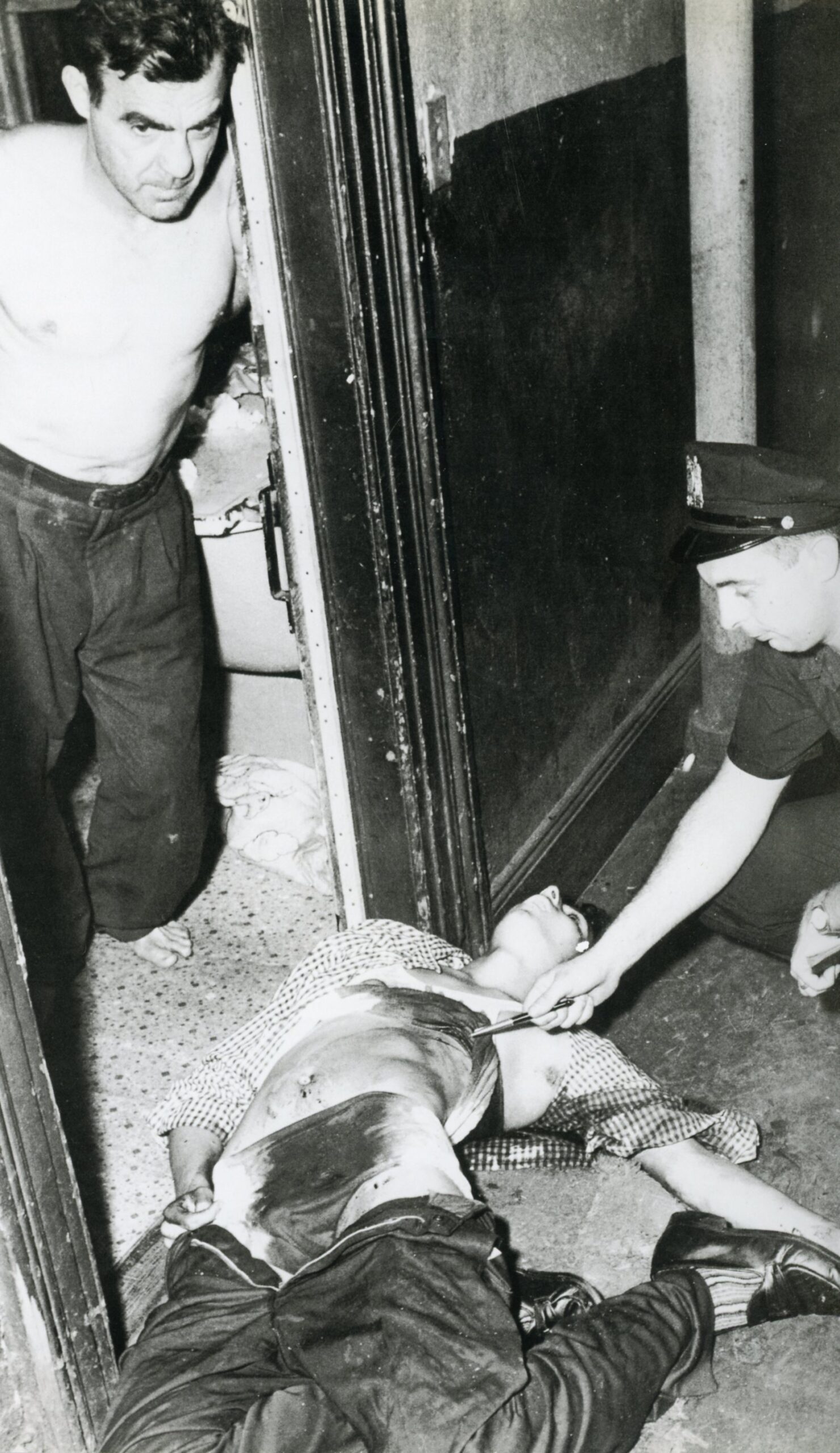
Anthony Krzesinksi lies dead in the hallway of a building where he ran after being attacked by Salvador Agron, Antonio Hernandez, and other gang members. A patrolman points to a stab wound in the body.

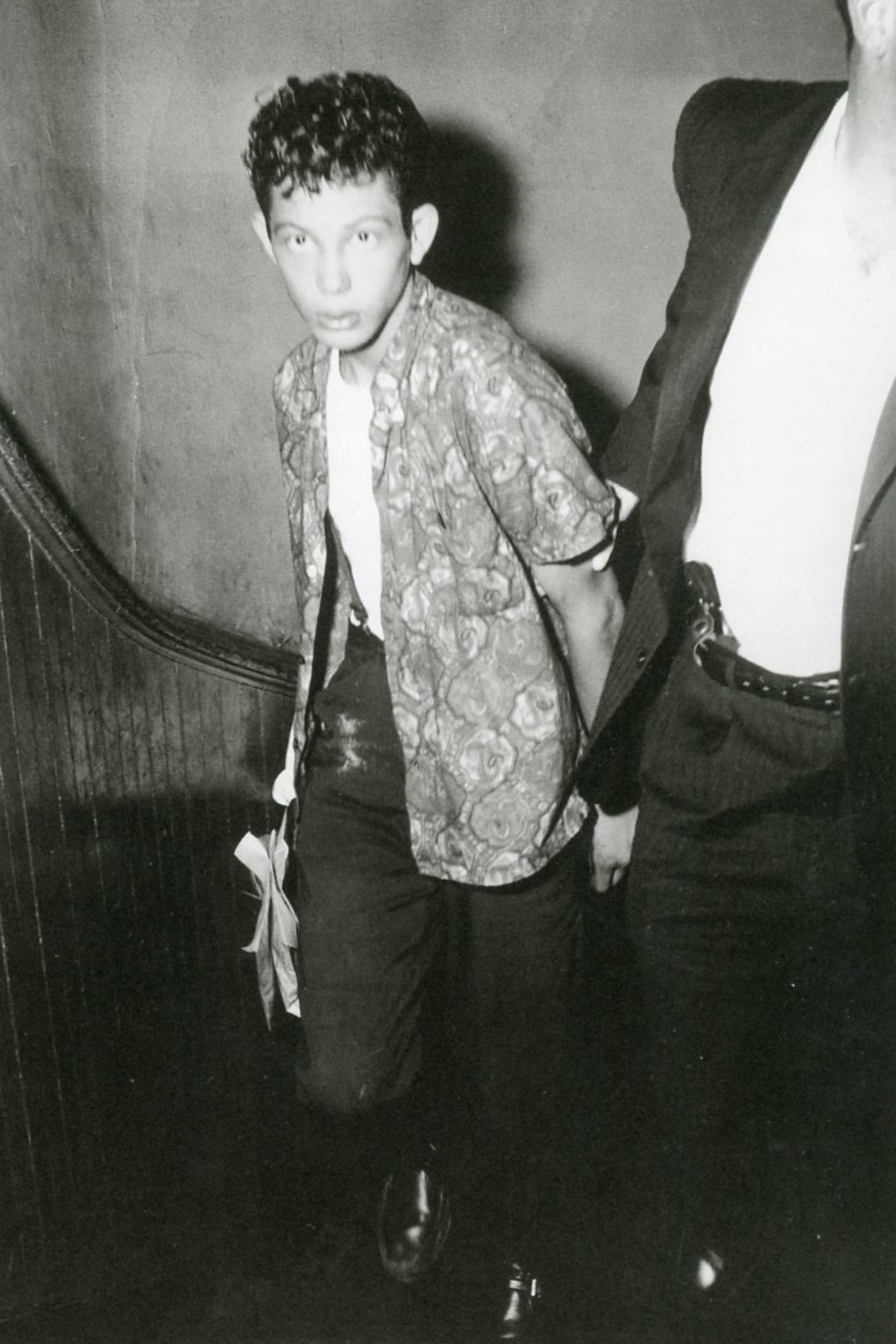
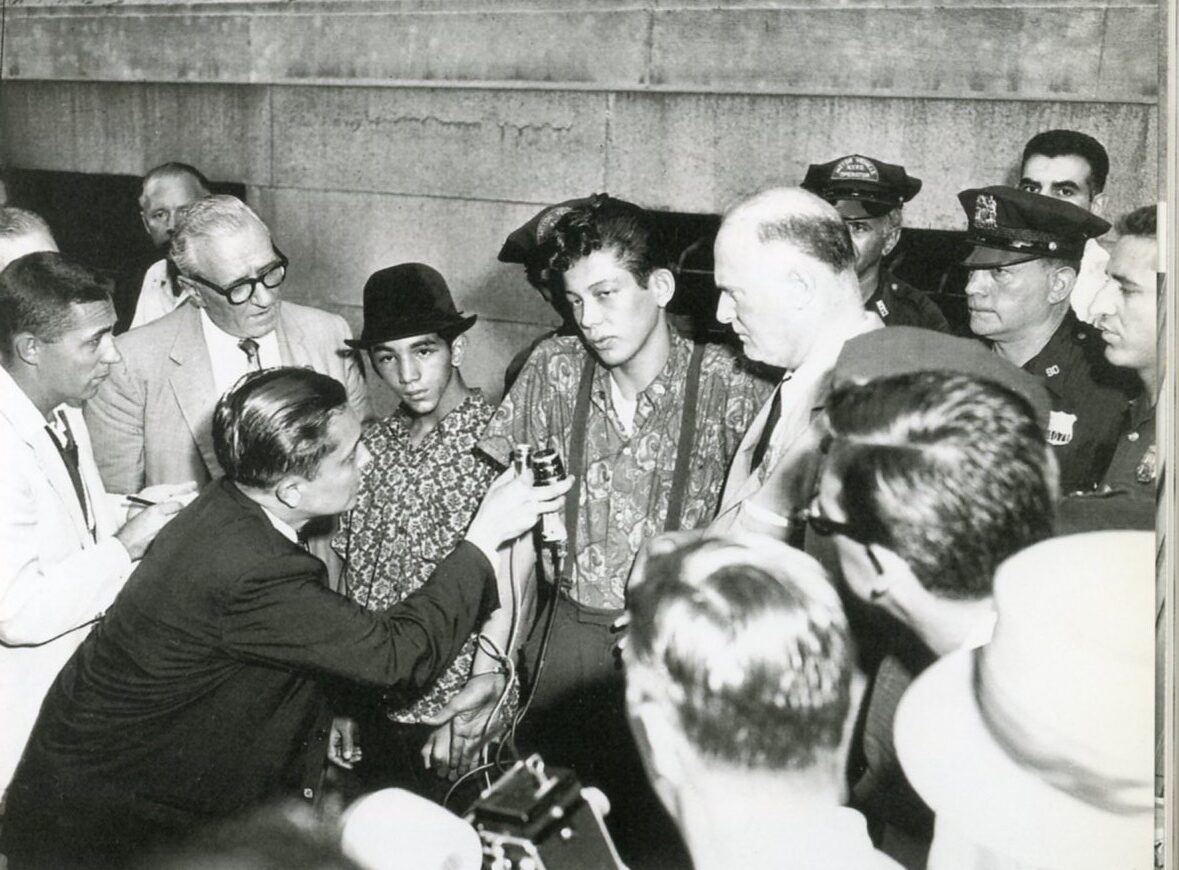
West Side Story was on Broadway. On the evening of August 29, 1959, one day after his sixteenth birthday, Salvador Agron traveled from the Upper West Side to West Forty-sixth Street with his friend Antonio Luis Hernandez and fellow Vampires gang members. They were on their way to act out their own version of a “rumble,” in a park not far from where the musical was playing. Belts and knives, sticks and pipes were the chosen weapons. When the other gang, the Norsemen, didn’t show, some of Agron’s cronies stayed in the park. Three youths, Robert Young and Anthony Krzesinski, both sixteen, and Edward Riemer, eighteen, who were not part of any gang, started making fun of the black cape Agron was wearing. With the help of Hernandez, known as “The Umbrella Man,” and various gang members, Agron attacked the three other youths, killing Young and Krzesinski and injuring Riemer. Agron was the only one to admit to the murders.


Agron is hustled up the steps of the West Forty-seventh-Street police station for booking after the murder in Hell’s Kitchen.

The case of “The Capeman and the Umbrella Man” became a sensation. Agron’s words to the press both confounded and confirmed people’s worst fears. Asked why he committed the murders, he said, “Because I felt like it.”


Reporters crowd around Hernandez (in hat) and Agron as detectives lead the pair from police headquarters.

He was charged with two counts of first-degree murder and one count of attempted first-degree murder. At the age of sixteen, he was sentenced to death, and was the youngest prisoner at Sing Sing on death row. Eleanor Roosevelt campaigned to have the sentence commuted to life, an action supported by the father of one of the victims. On February 7, 1962, six days before Salvador Agron’s scheduled execution, Governor Nelson Rockefeller commuted his sentence. Agron was released from jail in 1979. Seven years later he died, of natural causes, at the age of forty-three.

Culled from: Shots in the Dark


Andersonville Prisoner Diary Entry Du Jour!

This is the continuation of the 1864 diary of Andersonville prisoner Private George A. Hitchcock (see the archived version for all entries up until now).

Here’s today’s entry:

November 27th. Having spent the night in bivouac by the side of the railroad, in the morning our names are taken and we are sent inside another stockade, which we find crowded with old prisoners from Andersonville. Laird and I spread our blankets together, and at night drew a ration of meal and flour, which, by the aid of a few chips, we made a supper of, and though our hopes had been checked by this termination of “the exchange,” still the change of air and scene has stimulated us somewhat, and we do not feel ready to say die yet.

Culled from: Andersonville: Giving Up the Ghost

MFDJ 03/23/24: Ill-Advised Braggart

Today’s Boastful Yet Truly Morbid Fact!

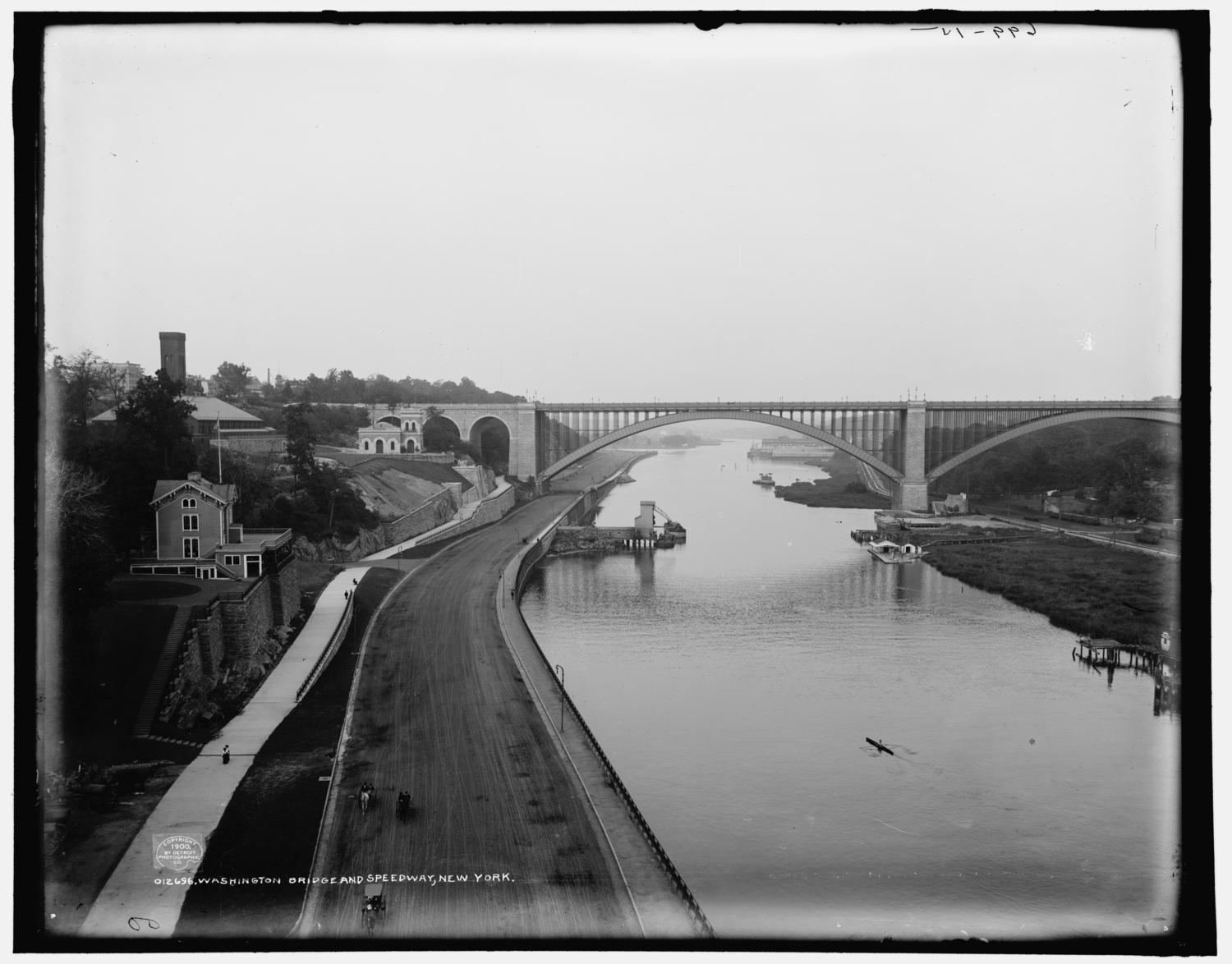
Idle boasts are as deadly as heated arguments. Details are scanty, but in 1931, three 9-year-old boys set out from the heart of Harlem to celebrate the Fourth of July holiday on the banks of the Harlem River. Sadly, one little fellow just could not shut up about what a great swimmer he was. So one of the trio, Hallie H., demanded that he put up or shut up. But this young scamp didn’t put his challenge into mere words. With unspoken eloquence, he simply shoved the braggart into the dark and dirty waters.

The results of this challenge quickly demonstrated that the boy’s ability to talk far outstripped his ability to swim. So inept were his efforts that the third boy dived in in a poorly advised effort to save him. But the first lad struggled so furiously that he dragged them both under. At first, the twin drowning was dismissed as just another unfortunate accident. But the word about what really happened was out on the street. Soon the police were knocking at Hallie’s door.


Harlem River circa 1900

Culled from: Murder Can Be Fun #17


Ghastly!

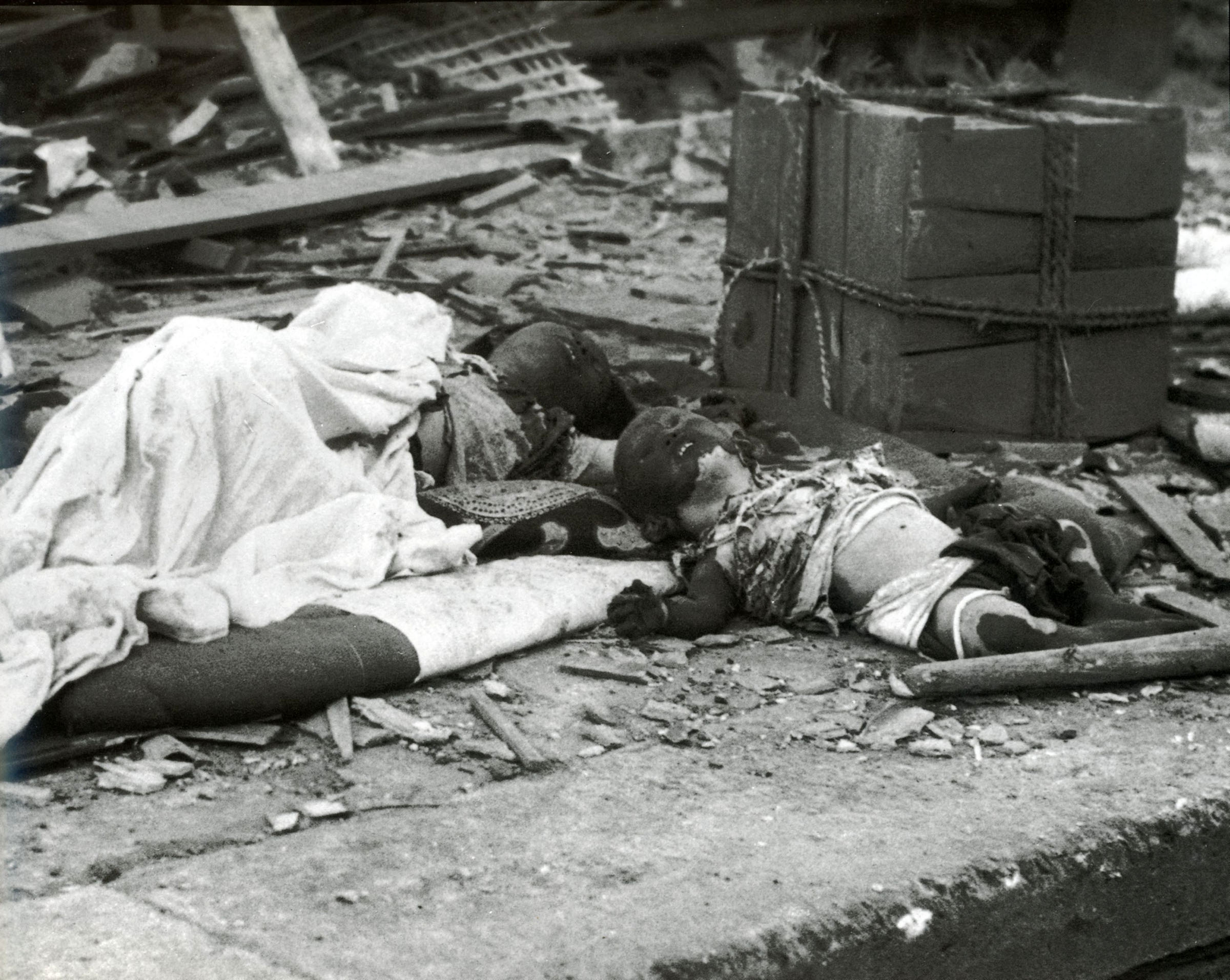
Yosuke Yamahata photographed the aftermath of the atomic bombing of Nagasaki on August 10, 1945.  Here’s one of his haunting images from the book Nagasaki Journey: The Photographs of Yosuke Yamahata, August 10, 1945.


Andersonville Prisoner Diary Entry Du Jour!

This is the continuation of the 1864 diary of Andersonville prisoner Private George A. Hitchcock (see the archived version for all entries up until now).

Here’s today’s entry:

November 16th. Sweet potatoes were issued again. Another train of sick arrived from Andersonville. Our sick did not get away, and all returned inside the stockade to-day.

Culled from: Andersonville: Giving Up the Ghost
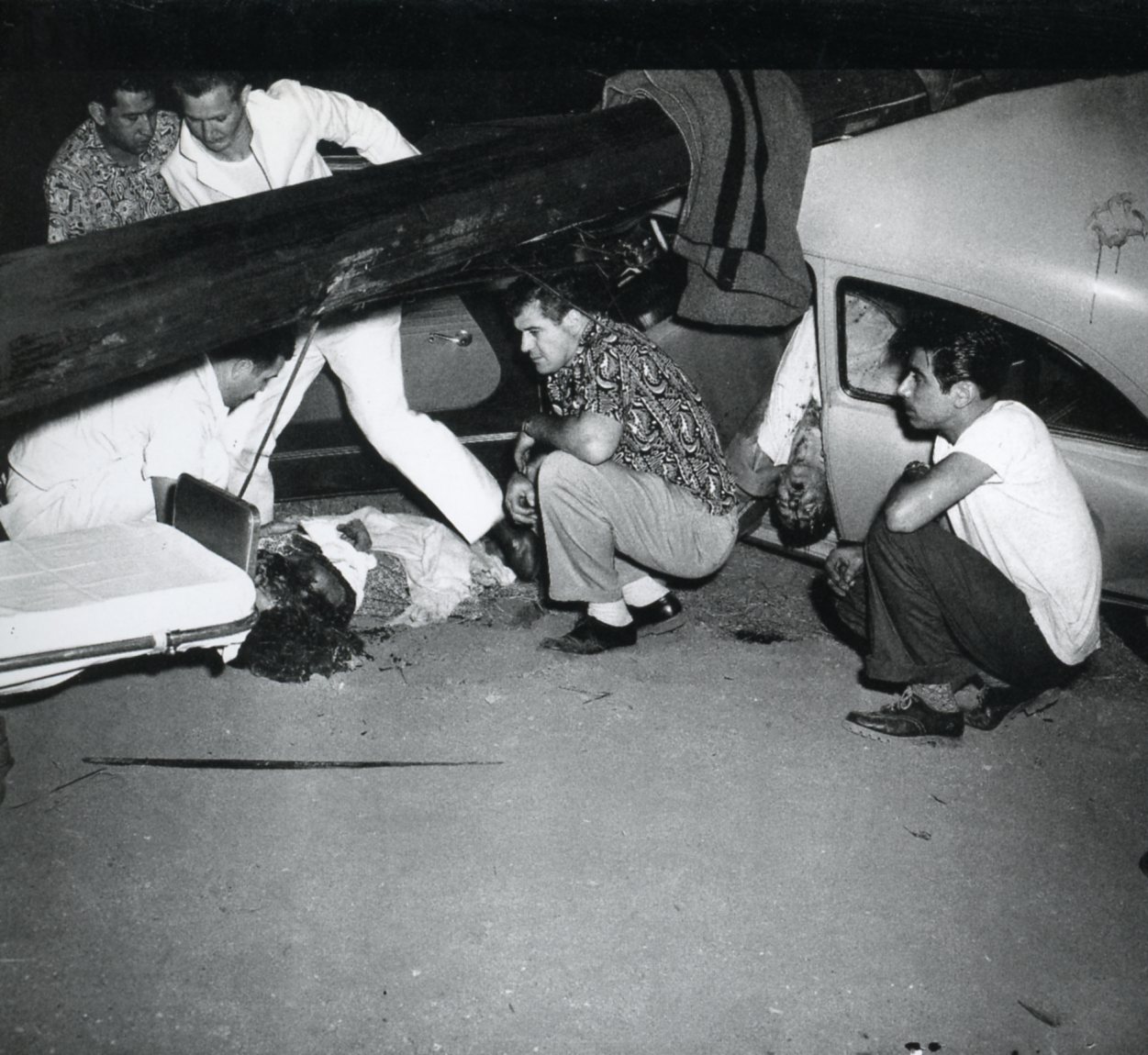
MFDJ 03/22/24: A Random Bullet at the Polo Grounds

Today’s Ill-Fated Yet Truly Morbid Fact!

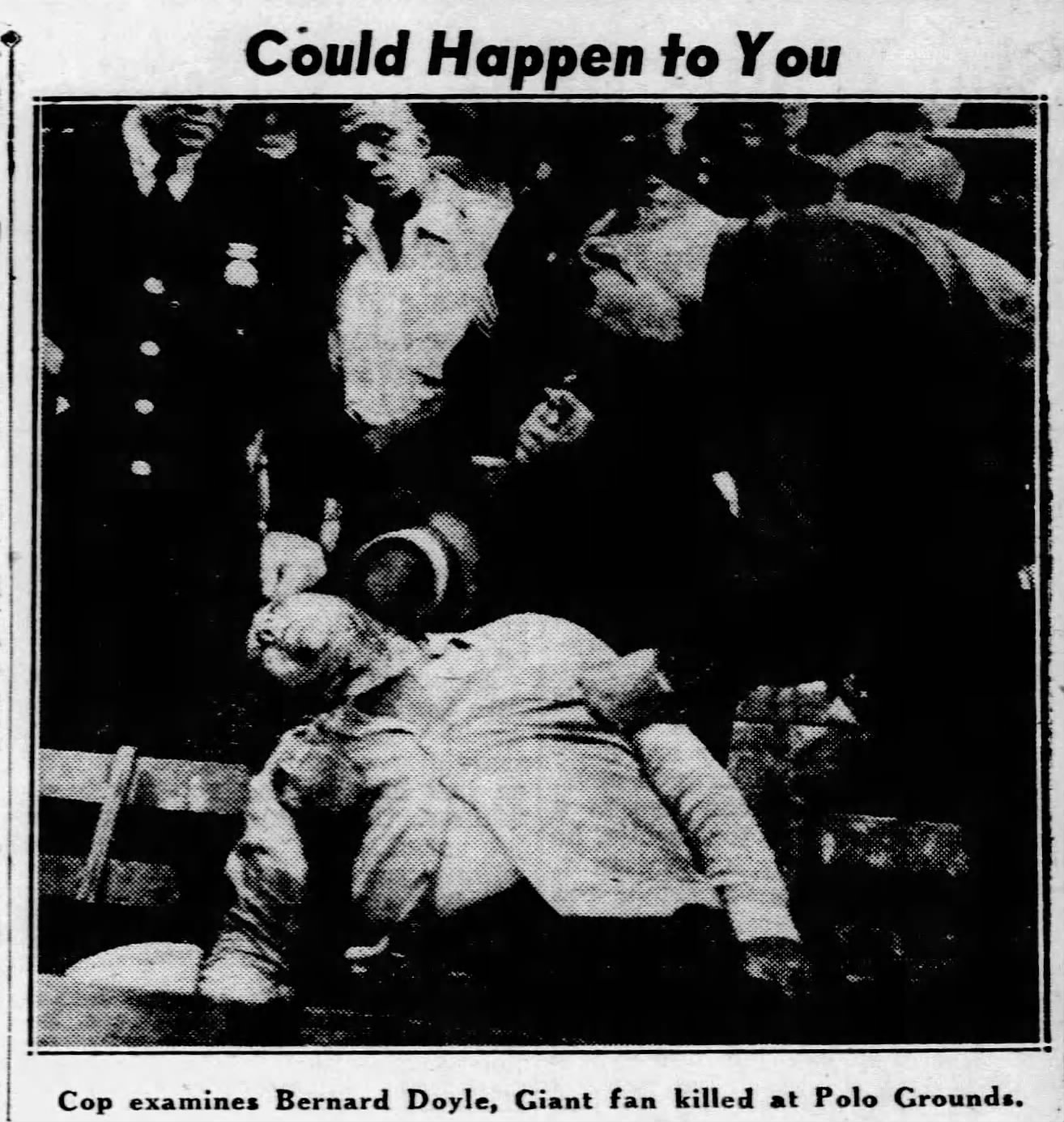
As Bernard Doyle settled in his seat in the grandstand of the Polo Grounds on July 4th, 1950, he expected nothing but a pleasant, All-American day of baseball, fireworks and beer. The 54-year-old former boxing manager was treating a friend’s son to an afternoon of baseball, and what an afternoon it would be: a double-header between the New York Giants and the Brooklyn Dodgers.

Just as the Dodgers stepped onto the field to start warming up, his afternoon ended. Doyle turned to say something to his young companion, only to slump forward in his seat, blood pouring from his head. He was taken to Harlem Hospital in a hastily summoned ambulance, but for naught. The autopsy revealed he’d died of a bullet wound to the head.

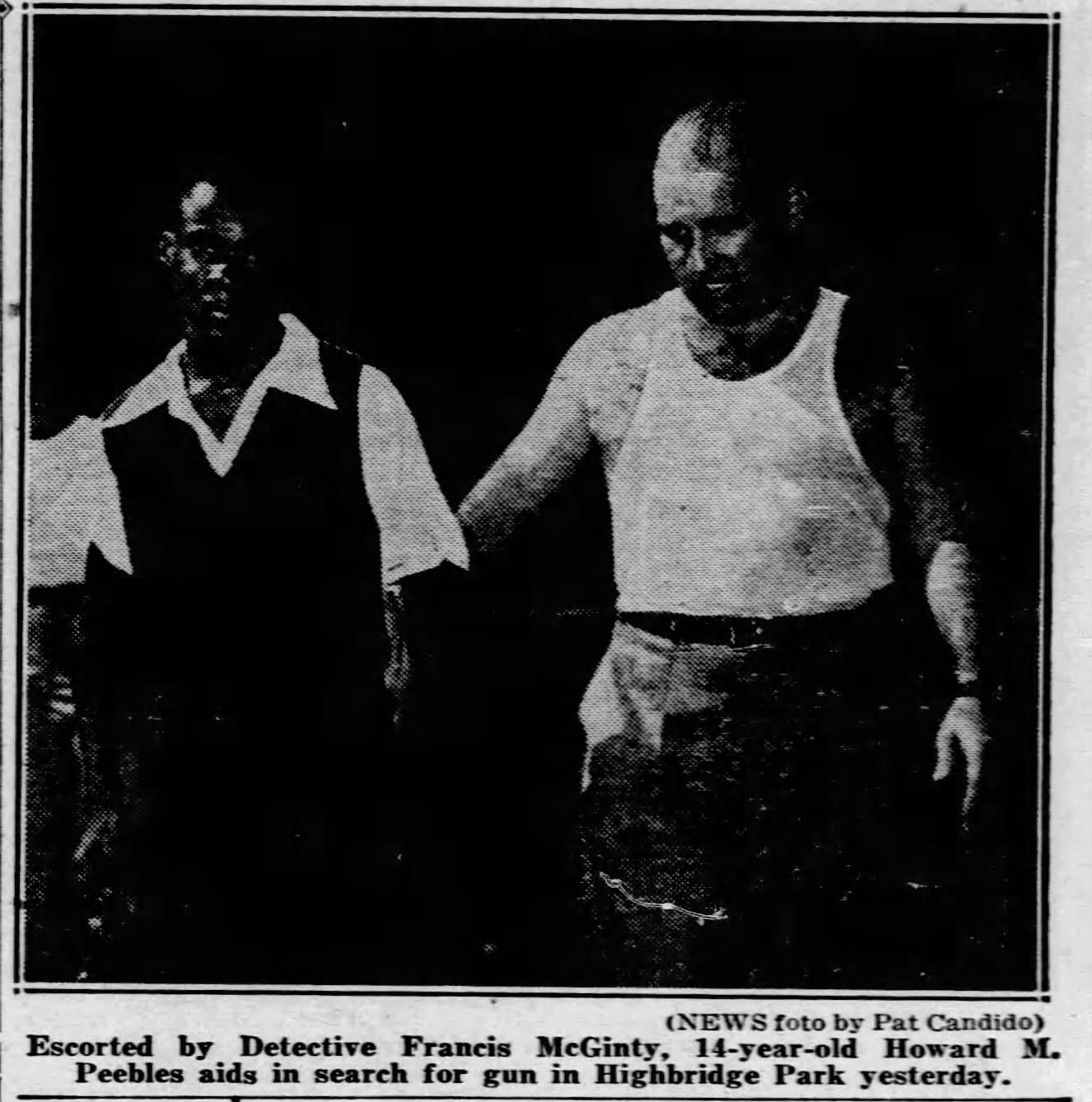
A few days later, a 14-year-old boy, one of the local juvenile delinquents, broke down and admitted to police he had fired a shot into the stadium. From where he shot, he couldn’t even see into the stands. But it did the trick.


The “Gun-Happy” Culprit

Culled from: Murder Can Be Fun #18


Vintage Crime Scene Du Jour!


ANOTHER TRIANGLE CASE….

May 31, 1935
Photographer: Detrick

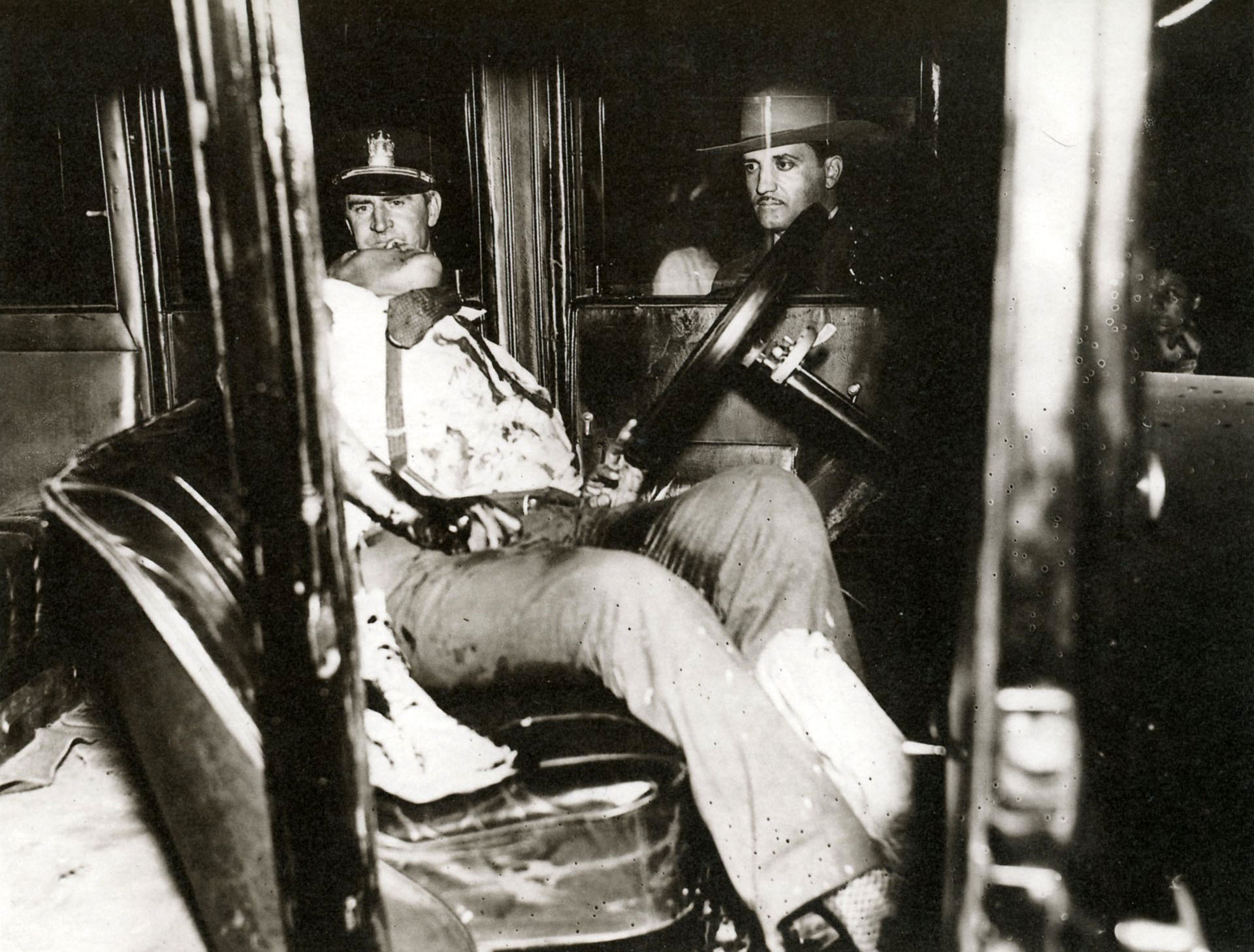
Man Murdered in Auto, Paramus, N.J.

Chief of Police, Bernard Martin of Paramus Police, and Carl De Marco of Bergen County Police, examining body of late David Corly… in Dodge Sedan in which he was killed on Howland Ave., off Spring Valley Rd., Paramus… Another triangle case…. — photographer’s caption.

Culled from: New York Noir

Here’s an article from the Saturday, June 8, 1935 issue of The New York Age shedding more light on the murder.  I could find no evidence it was ever solved.

Cabaret Man Put On Spot

POLICE SEEK  WHITE WOMAN WHO PUT WEALTHY CABARET MAN ON SPOT IN JERSEY

Sportsman Murdered In Car On Lonely Road By Unknown Men

WOMAN AS LURE

Killed 10 Minutes After Mysterious Phone Call Lured Him To Spot

Special To The New York Age.

HACKENSACK, N. J.—Murder in all its grim ugliness reared its head and stalked rampant through the countryside here last Wednesday evening when David Corly, 49, one of this city’s most prominent Negroes, was found shot to death over the wheel of his car on a lonely Paramus road. Police are still attempting to patch together fragmentary clues and wild rumors in an effort to solve the killing. Thus far no arrests have been made.

Several witnesses have been found who profess to have heard the four shots which killed the business man, one of them claiming to have seen a white woman run from the death car to one of two others close by and speed away. The fact that he is said to have left his home shortly before the killing after receiving a telephone call has given rise to the theory that Corly, reported to be the wealthiest Negro in the city and owner of the Golden Harbor Rest, a night club frequented by colored residents, was “put on the spot” in gangster style by unknown enemies.

Working together in an attempt to piece the mystery are four groups of investigators, the County Police, the Hackensack and Paramus Police, and operatives from Prosecutor John J. Breslin’s office, headed by Chief Henry R. Lockwood. A number of local colored residents were questioned by Detective Captain Franklin Zimmerman, Friday, but none were held.

Saw Woman

The slaying was committed at Spring Valley and Howland avenue, near the homes of Herbert Howland and Arthur Mann, both of whom told the police that they had seen two other cars near the one in which Corly’s body was found. Another witness who came forward, declared that right after the four shots, which followed each other in rapid succession, a woman leaped from Corly’s car, ran to one of the others already in motion and jumped in. Both cars then sped north out of sight along Spring Valley Road.

Chief Lockwood and Patrolmen Genter, DeMarco and Courtright of the County Police, arrived immediately after the shooting in response to a radio alarm and found Corly dead. He was later examined by Dr. Arthur Greenfield, assistant County physician, and Dr. Sidney F. Johnston of Rochelle Park. An autopsy disclosed that he had been struck by three bullets, one in the right leg, one in the right arm and the third in the right breast. The last one was the fatal wound.

Was Reputed Wealthy

Corly lived at 291 Second street. Generally recognized as the wealthiest colored citizen in the community he owned five houses, including the night club, and two automobiles. It is estimated that he invested almost $100,000 in the Golden Harbor Rest. He had lived in and around Hackensack for the last 27 years and was generally known to be “soft spoken and very pleasant.”

“I know he helped out a lot of colored boys when they got in trouble or when they were down on their luck,” said a police captain.

Charlie Jones and Roland Williams, two men who worked with him at the Golden Harbor Rest, however declared that he was a very shrewd business man, and around his neighborhood, he was described as being a pleasure loving man who indulged himself freely.

His wife, Bertha, 31, asserted she was at home on the night of the tragedy. Although it was reported that during some sort of argument between them early last year, Corly had fired a shot at his wife, no hint of disagreement of any sort could be found recently.

Although no definite trace of any entanglement between Corly and any other women could be established, police seemed inclined to the theory that he was shot by someone who had made an appointment with him just for that purpose. Three shells were found in the car,  two of them on the seat by the body, indicating that he had been shot at very close range.

Called “Spot!” Murder

The mysterious telephone call just shortly before he left home on the murder night, the woman seen jumping from the car, and the apparent collusion of the other two cars seen at the time of the slaying are all pointed to by police as circumstances similarly related to gangster “spot” murders.

In addition to his wife, Corly is survived by a son,13 years old, two sisters Anna E. Johnson and Mrs. Lola Wright, a brother, William H Corly, a niece, Janie Wright and a nephew, Silas Chapman. Funeral services were held Saturday afternoon from Varick Memorial Church on Atlantic Street with Rev. S. H. Williams officiating.


Andersonville Prisoner Diary Entry Du Jour!

This is the continuation of the 1864 diary of Andersonville prisoner Private George A. Hitchcock (see the archived version for all entries up until now).

Here’s today’s entry:

November 15th. Shepard and his crowd left us. It did me good to see him go, though my heart sank to feel that I must always be left behind.

Culled from: Andersonville: Giving Up the Ghost