Today’s Animal-like Yet Truly Morbid Fact!
On March 16, 1945, the Nazis liquidated the death camp at Spaichingen, located in southwestern Germany, about twenty miles north of the Swiss border. Joseph Freeman and thousands of other inmates began a six-week death march ordeal that ended in the city of Fussen in southern Germany. Joseph’s story is documented in the book The Road To Hell: Recollections of the Nazi Death March. The following is a brief excerpt from the book, discussing one month into the march.
Ever hungry and shaking from the cold, we continued to trudge along the highway. When the Unterscharfuehrer took over command of our group, things got worse for us. We didn’t get rations on a daily basis. The little food we received was barely enough to keep us alive. The SS was trying to starve us to death. Every other day we would get a small piece of bread and a cup of cold water. No more hot water. After a sleepless night in the open, we waited to receive this little morsel of bread and a few precious sips of water. Some mornings we were disappointed; we waited for our rations but instead the SS forced us to move out onto the main road.
Tired and shivering, we could hardly move but we had to. Again, so many of us could not make it anymore. We left many stiff bodies, frozen in the place of our night’s rest. The SS did not care any longer. they rushed us out. No time to look back. We dragged ourselves out on the road for another day of misery. We had been moving slowly, the same routine, one foot in front of the other. We pushed our bodies forward, one supporting another. No more walking in groups of hundreds. The Kapos walked with us, no longer at the head of the group. The SS took over and pushed us to move along. The hitting lost its effect. People got used to being beaten. The SS hit the fallen prisoners. When this did not help they killed them and pushed their bodies into ditches on the side of the road. We did not care anymore. We had been walking half asleep. I was holding onto Chaim and he was holding onto me. We found a way to sleep and walk at the same time. I would close my eyes for a few minutes, slowly pushing my body forward, then Chaim would close his eyes while walking for a few minutes. It was a parade of moving shadows. Thirsty, our lips began to crack. My tongue was so dry I felt I was choking. It became impossible to swallow. We were moving and sobbing, afraid to stop. Death was now following us. So many of us had been killed by the SS. For them, this was routine. Time was moving so slowly. When you suffer, every second is long.
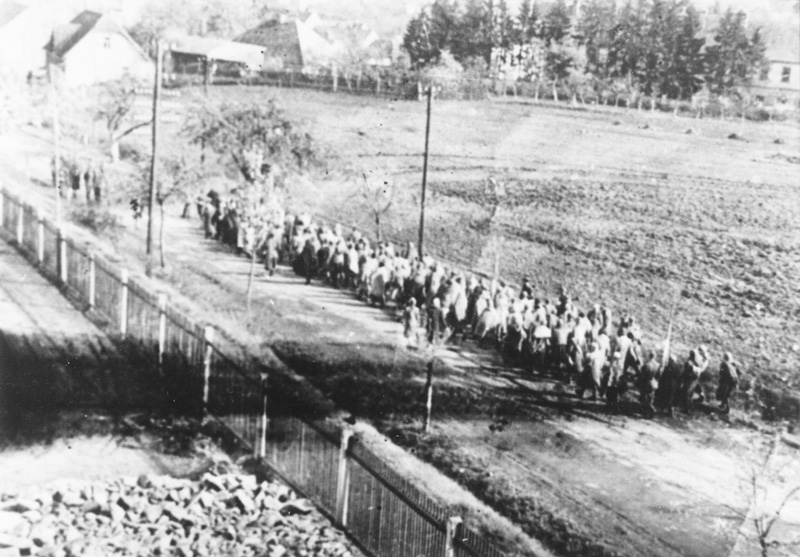
Nazi death march to Volary, 1945
Another day was coming to an end. It was getting dark. Again the SS ordered us off the main road. Again there was an open field. As I looked back I saw our group getting smaller. Exhausted and famished, we could barely move. We crawled to the front of a large building. The SS ordered us in. I grabbed a few handfuls of grass and quickly put it in my pocket. Chaim had the opportunity to grab a few pieces of ice from the frozen ground. Once inside, we covered ourselves with blankets. I pulled out a few blades of grass and mixed it with the melted snow. We swallowed this strange mixture, but still our hunger kept us awake. The night, so miserable and terrible, lasted forever. Insects were eating their way into our clothing, but the cold and hunger were worse than the bugs. We were constantly coughing and sneezing. Unshaven, disheveled from the same clothes we had been wearing for weeks, we began to look like monsters. Gradually, we began to behave like animals, hopeless beasts at the mercy of butchers, waiting to be slaughtered without emotion.
The nights were the worst. We were dying of hunger, yet for the SS who watched us there was plenty of food to eat. We watched them eat, which only made us more aware of our hunger. The SS stood around their warm fireplace and gazed upon us as we lay on the frozen ground, shaking and shivering from the cold. The guards were enjoying their cigarettes, eating and drinking vodka. This was unbearable for us; we were no longer human.
One particular moment will always stay with me, an episode which shows what hunger can do to a so-called human body. It was the night after a very long and painful day early in April. As always, the SS were standing around the fireplace, eating their rations. One officer became sick and went to the side of the road. He doubled over and began to vomit. Chaim and I had been lying on the ground, not too far from the fire. Chaim quietly whispered that he was going to go and pick up the food the soldier had just thrown up. I admonished him, “You cannot eat that. It is sour.” He turned to me and said, “I’m hungry. This is food.” He crawled over to where the soldier had thrown up and swallowed the vomit left on the ground. Chaim came back and after a while, he threw up too. Others had been watching what was going on. At the moment Chaim began to vomit, a few of the starving people, like wild animals, threw themselves on the liquid remains, devouring it in seconds. This is what hunger can do. You appear human, but you are not any longer. Hunger can transform you into something less than human. It was so terrifying to witness this. The SS had turned us into monsters and this was in April 1945, a few weeks before liberation. Not many of us lived to tell about the last moment of the living hell we suffered.
Culled from: The Road To Hell: Recollections of the Nazi Death March
Civil War Injury Du Jour!

Photograph No. 156. Recovery without an operation after gunshot fracture involving the right acetabulum and head of the femur.
Lieutenant James C. Strong, 38th New York Volunteers was wounded at the battle of Williamsburg, Virginia, May 6, 1862, by a conoidal musket ball which entered over the right sartorius muscle about four inches below its origin and made its exit near the right margin of the lower portion of the sacrum. Surgeon A. J. Berry, 38th New York Volunteers, examined the wound and found that the ball had deeply grooved the head of the femur and had fractured the upper rim of the acetabulum. A detached fragment of the rim nearly one and one-half inches in length, a part of it covered with articulate cartilage, together with portions of clothing, were extracted from the wound. On May 8 the patient was transferred by a steamer from Queen’s Creek Landing to the Hygeia Hospital at Fort Monroe. Here he remained until the 13th when he undertook a painful journey on a litter and reached his home in Buffalo, New York. The injured limb was semi-flexed and rotated inwards, the head of the femur being dislocated upon the dorsum of the ileum. Any attempt to place the limb in position produced such acute suffering that the effort was abandoned. For ten weeks there was profuse suppuration with burrowing of pus in the thigh and intense pain with chills, profuse perspiration and great prostration after which a very gradual amendment took place. On December 12, 1862, the patient was removed to Philadelphia and entered at the officer’s hospital at Cammack’s Woods where he was able to bear treatment by Buck’s method of extension by weights. Here a number of spicula of bone were extracted or washed from the wound. On January 6, 1863, the patient was discharged from hospital. On June 1 the wounds were nearly closed and he rejoined his regiment on crutches, and was mustered out with the regiment on June 22, 1863. On September 29 he was appointed Colonel in the Veteran Reserve Corps. He was subsequently brevetted Brigadier General. In July, 1866, when the photograph was taken, General Strong was in good health. His limb was shortened nearly five inches, but by the inclination of the pelvis and extension of the toes, he was able to walk with surprising ease and activity with or without a cane. The head of the femur was firmly ankylosed on the dorsum of the ileum. The cicatrices appeared sound.
Photographed at the Army Medical Museum
By order of the Surgeon General: GEORGE A. OTIS
Culled from: Orthopaedic Injuries of the Civil War
Andersonville Prisoner Diary Entry Du Jour!
This is the continuation of the 1864 diary of Andersonville prisoner Private George A. Hitchcock (see the archived version for all entries up until now).
Here’s today’s entry:
September 28th. Warm and comfortable last night. Drew rations of meal, beef, beans, wood, pork, salt, and molasses, which were dealt out to us in crumbs, drops, splinters, and teaspoonfuls. Three and a half detachments went out to-day.
Culled from: Andersonville: Giving Up the Ghost