Thanks to the entrancing Casey Anthony trial (and if you haven’t been following it you’re really missing out!), we’ve all grown familiar with an old Friend To Fiends: chloroform. Today we look back to the discovery of that magical substance with…
Today’s Sedated Yet Truly Morbid Fact!
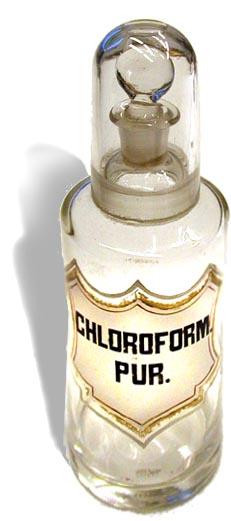 The story went that the doctor who pioneered chloroform as an anesthetic had recognized its potential after it knocked him out cold. James Young Simpson, an Edinburgh physician, had been searching for something better than ether to relieve pain during surgery and childbirth. Ether could be frustratingly slow to act. Also it smelled awful, irritated the lungs, and was prone to ignite, which posed a definite risk at a time when surgeons often worked by candlelight.
Simpson and his two lab assistants decided to experiment on themselves until they found something that worked. They had already tried and dismissed compounds including acetone and benzene when, on the evening of November 4, 1847, they poured out tumblers of chloroform and dipped their faces into the vapor rising from the glass. Within two minutes all three were lying unconscious under the table, “in a trice under the mahogany,” as Simpson later wrote. [Oooh, I Say! – DeSpair] They awoke perhaps half an hour later, lightheaded and dizzy but cheerfully unharmed. “This will change the world,” he thought.
For the next five decades chloroform gained steadily in popularity. Every drugstore stocked it; most doctors, barring a few wary holdouts, prescribed it in abundance. It was mixed into cough syrups and liniments; it was dispensed as a sedative, a sleep aid, a painkiller, a treatment for alcoholic DTs, for hiccuping, seasickness, colic, vomiting, and diarrhea. No one was exactly sure how it worked, just that it appeared to slow the body down and sedate the brain, sliding a patient into a much-desired stupor.
The more physicians used chloroform, though, the more they realized that it was a capricious kind of anesthesia. There were reports of patients who inexplicably, unexpectedly died on the operating table before the surgeon even lifted his knife An invalid would slide away into chloroform-induced unconsciousness and just keep sliding. The breathing would sputter to bare gasps; the heartbeats would decrease in an ever-slowing rhythm. Alarmed doctors began tallying the deaths. On average, it seemed, chloroform anesthesia killed at least 1 in every 3,000 patients. And no one knew how to fix that because no one was sure why it happened.
Chloroform was a simple enough compound, an uncomplicated arrangement of carbon, hydrogen, and chlorine. Yet somehow that tidy mixture formed a chemical loose cannon, killing without warning or apparent reason. Doctors weren’t really even sure what a safe dose was. One patient died after receiving one-thrid of an ounce; another man, a known chloroform addict, succumbed only after going through a quart of the drug. Chloroform, not surprisingly, was riskiest for children, the elderly, and alcoholics, but it also, unpredictably, killed healthy adults.
At the turn of the 20th century, the British Medical Association called chloroform the most dangerous anesthetic known, and the American Medical Association urged that hospitals stop using it entirely. But it would be several more decades before chloroform disappeared from the pharmacy shelves.
Culled from: The Poisoner’s Handbook