Today’s Pus-Filled Yet Truly Morbid Fact!
On July 21, 1881, Charles Guiteau shot President James A. Garfield in the waiting room of Sixth Street Station in Washington, D.C. Here’s the story of the assassination from Sam Kean’s marvelous The Tale of the Dueling Neurosurgeons: The History of the Human Brain as Revealed by True Stories of Trauma, Madness, and Recovery
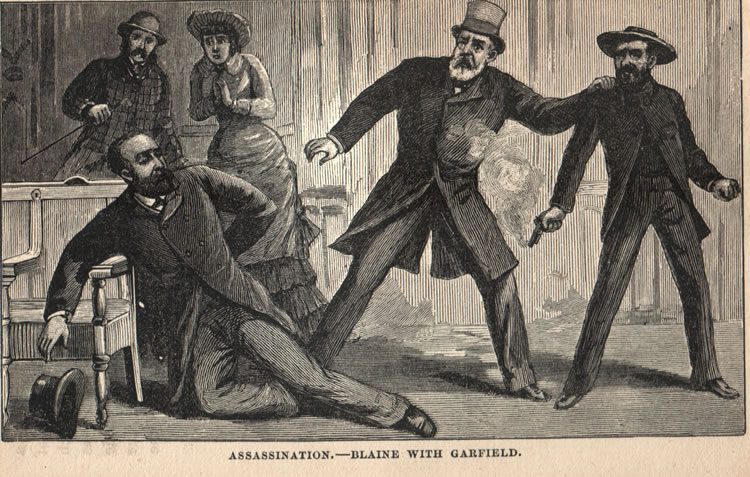
Kill Garfield. Slinking out, Guiteau closed to within two yards. The first shot grazed Garfield’s arm, stunning him. Guiteau fired again and plugged Garfield in the lower back. This second shot brought pandemonium on the platform – screams, hollers, chaos. Guiteau speed-walked away, but a policeman nabbed him at the depot exit.
Meanwhile Garfield’s legs crumpled and he sank down, a circle of red blooming on his back. Two doctors arrived moments later – as did Garfield’s advisors, including Robert Todd Lincoln, who sixteen years before had seen his father borne out of Ford’s Theatre. “Mr. President, are you badly hurt?” one doctor asked. According to one account, Garfield breathed, “I’m a dead man.”
So began the national James Garfield deathwatch. With the recent expansion of telegraph lines across the world, Garfield’s suffering became practically a live event, and Garfield’s physician, one Dr. Doctor Bliss (sic the first name, and last), took full advantage of the new medium. Newspapers coast to coast reprinted his daily bulletins, and many cities plastered updates onto huge billboards in their public squares.
Unfortunately, Dr. Doctor provided more bliss with his public relations than with his medical care. Garfield suffered from three main problems over the next few months: isolation, hunger, and pain. Isolation, because Bliss confined him to a bed and forbade even family members from seeing him at first. Hunger, because Bliss, fearing an intestinal infection, began feeding the president rectally, with a slurry of beef broth, egg yolks, milk, whiskey, and opium. (The empty-bellied president spent many an hour that summer fantasizing about hearty recipes from his frontier boyhood such as squirrel soup.) Pain, because Guiteau’s second shot had lodged itself inside Garfield’s torso; he described the discomfort as a “tiger claw” raking his legs and genitals. Bliss tried excavating the bullet, but no matter how many times he worked his fingers into the wound and rooted around in Garfield’s groin, the slug eluded him. Other doctors tried their hands, too, and Bliss even recruited Alexander Graham Bell to rig up a crude metal detector of batteries and wire. No trace. A few doctors begged Bliss to check near Garfield’s spinal cord instead, since the collapse of the president’s legs at the depot and the subsequent shooting pain both sounded like neurological trouble. Bliss blew them off and kept digging. Meanwhile, he kept releasing what one historian called “fraudulently optimistic” bulletins about Garfield’s progress and sure recovery. Other doctors leaked more negative assessments, causing a rift within the president’s medical team.
Bliss eventually granted Garfield’s wish to escape D.C., and they relocated to the president’s cabin in coastal New Jersey. Ironworkers laid 3,200 extra feet of track right to the cabin door, they pushed Garfield’s railroad car the last quarter mile when it got stuck on a hill. The change of scenery and seaside air buoyed the president at first, but he soon faded, as he still couldn’t eat. Overall, Garfield lost eighty pounds in eighty wretched days, and when Bliss’s fingers finally infected Garfield’s wound, turning it into a slimy pocket of pus, Garfield had no fight left. He died on September 19, 1881. The autopsy found the bullet nestled near his spine.
And What Became Of Charles Guiteau?

Now, does THIS look like the face of a madman?
“The doctors killed Garfield; I just shot him.” – Guiteau does have point there…
From Wikipedia:
Once Garfield died, the government officially charged Guiteau with murder. He was formally indicted on October 14, 1881, for the charge of murder, which was previously attempted murder after his arrest. Guiteau pleaded not guilty to the charge. The trial began on November 14, 1881, in Washington, D.C. The presiding judge in the case was Walter Smith Cox. Guiteau’s court-appointed defense lawyers were Leigh Robinson and George Scoville, although Guiteau would insist on trying to represent himself during the entire trial. Wayne MacVeagh, the U.S. Attorney General, served as the chief prosecutor. MacVeagh named five lawyers to the prosecution team: George Corkhill, Walter Davidge, John K. Porter, Elihu Root, and E.B. Smith.
Guiteau’s trial was one of the first high-profile cases in the United States where the insanity defense was considered. Guiteau vehemently insisted that while he had been legally insane at the time of the shooting, he was not really medically insane, which was one of the major causes of the rift between him and his defense lawyers.
Dr. Edward Charles Spitzka, a leading alienist, testified as an expert witness. Dr. Spitzka had stated that it was clear “Guiteau is not only now insane, but that he was never anything else.” While on the stand, Spitzka testified that he had “no doubt” that Guiteau was both insane and “a moral monstrosity”. Spitzka came to the conclusion that Guiteau had “the insane manner” he had so often observed in asylums, adding that Guiteau was a “morbid egotist” who “misinterpreted and overly personalized the real events of life”. He thought the condition to be the result of “a congenital malformation of the brain”.
George Corkhill, who was the District of Columbia’s district attorney and on the prosecuting team, summed up the prosecution’s opinion of Guiteau’s insanity defense in a pre-trial press statement that also mirrored public opinion on the issue. Corkhill stated the following:
He’s no more insane than I am. There’s nothing of the mad about Guiteau: he’s a cool, calculating blackguard, a polished ruffian, who has gradually prepared himself to pose in this way before the world. He was a deadbeat, pure and simple. Finally, he got tired of the monotony of deadbeating. He wanted excitement of some other kind and notoriety, and he got it.
—George Corkhill – District attorney for District of Columbia
Guiteau became something of a media sensation during his entire trial for his bizarre behavior, which included him frequently cursing and insulting the judge, most of the witnesses, the prosecution, and even his defense team, as well as formatting his testimony in epic poems which he recited at length, and soliciting legal advice from random spectators in the audience via passed notes. He dictated an autobiography to the New York Herald, ending it with a personal ad for “a nice Christian lady under 30 years of age”. He was oblivious to the American public’s hatred of him, even after he was almost assassinated twice himself. He frequently smiled and waved at spectators and reporters in and out of the courtroom, seemingly happy to be the center of attention for once in his life.
Guiteau attempted to convince President Chester A. Arthur to set him free through a letter as he had just increased Arthur’s salary by making him president. At one point, Guiteau argued before Judge Cox that President Garfield was killed not by the bullets but by medical malpractice (“The doctors killed Garfield, I just shot him”), which, if one discounts the fact that Guiteau had been responsible for Garfield needing that medical attention in the first place, was more than a little true. Guiteau’s argument had no legal support, however. Throughout the trial and up until his execution, Guiteau was housed at St. Elizabeths Hospital in the southeastern quadrant of Washington, D.C. While in prison and awaiting execution, Guiteau wrote a defense of the assassination he had committed and an account of his own trial, which was published as The Truth and the Removal.
To the end, Guiteau was actively making plans to start a lecture tour after his perceived imminent release and to run for president himself in 1884, while at the same time continuing to delight in the media circus surrounding his trial. He was found guilty on January 25, 1882. After the guilty verdict was read, Guiteau stepped forward, despite his lawyers’ efforts to tell him to be quiet, and yelled at the jury saying “You are all low, consummate jackasses!” plus a further stream of curses and obscenities before he was taken away by guards to his cell to await execution. Guiteau appealed his conviction, but his appeal was rejected, and he was hanged on June 30, 1882, in the District of Columbia, just two days before the first anniversary of the shooting.
Of the four presidential assassins, Guiteau lived longer than any after his victim’s death (nine months). While being led to his execution, Guiteau was said to have continued to smile and wave at spectators and reporters, happy to be at the center of attention to the very end. He notoriously danced his way to the gallows and on the scaffold as a last request, he recited a poem he had written during his incarceration which he called I am Going to the Lordy. He had originally requested an orchestra to play as he sang his poem, but this request was denied.
After completing his poem, a black hood was placed over Guiteau’s head and moments later the gallows trapdoor was sprung, the rope breaking his neck instantly with the fall. Guiteau’s body was not returned to his family, as they were unable to afford a private funeral, but was instead autopsied and buried in a corner of the jailyard.
With tiny pieces of the hanging rope already being sold as souvenirs to a fascinated public, rumors immediately began to swirl that jail guards planned to dig up Guiteau’s corpse to meet demands of this burgeoning new market. Fearing scandal, the decision was made to disinter the corpse. The body was sent to the National Museum of Health and Medicine in Maryland, which preserved Guiteau’s brain as well as his enlarged spleen discovered at autopsy and bleached the skeleton. These were placed in storage by the museum.
Part of Guiteau’s brain remains on display at the Mütter Museum in Philadelphia.