Okay, I admit today’s MFDJ is too long but I found it all so fascinating that I just kept going and going and this is where I stopped. So, I hope you can take the time to read it all and find it interesting too. And I will try to behave myself where length is concerned in the future!
Today’s Vitamin-Saturated Yet Truly Morbid Fact!
Today’s MFDJ continues yesterday’s fact and the story of the Dutch ship navigated by Willem Barentsz, which had a nasty encounter with a polar bear who was killed by the sailors. That particular journey was aborted and in 1596 Barenstz set out on another journey, determined to push further north this time. During this trip, Barenstz learned that polar bears can be just as dangerous dead as alive.
… This time Barentsz pushed too far. He reached the northern tip of Novaya Zemlya and rounded it at last, but as soon as he did so, an unseasonable freeze swept down from the Arctic. The cold stalked his ship southward along the coastline, and each day it became harder to shoulder out room between the floes. Pretty soon Barentsz found himself checkmated, marooned on a continent of ice.

For my fellow Americans who have no clue where Novaya Zemlya is!
Abandoning their floating coffin – the men could no doubt hear the ice expanding and splintering the ship beneath their feet – the crew staggered ashore to a peninsula on Novaya Zemlya to seek shelter. In their one piece of good luck, they discovered on this treeless island a cache of bleached-white driftwood logs. Naturally the ship’s carpenter up and died immediately, but with that wood and a few timbers salvaged from their ship, the dozen crewmen built a log cabin, about eight yards by twelve yards, complete with pine shingles, a porch, and front stairs. With more hope than irony, they called it Het Behouden Huys, the Saved House, and settled down to a grim winter.
Cold was the omnipresent danger, but the Arctic had plenty of other minions to harass the men. In November the sun disappeared for three months, and they grew stir-crazy in their dark, fetid cabin. Perversely, fires threatened them too: the crew almost suffocated from carbon monoxide poisoning one night because of poor ventilation. They managed to shoot some white foxes for fur and meat, but the critters constantly nipped at their food supplies. Even laundry became a black comedy. The men had to stick their clothes almost into their fires to get enough heat to dry them. But the garments could be singed and smoking on one side, and the far side would still be brittle with ice.
For sheer day-to-day terror, however, nothing matched the run-ins with polar bears. One of Barentsz’s men, Garrit de Veer, recorded in his diary of the voyage that the bears practically laid siege to Het Behouden Huys, raiding with military precision the barrels of beef, bacon, ham, and fish stacked outside. One bear, smelling a meal on the hearth one night, crept up with such stealth that it had padded up the back stairs and crossed the back door’s threshold before anyone noticed. Only a lucky musket shot (which passed through the bear and startled it) prevented a massacre in the tiny quarters.
Fed up, half-insane, lusty for revenge, the sailors charged outdoors and followed the blood in the snow until they tracked down and killed the invader. When two more bears attacked over the next two days, the sailors again cut them down. Suddenly in high spirits and hungry for fresh meat, the men decided to feast on the bears, stuffing themselves with anything edible. They gnawed the cartilage off bones and sucked the marrow out, and cooked up all the fleshy victuals – the heart, kidneys, brain, and, most succulent of all, the liver. And with that meal, in a godforsaken cabin at eighty degrees north latitude, European explorers first learned a hard lesson about genetics – a lesson other stubborn Arctic explorers would have to keep learning over and over, a lesson scientists would not understand fully for centuries. Because while polar bear liver may look the same purplish red as any mammal’s liver and smell of the same raw ripeness and jiggle the same way on the tines of a fork, there’s one big difference: on the molecular level, polar bear liver is super-saturated with vitamin A.
Vitamin A stimulates growth and helps convert immature cells into full-fledged bone or muscle or whatever at a fast clip. Vitamin A is especially potent in the various layers of skin. In adults, for instance, vitamin A forces certain skin cells to crawl upward from inside the body to the surface, where they die and become the protective outer layer of skin. High doses of vitamin A can also damage skin through “programmed cell death.” This genetic program, a sort of forced suicide, helps the body eliminate sickly cells, so it’s not always bad. But for unknown reasons, vitamin A also seems to hijack the system in certain skin cells – as Barentsz’s men discovered the hard way.
After the crew tucked into their polar bear stew, rich with burgundy liver chunks, they became more ill than they ever had in their lives. It was a sweaty, fervid, dizzying, bowels-in-a-vice sickness, a real biblical bitch of a plague. In his delirium, the diarist Garrit de Veer remembered the female bear he’d helped butcher, and moaned, “Her death did vs [sic] more hurt than her life.” Even more distressing, a few days later de Veer realized that many men’s skin had begun to peel near their lips or mouths, whatever body parts had touched the liver. De Veer noted with panic that three men fell especially “sicke,” and “we verily though that we should haue [sic] lost them, for all their skin came of[f] from the foote to the head.”
Only in the mid-twentieth century did scientists determine why polar bear livers contain such astronomical amounts of vitamin A. Polar bears survive mostly by preying on ringed and bearded seals, and these seals raise their young in about the most demanding environment possible, with the 35°F Arctic seas wicking away their body heat relentlessly. Vitamin A enables the seals to survive in this cold: it works like a growth hormone, stimulating cells and allowing seal pups to add thick layers of skin and blubber, and do so quickly. To this end, seal mothers store up whole crates of vitamin A in their livers and draw on this store the whole time they’re nursing, to make sure pups ingest enough.
Polar bears also need lots of vitamin A to pack on blubber. But even more important, their bodies tolerate toxic levels of vitamin A because they couldn’t eat seals – about the only food source in the Arctic – otherwise. One law of ecology says that poisons accumulate as you move up a food chain, and carnivores at the top ingest the most concentrated doses.
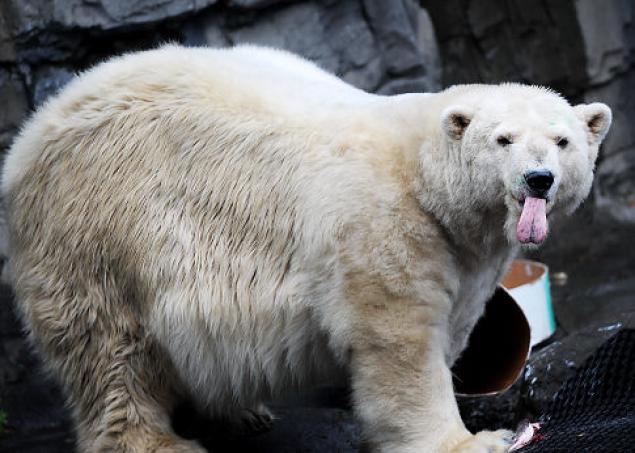
Nyah-nyah!
We hominids have been learning and relearning this same hard lesson about eating carnivore livers for an awfully long time. After polar bears arose, Eskimos, Siberians, and other northern tribes learned to shun polar bear livers, but European explorers had no such wisdom when they stormed into the Arctic. Many in fact regarded the prohibition on eating livers as “vulgar prejudice.” As late as 1900 the English explorer Reginald Koettlitz relished the prospect of digging into polar bear liver, but he quickly discovered that there’s sometimes wisdom in taboos. Over a few hours, Koettlitz felt pressure building up inside his skull, until his whole head felt crushed from the inside. Vertigo overtook him, and he vomited repeatedly. Most cruelly, he couldn’t sleep it off; lying down made things worse. Another explorer around that time, Dr. Jens Lindhard, fed polar bear liver to nineteen men under his care as an experiment. All became wretchedly ill, so much so that some showed signs of insanity.
Culled from: The Violinist’s Thumb and Other Lost Tales of Love, War, and Genius as Written by Our Genetic Code
Nice doctor, huh? “Let’s see what happens if I feed these guys polar bear liver… Hmmmm, verrrry interesting!”
Scientist Du Jour!
It’s a rare scientist who documents his own death for science, but that’s what Karl P. Schmidt did in 1957. Respect! (Thanks to Eleanor for the link.)
 |