Today’s Disease-Ridden Yet Truly Morbid Fact!
Philadelphia in the early 1800s was an easy place to die. The simplest thing could end your life: a broken bone from a fall, a leg gouged by a loose nail, a hand burned by a pot of boiling soup. In a time before antibiotics, infections could ravage a body in days. You could die from allergies. You could die from asthma. You could die from a single rotten tooth.
The food you ate and the water your drank could kill you just as easily as the guns that were bought and sold without regulation. Of course, there was cancer and diabetes, gout and heart disease. There was murder and suicide and accidental drownings, as well as executions by city and state.
Infectious diseases ran rampant through populous cities like Philadelphia, wreaking havoc on everything they touched.
There was smallpox, spread simply by human interaction. It caused the body to burst into blisters, lesions, and scabs, affecting adults and children equally and brutally. If you were lucky enough to survive it, the scars left behind – including sterility – could haunt you the rest of your life.
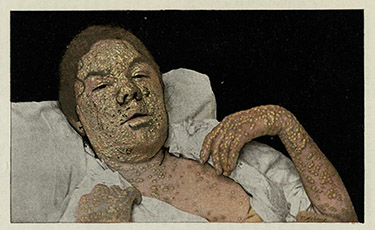
Smallpox victim
There was yellow fever, which no one knew was spread by mosquitoes and which earned its name by turning its victims yellow, before forcing them to bleed from the eyes and mouth and erupt with the black vomit of partially digested blood.
In 1793, yellow fever struck a rain-soaked Philadelphia so hard that the entire government shut down. Once symptoms were seen, the infected person was all but abandoned by friends and family. To protect their own patients, the Pennsylvania Hospital and Almshouse refused to receive yellow fever victims, forcing ailing citizens to eventually die alone in the streets. It became such a problem hat local authorities annexed a circus ground on the outskirts of the city as a “depository [for] victims of the plague who had nowhere to go and nobody to care for them.” The city’s most prominent physician, Dr. Benjamin Rush, advised that all his patients leave the city at once, and anyone forced to remain should immediately engage in “heroic bleeding and purging.” Rush’s advice only caused more death. [That guy again! – DeSpair] By the end of the disease’s reign, more than one-tenth of the city’s entire population was dead.
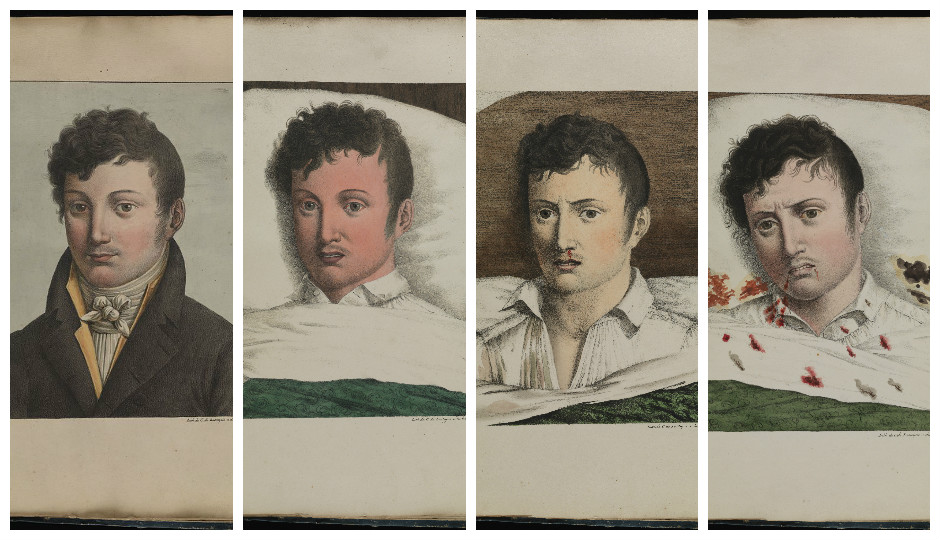
Yellow fever infecting a victim
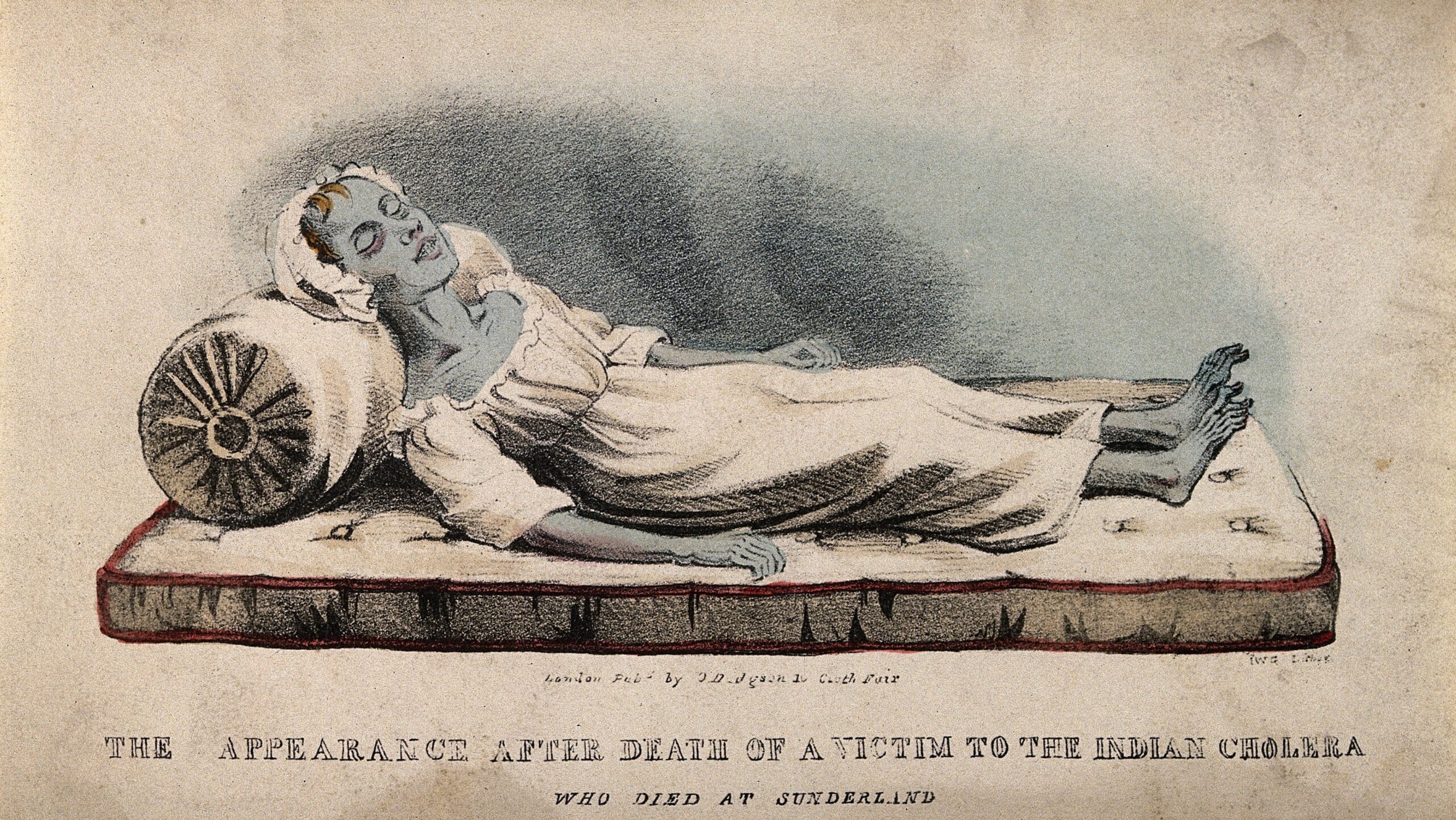
There was cholera, spread through contaminated drinking water, which painfully dehydrated its victims, the affected bodies retching liter upon liter of a fluid that looked like rice water and smelled like fish.
In 1832, cholera spread across the East Coast, finally hitting Philadelphia in July. It became such an overwhelming problem that Philadelphia publishing house Carey, Lea & Blanchard (at the time, the country’s leading publisher of medical books) began publishing The Cholera Gazette, a weekly publication designed to inform the public of the progress and hopeful treatment of this terrible disease. It became wildly popular as the death toll from the disease caused Philadelphia to log in sixty to seventy deaths a day. It took nearly four months for the city to rid itself of the disease, and as testimony to the “heroic role of the medical profession in battling the infection,” the city council would eventually reward the physicians in charge of the hospitals during this time with silver pitchers of recognition.
There was also malaria and croup, diphtheria and dysentery, measles and whooping cough, consumption and scarlet fever. Even something as simple as the flu could kill hundreds in a city over one winter.
Culled from: Dr. Mutter’s Marvels: A True Tale of Intrigue and Innovation at the Dawn of Modern Medicine
Arcane Excerpts: Cholera Gazette
Of course, I had to go and find some issues of The Cholera Gazette and read them. Here are a couple of interesting case studies from the Wednesday, August 8, 1832 issue of theGazette. These victims were treated by injecting them with saline solution, with mixed results. (As you can see, Cholera is a horrible way to die.)
Injection of Saline Solutions into the Veins
No. 5.
Details of Two Cases of Malignant Cholera treated by Venous Injection, by Dr. Craigie, of Leith.
No. 1. Case successful. 15lbs. injected at intervals in nine hours.—Martha Smith, aged thirty-eight, a noted drunkard, thin and debilitated, in sixth month of pregnancy, admitted into the hospital at 8 P. M. May 16th, 1832.
It appears she had had vomiting and purging since Sunday morning, 12th inst. Cramps came on about four hours ago in both legs; great evacuations both upwards and downwards like dirty water. The countenance is now collapsed; eyes sunk; tongue cold; pulse imperceptible at wrists; very small in brachial artery; 124.
℞. Muriat sodæ, ℨiij; Carbon sodæ, ℨi; Aq. calid. ℔vj. solve. Ft. Enema statim injiciend. Sinapisms to spine and epigastrium; let her be placed on heated tin mattress.
Nine A. M. Has a good deal of vomiting; is getting warmer; pulse now perceptible in right wrist; tongue warmer; she allows the enema to come away without giving notice to nurse. Saline enema as above, with the addition of white of eggs, to be repeated every half hour.
Ten. Vomiting and purging of watery fluid, with slimy matter in it.
Half-past ten. Cramps have returned severe in left leg; pulse again imperceptible; urgent thirst, and constant vomiting. Rep. enema et pulveres effervescentes.
Half-past eleven. Breathing becoming much affected; extreme restlessness; cramps severe in legs, and every symptom of sinking. Let the following saline solution be injected into one of the veins of the arm.
℞. Muriat sodæ, ℨi; Carbon sodæ, gr. x; Aq. calid. ℔iij, solve temp. 105° Fahr.
Noon. When about ℔i. had been thrown in, the pulse was perceived to flutter at the wrist, and gradually strengthened as the injection was proceeded with. By the same ℔iiiss. had been injected, the countenance, which was before quite death-like, now beamed with the appearance of health, and she began to converse freely. Pulse 96, moderate. To have ℥i. gin in warm water with sugar.
Half-past one. The gin was immediately rejected. Pulse has again gradually become imperceptible, and respiration quick and laborious.
Two. Let the venous injection be repeated to ℔vij.
The effect of the injection, as formerly, was very striking. To see an individual who seemed in articulo mortis brought back, as it were, in so short a space of time to an apparently tolerable state of health, could not but astonish the beholder. Before the injection was finished the pulse had returned to a healthy fulness and firmness. Expresses herself much relieved; no purging, but vomits much serous matter.
℞. Muriat sodæ, ℨij; Carbon sodæ, ℨi; Alcohol. dilut. ℥i; Aq. calid. ℔iij. M. ft. enema statim injiciend.
Four. Enema retained about an hour and a half; surface of body now comfortably warm; she has not passed more fluid by stool than was thrown into the rectum.
Six. Has slept softly for an hour; the first sleep she has had for many days.
℞. Subm. hydrarg. gr. v; Pulv. opii, gr. ss. M. sumat stat. et rep. 3tia quaque hora.
Nine. Complains much of vomiting and sense of weakness; countenance rather collapsed; breathing rather difficult.
Let ℥lxxx. be injected into the veins again gradually.
After the first few ounces were thrown in she complained of an acute pain at the epigastrium, and faintness, probably arising from the fluid being thrown in too fast upon the heart, or from the passing of a bubble or two of air, which may have got in from the inaccuracy of the injecting apparatus used. Be that as it may, the circulating system was so much affected, that the pulse, from being distinct though feeble, became quite imperceptible, but on stopping the injection for a few minutes the pulse gradually returned, and the pain abated. She expresses herself as always getting relief from the operation.
Eleven. Vomiting continues urgent.
App. emp. cantharid. epigast. Effervescing draughts occasionally.
May 17th. Has passed about ℔j. of urine, of natural appearance; this is the first she has made since she was brought in.
From this time she went on gradually to improve, but stomach continued very irritable, and the matter vomited was bilious.
21st. Labour pains came on, and she was delivered of a still-born female child.
22d. Symptoms of phlebitis in right arm came on, proceeding from the wound upwards, but this yielded to the ordinary treatment, and she may now be considered out of all danger, though she is not yet reported cured.
THOMAS CRAIGIE, M. D.
Leith, May 26th, 1832.
No. 2. Case fatal—appearances on dissection.—George Cousins, aged ten, was brought into quarantine at nine, A. M. 13th May, on account of his mother being ill of cholera. About an hour after admission began to vomit and purge, and it appears he has had diarrhœa severely all the morning. Pulse 102, extremely weak; complains much of sickness; countenance collapsed; areolæ rather dark under the eyes; voice very weak.
He had hot air-bath immediately, and got the following dose:—
℞. Ol. ricini, ℥ss; Tinct. opii, gtt. xv; Aq. menth. pip. ℥iss. M. ft. haust.
Half-past eleven, A. M. Draught retained; sickness has gone off; complains of heat of bath; let it be removed.
Noon. Has vomited some watery matter, with undigested potatoes in it, and again a rice-watery fluid with flocculi. He has now a considerable degree of jactitation; countenance more sunk, and great desire for cold water. These symptoms went on increasing in severity in spite of sinapisms to spine, effervescing draughts, calomel, and Dover’s powder, warm water, enemeta, &c., and head symptoms were now making their appearance.
Half-past two P. M. Pulse quite imperceptible, and has been so for an hour and a half; he lies quiet and drowsy, with eyes turned upwards; face bedewed with cold perspiration; hands and feet cold and very blue.
My colleagues, Drs. Combe and Lewins, saw him with me at this time, and concurred with me in thinking him not only beyond all hope of recovery, but likely to die within an hour or two.
From what I had seen of the resuscitating powers of Dr. Latta’s treatment on the boy’s mother this morning, by venous injection, I determined on giving it a trial, though this was a case rather likely to bring discredit on the remedy than otherwise. The following solution, at temperature 102° F. was slowly injected into the median basilic by means of a common silver blow-pipe attached to Reid’s enema syringe:—
℞. Muriat sodæ, ℨi; Carbon sodæ, gr. x; Aq. calid. ℔vj. solve. T. 102.
Three P. M. A few minutes after the injection was commenced the pulse returned to the wrists, the blueness and coldness of the extremities gradually wore off; the countenance was much improved; and the whole fluid was injected within twenty minutes.
Half-past three P. M. He has now a healthy, blooming appearance; is sitting up in bed, and looking about him as if awoke out of a dream. Pulse 110, natural; extremities of good colour and warm; voice much stronger.
Half-past four P. M. Pulse has been gradually falling off since last report; is getting listless, and dislikes to be troubled with questions, breathing becoming laborious, and head symptoms more marked, with squinting to a slight degree superadded.
Seven P. M. Pulse again imperceptible; respiration quick and laboured; countenance collapsed; tongue and breath cold; says he is dying.
Let the venous injection be repeated to ℔iij.
Half-past seven P. M. Pulse immediately returned, of natural strength and fulness, and continues so.
Nine P. M. Lies very quiet; pulse good; breathing more natural; surface of body covered with warm perspiration.
Ten P. M. Large watery evacuations from the bowels came on soon after last injection; the quantity cannot easily be guessed, but must have been considerable, as it is running through the mattress on the floor. Pulse scarcely perceptible; screams loudly like a child in hydrocephalus.
Eleven P. M. Pulse quite imperceptible; is sinking fast; venous injections attempted a third time, but desisted from as it was not productive of the first good effects. Both pupils much dilated. Died at two A. M. 14th.
Dissection fifteen hours after death.—On exposing the brain and spinal marrow, but before opening their investing membranes, the least pressure with the fingers on the middle of the hemispheres of the brain caused a remarkable undulating down to the middle of the back, showing the existence of a fluid beneath the membranes, and on opening them about two drachms of pure serum flowed out.
The surface of the brain was rather vascular, and the blood in the most minute vessels particularly bright. A few ecchymosed spots on its surface. All the other viscera were found healthy. The urinary bladder contained about half an ounce of urine.
THOMAS CRAIGIE, M. D.
Leith, 26th May, 1832.