Today’s Explosive Yet Truly Morbid Fact!
The Wingfoot Air Express was a dirigible that crashed into the Illinois Trust and Savings Building in Chicago on Monday July 21, 1919. The Type FD dirigible, owned by the Goodyear Tire and Rubber Company, was transporting people from Grant Park to the White City amusement park. One crew member, two passengers, and ten bank employees were killed in what was, up to that point, the worst dirigible disaster in United States history.
The following is part 2 of excerpts from the book City of Scoundrels detailing the crash of the flaming dirigible into the bank building:
As the five o’clock hour approached, activity on the floor was waning. The women in the stenographic pool were finishing up for the day, pecking out a few last lines before pulling the covers over their typewriters and getting ready to leave. Helen Berger, the stout but ever-energetic chief stenographer, was attending to last-minute details with teller Marcus Callopy. Assistant cashier F. I. Cooper had left his desk and was accompanying a messenger to the vault area with some records.
A few people noticed a change in the light around them as a shadow passed over the skylight above. This was followed by a sudden flash, which made some think that a photographer was taking a picture. Cooper the cashier, standing at the entrance to the bank’s large time vault, heard a sound of breaking glass overheard and turned around to investigate. What happened next was horrifying. “The body of a man,” he later said, “so badly burned and mangled that I could not tell at first that it was a man, came hurtling through the air and fell at my very feet.” It was the body of mechanic Carl Weaver.
That was when the entire bank seemed to detonate.
“I thought a bomb had been exploded,” one man said. Bombings had been in the news all year, and many bank employees worried that the Illinois Trust might be a target. But it instantly became clear that this was no ordinary explosive device.
A. W. Hiltabel was working in one of the teller cages at the south end of the room: “The first thing I heard was the breaking of the skylight,” he said. “I looked up and saw fire raining down from the roof. There seemed to be a stream of liquid fire pouring down into the room.”
Debris was suddenly falling everywhere. A huge engine and fuel tank slammed to the marble floor in front of him. “They exploded,” Hiltabel said. “Flames shot high into the room and all over the place. I ducked under my desk.”
Carl Otto and his colleague Edward Nelson were in conference at the telegraph desk when they heard the terrific explosion above them. Suddenly they found themselves showered by “an avalanche of shattered window panes and twisted iron.” Something sharp and heavy struck Nelson in the knee, throwing him to the ground. As hot sheets of flame billowed around him, he managed to crawl across the floor to an open teller cage. He scrambled up over the marble counter and out of the teller window to the lobby outside.
Carl Otto was not so lucky. The telegrapher took a direct hit from the falling engine and was instantly, horribly, crushed. [Incidentally, Carl had missed several weeks of work suffering from influenza. His wife had begged him to stay home one more day and start work on Monday, when his sick leave officially ended, but Carl was adamant that if he was physically able he needed to work. Bummer. – DeSpair]
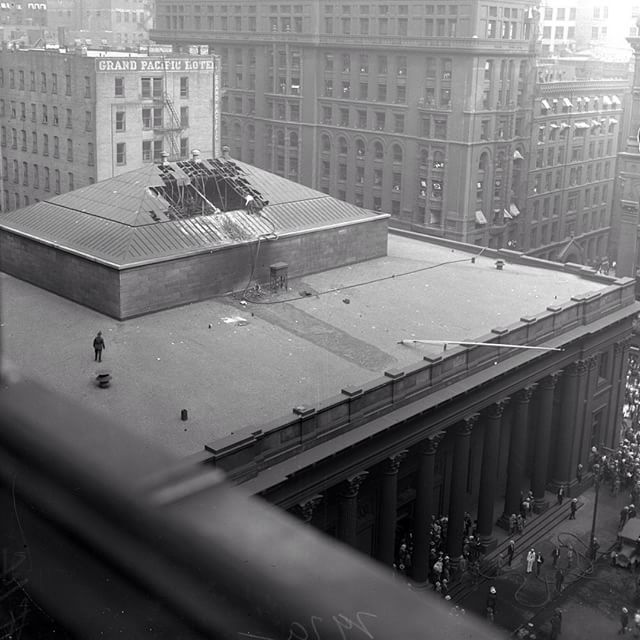
The hole in the skylight of the bank building
The initial shattering of the skylight had brought C. C. Hayford out of his office in the credit department. “I ran out and an explosion… hurled me over,” he later explained. “I got up and someone ran into me, screaming, ‘Oh my God, it’s raining hell!'” Then Hayford saw great columns of fire rising almost majestically above the line of teller cages before him. He could make out silhouetted figures struggling in the flames. “The screams were indescribable,” he said. “I turned sick. A man – I don’t know his name – staggered out of the cage carrying the body of a girl. His own face was covered with blood.”
By this time, the central court was, according to workers in the balcony, “a well of fire, a seething furnace.” Clerks, stenographers, and bookkeepers, many of them with clothes ablaze, were clawing toward the two exits; others managed to escape through the narrow teller windows. “I saw women and men burning,” said Joseph Dries, a clerk in the bond department. “I saw everybody trying to get out through the doors of the cages.”
But many didn’t move fast enough. Stenographer Maria Hosfield looked on in horror as her boss was burned alive. “I was sitting next to Helen Berger and saw her become enveloped in flames,” she said. Several men ran to the chief stenographer and tried to extinguish her burning clothes. “She was saturated with gasoline,” said bank guard William Elliott. “Everything was so confused… but I heard the screams, and I looked and saw flames eating her.” He took off his coat and wrapped it around her. Pushing her to the ground, he rolled her on the floor to douse the flames, severely burning his hands. But he knew he had been too late.
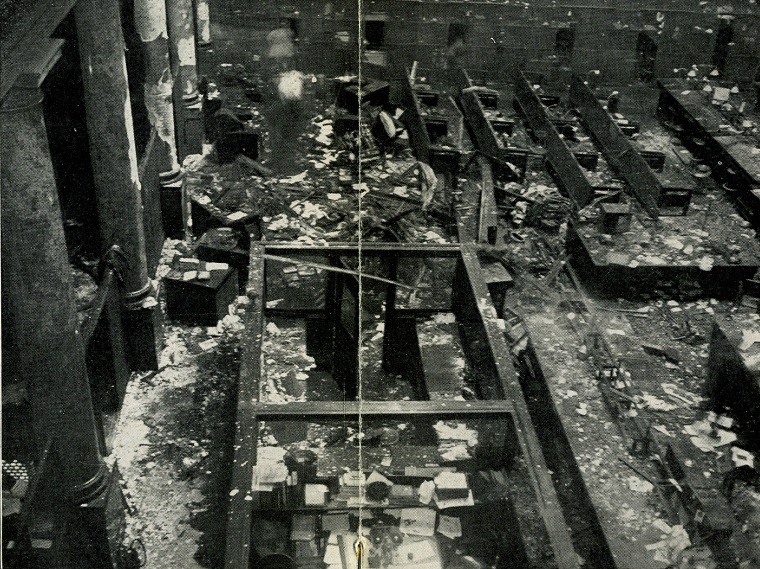
The burned out interior of the bank
By now, police and firefighters were arriving on the scene. The intense heat of the fire, however, made it difficult for them to enter the caged rotunda. People were pouring out of the bank’s windows like bees escaping a burning hive. Half-naked, dazed, and bloodied, many were now wandering numbly through the streets of the financial district. “When I got to the street,” bank employee W. A. Woodward said, “I noticed that my face, head, and arms were covered with blood… A man I had never seen before rushed up to me and said, ‘Man, don’t you know that you are badly hurt?’ There was no ambulance near, so this man hustled me into a taxicab and took me to St. Luke’s Hospital.”
A crowd estimated at twenty thousand people had been drawn to the streets of the southern Loop to watch the disaster. Many were trying to help the victims. Several gathered around Milton Norton. The photographer lay in the street in front of the Board of Trade Building, still attached by rope to his smoldering parachute. By all appearances, the man seemed dead. But someone flagged down a passing automobile and ordered the drive to take the battered man to the hospital.
Meanwhile, Jack Boettner had made his way to the street. After detaching himself from his burning chute on the roof of the Board of Trade Building, the pilot had found a fire escape and started down. It took a long time for him to reach street level. Amazed to find himself only slightly injured, he set off amid the confusion to search for his men. He was intercepted on the street by two police detectives, and when he told them who he was, they immediately arrested him and took him away for questioning.
Back at the Illinois Trust Building, firemen struggled to bring the blaze under control. Charred and bloody bodies were now being removed from the rotunda. Friends and relatives of bank employees ran frantically around the streets, looking for their loved ones. Bystanders were doing what they could, wrapping the injured in their own jackets and helping them to waiting automobiles. Even those people who had only witnessed the disaster were stunned, incredulous. No one could quite take in the reality of what had happened. How had this experimental blimp – this enormous, floating firebomb – been allowed to fly over one of the most densely populated square miles on Earth?
Culled from: City of Scoundrels: The 12 Days of Disaster That Gave Birth to Modern Chicago
In the end, pilot Jack Boettner and chief mechanic Harry Wacker were the sole survivors of the 5 people in the dirigible. And an additional 10 bank employees were killed in the crash and inferno.
And Capitalism Stops for No Blimp!
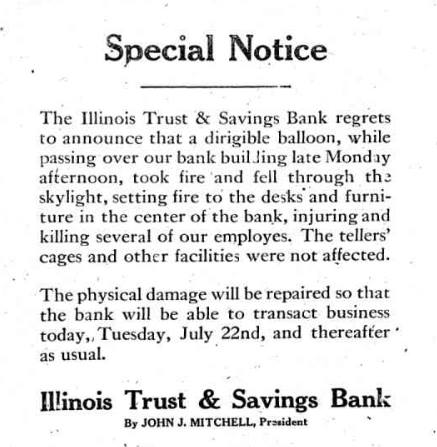
” How nice of them to acknowledge the names of their dead and injured employees, eh?”
Given the time period and the chaos of the scene, it’s probably likely that the casualty list was not available, much less finalized by the time the announcement had to go to print.