Today’s Aggressively Individual Yet Truly Morbid Fact!
“Having seen it… I desire urgently never to see it again. Its air is dirt.”
Rudyard Kipling made these remarks about Chicago, a city that during the Gilded Age yielded nothing to New York in the breadth and virulence of its pollution. Which city was dirtier was an academic question, but one visitor noted a difference in the character of Chicago’s industry-created climate: “The smoke… has a peculiar aggressive individuality…”
It is possible that the observer was a romantic, attributing to Chicago’s pollution the pugnacious, emotional qualities that the city was noted for. However, its very location on low prairie flats militated against the chance of becoming a healthy place to live in. In early Chicago, natural drainage was nonexistent, flooding habitual, and the Chicago River fetid “with grease so thick on its surface it seemed a liquid rainbow.”
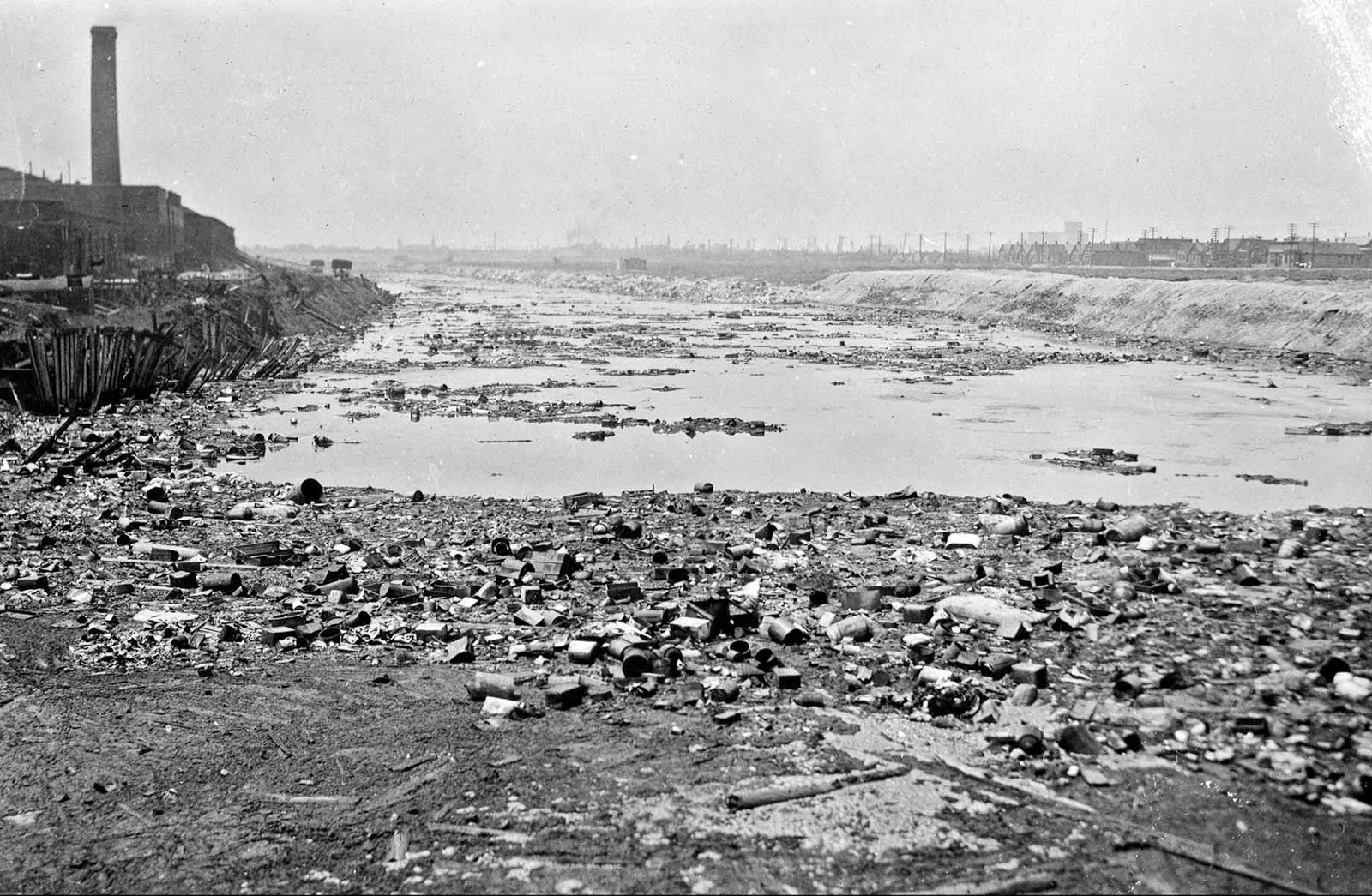
Disgusting contaminated Bubbly Creek
The city tackled these problems with the buoyant spirit of the frontier, literally raising itself – on pilings and vast land-fill – seven to twelve feet above the prairie. Its population – only five thousand souls in 1840 – grew to a startling one million by 1890. The great fire of 1871 did not stop Chicago’s blustering advance; indeed the fire and smoke it produced may have had a baptismal effect on its people, tempering them for the ordeal to come.
As it grew during the 1870s into a major transportation center, with eight railroads, a busy port, and heavy industry keeping apace, Chicago’s pollution assumed a permanent, almost solid quality. “During my stay of one week, I did not see in Chicago anything but darkness, smoke, clouds of dirt,” reported the Italian dramatist Giuseppe Giacosa. “One morning, when I happened to be on a high railroad viaduct, the city seemed to smolder, a vast, unyielding conflagration.”
The largest assemblage of stockyards in the world added a pungent flavor to Chicago’s air. The stockyards were the city’s pride, and visitors were constantly being dragged to see them. After witnessing the disemboweling ceremonies, Lord Coleridge pleaded to be led outside or he “never could eat sausage again.”
Filth of the Stockyards
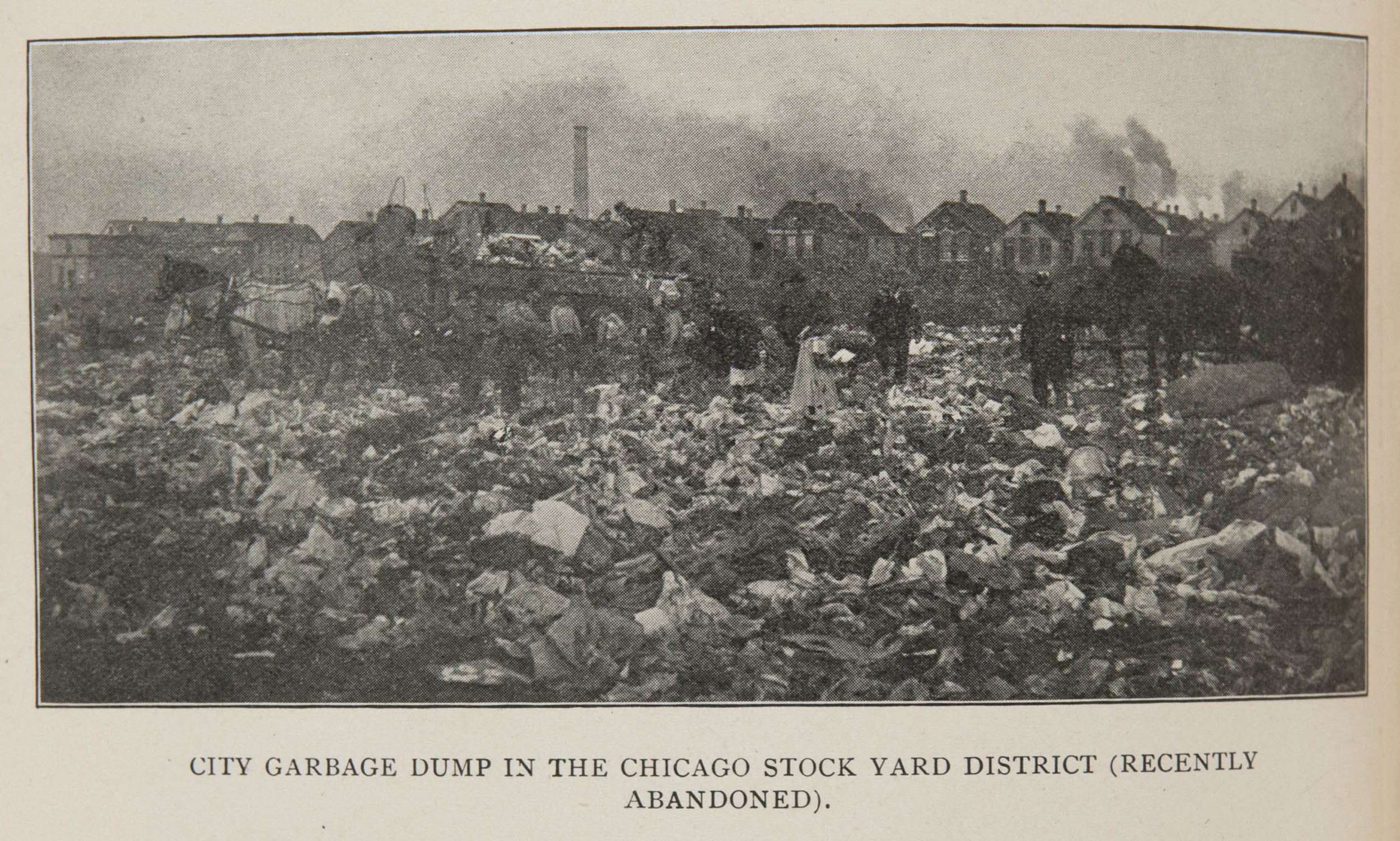
City Garbage Dump in the Chicago Stock Yard District (Recently Abandoned)
A feature of the city’s outlying districts, which lacked paved streets, was the sandstorms blown by the wind from Lake Michigan, stinging the eyes and making travel a hardship. A visitor remarked: “How a person can navigate this dirty city at night is a mystery to me.”
Because of its assault on eye, ear, nose, and throat in the good old days, Chicago was rarely mentioned without he adornment of various uncomplimentary adjectives. Today it is known affectionately as the Windy City. And that is a monumental achievement.
Culled from: The Good Old Days, They Were Terrible!
Paranormal Legend Du Jour: The Ghost Ship Palatine
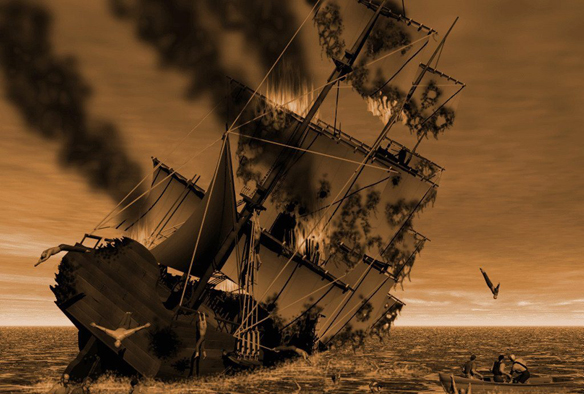
Carrying some 300 immigrants to America, the Dutch ship Palatine sailed from Amsterdam in 1752. After a brutal, gale-wracked voyage, the vessel came to a calamitous end around Christmastime, off Block Island at the mouth of Long Island Sound. By one account, wreckers used false lights to lure her onto rocks, plundered the ship, and then set her afire. Passengers were taken ashore, but as the blaze consumed the Palatine a scream silenced the pillagers. Though the flames and smoke they saw a lone-doomed woman crawling the burning deck.
At Christmastime a year later and in successive years, Block Islanders said they saw the burning Palatine return. In 1869, an old man named Benjamin Corydon, who had grow up on the mainland opposite the island, avowed that on eight or nine occasions he had seen the spectral vessel, her “sails all set and ablaze,” and that her visits had ceased when the last of the wreckers who lured her to destruction died. But perhaps he spoke too soon: A sighting of the blazing ghost ship was reported as recently as 1969.
Culled from: Mysteries of the Unknown: Hauntings