Today’s No-Good Yet Truly Morbid Fact!
Airline employee Stanley Jones and his mother-in-law ventured out into the foothills above 106th Street near the Oakland Zoo early in the morning of December 7, 1938, to pick mushrooms. Thinking they had seen an animal lying in a shallow ditch, they looked closer to discover that it was actually the lifeless body of a half-naked young woman wearing a fur jacket. A deep knife wound in her chest appeared to be the cause of death, although she had several smaller wounds in the neck. Police discovered tire tracks and evidence that the body had been dragged fifteen feet to where she was unceremoniously dumped. The area was known as a local lovers lane.
The police quickly discovered that the dead girl was nineteen-year-old beauty school instructor Leona Vhught. The six-foot-tall blonde was a graduate of Fremont High School where she was an honor student. Her many female friends lined up to tell the detectives that Leona had made an early morning date with a local rogue named Rodney J. Greig.
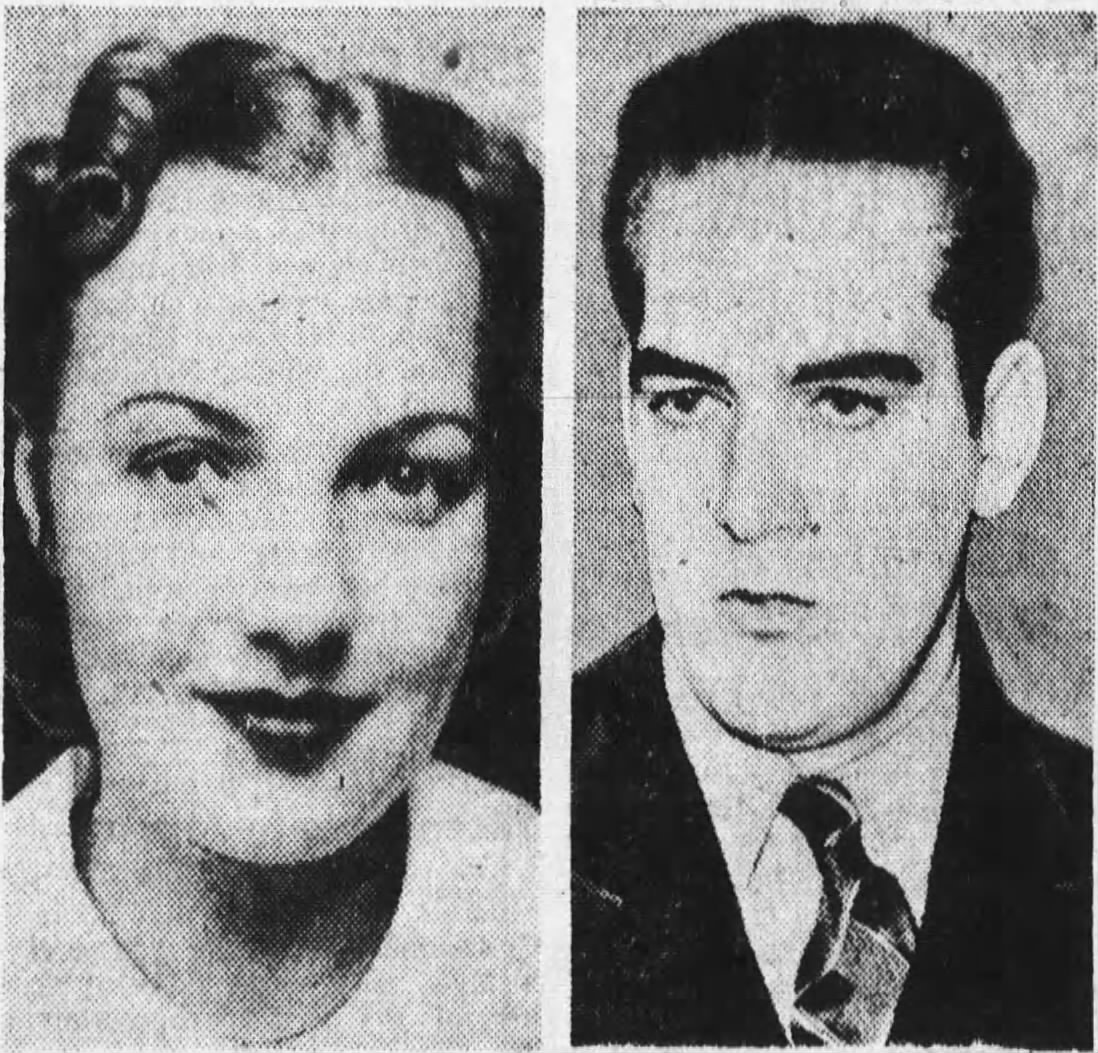
Leona and no-good Rodney.
Twenty-one-year-old Rodney Greig was a petty criminal who had his first contact with the police when he was ten years old. The handsome Berkeley resident was a thorn in the sides of his law-abiding parents. He was just no good.
Besides episodes of petty theft in the East Bay area, Greig had once done time at the infamous Preston School of Industry in Ione for breaking into his place of employment, a San Francisco wholesale grocer, and stealing two hundred and thirty dollars. He was promptly caught and arrested, yelling threats as he was being led away.
Life at the old Preston School of Industry, also known as the Castle because of the towering, red sandstone Romanesque Revival-style building high on a hill in Amador County that couldn’t be mistaken for anything else, was tough, but fair. The reformatory was reserved for young offenders who were not incorrigible. The inmates were schooled and taught marketable skills to set them on a straight and narrow path toward a better life.
Some of the graduates of the Castle went on to great success, like comedian Eddie Anderson, who played Rochester on the long-running Jack Benny radio and television programs, country musician Merle Haggard, actors Rory Calhoun and Eddie Bunker, boxers Don Jordan and Eddie Machen, authors Neal Cassady, Phil Thatcher, Ernest Booth and Bill Sands, casino owner Tony Cornero, and tennis great Pancho Gonzales. However, many other inmates, like Greig, went on to a life of crime or an early death.
Greig was found by police in his Berkeley home, sleeping soundly. He agreed to go with the police to the station house for questioning and quickly admitted in those pre-Miranda Rights days that he had indeed murdered the young lady, claiming that it was an accident. The police found Vhught’s watch, locket, and keys in his room. They found a bloody hunting knife, along with photographs of naked women, in a back cushion of his car.
At the police station, Greig nonchalantly told the detectives that he had killed Vhught and that he threw her purse and gloves in a garbage can at 19th and Alice Streets. A little later, Greig changed his story and said that Vhught was despondent over her height and the lack of available men that were willing to date a female as tall as she was. He claimed that she was always talking about suicide.
Confidently, Greig told the police that after listening to her talk about suicide, he pulled out a large hunting knife, held it to her chest, and accidentally stabbed her. He pulled the knife out of her breast and lit a cigarette while the beautiful girls’ life drained out of her. Greig smoked several more cigarettes before he decided to check to see if Vhught was still alive. Instead of feeling for a pulse, Greig took out a smaller knife and made three cuts in her neck to see if she would bleed. He told the police that he was innocent by reason of insanity. Greig waived his right to a jury trial at his sanity hearing and agreed to a bench trial presided by the Honorable Edward J. Tyyrrell.
The impeccably dressed Greig slumped his head onto his chest as his insanity defense immediately wilted when one by one, six female friends of Leona Vhught debunked Greig’s accusations of Vhught being suicidal. They also told of warning Leona not to go out with Greig, and that she had told them that Greig had gotten a little too fresh with her on their previous date.
A parade of doctors and family members claimed that Greig suffered from epileptic seizures possibly brought on as a result of an automobile accident a few years earlier. Throughout the hearing, Greig was aloof, wisecracking with the press during recesses, but he broke down on the stand when he was being questioned and sobbed hysterically.
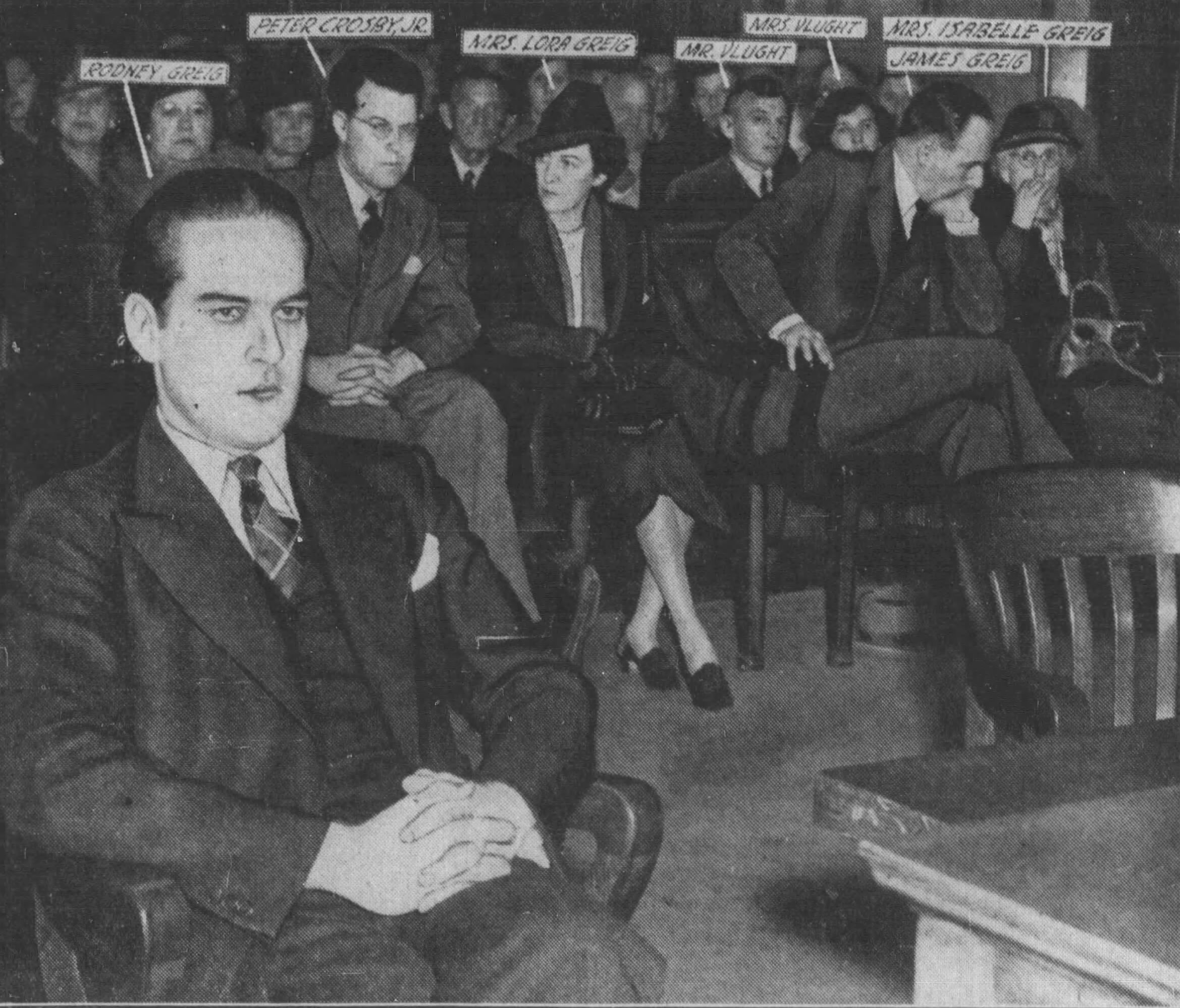
Greig on the Dock.
The prosecutors called Greig a colossal liar and were able to prove that Greig was standing out side of his car when he stabbed Vhught in the chest. They also proved that Vhught was sitting upright in Greig’s car when Greig plunged his knife into her up to the hilt.
Since Greig had waived a jury trial, admitting his guilt, and gone before the judge only on a sanity issue, it was up to Tyrrell to determine the sentence. On March 13, 1939, Judge Tyrrell declared that Rodney Greig was sane. Greig showed no emotion as the judge spoke. His attorneys responded by asking for a two-day continuance, which was granted.
Two days later, on March 15, Judge Tyrrell sentenced the dapper murderer to death by gas chamber at San Quentin Prison. It was only the second death sentence that Judge Tyrrell ever handed down. Observers claimed that Greig didn’t bat an eyelash when he heard the verdict. After he was returned to the Oakland jail, he enthusiastically played a card game with fellow prisoners.
On November 9, 1939, the Supreme Court of California denied Greig’s appeal and Greig went to his death on August 23, 1940. In a last act of defiance, the twenty-two-year-old Rodney Greig ripped his blindfold off as he was being led into the gas chamber.
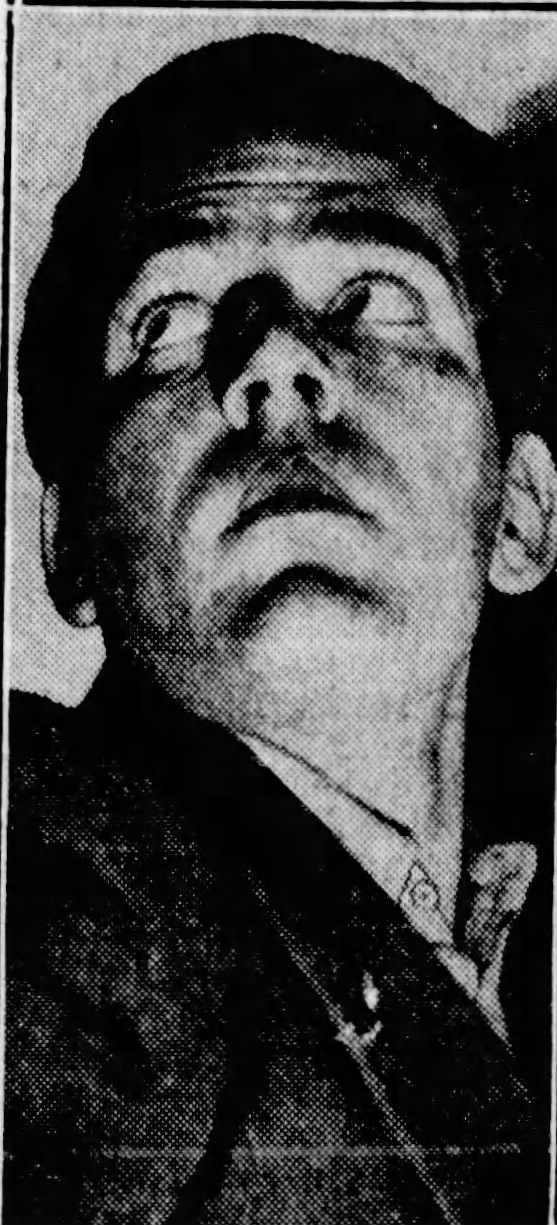
Goodbye, Greig.
Culled from: Death In California by David Kulczyk
Vintage Medical Photo Du Jour!
Here’s an except from Stanley Burns’ excellent collection of vintage medical photographs, A Morning’s Work.

Gunshot Wound to the Back, with Penetration of the Chest, 1865
Reed Brockway Bontecou, M.D., Washington, D.C.
Leona’s first clue that this fellow wasn’t worth her time should have been that his name was Rodney. I swear, all the Rodneys I’ve met (the name has some popularity here in Delaware up till a generation after mine) have been at least sort-of no-goodniks.