Today’s Infectious Yet Truly Morbid Fact!
From 1490 onwards something which appeared to contemporary writers to be a new disease swept over Europe. Thence it spread to India, China, Japan, and eventually, to the rest of the world. Early medical historians accepted that this new disease originated in the army of Charles VIII who, having launched an invasion of Italy in the autumn of 1494, attacked Naples in February 1495, or that it started in the city and was transmitted to the French army. This army of about 30,000 men was not, in fact, French but was composed of mercenary troops, French, German, Swiss, English, Hungarian, Polish and Spanish. The great number of sick forced Charles to withdraw and abandon his attempted conquest of northern Italy. This, at least, is fact and provides us with an example of how disease can affect the course of history. The classical story – or perhaps legend – continues that the remnant of Charles’s disbanded army streamed back to their homes, thus spreading the disease throughout the many parts of Europe from which they came. Very shortly afterwards the sickness became known by names which varied according to the supposed country of origin. We hear of “the Neapolitan,” “the French” and the “the Polish” disease. Later it became known in China as “Canton disease” and in Japan as “the Chinese disease.” [Everything old is new again, eh? – DeSpair] Englishmen knew it as “the French pox” or “the great pox”. The French also named it “the Spanish disease” and this brings us to the earliest theory of the origin of syphilis.
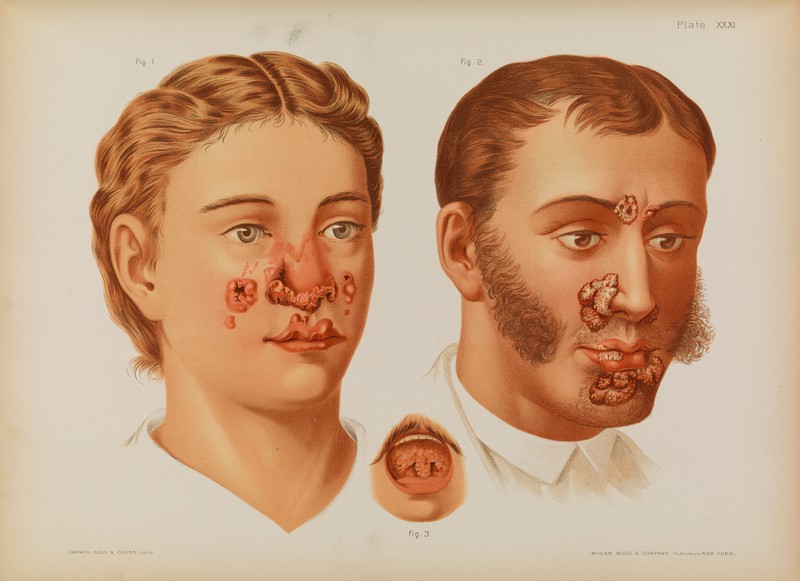
Syphilis: The Great Pox
Christopher Columbus first saw the New World, probably one of the Bahama Islands, on October 12, 1492. Between October and January he visited Cuba and Haiti. In the latter month, he set sail for Europe, landing at Palos, the port from which he had set out, on March 15, 1493. He brought with him ten natives from the West Indies, of whom one died soon after landing, and a crew of forty-four men. The crew were disbanded and some are said to have joined the troops of Gonzalo de Cordoba who marched with Charles VIII to Naples. Columbus travelled with his nine natives to Seville, left three of them there, and took the remaining six on to Barcelona. At the end of April the six Indians, all males, were shown naked to the court; they are described as brown and comely, more like Asiatics than Africans. There is no mention of any disease.
Twenty-five years later, in 1518, a book, printed in Venice, first mentioned the theory that a “Spanish disease” had been imported from America (or the West Indies) by seamen in the 1492-3 expedition led by Columbus. This theory was supported and popularized in 1526 by Gonzalo Fernandez de Oviedo y Valdes, who had been a page at the Spanish court when Columbus showed his Indians. Oviedo made several voyages to the West Indies and reported that he had found evidence of the new disease among the natives. In 1539 Rodrigo Ruiz Diaz de Isla, a physician, published description of “the West Indian disease” or “bubas” , and claimed to have treated at least one, if not more, of Columbus’s crew at Barcelona. Diaz de Isla practiced in several of the larger Spanish ports, so he may, after a lapse of over forty years, have wrriten Barcelona in mistake for Palos or Lisbon.
The first theory therefore maintains that syphilis was introduced into Europe from the West Indies by ship in 1493. Many medical historians support this opinion. The evidence in favor is that a new disease of great virulence undoubtedly did appear in Europe at about the time of Columbus’s return. Another point, sometimes cited, is that one of the earliest and more popular treatments was by holy wood or guaiacum, a resin obtained from two evergreen trees which are indigenous to South America and the West Indies. However, there is no evidence whatsoever of disease in the imported Indians or among the forty-four seamen who returned with Columbus; the homeward voyage seems to have been remarkably healthy.
The second theory holds that syphilis originated in Africa and was introduced into Spain and Portugal by the importation of slaves. There is an African disease, yaws, which is bacteriologically indistinguishable from syphilis but which, unlike the modern infection, is chiefly transmitted by non-venereal contact. It is particularly common among children who play together naked. For this reason yaws is seen only in hot climates where it appears as a horrible skin eruption. The causative organism is the same as that of syphilis; if introduced into cold climates, where people are customarily fully clothed, yaws will settle down into ordinary syphilis, carried mainly by venereal contact. In fact, yaws and syphilis are probably different manifestations of one and the same disease.
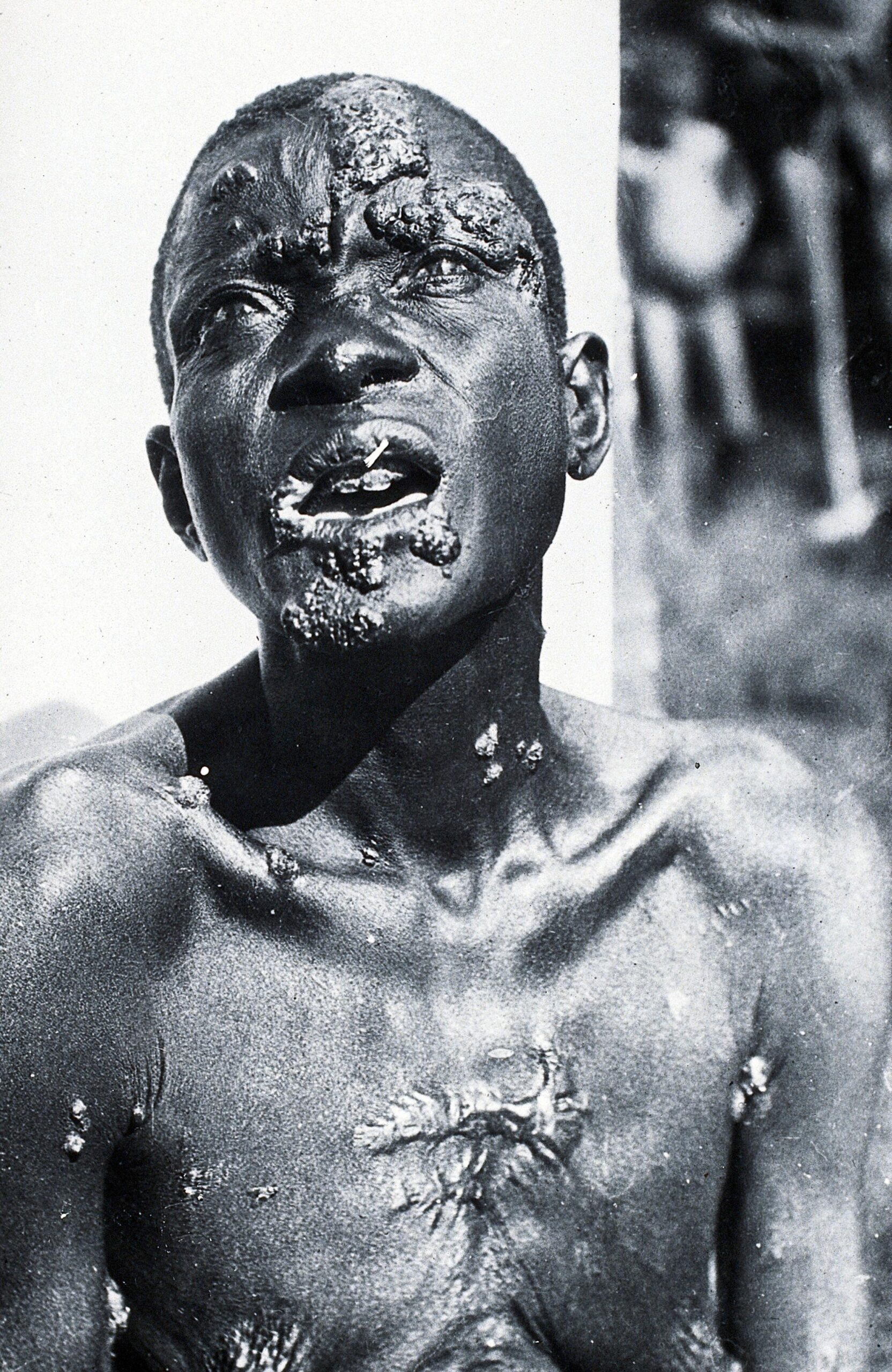
Yaws: An Equally Great Pox
Culled from: Disease and History
By the way, Yaws is HORRIFYING, as this old Malady of the Month will attest!
Oh, and so is Syphilis as this old Malady of the Month will equally attest!
Crime Scene Du Jour!
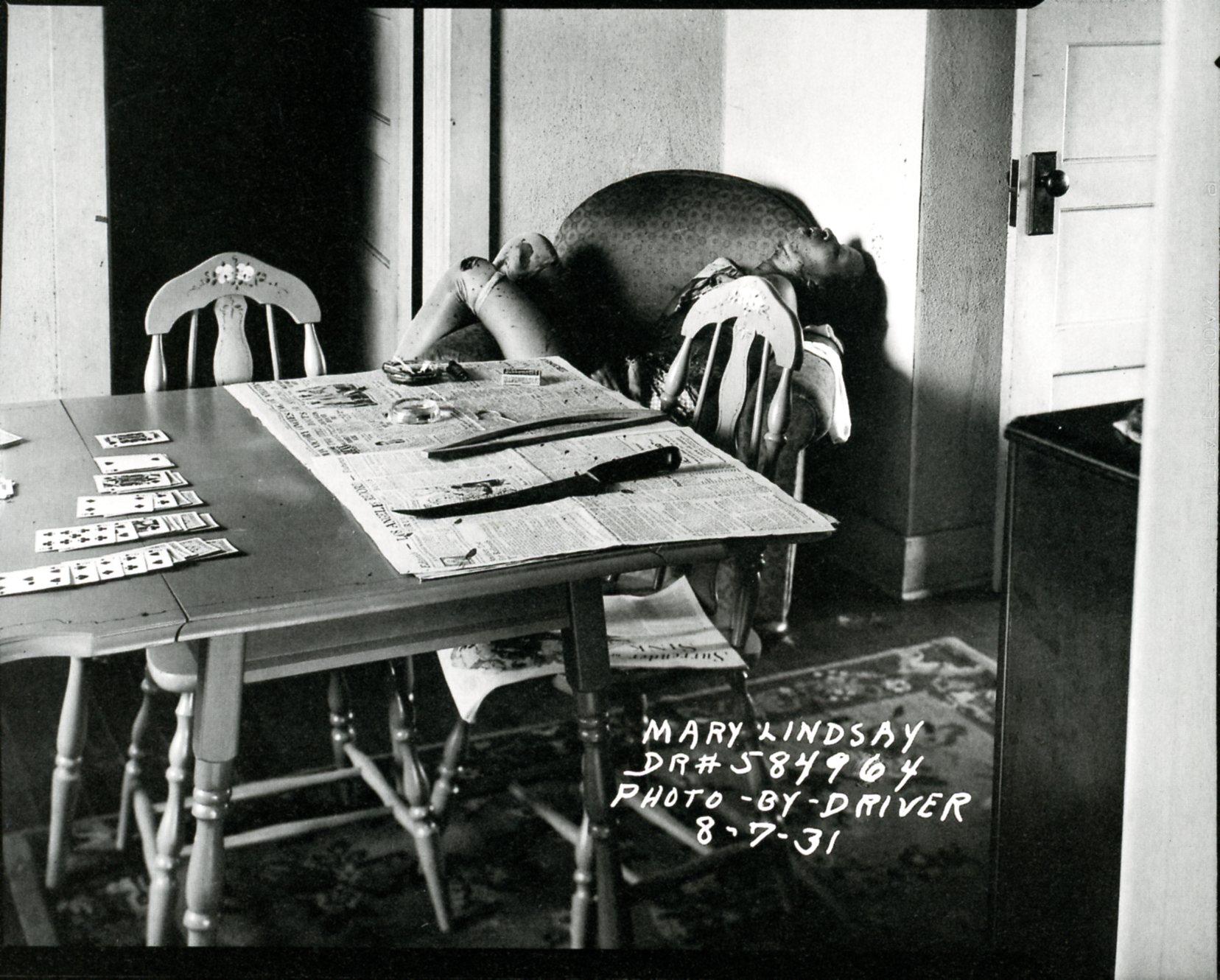
Photographer: Driver, 08-07-1931
Police arrived at a Wilshire Avenue apartment to find the body of Mrs. Mary Irving (aka Mary Lindsay) who had been stabbed several times. The home was known to police as a fancy drinking and gambling salon. A piece of galvanized clothesline was missing from the line in the yard. Later the same day, the Sheriff’s office discovered Irving’s live-in companion, Emmett Hicks, 41, hanging from a crossbar of the high-tension tower of Southern California Edison company’s power line at 99th Street near Zamora Street over a vacant lot. Police report stated, “a clear case of murder and suicide.”
Culled from: Scene of the Crime: Photographs from the LAPD Archive