Today’s Parental Yet Truly Morbid Fact!
Aeroflot Flight 593 was a passenger flight from Sheremetyevo International Airport, Moscow, Russia, to Kai Tak Airport in Hong Kong. On March 23, 1994, the aircraft operating the route, an Airbus A310-304 flown by Aeroflot, crashed into the Kuznetsk Alatau mountain range in Kemerovo Oblast, killing all 63 passengers and 12 crew members on board.
No evidence of a technical malfunction was found. Cockpit voice and flight data recorders revealed the presence of the relief captain’s 12-year-old daughter and 16-year-old son in the cockpit. While seated at the controls, the pilot’s son had unknowingly partially disengaged the A310’s autopilot control of the aircraft’s ailerons. The autopilot then disengaged completely, causing the aircraft to roll into a steep bank and a near-vertical dive. Despite managing to level the aircraft, the first officer over-corrected when pulling up, causing the plane to stall and enter into a spin; the pilots managed to level the aircraft off once more, but the plane had descended beyond a safe altitude to initiate a recovery and subsequently crashed into the mountain range. All 75 occupants died on impact.
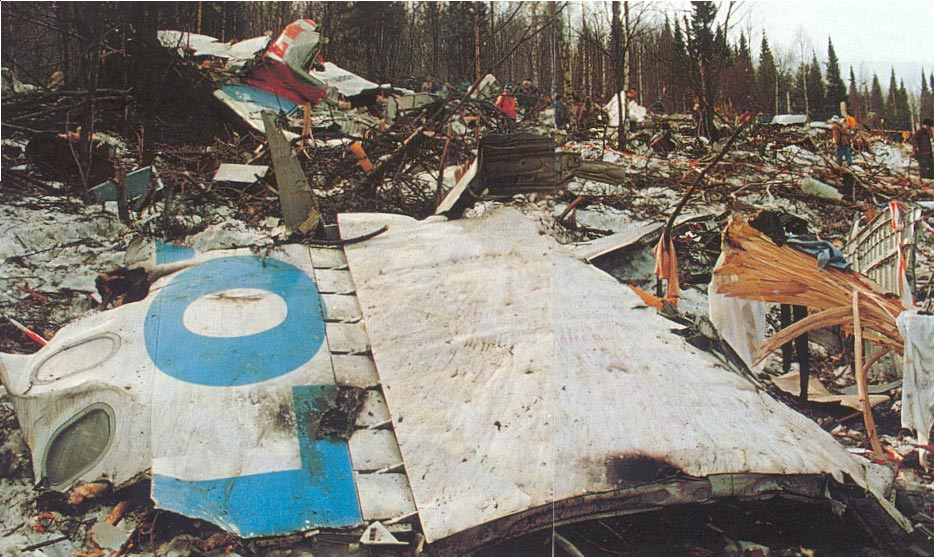
The Ruins of Flight 593
Here’s the detailed story of the crash:
On the evening of the 22nd of March, 1994, the crew of Aeroflot flight 593 to Hong Kong reported for duty at Moscow’s Sheremetyevo International Airport. The Airbus A310 operating the flight had earlier arrived from London with several connecting passengers, but the second leg of the journey was lightly booked, with just 63 passengers on board, including numerous businessmen and several off-duty Aeroflot employees. They would be joined by 12 crewmembers, including nine flight attendants and an augmented cockpit crew of three, consisting of 40-year-old Captain Andrei Viktorovich Danilov, 33-year-old First Officer Igor Vasilyevich Piskaryov, and 39-year-old relief Captain Yaroslav Vladimirovich Kudrinsky, whose presence enabled the pilots to rotate their positions without exceeding duty time limits on the nearly 14-hour flight.
Being a pilot on Aeroflot’s international services came with certain benefits which few could afford under the strained economic conditions in Russia in 1994. Among these were free or deeply discounted tickets for pilots’ families, providing the wives and children of A310 crewmembers with a unique opportunity to see the world at a time when most Russians could not. On the night of the 22nd of March, relief Captain Kudrinsky was using this policy to bring his children on their first ever trip abroad. Fifteen-year-old Eldar Kudrinsky and his 12-year-old sister Yana were among the 63 passengers, where they had been placed under the care of fellow passenger and off-duty Aeroflot pilot Vladimir Makarov, whose own daughter was on board as well.
At 13:39 UTC—already after dark in Moscow—flight 593 took off from Sheremetyevo Airport and climbed to its cruising altitude of 10,100 meters, approximately 33,300 feet. Captain Danilov and First Officer Piskaryov were at the controls, and would remain so for the next couple of hours.
By the time the cockpit voice recording begins at 17:26 UTC, Danilov had already returned to the cabin to sleep, turning over his seat to relief Captain Kudrinsky, who would remain on the flight deck all the way to Hong Kong. Piskaryov was still in the right seat, and would not be expected to hand it over until near the end of the flight, allowing Danilov to return. At that point they were still over Russia, high above Kemerovo Oblast’ in southern Siberia, near the city of Novokuznetsk, with many hours still to go.
Events first began to drift away from the ordinary at 17:40, or 00:40 local time in Novokuznetsk, when relief Captain Kudrinsky opened the cockpit to some very important guests—his children. Accompanied by the off-duty pilot Makarov, Yana and Eldar entered the cockpit at their father’s invitation to see the advanced A310 for the first time. Excited to be in the cockpit and awed by the vast array of computerized displays, the children were enthralled from the start. For a few minutes, Kudrinsky explained various aspects of the plane and what made it special, but he had bigger ideas, too. And so at 00:43, he turned to his 12-year-old daughter and said, “Come and sit here now, in my seat, would you like that?”
According to Russian aviation regulations, bringing guests into the cockpit of a passenger flight while en route was not, still is not, and never has been permitted. Needless to say, however, bringing children (usually boys) up to the flight deck while in the air was a longstanding tradition around the world prior to the post-9/11 crackdown on cockpit security breaches, and many people who grew up in the second half of the 20th century fondly recall receiving such invitations, typically without realizing that the practice was technically not allowed. Although it could occasionally present a distraction, giving children a glimpse of the flight deck was not normally a serious safety risk, especially since there was precious little else for pilots to do during level flight in cruise. But while inviting children to view the cockpit is one thing, allowing them to sit in the captain’s seat is quite another—albeit one which nevertheless happened from time to time without serious consequences.
At her father’s invitation, Yana clambered into the left seat of the A310, which Kudrinsky had vacated moments earlier. She found it hard to see over the dashboard, so she said, “Dad, raise me up,” and Kudrinsky adjusted the seat height to give her a better view. In the distance, the last lights of the Kuzbass mining region faded into a near-endless expanse of night-darkened mountains.
For a few minutes, Yana asked about various systems, and Kudrinsky faithfully answered. Then, it seems, he got another dubious idea: “Hey Yana, are you going to fly it?” he said. “Go ahead, take the controls.”
As Yana lightly placed her hands on the control column, her father stood between the pilots’ seats, reaching for the autopilot control panel, and switched the autopilot’s lateral control mode from “NAV” to “heading select.”
Throughout the flight, the plane had been flying on autopilot, with its vertical channel in altitude hold mode to keep the plane at 10,100 meters, while the lateral channel navigated the plane along a pre-programmed string of waypoints stretching all the way from Moscow to Hong Kong. By switching from “NAV” mode to “HDG/SEL” mode, Kudrinsky temporarily switched off that pre-programmed track, allowing him to direct the autopilot to assume a particular magnetic heading. Once the system was in heading select mode (HDG/SEL), he simply turned the heading knob on the autopilot control panel several rotations to the left, and the autopilot dutifully placed the plane into a left turn. In response to the autopilot’s inputs, the control column turned to the left beneath Yana’s hands, giving her a simulation of what it might feel like to fly the plane. Although some accounts insinuate that Kudrinsky was trying to give her a convincing illusion of control, it appears his actions were merely demonstrative, as he explained what he was doing throughout the maneuver.
After letting the plane turn to the left for some time, reaching a bank angle of about 20 degrees, Kudrinsky eventually re-engaged NAV mode, and the autopilot automatically turned the plane back to the right to resume the pre-programmed route.
Seven and a half minutes had passed, in which Yana and her father engaged in almost continuous conversation, before the girl left the captain’s seat to make way for her older brother Eldar. The 15-year-old Eldar was even more enthusiastic about the airplane than his sister, and Makarov, who was standing in the back of the cockpit, joked, “Let’s get a picture of the pilot!”
“You’re taking a picture?” Eldar asked.
“Yes, I am,” said Makarov, presumably wielding a camera.
Eldar had been sitting in the captain’s seat for three minutes before he became emboldened enough to ask, presumably gesturing at the control column, “Can I turn this? The control?”
“Yes,” Kudrinsky said without hesitation. He presumably believed that with the plane on autopilot, any inputs Eldar might make would have no effect on the course of the flight.
Eldar immediately placed his hands on the control column.
“Okay, watch the ground, where you’re going to turn.” Kudrinsky instructed. “Go to the left, turn to the left!”
Eldar cautiously applied about 10 kilograms of force, turning the wheel three or four degrees to the left. Initially, the autopilot resisted, keeping the plane on course. Seconds later, however, Kudrinsky switched the autopilot to HDG/SEL mode and used the heading knob to enter a leftward heading, causing the autopilot to turn the plane to the left in line with Eldar’s inputs. The feedback force on the control column relaxed until it disappeared.
“See it turn?” Kudrinsky said. “Is the plane turning to the left?”
“It is,” said Eldar.
After about eight seconds, by which time the plane had reached 21 degrees of left bank, Kudrinsky reached for the heading knob again, and turned it back to the right.
“Now going right,” he said.
“Set the horizon to normal for him,” Makarov interjected.
In response, the autopilot began to bank back the other way, slowly rolling through wings level. Eldar followed through, letting his hands move with the control column as it turned to the right.
At that point, Kudrinsky switched the autopilot’s lateral channel back to NAV mode to resume their pre-planned track. The right bank increased from six to fifteen degrees, then started to go back to the left as the plane rolled out on its intended heading. But this time Eldar was out of the loop: instead of letting the control column turn beneath his hands, he held it in place at three to five degrees right, causing the feedback force to increase as the autopilot tried to bank the other way.
Given time, Kudrinsky might have noticed the problem and told Eldar to either let go or turn the other way, but at that moment Yana started plying him with questions again, so he turned his attention to his daughter. All the while, the feedback force on the control column increased until, at 00:55 and 29 seconds, the autopilot’s lateral channel quietly disconnected.
Like many other autopilots on Western aircraft—but unlike those on Soviet models—the A310 autopilot’s lateral and vertical channels could each disconnect independently under specific circumstances, without affecting the other. This design feature was not intended to be used in normal flight. It existed only so that a pilot could react immediately in the event of a sudden departure from controlled flight while the plane was on autopilot. Applying between 11 and 13 kilograms of roll force to the control column would disconnect the autopilot’s lateral channel, while a similar amount of force applied forward or backward would disconnect the vertical (pitch) channel, allowing a pilot to take control instantly without having to fight against a malfunctioning autopilot, and without having to waste time reaching for the autopilot disconnect button either. This is a standard feature of almost every autopilot, but on most Soviet models, force applied in any direction would disconnect both channels simultaneously.
The insidious aspect of this feature on the A310 was that the disconnection of one channel but not the other would fail to trigger either the visual or aural autopilot disconnect warnings. If, for example, only the lateral channel was disconnected, then not only would the autopilot remain engaged, but the selected lateral mode would continue to be displayed on the autopilot control panel, even though the autopilot actually no longer possessed any lateral control authority.
In the event, the lateral channel disconnected when the roll force on the control columns reached 11-13 kilograms, and did so with no warning whatsoever. Flight data showed that Eldar alone was not responsible for the disconnection—First Officer Piskaryov was holding onto his control column as well, presumably in order to react if Eldar made any sudden inputs. Because the control columns were linked, he could feel every input which Eldar made. He might therefore have been unaware that it was the autopilot which was trying to turn back to the left, and not Eldar. Furthermore, the disconnection threshold was met when the cumulative force on both control columns reached 11-13 kilograms, meaning that Eldar and Piskaryov might each have been applying as little as 5-6 kilograms of force when the disconnection occurred.
As the lateral channel disconnected, a torque limiter engaged to physically declutch the autopilot’s aileron actuator, preventing it from making any roll inputs. This would have caused a change in the feedback forces on the control columns as the resistance put up by the autopilot abruptly vanished, but Eldar could not have been expected to notice, and Piskaryov probably thought the change in feedback was because of an input by Eldar. As a result, no one noticed that the autopilot was no longer steering the plane—in fact, Piskaryov and Eldar were. With their control columns positioned a few degrees right of center, and the autopilot no longer compensating, the plane slowly began to bank to the right, initially at a rate of about one degree per second. After a little while, someone—probably Eldar—turned the wheel a little farther, and the rate of roll increased to two degrees per second. Before long, the plane reached 30 degrees of bank, the normal in-flight maximum, and then kept right on going, approaching 45. Incredibly, amid the banter in the cockpit, no one noticed that something was wrong.
In the background, the cockpit voice recorder captured Kudrinsky conversing with Yana. The girl’s voice was faintly audible in the background, but only Kudrinsky’s side of the conversation could be understood.
“What’s the matter Yana?”
“Why?”
“You’ll only go to sleep in the first class cabin. Don’t run there or they’ll fire us!”
At 00:55 and 36 seconds, Eldar suddenly commented, “Why is it turning?” Against the odds, he was the first to notice that the plane was going off course.
“It’s turning by itself?” Kudrinsky asked.
“Yes,” said Eldar.
“But why is it doing that?” said Kudrinsky.
“I don’t know,” Eldar replied.
“Have we lost the route?” Kudrinsky asked.
“It’s entering a [holding] area,” Makarov suggested.
“We’ve reached an area, a holding area,” Piskaryov agreed.
“Have we?” asked Kudrinsky.
“Of course,” said Piskaryov.
On their flight management displays, the pre-programmed navigation track had been replaced by a curving white line ahead of the aircraft symbol, circling back the way they came. This was simply the aircraft’s projected trajectory, but, not realizing that the autopilot was no longer in control of their heading, the pilots failed to consider this possibility. Instead, they seem to have concluded that the autopilot had inadvertently placed them into a holding pattern above a navigational waypoint—an annoying issue which was not unheard of in the complex airspace over the former Soviet Union.
As the pilots debated the reason for the turn, the plane’s bank angle increased past 45 degrees. With the wings unable to maintain lift at such a high bank angle, the plane began to descend. The autopilot’s still-active vertical channel, which had been set to hold an altitude of 10,100 meters, reacted by pitching the nose up and increasing engine thrust. As it accelerated into the turn, the G-forces on board the plane started to increase, pressing the occupants harder and harder into the floor.
“Guys…” Makarov said, sounding nervous.
As the autopilot pitched up in the turn, the angle of attack—that is, the angle of the airflow over the wings relative to the plane’s direction of travel—began to increase rapidly. If the angle of attack becomes too high, the air will no longer flow smoothly over the tops of the wings, resulting in heavy buffeting, followed by an aerodynamic stall as the wings lose their ability to generate lift. Within seconds, the angle of attack approached the stall threshold, and the airplane started to vibrate alarmingly.
“Hold it, hold the column, hold it!” Kudrinsky shouted at both Piskaryov and Eldar. In response, Eldar held his control column in the neutral position, while Piskaryov attempted to bank back to the left. Because he was fighting Eldar, and because the disrupted airflow over the wings was reducing the effectiveness of the ailerons, his inputs were ineffective, and the plane continued rolling to the right. Unsure why the plane wasn’t reacting, Piskaryov turned back to the right to gauge the response. As a result, the roll rate rapidly accelerated, causing the plane to reach 90 degrees of bank in a matter of seconds.
“The speed!” Piskaryov exclaimed. Turning to Eldar, he shouted, “Turn the other way! The other way!”
“Turn left!” Kudrinsky chimed in.
“Turn right!” Piskaryov said, mixing up his directions.
“Turn left, left!” Kudrinsky corrected.
“The other side!”
“Left!”
“To the right!”
“To the right?”
“Don’t you see or what? Turn right! To the right!”
Two altitude alert warnings sounded as the plane left its programmed altitude, followed by a loud autopilot disconnect alarm as Piskaryov’s inputs finally exceeded the disconnect threshold of the vertical channel. Simultaneously, the airplane stalled, suffering a catastrophic loss of lift, triggering a stall warning for four seconds before the autopilot alarm overrode it. Still banked between 80 and 90 degrees to the right, the plane began to fall into a spiral, its nose pitched down as much as 50 degrees. The G-forces continued to increase as the spiral tightened, making the occupants feel twice their normal weight.
In response to the stall, an automated system known as the alpha floor protection kicked in, pushing the nose down to decrease the angle of attack. The inputs were effective, as the plane exited the stall and airflow over the wings stabilized, but now they were in a steep 40-degree dive, accelerating rapidly with the engines near full power. The rate of descent increased toward -40,000 feet per minute, the pilots’ altimeters unspooling faster than they could read them.
“To the left! There’s the ground!” Piskaryov said, regaining his bearings. He turned his controls hard to the left, and the wings rolled level, pulling the plane out of its spiral. Within seconds, however, the aircraft exceeded its maximum operating speed, triggering a terrifying overspeed warning. Traveling at a blistering 420 knots, Piskaryov hauled back on his controls to recover from the dive, but the high-speed pull-out caused G-forces to skyrocket. The aircraft was subjected to an astonishing 4.7 G’s, far exceeding the design limit load. The airplane’s structure began to warp under the immense strain.
“Eldar, get out!” Kudrinsky shouted at his son. “Go to the back, go to the back Eldar!” he screamed. “You see we’re in danger, don’t you?” But the G-forces were pressing him down into his seat so hard that he would have felt five times his normal weight. Although he tried to obey his father’s order, he was physically unable to move.
“Throttles to idle!” Piskaryov shouted, trying to reduce their speed. But by that point the plane was already starting to level out, and their speed was decreasing. Normal flight may have resumed if Piskaryov had simply let go of the controls, but instead he continued to hold his control column all the way back to the stop. Within seconds, the airplane began to climb. But if Piskaryov wanted to push the controls forward to level off, he might have been unable to do so—the diminutive copilot topped out at just 160cm (5’3”), and his seat was pushed all the way back to the stop. In that position, he couldn’t even reach the rudder pedals, and probably couldn’t push the control column more than a few degrees toward nose down either.
Meanwhile, Kudrinsky continued to shout at his son. “Get out!” he yelled. “Eldar, get out, get out! I’m telling you, get out!”
As the plane climbed steeply, their airspeed dropped precipitously. Within seconds, they had decelerated to just 99 knots, far too slowly to maintain flight. The G-forces lifted, replaced by near weightlessness. Eldar scrambled out of the captain’s seat, but in the process he accidentally stepped on the right rudder pedal, sending the plane yawing sharply to the right. As Kudrinsky threw himself back into his seat, Piskaryov rolled hard to the left against the right yaw, the plane stalled, spun around, and flipped violently upside down, hurtling into a spiral dive.
“Full power! Full power! Full power” Piskaryov bellowed, and Kudrinsky jammed the throttles forward.
“I gave power, I gave it!” Kudrinsky yelled. “What’s the speed?”
“I haven’t seen the instrument!” said Piskaryov.
Their speed was beginning to increase again, but they were spinning around and around like a top, descending rapidly with the nose pointed almost directly at the ground. Furiously working the controls, Kudrinsky managed to stabilize their roll angle at 20 degrees left, and together the pilots started to pull the plane out of the dive, from 90 degrees nose down to just 20. But Kudrinsky was only barely able to maintain his inputs—his seat was also pushed all the way back, and at only 170 cm (5’7”), he was not tall enough to reach the controls properly from this position either.
“The speed is high!” Piskaryov exclaimed.
“It is high, isn’t it?” said Kudrinsky.
“Too high!” said Piskaryov.
“I switched it off,” said Kudrinsky.
“We’ll get out, we’ll get out, we’ll get out,” said Piskaryov. “To the right, foot to the right! The speed is high, reduce power!”
“I reduced it!” said Kudrinsky.
Unfortunately, just as they were on the cusp of recovery, the increase in pitch caused their speed to drop too low, and an inadvertent kick to the rudder sent them back into a violent spin, this time even tighter than before. The plane turned over again into another dive, accelerating alarmingly.
“Gently!” Piskaryov shouted. “Fuck, not again!”
“Don’t turn right, the speed, I put some…” Kudrinsky said.
“Oh!”
Kudrinsky pumped the rudder back and forth, arresting the spin. Although they were still falling fast, some semblance of control was starting to return again. Both pilots started trying to ease the plane out of the dive.
“We’ll get out now! Everything is okay!” Kudrinsky yelled. “Pull up gently! Gently, gently I said!”
At that point the spin finally stopped, and the nose came up to the horizon. They were still falling rapidly, but the rate of descent was starting to decrease as they pulled out of the dive. A little more time, and they would have made it—but it was too late. In a nearly flat attitude and with a descent rate of -13,800 feet per minute, Aeroflot flight 593 slammed into the side of a snow-covered mountain, ripping a terrible swath through the darkened forest. The A310 disintegrated utterly, spewing debris out into the night at tremendous speed amid a great flash of fire. Seconds later, the last flying pieces of wreckage came clattering to a stop, and quiet again descended over the Siberian wilderness, save only for the faint crackle of the flames.
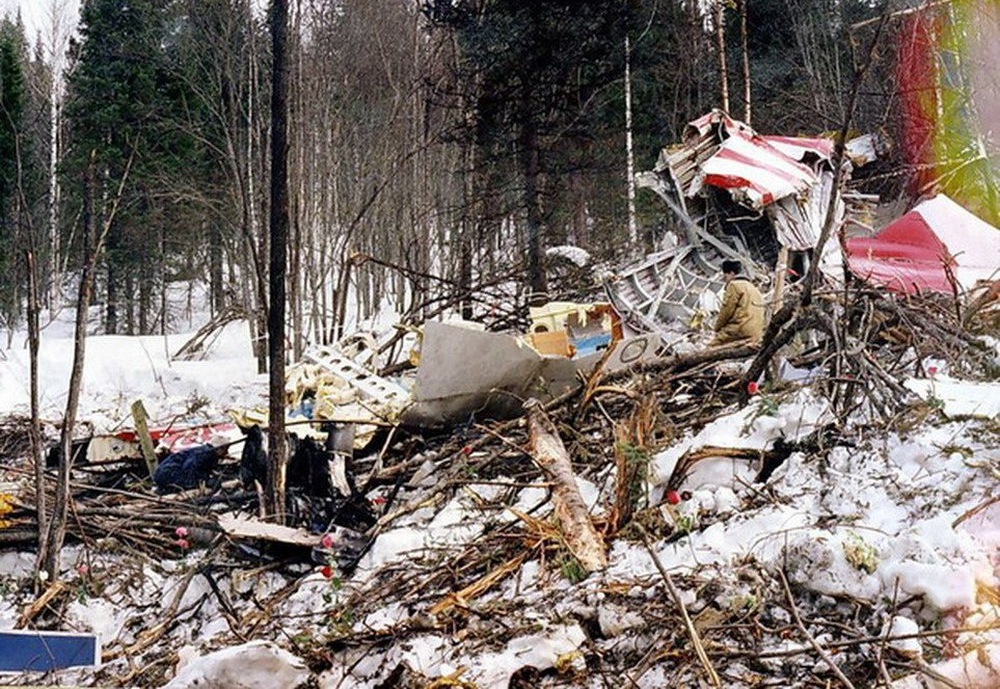
And then all was still…
Culled from: Imgur
Mütter Specimen Du Jour!
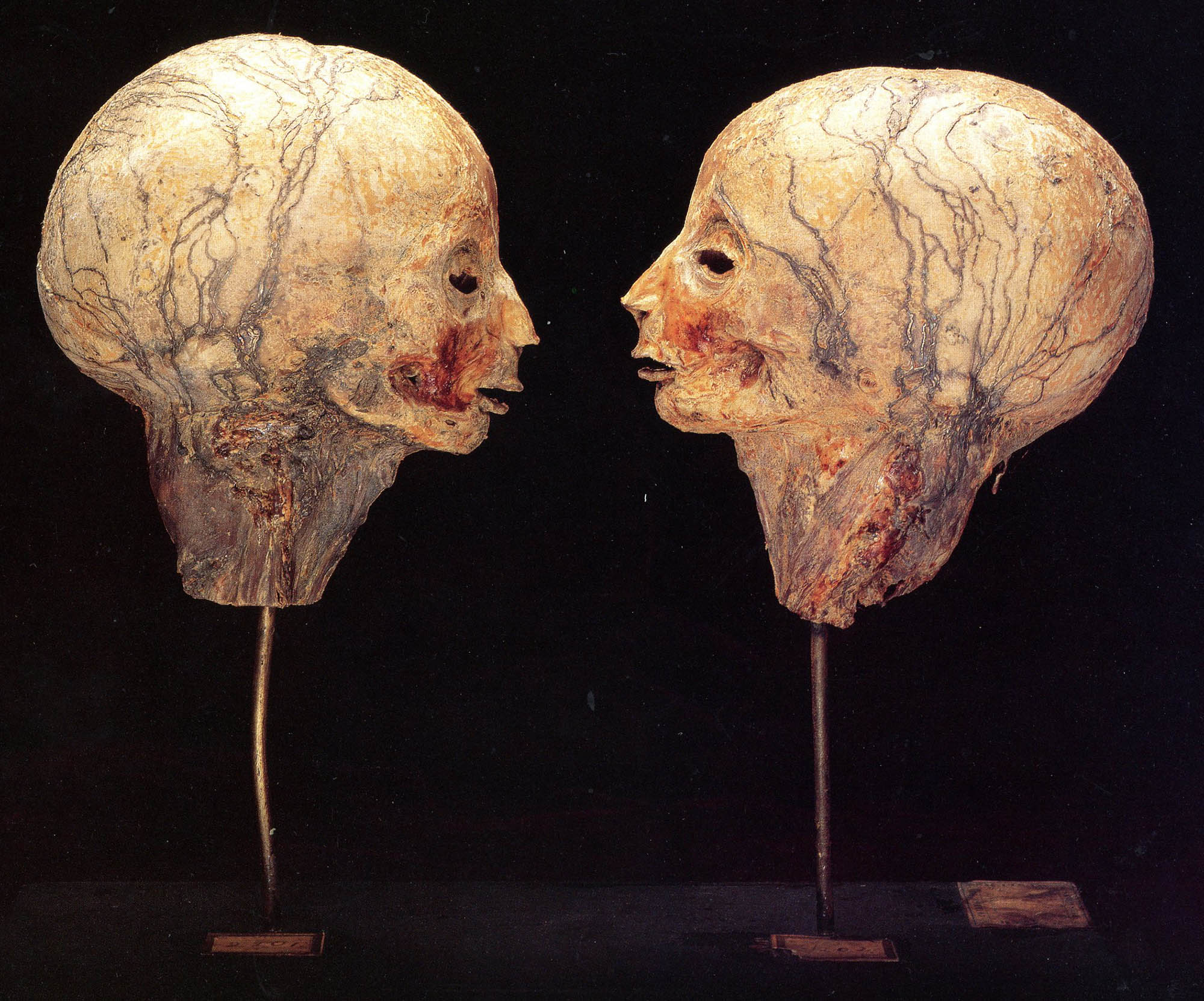
Specimen of a child’s head, demonstrating the lymphatics of the scalp
Mercurial injection was traditionally used to demonstrate the lymphatic system, since it was able to penetrate the smallest vessels.
This is one of a number of preparations purchased in 1867 from the renowned Parisian anatomist, Prof. Marie Philibert Constant Sappey.
Culled from: The Art of Medicine, College of Physicians of Philadelphia, Calendar 1999