Sorry for the long delay in facts – life has been ever-complicated and I just haven’t had the energy for it. However, I’m returning with a renewed vigor and this time, hopefully, I mean it!
In other news, my switch from Mailchimp to Substack is going to take longer than expected for technical reasons so I figured I should start sending out facts again under the Mailchimp banner until I get things sorted out. Soon, soon, I will make the change!
As always thank you for for your continued support and for staying morbid in my absence!
Today’s Dual Yet Truly Morbid Fact!
During the nineteenth century, there were few spectacles that could simultaneously unite the law-abiding community and provide an object lesson for the young and impressionable like a public hanging. This was certainly true on February 9, 1844, when an estimated eight to twenty-thousand people gathered on a bitter cold day to watch the first “legal” execution even held in Franklin County, Ohio. “For a week or ten days every road leading to Columbus, for the distance of fitty or one hundred miles, was lined with wagons and vehicles of every character, bringing whole families” to see William Graham (a.k.a. James or William Clark) and Esther (possibly Hester) Foster die on the gallows. Due to the freezing weather, many of the spectators took refuge inside taverns and public houses for as long as possible.
Although the event was not scheduled to take place until two o’clock in the afternoon, ordinary citizens began assembling at the site the day before and continued to arrive throughout the night. Among them were members of the Columbus Guard, a local militia group, who had a personal stake in seeing that Graham got his just desserts: his victim had been one of them. No less than a quarter of those in attendance were “FEMALES!” — a fact local newspaper reporters found both fascinating and appalling, particularly when some of them began pushing and shoving in order to get a “conspicuous position, so that they could gloat their eyes with the rare sight.” (“Gloat your eyes with the rare sight!” – my new t-shirt slogan! – DeSpair)
Public executions were not an especially rare occurrence during the nineteenth century, although a double event was, and the hanging of a man and a woman side by side was virtually unheard of. A little over a year earlier, some fifty thousand spectators had swarmed Bellefontaine to see Andrew Hellman swing for poisoning his children. And just a month before, a crowd of some fifteen to twenty thousand flocked to Zanesville to witness the hanging of Solomon Shoemaker for the murder of his brother.
In 1840, Columbus was a budding community with a population of 6,048, which climbed to 17,882 just ten years later. It had little to recommend save for the fact that it was the state capital and the site of a rather fine new penitentiary opened in 1834. That same year, Graham was sentenced to fifteen years for highway robbery. He was twenty years old and headstrong; twice he tried to escape. On June 9, 1841, Graham, who worked in the penitentiary stone shop, had slain the twenty-two-year-old guard Cyris Sells by striking him with a cooper’s ax while he was combing his hair. Five blows had nearly severed his head from his body. Sells had earlier whipped the entire prison company for some violation of prison rulses, and Graham vowed revenge.
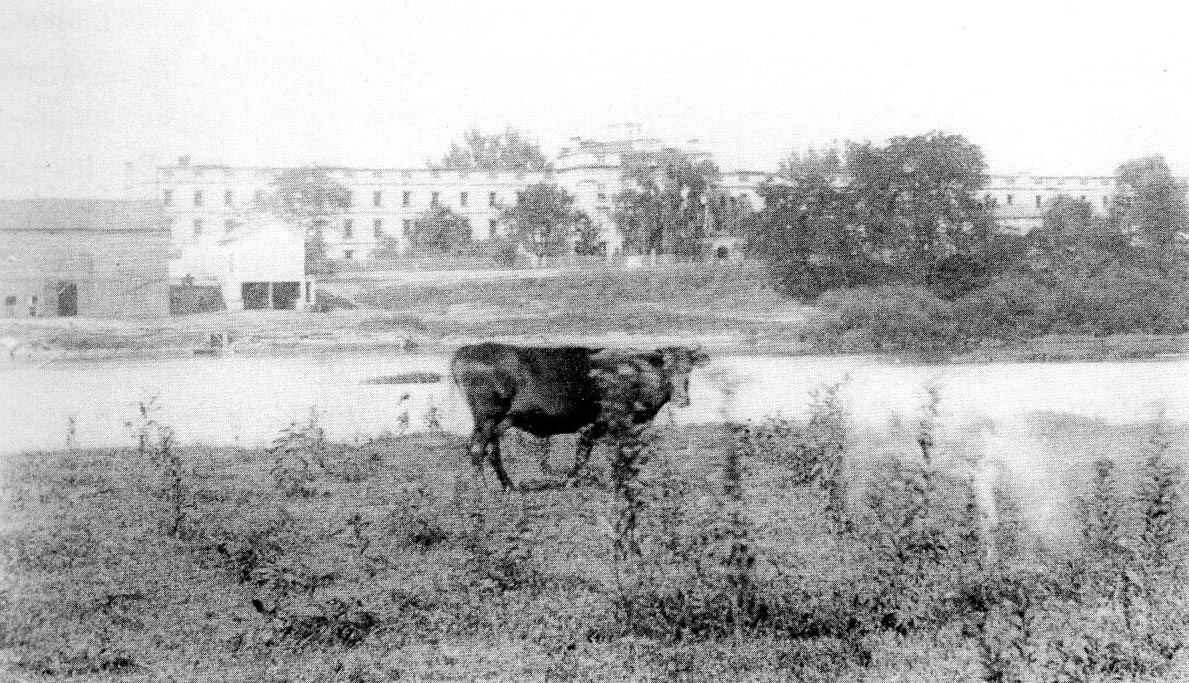
The Ohio Penitentiary in the early cow town days.
Foster, a resident of the prison’s Female Department, was serving a twenty-year sentence for aiding an assault and rape with intent to murder. Although it was an ugly offense, the penalty was still regarded as unusually harsh. A former chambermaid from Cincinnati, she had killed another female convict, Louisa White, on March 13, 1843, by bashing in her head with an iron fire shovel while they were working in the kitchen. Until then, Foster had been a rather docile inmate.
According to early prison historian Daniel J. Morgan (superintendent of the prison school), Foster was assisted by another prisoner, whose trial, for some reason, was continued until the next term. Nothing more was heard of her. What is known, however, is that the victim was white and Foster was “colored” (as was her codefendant). Foster purportedly was a woman of limited intelligence who “did not have a bad history.” Graham, on the other hand, had been a troublesome inmate from the start. Sells was a member of the soon-to-be-famous Sells Brothers circus family.” He was also the first prison employee killed in the line of duty.
Because Graham’s trial was postponed until December 1843 at the request of his attorneys, both cases – his and Foster’s – were tried in the same term of court. Graham’s defense was insanity. He was represented by Gustavus Swan, later president of the State Bank of Ohio, and John W. Andrews. Swan, who had never lost a criminal case, said that if he lost this one, he would never practice law again. He did, and he didn’t. While the name of Foster’s attorney is unknown, many openly questioned the first-degree murder charge against her since the crime clearly was not premeditated. However, prosecutor John Heyl, a young and relatively inexperienced attorney, prevailed in both cases, assisted by Colonel Noah H. Swayne.
As the time approached, several ministers attempted to pray with the condemned. An emotional Foster knelt to join the pastors in prayer. If she had any last words, they were not recorded. Graham, however, twice refused to participate, defiant to the end. He did make a short statement: “My name is Graham, my father and brother killed a traveler in Missouri and were lynched for it.” His last words were, “Let her go quick.” After a “short, fervent and solemn exhortation” by Reverend Whitcomb, Sheriff William Domigan adjusted the nooses around Graham’s and Foster’s necks, and then they dropped through the trapdoor and into eternity.
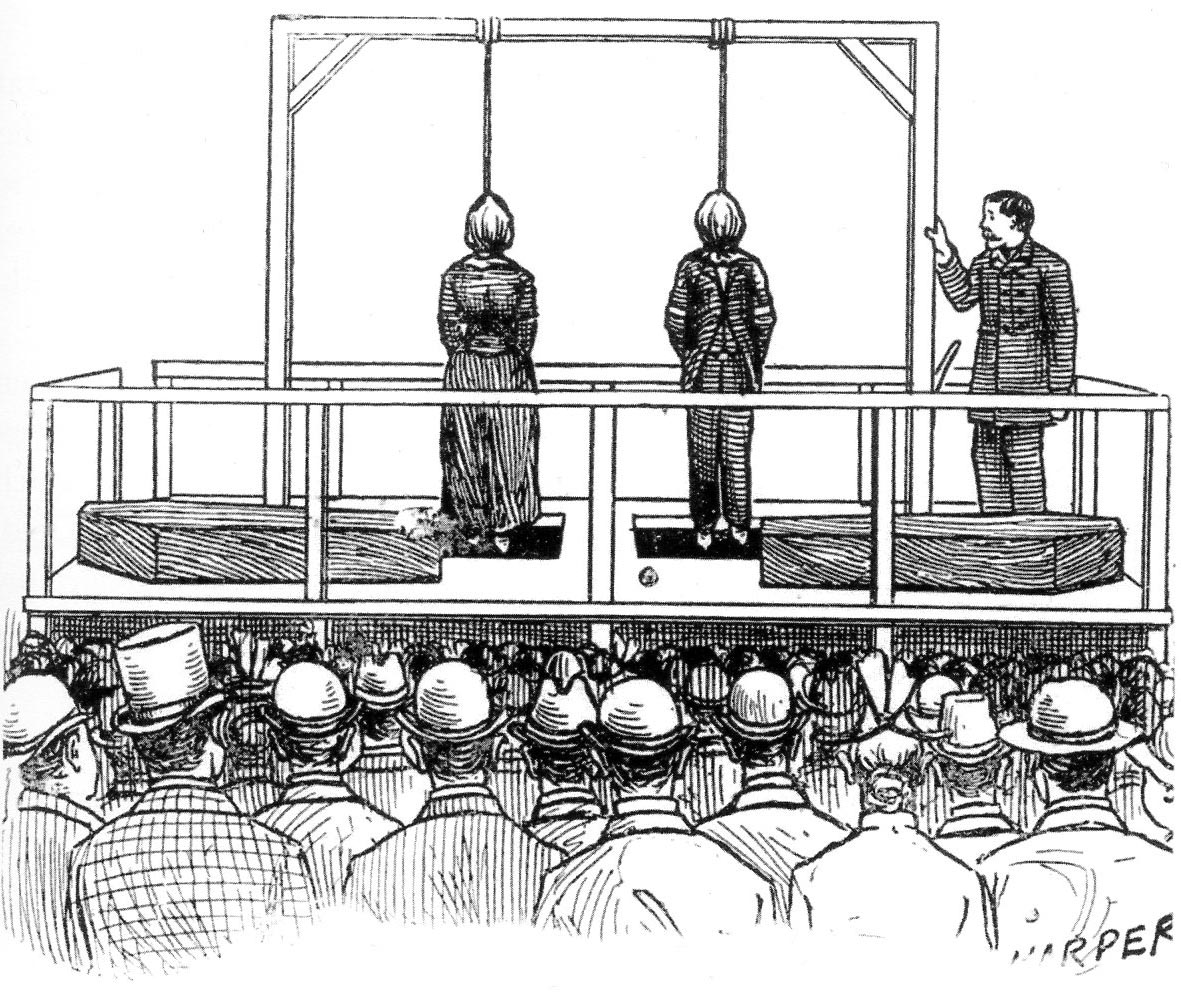
The “dual event” was captured in this widely circulated woodcut from Harper’s Magazine.
Whether Foster and Graham died quickly or not is unknown. In exchange for all the “candy and sweetmeats” she could eat, Foster had agreed to allow a Columbus doctor to dissect her body after her death. A number of other local physicians attended Graham’s autopsy to test a theory held by many phrenologists that criminals had certain physiological deficiencies and could not be held morally responsible for their behavior. However, there was disagreement over what his brain revealed.
Sheriff Domigan had promised Graham that he would not end up as an anatomical specimen, so his remains were interred in the old prison graveyard nearby. Nevertheless, two groups of physicians had designs on Graham’s corpse. As one crew was digging him up, the other fired on them, causing the would-be grave robbers to flee. The rival group then took possession of the body. For many years, Dr. Ichabod Gibson Jones and his colleague, Dr. Little, kept one of Graham’s feet in a body of alcohol in their office on East Town Street between High and Third Streets. And a “good wax figure likeness” of Graham was on display at Captain Walcutt’s museum.
Culled from: Inside the Ohio Penitentiary
Special thanks to Jim for gifting me the book!
Weegee Du Jour!
Weegee was the pseudonym of Arthur Fellig (June 12, 1899 – December 26, 1968), a photographer and photojournalist, known for his stark black and white street photography. Weegee worked in Manhattan, New York City’s Lower East Side as a press photographer during the 1930s and ’40s, and he developed his signature style by following the city’s emergency services and documenting their activity. Much of his work depicted unflinchingly realistic scenes of urban life, crime, injury and death.
Here’s a photo from the book Weegee’s New York: Photographs, 1935-1960
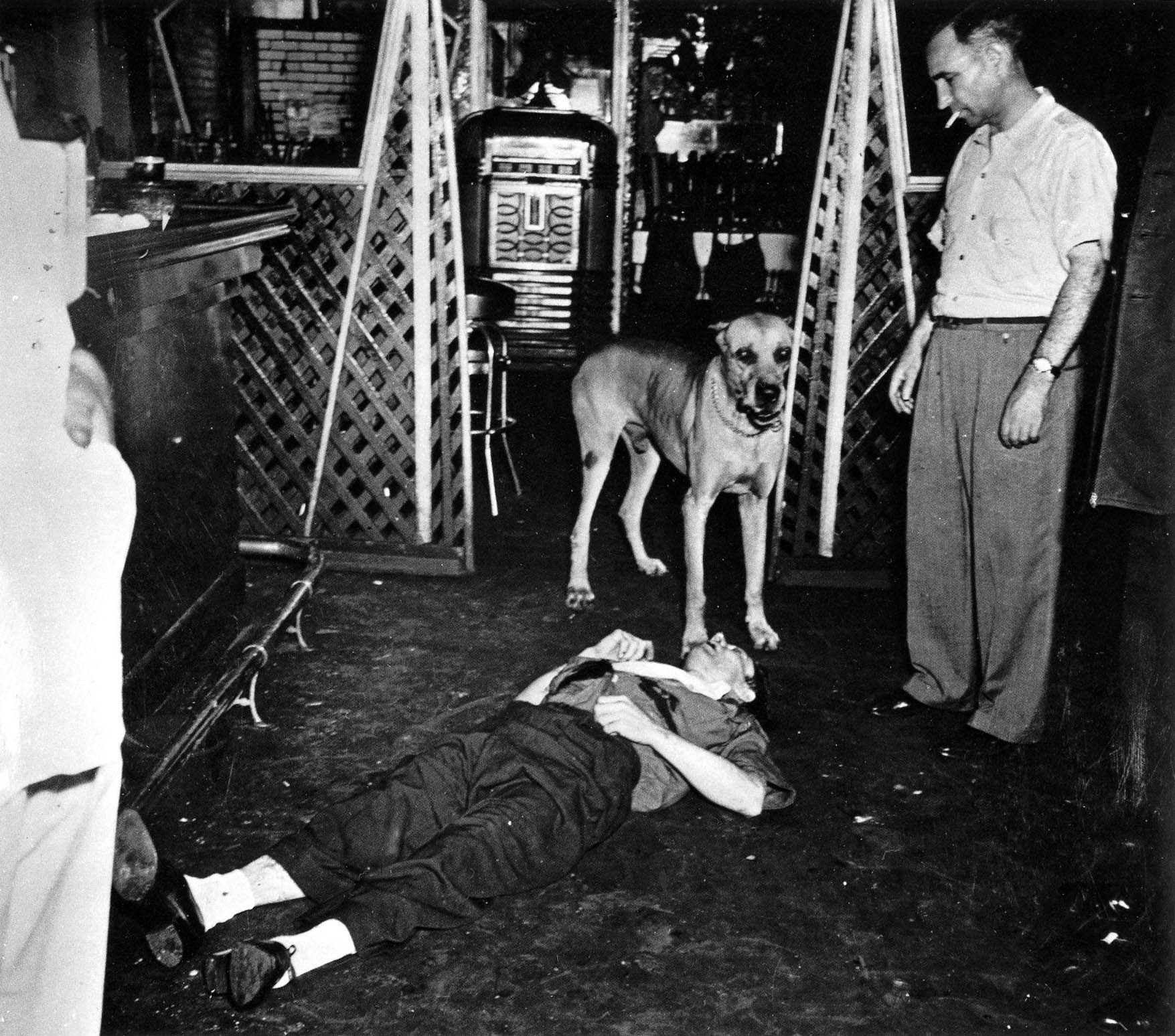
Dead man in a bar
It is a good slogan, but I think “gloat” here is meant to be “glut” as in “feast your eyes.” Maybe the reporter wasn’t as good with words as he thought …