Today’s Brash, Cocky Yet Truly Morbid Fact!
Alfred “Jake” Lingle was not the only reporter in Chicago who cozied up to gangsters for a good story. That he was able to conceal his jaunty reputation as a horse-playing rake in tight with gangsters on both sides of town from his editor, Edward Scott Beck, at the somber, solidly conservative Chicago Tribune is what makes this story so fascinating.
The literary wags of the Herald-Examiner, the Journal, and even of the occasionally bombastic and highbrow Daily News were known to hoist a cocktail or two in the company of underworld bons vivants. Their livelihood and reputations often depended on the tidbits of useful information they pried loose from a hood cradling a highball. Such was not the case at the good, gray Tribune, where reporters were expected to maintain aristocratic detachment and conduct themselves with the same decorum as foreign correspondents covering the Hague tribunals.
Jake Lingle was personally acquainted with Al Capone—their friendship began in 1920. In fact, Lingle was friendly with just about every politician, gangster, footpad, and cop on the make, including the commissioner of police, William Russell, a boyhood chum from California Avenue and Jackson Boulevard, whom Lingle helped elevate to the superintendency in 1928.
Jake Lingle was hired as a Tribune copyboy in 1918, when the pressroom was still located at Madison and Dearborn Streets. He had no aptitude for writing, but it was his long list of contacts and that nickel in his pocket for a phone call to the city desk that made him indispensable to the editors and rewrite men.
The brash and cocky reporter cultivated acquaintances in the courts, the lockup, and the gin mills of the North and South Sides. Relying on the word of informants and the bonds of friendship, he became the city’s cleverest police reporter, and one of its wealthiest, through shrewd manipulation of the stock market and investment in syndicate-owned gambling clubs like the Sheridan Wave up on the North Side.
Lingle lived like a sultan at the Stevens Hotel. He kept a secret bank account at the Lake Shore Trust and Savings totaling $63,900—not a bad haul for a $65-a-week reporter. When details of the secret bank account and his spendthrift lifestyle were bared, it caused major embarrassment and a tidal wave of unwanted publicity for the “World’s Greatest Newspaper.” The Tribune editorial board was forced to back down from its hasty decision to elevate Jake to heroic martyrdom.

Jake Lingle circa 1927
The afternoon of June 9, 1930, found Lingle milling about the lobby of the Hotel Sherman, where he greeted friends and colleagues with a firm handshake and warm, engaging smile. Jake was a crowd-pleaser, and he was well liked. In another life, he would have made a great politician.
After a light lunch at the coffee shop in the hotel, he exited on the Clark Street side and headed east down Randolph, past Marshall Field’s, and toward the IC station to catch a 1:30 train to Washington Park in Homewood. Lingle paused at the newsstand outside what was then the central library to purchase a Racing Form and a newspaper. After handing the newsboy his change, Jake puffed his cigar, adjusted his straw boater, and walked slowly toward the subway stairs, scanning the scratch sheet. Three men sitting in a parked roadster called out to him.
“Hey Jake! Don’t forget to play Hy Snyder in the third!”
Lingle smiled and waved. “Got him!” he replied.
As he descended the stairs, two men brushed up alongside him. If he knew who these men were, he did not let on, nor did he appear to be overly concerned, according to eyewitnesses. Inside the tunnel under Michigan Avenue, one of the men paused to buy a paper. A moment later a shot rang out.
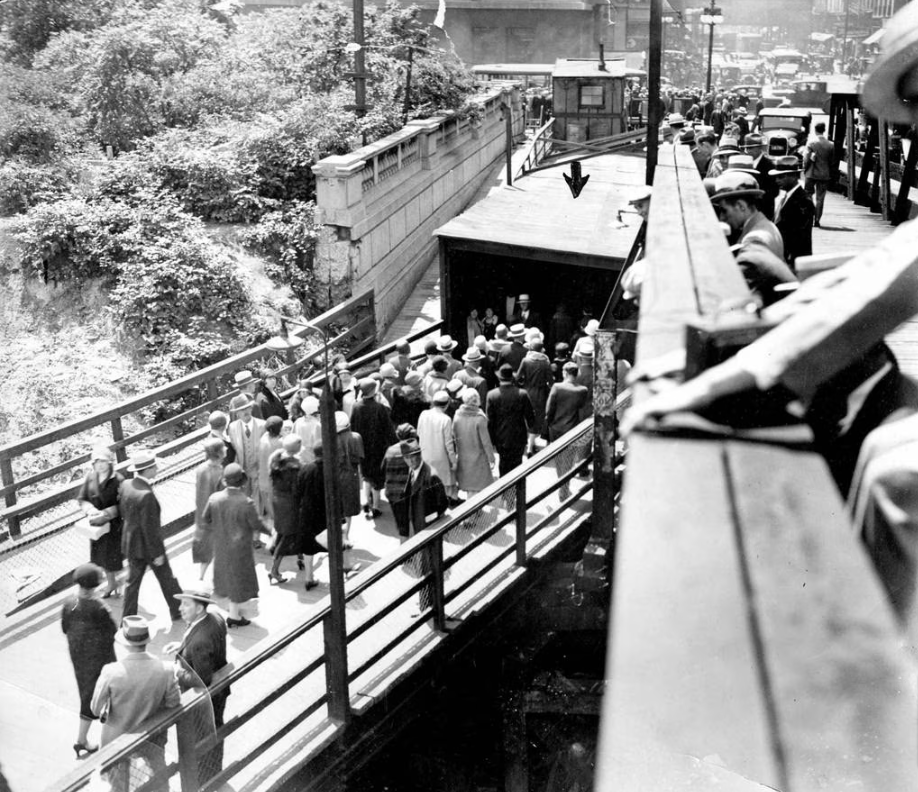
The entrance to the Michigan Avenue tunnel
With a bullet lodged in his head, Lingle fell to the pavement, facedown. A blond-haired man tossed aside the .38-caliber murder weapon and disappeared into the crowd. At least fourteen people (probably many more) eyeballed the killer, but they did nothing to stop him.

The body of Jake Lingle where it fell
Weeks and then months passed before the police produced a suspect. The serial number on the murder weapon had been defaced, but ballistics expert Colonel Calvin Goddard traced the origin of the gun to the sporting goods store owned by Peter Von Frantzius at 608 Diversey Parkway. Records showed that the weapon had been sold to one Frankie Foster, a member of Bugs Moran’s North Side mob. Foster fled to Los Angeles hours after the Lingle shooting, but was indicted in Cook County as an accessory before the fact to murder.
Foster, whose real name was Frank Citro, was extradited to Chicago and held in the county jail for four months, but the evidence was inconclusive and the charge against him was nol-prossed.
Then, as hopes for a quick solution waned, a new suspect turned up. Leo Vincent Brothers, a labor union slugger from St. Louis, was arrested in New York and indicted for the Lingle murder. Great rejoicing and a collective sigh of relief came from the Tribune editorial board, who expected justice to be served and the gangsters handed their comeuppance. Brother was convicted and sentenced to fourteen years in prison on April 2, 1931.
“I can do that standing on my head!” Brothers quipped, lending credence to the theory that he had voluntarily taken the fall for Jack Zuta, a North Side racketeer who ran a string of whorehouses, but who was already dead by the time the trial wrapped up.
Of course, it has long been suspected that Al Capone also wanted that double-crossing reporter shoved aside. It seemed that everyone had a motive and the opportunity, but crime historians are in general agreement that Brother took the rap and served his time for a substantial cash payoff. We’ll never really know for sure. The secret died with Foster, who suffered a fatal heart attack in Studio City, Los Angeles, on April 22, 1967.
The murder of Alfred Lingle galvanized public opinion against the gangs of Chicago. The bell began to toll for Al Capone, who had finally gone too far.
Culled from: Return to the Scene of the Crime
Post-Mortem Portrait Du Jour!
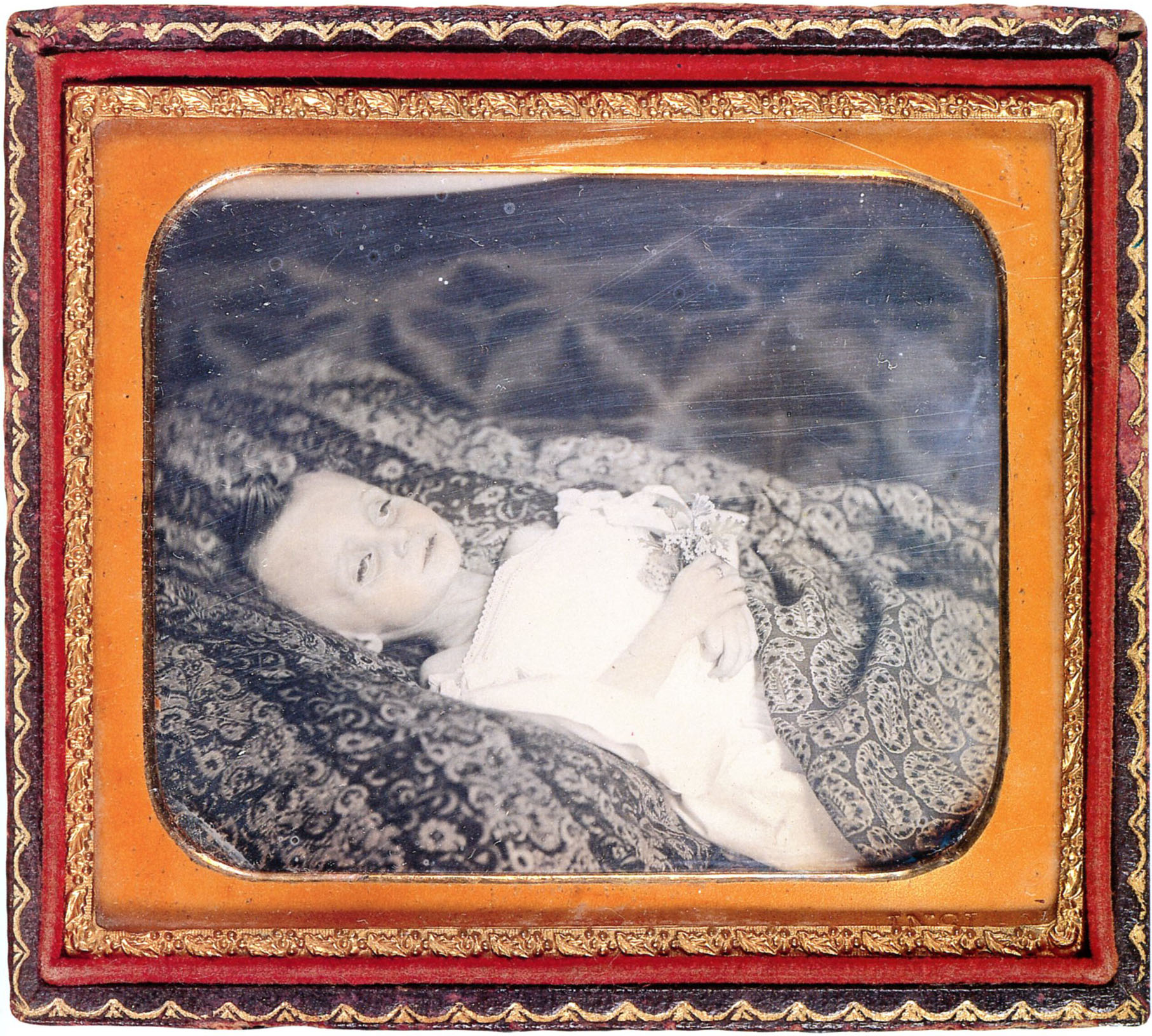
MALNOURISHED GIRL WITH FLOWERS ON BLANKET
Henry E. Insely, New York City
2 3/4 x 3 1/4″ Daguerreotype
Circa 1848
Culled from: Sleeping Beauty I
Andersonville Prisoner Diary Entry Du Jour!
This is the continuation of the 1864 diary of Andersonville prisoner Private George A. Hitchcock (see the archived version for all entries up until now).
Here’s today’s entry:
June 26th. Prisoners from General Steele’s army came in. I washed my pants in the creek. I am feeling quite weak from diarrhoea, which makes me desponding. This is the Sabbath; but how unlike our peaceful New England Sabbaths. Poor starved men of almost every nationality; many without a spark of principle, bounty-jumpers, New York “dead rabbits,” Baltimore “plug-uglies,” the sick and dying all around, make this a scene of horror which will be ever vivid in my memory, if I am allowed to see the end of all this. But every dark cloud has its silver lining, and I can trust God has us under his keeping.
Culled from: Andersonville: Giving Up the Ghost