Today’s Trivial Yet Truly Morbid Fact!
Victims of lynch mobs, more often than not, had challenged or unintentionally violated the prevailing norms of white supremacy, and these offenses ranged from the serious (in the eyes of whites) to the trivial. Charles Jones, a youth from Grovetown, Georgia, was lynched by 150 whites for stealing a pair of shoes and “talking big.” Henry Sykes was lynched in Okolona, Mississippi, for calling up white girls on the telephone and annoying them. A Texas youth was jailed for writing an insulting letter to a young white woman; a mob broke into the jail and shot him to death. Jeff Brown accidentally brushed against a white girl as he was running to catch a trail; a mob hanged him for “attempted rape.” For their “utter worthlessness,” John Shaw and George Call, two eighteen-year-old youths from Lynchburg, Virginia, were shot to death after the mob’s attempt to hang them failed. A South Carolina editor acknowledged in 1917 that some three-fourths of lynchings were for “trivial offenses,” and sometimes entirely innocent men were “butchered.”
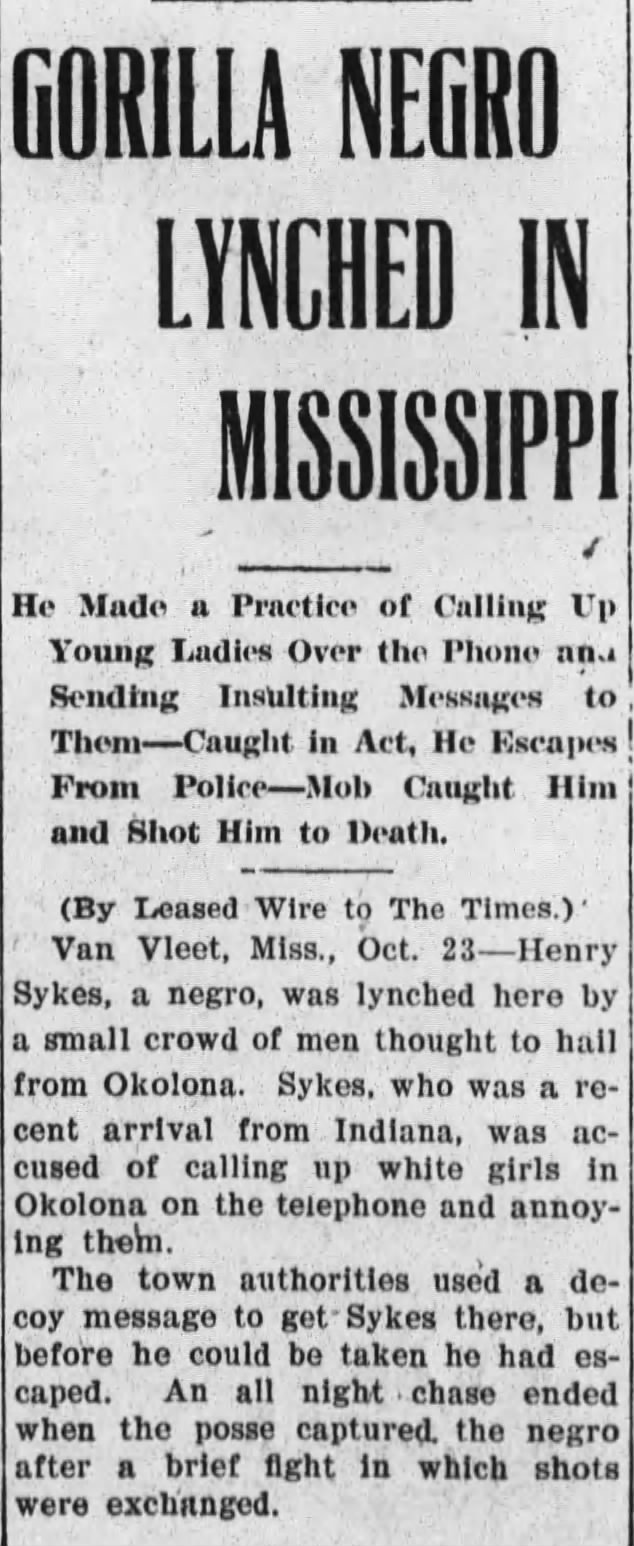
“Gorilla Negro Lynched in Mississippi” headline for Henry Sykes murder in Rawleigh Times, North Carolina, October 23, 1907
All too often, black southerners, innocent of any crime or offense were victims of lynching or burnings because they were black and in the wrong place at the wrong time. The only evidence against Jim Black, Thomas Ryor, and James Ford, implicated in the murder of the wife of a white farmer of Hendersonville, South Carolina, was that they had been spotted in the neighborhood; the three black youths were quickly lynched. The white farmer later confessed to murdering his wife and concealing her body. Fred and Jane Sullivan were accused of burning a barn; a mob lynched the couple, ignoring their four-year-old child. After emptying their guns into Bob Kennedy for assaulting a white man, a mob discovered he was not the man wanted for the crime and continued their chase for “the guilty one.”
Culled from: Without Sanctuary: Lynching Photography In America
Lynching Photo Du Jour
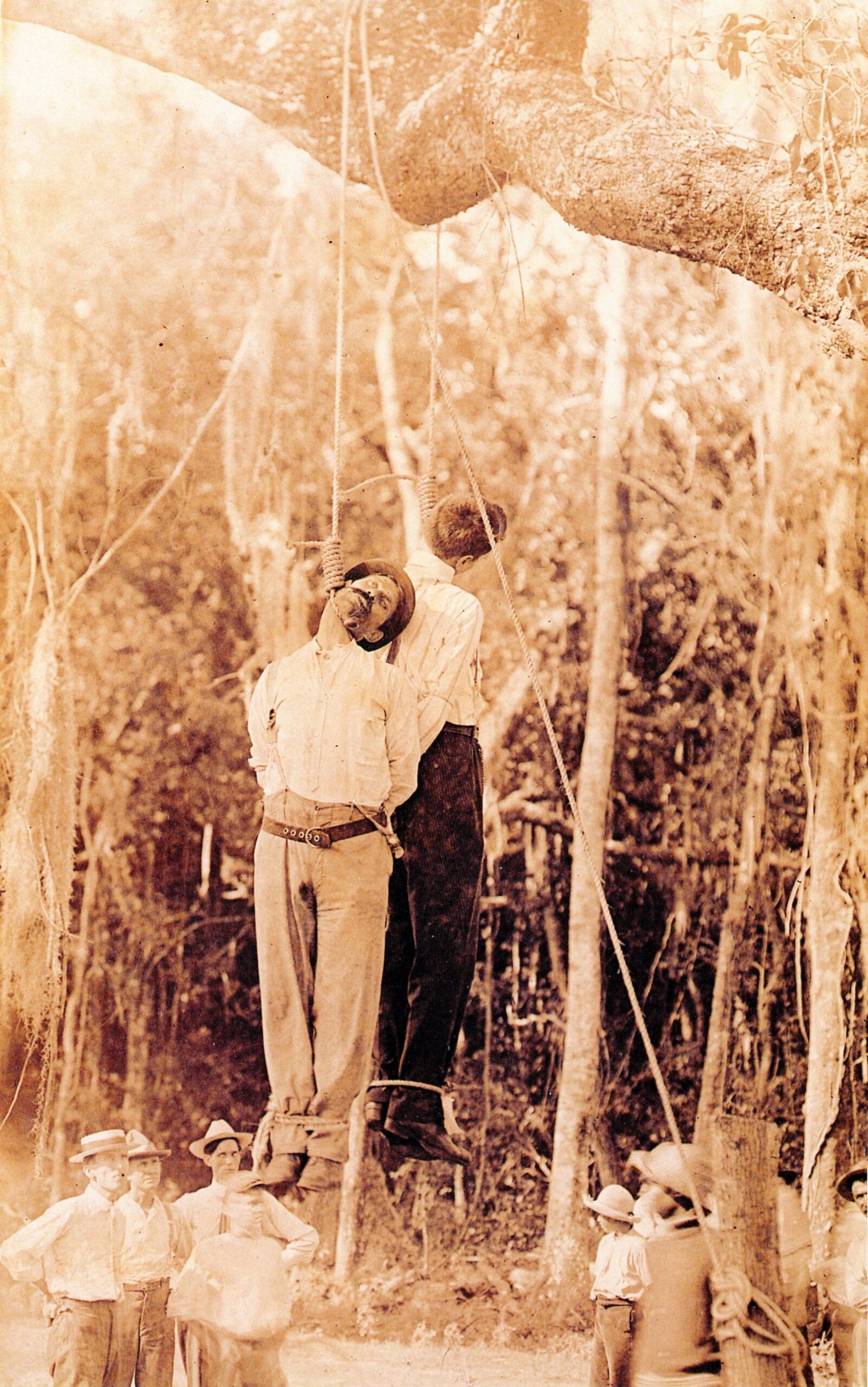
The lynching of Castenego Ficcarotta and Angelo Albano,
September 20, 1910, Florida.
The rare white lynching. Here’s a summary of the event from the Florida Historical Quarterly:
On 20 September 1910, law enforcement officers in Tampa arrested two Sicilian immigrants, Angelo Albano and Castenge (alias Castenzio and Costanzo) Ficarotta. They were charged with complicity in what ultimately turned out to be the fatal shooting of J. Frank Esterling, an accountant for the Bustillo Brothers and Diaz Cigar Company, a large cigar manufacture that employed some 600 workers in West Tampa. While Albano and Ficarotta were being taken to the county jail, at a time when Esterling was still alive though hospitalized in critical condition, a crowd of twenty-five to thirty people stopped the horsedrawn hack by which the two suspects were being moved, seized the two prisoners, transported them to a nearby grove, and lynched them. As a desecrating insult to the corpses, a pipe was placed in Ficarotta’s mouth and a notice was pinned to Albano’s belt. Written in black ink, the notice read “Beware! Others take note or go the same way. We know seven more. We are watching you. If any more citizens are molested, look out-Justice.”
Culled from: Without Sanctuary: Lynching Photography In America
Andersonville Prisoner Diary Entry Du Jour!
This is the continuation of the 1864 diary of Andersonville prisoner Private George A. Hitchcock (see the archived version for all entries up until now).
Here’s today’s entry:
July 6th. Very hot. More prisoners came in to-day. The camp is full of rumors of an an exchange to begin to-morrow. Succeeded in getting an axe for a few moments and cut up some wood.
Culled from: Andersonville: Giving Up the Ghost