Monthly Archives: July 2013

Morbid Fact Du Jour For July 28, 2013

Today’s Honorable Yet Truly Morbid Fact!

In classical Greece and Rome, suicide was an accepted means of hastening reunion with one’s ancestors.  This was the time of the ‘honor suicide’, a description which subsumed at least three major motives for ending one’s own life: the warrior who wished to escape his enemies; the woman who wished to safeguard her chastity; and the person who wanted to die with dignity rather than suffer the ignominy of disease or senility.  The ancient Greeks and Romans looked tolerantly upon suicide, and anyone who was moved to take their own life was not regarded as a criminal.  Indeed, three philosophical schools – Cynics, Stoics and Epicureans – actively encouraged the practice.  Stoics taught that it was a man’s right to live in dignity and that he was at liberty to seek escape from anything that might compromise such dignity, be that disease, senility or being compelled to live under a political tyranny.

Culled from: Death: A History Of Man’s Obsessions and Fears

Morbid Fact Du Jour For July 25, 2013

Today’s Self-Sacrificing Yet Truly Morbid Fact!

January 13, 1982, was a bitter cold day in Washington, D.C. National Airport had been closed that morning due to heavy snow, but reopened at noon when the snowfall began to let up. Air Florida Flight 90, headed for Tampa and Fort Lauderdale, was running behind schedule. After being (inadequately) de-iced, the plane sat at the gate for nearly another hour before it began takeoff procedures. During that time more ice had built up on its wings and in the engine, resulting in skewed instrument readings. As the plane taxied down the runway, passenger Joe Stiley, a trained pilot himself, noted the rough ride, the ice on the wings and the thickening snowfall and said to his secretary Nikki Felch “We’re not going to make it.”

He was right. Flight 90 made it into the air at four P.M. But it remained airborne for only 30 seconds before plummeting from the sky and crashing into the 14th Street Bridge over the Potomac River, crushing seven occupied vehicles on the bridge and killing four motorists, tearing away 97 feet of guardrail.

Most of the wreckage immediately became submerged in the water, but the tail remained afloat. Six survivors floated near it in the ice-choked river. Flight attendant Kelly Duncan, the only crew member not killed in the crash, found a single life vest and gave it to Joe Stiley, the most seriously injured.

The roads and the bridge were clogged with traffic that afternoon as federal employees were dismissed early because of the blizzard. As a result police and ambulances were slow in getting to the crash site; they were even forced to drive on the sidewalk in front of the White House. So at first civilians tried throwing lifelines out to the survivors, tying together belts, coats, plastic bags, battery cables, anything they could find. Roger Olian, who’d been driving across the bridge when the plane hit, twice entered the river in an attempt to reach the injured passengers, but had to be pulled to shore when he began to weaken from hypothermia.

Eagle One, a U.S. Park Police helicopter, arrived on the scene at 4:20 P.M., flying so dangerously low that its skids were sometimes underwater. A lifeline was thrown and was caught by Bert Hamilton, who was then pulled to shore as the helicopter maneuvered between the spans of the bridge. It returned and dropped another lifeline. Arland Williams Jr. caught this line and passed it to Kelly Duncan, who was then towed ashore. Fearing that the remaining survivors could not last much longer, the helicopter crew next dropped two lifelines. Nikki Felch caught one, and Williams caught the other; he again passed the line on to Joe Stiley, who in turn grabbed Priscilla Tirado, who was nearly blinded by jet fuel and hysterical over the loss of her husband and baby son. The helicopter began towing the three survivors to shore, but Felch and Tirado both lost their grip and fell back in to the water.

Lenny Skutnik, a Congressional employee watching from the shore, stripped off his coat and boots and plunged in a short-sleeved shirt into the icy water, swimming out to Priscilla Tirado and bringing her to safety. Meanwhile, after dropping off Joe Stiley, the helicopter returned for Nikki Felch, the paramedic dropping into the water to retrieve her.

Now only Arland Williams was left in the river. He had been treading water strongly for nearly half an hour but now those watching from land, and millions of people watching the scene on live TV, could see that he was beginning to sink. They could do nothing but call out to him, “Hold on! They’re coming back!”

It was too late. When the chopper returned, Williams had disappeared.

In all, the crash of Air Florida Flight 90 claimed the lives of 78 people, including four on the bridge. But it also produced heroes in ordinary people. Olian and Skutnik received the Coast Guard’s Gold Lifesaving Medal; Eagle One pilot Donald Usher and medic Gene Windsor received the Silver. Arland Williams posthumously received the Gold medal, and all five men were given Carnegie Medals for their courage and selflessness. The repaired span of the 14th Street Bridge is now the Arland D. Williams Jr. Memorial Bridge.

Culled from: Wikipedia
Submitted by: Aimee

The saying is that “greater love hath no man than he who lays down his life for his friends.” True, unless that man gives up his life for strangers. – Aimee

Morbid Fact Du Jour For July 23, 2013

Today’s Electrifying Yet Truly Morbid Fact!

Most people know by now that the old saying “Lightning never strikes twice in the same place” isn’t true; look no further than the Empire State Building, which is struck by lightning countless times each year. And most people also know that their chances of being hit by lightning are very small.

So how does one explain the incredibly bad luck of Roy Sullivan? Sullivan was born in Virginia in 1912 and holds the record for being the person to have sustained the most recorded lightning strikes in the world. Sullivan worked as a ranger in Shenandoah National Park, a job which kept him outdoors most of the time, but even this hardly accounts for his seven lightning strikes.

Sullivan was first struck in 1942 as he exited a fire-lookout tower due to a bad storm. He deemed this to be his worst strike. His leg was burned, his toenail was lost and his shoe was blown off. He had 27 years to get over this scare before he was struck again. In 1969, Sullivan was driving on a mountain road when lightning struck a tree and was then deflected through the open truck window. Sullivan lost his lashes, eyebrows and most of his hair and was knocked unconscious; the truck continued to roll and miraculously came to a stop near the edge of a cliff.

The next year, Sullivan was struck again, and again two years later. He was by this time understandably wary of approaching storms and took to carrying a jug of water with him to douse himself if he was struck again. Which he was, in 1973 and again in 1976. Both times, he spotted storm clouds and tried to take cover. Both times, he believed the cloud was following him, and eyewitnesses agreed. His final strike occurred in 1977 while he was fishing in a pond. He suffered burns to his torso, and as he was leaving the pond, a black bear arrived and tried to steal the trout he’d caught before being struck. Though disoriented and in some pain, Sullivan managed to hit the bear with a stick and scare it away.

Sullivan actually believed he’d been struck eight times, the first when he was a young boy; he and his father were working in a wheatfield, and a bolt of lightning struck the blade of his scythe but didn’t injure him. Since he couldn’t give proof of this incident, he never officially claimed eight lightning strikes. One more incident that could be proven was that Mrs. Sullivan was also struck by lightning, while she and her husband were hanging laundry out to dry. Sullivan was known to all as the Human Lightning Rod, and was dismayed that many of his friends avoided him during bad weather for fear of being struck.

Roy Sullivan died in 1983, not by lightning, but by a self-inflicted gunshot wound, apparently resulting from unrequited love.

Culled From: Wikipedia
Submitted by Aimee

Remember Ranger Roy next time you’re outdoors and the sky begins to darken and the thunder starts to rumble and the wind rises … – Aimee

Morbid Fact Du Jour For July 22, 2013

Today’s Amish Yet Truly Morbid Fact!

On Christmas Eve, 1985, a man driving toward the small town of Chester, Nebraska, saw a flash of bright blue in a field alongside the road. He stopped to investigate it and discovered the body of a small boy, wearing a blue footed sleeper. There were no clues to his identity, and the medical examiner was unable to pinpoint a cause of death. The residents of Chester adopted the dead boy, named him Matthew and gave him a proper burial.

The case drew wide media attention, with reporters dubbing the victim Little Boy Blue. In December 1987, Reader’s Digest published an article about the case, and finally, the boy was identified. A couple in Wyoming recognized Little Boy Blue, aka Matthew, as Daniel Stutzman, whom they had cared for as a favor to his father, their friend, Eli Stutzman.

Stutzman had been raised in Ohio’s Amish community, where he was known to be a pathological liar and was suspected of having something to do with the death of Daniel’s mother Ida, eight months pregnant, in a suspicious barn fire in 1977. He’d left the Amish lifestyle behind and had taken Danny as he drifted across the country. Danny Stutzman was described by others as a slow, sad child with a severe stutter, alternately neglected and abused by his father. The Wyoming couple who had been keeping him last saw him shortly before Christmas of 1985, when the elder Stutzman picked him up at their house, saying they were going back to Ohio to visit relatives.

They had no way of knowing that Stutzman was on the run, wanted in Texas in connection with the murder of his former roommate and employee Glen Pritchett, shot to death and left in a ditch with his pants down in May of 1985.

Stutzman was arrested soon after his son’s identity was confirmed. He denied killing Danny, saying that the boy had been sick with a respiratory infection and had died in his sleep while they were traveling at night through Nebraska; he claimed to have panicked and left the body so that “God could take care of him.” Danny’s body was exhumed and reexamined, but still no cause of death could be determined. Stutzman could only be charged with abandoning a dead body and failing to report a death. He was convicted of these in Nebraska, then found guilty of killing Glen Pritchett in Texas. He served sixteen years and was paroled in 2005. He was by then in his fifties, addicted to crack cocaine and HIV-positive, and committed suicide by slashing his wrist on January 31, 2007.

Many questions remain. Was Ida Stutzman’s death an accident, or was she killed and the barn burned for financial gain, as many in his hometown believed? Did Danny pass away quietly or was he murdered by a father who was known to mistreat him? Some authorities in Texas theorize that Danny may have witnessed Glen Pritchett’s murder and was thus killed to prevent him from telling what he knew.

And there are other murders connected to Eli Stutzman. David Tyler, 36, was killed by blunt force head trauma in Durango, Colorado, a month before Danny’s body was found. Like Stutzman, Tyler was a gay man who occasionally used drugs and liked to party. Shortly after his death, an acquaintance of his, Dennis Slaeter, 24, was shot to death in the basement room of the liquor store in Durango where he worked, an apparent robbery. Both murders are unsolved, but as both men apparently knew Stutzman, their cases are being investigated to determine if they were related to Stutzman or to each other.

If they are, then Eli Stutzman may hold the dubious distinction of being America’s only known Amish (ex-Amish, to be exact) serial killer.

Culled from: Murderpedia
Generously submitted by Aimee

Aimee Says:  I highly recommend the above website, it is endlessly interesting and always being updated. There is also a book on the Stutzman case, Abandoned Prayers: An Incredible True Story of Murder, Obsession, and Amish Secrets (St. Martin’s True Crime Library) by Gregg Olsen, which goes into great detail about the bizarre and sordid life of this very strange man.

Morbid Fact Du Jour For July 12, 2013

Today’s Penetrating Yet Truly Morbid Fact!

Broadway’s affinity with ham has an enduring quality.  In the 1860’s, however, two species competed for attention in the heart of the city – one panting on stage, the other squealing and grunting in the streets.  The pig in the city was a paradox – an element of rural culture transposed to urban life.  Pigs roamed the streets rooting for food, the stink from their wastes poisoning the air.  Because they ate garbage, the pigs were tolerated to a degree in the absence of adequate sanitation facilities.  But this dubious contribution to municipal services was tiny in comparison with the nuisance they caused.  From the nation’s capital to Midwestern “porkopolis,” squares and parks amounted to public hogpens.

Urbana, Illinois, boasted more hogs in the city than people.  The human dwellings of Cincinnati in the 1860’s commingled with fifty slaughterhouses, which drew a yearly mess of almost half a million pigs through the streets.  And in Kansas City the confusion and stench of patrolling hogs were so penetrating that Oscar Wilde observed, “They made granite eyes weep.”

Culled from: The Good Old Days – They Were Terrible! by Otto L. Bettmann

Morbid Fact Du Jour For July 11, 2013

Today’s Bullheaded Yet Truly Morbid Fact!

A 14-year-old West Texas boy is dead after he ran into a bull statue on the Texas Tech University campus in June, 2013 and impaled himself on one of its horns. Miguel Martinez impaled himself while playing hide-and-seek with friends in the pre-dawn hours of Saturday morning. Campus police say Martinez was at the museum with two adults and two minors when police were called to the scene.  Martinez was running at the National Ranching Heritage Museum on the Texas Tech campus when the horn pierced his chest.

Culled From: Associated Press
Submitted by: Aimee

Talk about being on the horns of a dilemma! – Aimee

Morbid Fact Du Jour For July 10, 2013

Today’s Phenomenal Yet Truly Morbid Fact!

The Overtoun Bridge is an arch bridge located near Milton, Dumbarton, Scotland, over the Overtoun Burn. It has gained public attention because of the unusually large number of dogs that have allegedly leaped to their deaths over a number of decades. It is not known exactly when or why dogs began to leap from the bridge, but studies indicate that these deaths might have begun during the 1950s or 1960s, at the rate of about one dog a month. The long leap from the bridge onto the waterfalls of the Overtoun Estate almost always results in immediate death. Inexplicably, some dogs have actually survived, recuperated, and then returned to the site to jump again. These dogs are known to the locals of Dumbarton as “second timers.” The dogs have mostly jumped from one side of the bridge, during clear weather, and have mostly been breeds with long noses. The phenomenon has received international attention, and the Scottish Society for the Prevention of Cruelty to Animals has sent representatives to investigate. David Sexton, an animal habitat expert, discovered there to be mice and mink residing in the underbrush of the bridge. In a test, he distributed odor from all three species in a field and unleashed ten dogs – of the varieties which have died at the bridge – to see which one most interested them. Of the ten dogs tested, only two showed no interest in any of the scents while 70 per cent made straight for the mink.

Culled from: Rarely Known
Generously submitted by: Erika

Here’s a short video on the subject:
[tube]http://www.youtube.com/watch?v=Ysvn2JDzVw8[/tube]

The Library Eclectica Suggestions!

Erika wrote to tell me about a couple of books she quite enjoyed, and I thought I’d share.  Perhaps they might interest you?

Death Du Jour
by Kathy Reichs

Erika says:  “Perhaps you have already read it though! I always suspected that you may have named your blog entry after this book. ^_^ If not, you should definite check it out! The description of burned, mutilated, and rotting flesh is absolutely fantastic!”  (I did not name my page after this book.  In fact, my page pre-dates the book by 4 years.  She probably named the book after my page! – DeSpair)

Plot Synopsis:
Death Du Jour by Kathy Reichs is a fast paced thriller full of twists, turns and surprises that you won’t be able to put down. The protagonist, Brennan is working on a series of murder cases that seem all unrelated to one another while also dealing with her sister Harry who’s getting herself involved in a cult and doing research on the life of a nun that’s been dead for more than a century. The book also includes a lot of details about cults and forensic procedures, which are told in a very straightforward, easy-to-understand manner that, although they make the book longer, enhance the story.

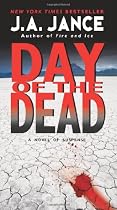
Day of the Dead
by J. A. Jance

Erika says:  “I found the scenes about torture to be the most intriguing!”

Plot Synopsis:
For more than thirty years, the case has remained stone cold — the brutal murder of a local Papago girl, her butchered body found stuffed into a large cooler that was left on the side of Highway 86. No one ever paid for the horrific crime … except, that is, the victim’s loved ones, who suffer to this day. Brandon Walker, once the sheriff of Pima County, Arizona, no longer feels he has purpose. A reluctant retiree living in the long shadow of his wife, Diana Ladd, a successful author of true-crime books, he is bored with golf, and more so with life. Salvation, though, comes with an invitation to join the ranks of The Last Chance, an exclusive nationwide fraternity of former cops and forensic experts who look into unsolved murders that have baffled local law enforcement agencies. And one such case is staring Brandon in the face with cold, dead, entreating eyes — a murder investigation that may have been mishandled by his department when he was a young lawman. The trail of a sadistic, calculating, and blood-chillinglyefficient killer soon leads Brandon into a strange world at the unlikely border between forensic science and tribal mysticism: a place where evil hides behind a perfect facade. Now the seeds of terror sown three decades earlier have bloomed and are bearing awful fruit. A forgotten homicide in the Arizona desert is only the beginning of the nightmare that is about to ensnare a diligent ex-cop and his family, for Brandon Walker is the only one still alive who can unravel a blood knot of terror and obsession that will free a dark truth more frightening than he ever imagined.

For more frightening fiction, check out The Library Eclectica!

Morbid Fact Du Jour For July 9, 2013

Today’s Pavlovian Yet Truly Morbid Fact!

Suzanne Capper, 16, of Moston, Manchester, UK, died on December 18, 1992, from injuries she’d sustained during a week of torture inflicted on her by people she’d considered her friends.  Suzanne had babysat the children of Jean Powell since she was ten years old, and as a teenager she began spending more and more of her time at Powell’s home. Powell’s friend Bernadette McNeilly and her children also shared the home, as did McNeilly’s teenage boyfriend Anthony Dudson. Jean Powell dealt amphetamines and stolen cars, and was carrying on a relationship with one of her customers, Jeffrey Leigh, as well as sleeping with Dudson and also still “dating” her ex-husband Glyn Powell.

Suzanne’s sister reported that Jean Powell and Bernadette McNeilly frequently mistreated Suzanne, but that didn’t prevent Suzanne from “pampering their every whim.” The simple bullying took a much darker turn due to a series of seemingly petty occurrences: Suzanne supposedly suggested that Jean Powell prostitute herself, Anthony Dudson contracted crab lice which McNeilly believed Suzanne had brought into the house, and McNeilly believed Suzanne had stolen a coat of hers.

On December 7, 1992, Suzanne was enticed to the home and then attacked. Her head and pubic hair was shaved off, she was beaten and kicked and locked in a closet overnight. She was moved to another house the next day and her torture was escalated. The Powells, Dudson, Leigh and Mcneilly were joined by Powell’s teenage brother Clifford Pook. Pook used pliers to pull out two of Suzanne’s teeth; she was injected with amphetamines, burned with cigarettes and kept tied to a bedframe, forced to listen to rave music at high volume through headphones, n particular, a 45-minute mix called “Hi I’m Chucki Wanna Play” which featured samples from the Child’s Play” movies.  McNeilly announced each torture session with “Chuckie’s coming to play!”  Soon, in a Pavlovian response, the words alone were enough to cause Suzanne to scream in fear.

After a week, when Suzanne’s captors learned that her stepfather planned to report her missing, they decided to kill her. She was taken in a stolen car to a wooded area, where McNeilly poured gasoline on her and set her on fire, singing “Burn Baby Burn” from “Disco Inferno.” The group then drove away, leaving Suzanne Capper for dead. However, she managed to put out the flames and walk about a quarter-mile down the road till she was spotted by three men on their way to work, who took her to a nearby home and had the residents call the police. Suzanne was badly burned, her face unrecognizable and her hands useless. She was able to tell the police what had happened and who was responsible before falling into a coma and dying four days later.

Bernadette McNeilly, Jean and Glyn Powell and Anthony Dudson are currently serving life sentences in prison. Jeffrey Leigh and Clifford Pook were given shorter sentences and have since been released.

Culled from: Wikipedia
Submitted by Aimee

With friends like these, who needs enemies? – Aimee