Today’s Savage Yet Truly Morbid Fact!
Belying its reputation as a month famous for winter storms and high seas, November 1913 began unusually warm and calm, but before the month was out the worst storm in the history of Great Lakes maritime navigation would claim numerous ships and even more lives.
On November 7, 1913, a massive low-pressure system moved into Lake Superior from the Prairies, colliding with another low-pressure system moving north from Minnesota. Hurricane-force winds and driving snow buried towns and cities. Rail traffic ground to a halt and buried towns and cities. Rail traffic ground to a halt and telegraph lines fell, leaving many towns isolated for days.
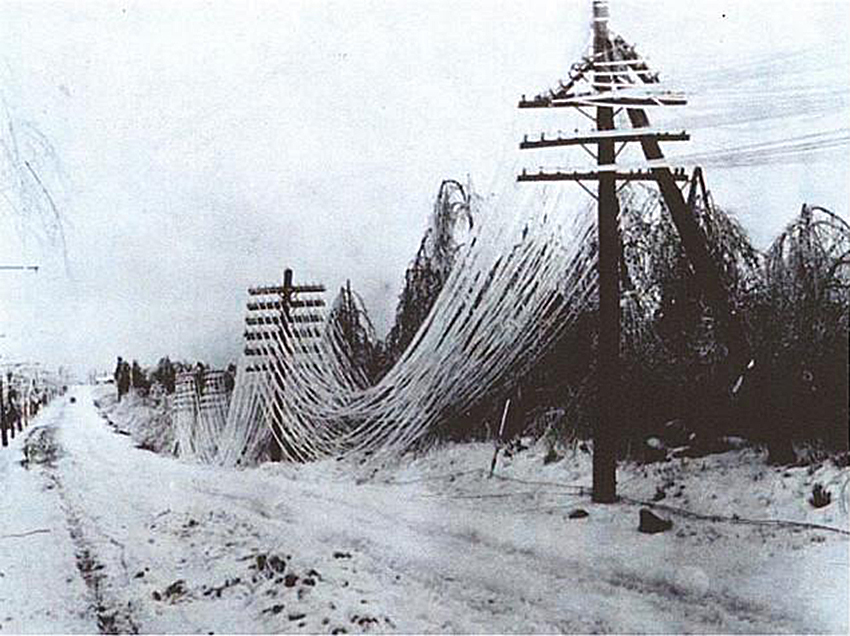
The Aftermath of the Storm in Ontario
On November 8, a third low-pressure system originating in the Gulf of Mexico joined this icy maelstrom. No one was prepared for the violence that followed. On Lake Huron, the cruel combination of savage seas and blinding snow and ice made survival for any ship caught on the lake almost inconceivable.
When the James Carruthers left the dock at De Tour, Michigan at 12:53 a.m. on Sunday the 8th, two lanterns were clearly displayed, white above red, denoting a northwest storm warning. Such signals were a common sight in November, however, and usually ignored. In fact, owners often reprimanded any skipper who took shelter from such a storm, especially when other boats made port safely.
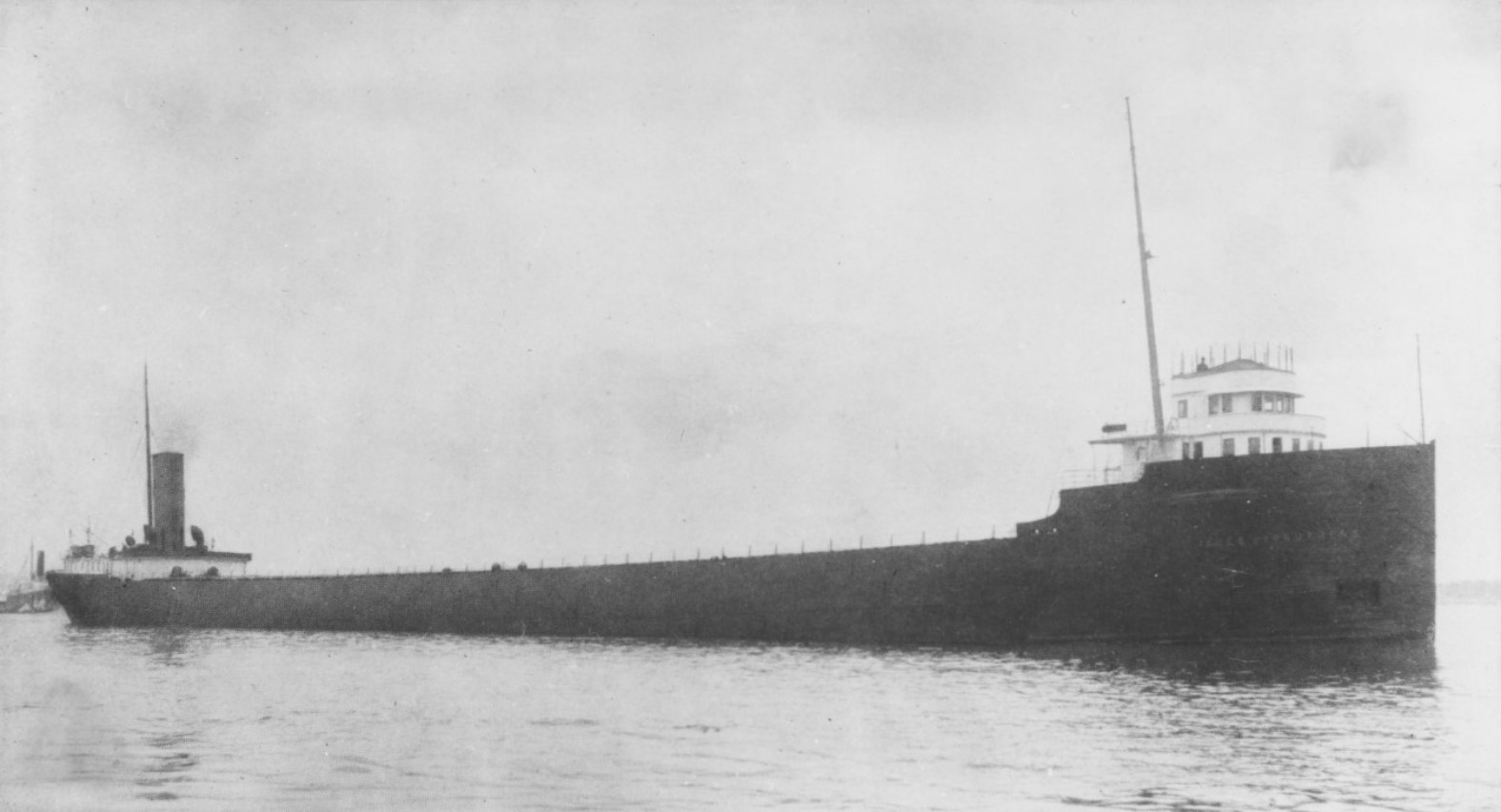
The James Carruthers
Several boats were beating north on Lake Huron: the tramp steamer Wexford loading with grain, the Howard M. Hanna, Jr. loaded with soft coal and the 269-foot (81m) package freighter Regina. As the Hanna neared Harbor Beach, Michigan, the wind shifted briefly to the southeast, then to the northeast, and finally to the north-northeast, where it steadily increased in strength. By afternoon, it had begun to snow heavily and the ships struggled with limited visibility.
One of the first victims was the coal-laden Argus. When spotted by Walter C. Iler, captain of the steamer George C. Crawford, the Argus was struggling in murderous troughs. Then before Iler’s eyes the worst possible scenario unfolded – the Argus’ bow and stern sat atop two different waves and the cargo, heavy in the midships, was suspended between them. “The Argus just appeared to crumple like an eggshell and disappeared!” All hands were lost.
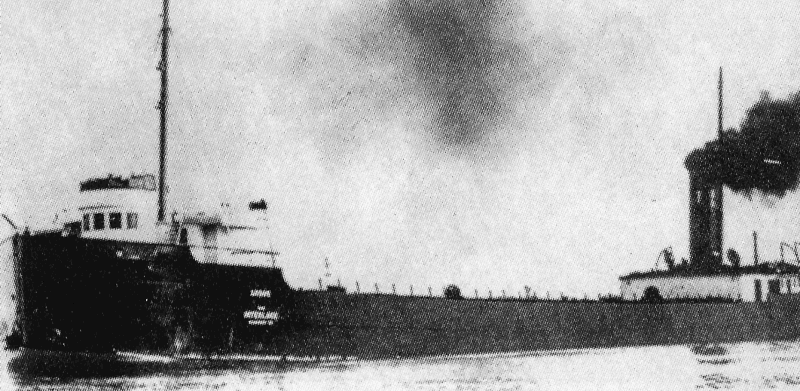
The Argus
The next to be overcome was the Hanna. Around 8 p.m. a massive wave broke over the stern, propelling the steward’s wife and furniture from her room through an interior bulkhead, dropping them into the engine room, much to the astonishment of Chief Engineer Charles Mayberry. By 10 p.m. the Hanna was aground on the Port Austin reef, broken in two pieces.
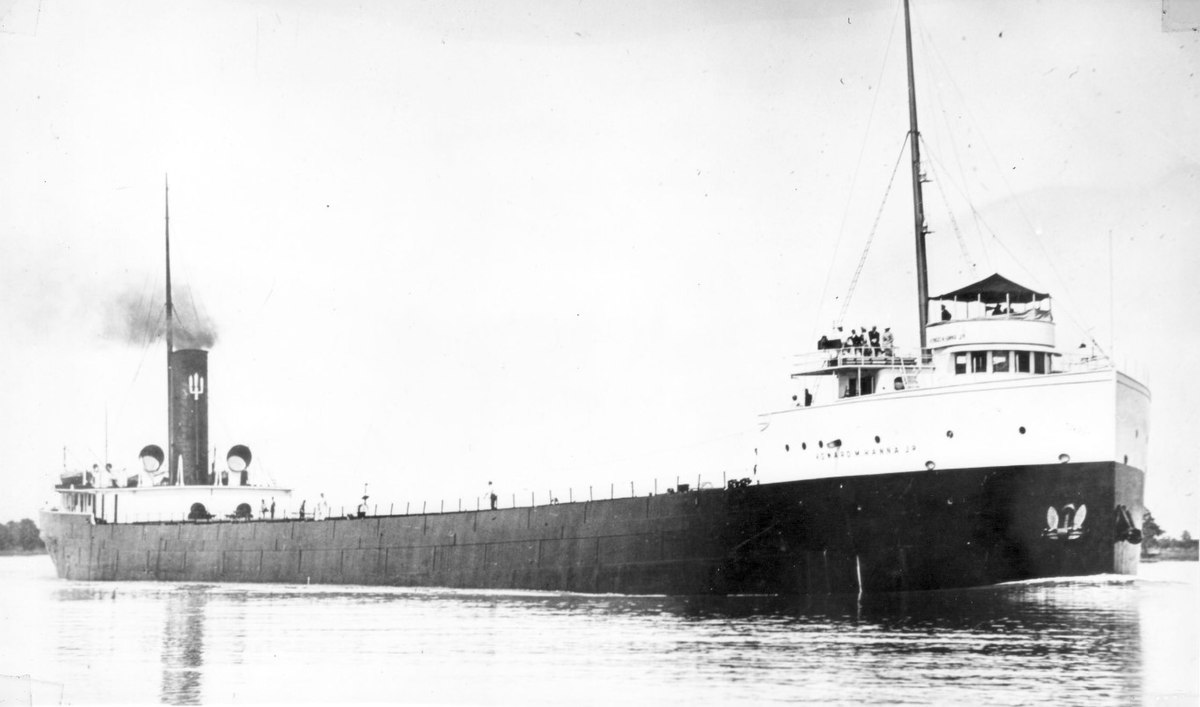
The Hanna
Everywhere, vessels struggled to find safe ports. By late Monday the 9th, the storm had begun to ease and evidence of shipwrecks began to appear along the shores of Lake Huron. At Port Franks, 30 miles (48km) east of Port Huron, ten frozen crewmembers of the Regina were found, surrounded by debris and cargo: hay, canned goods and mixed freight. Two more were found nearby, frozen in a lifeboat.
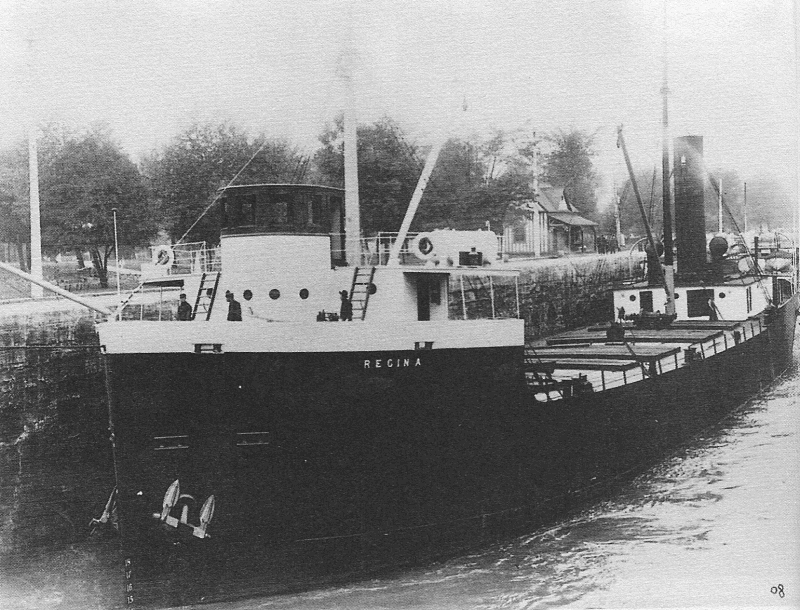
The Regina
A telegram received by the Pioneer Steamship Company in Cleveland confirmed that the John A. McGean had been lost with all hands. Three bodies lashed to a lifeboat bearing this name were found on the shore five miles south of Goderich, Ontario. The Carruthers was also presumed lost when life preservers, oars and rudders were discovered. South of Goderich near Kincardine, bodies and wreckage from the Argus turned up.
Families began to arrive at the ports to identify bodies of their loved ones. In Hamilton, Thomas Thompson received a wire from his daughter Mrs. Edward Ward of Sarnia, reporting that his son had been drowned and he was to come to Goderich at once. Mrs. Ward was certain that her brother John Thompson had been on the wrecked Carruthers. Late Tuesday night, Thompson arrived and identified one of the bodies as his son. The body’s left forearm was tattooed with the initials “J.T.”.
The next day, John Thompson read of his own demise in a Toronto newspaper and immediately set off for Hamilton. For some reason, he did not send any word to his family. In the meantime, his father had purchased a cemetery plot and made arrangements for the funeral. When John arrived, the wake was in full swing. Thomas Thompson, utterly shocked by his son’s appearance, exclaimed, “It’s just like you to come back to attend your own wake, and you can get right out of the house until this thing blows over!”
At Port Huron early on Monday the 9th, while surveying the wreck of his life-saving station, Captain George Plough glanced at the murderous lake and spotted a dark object about 100 feet (30m) long, floating three miles (4.8 kms) from shore. At first it was thought that it was the Regina, as crew members had been found not far from Port Huron. The hull lay in international waters between Canada and the United States but neither country immediately sent authorities to determine the ships’ identity. The U.S. finally dispatched the cutter Morrill, but upon arrival at the site, the ship was ordered to turn around to assist the steamer G.J. Grammer, driven ashore on Lake Erie. Many were confounded by this decision as the hull, lying directly in the shipping lane, was a potential hazard.
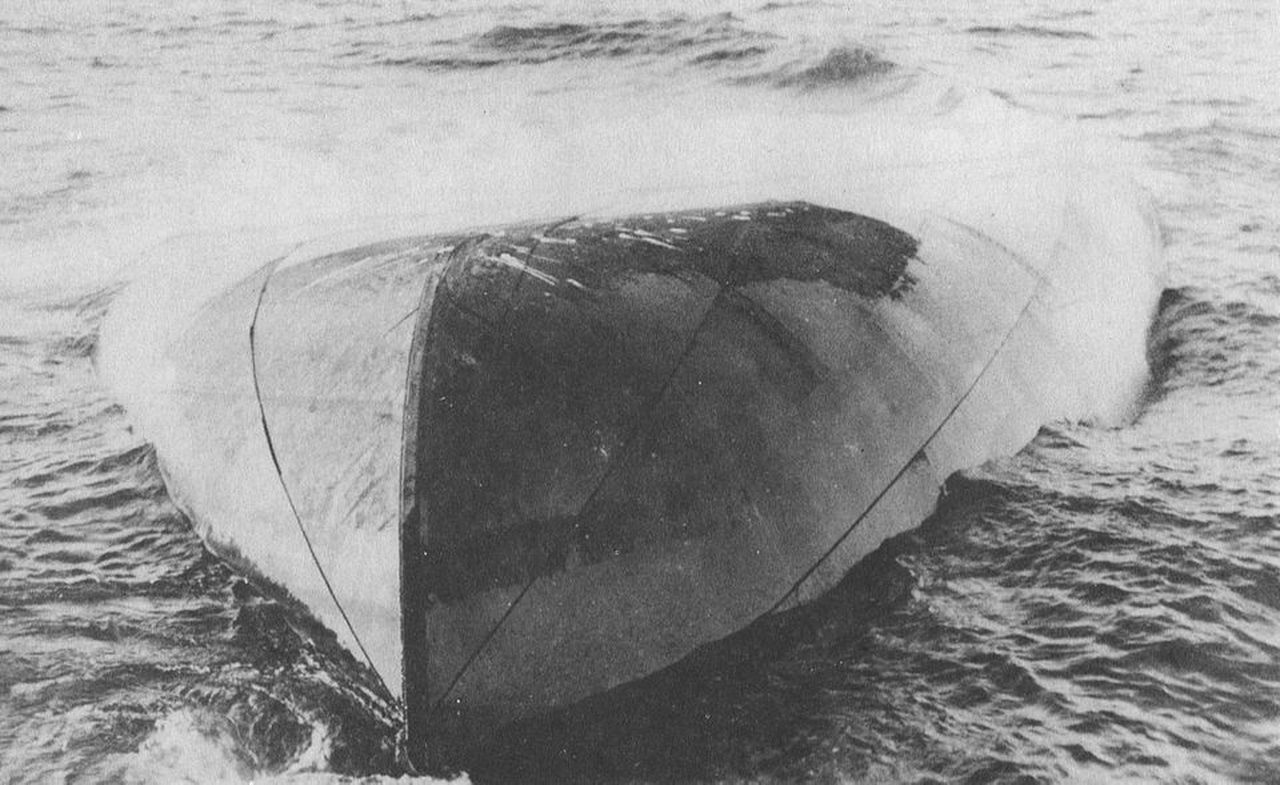
The “Mystery Ship”
William Livingstone, president of the Lake Carrier’s Association, was enraged and dispatched the tug Sarnia City to investigate. The tug’s crew speculated that the hull was stuck on the bottom of the lake, held by its spar. However, the hull could not be identified and Plough’s discovery was dubbed the “mystery ship.” Superintendent Dugan of the Merchant’s Mutual Line Company, owners of the Regina, visited the wreck and declared it was decidedly not their ship. All reports were going to President Livingstone of the Lake Carrier’s Association including that of the captain of the Sarnia City, who informed him that the mystery hull had eight plates, each no bigger than five feet (1.5m) across, indicating a vessel of between 250 and 300 feet (75-90m). Livingstone confidently announced that all American vessels of this size were accounted for and so the ship must be from Canada.
Might it be the 250-foot steel bulk freighter steamer Wexford? A landowner near St. Joseph had made a particularly haunting discovery. A quarter mile offshore, a man seemed to be waving to him. It turned out to be a crewmember from the Wexford. His upraised arms were frozen stiff and as the body bobbed up and down, it appeared to be waving. Other crewmen were found on the beach, which was awash with grain from the Wexford’s hold. The Wexford, at about 250 feet (75m) could fit into Livingstone’s theory.
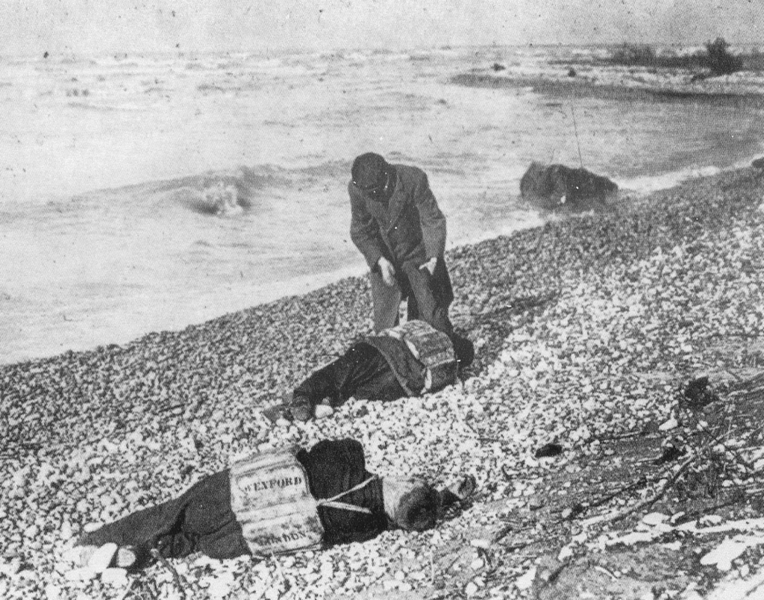
Wexford victims washed ashore
First Mate James McCutcheon had been scheduled to sail on the Wexford but had missed his train. Now he was being called upon to identify the bodies of his friends. He admitted that it was the third time he had missed the boat and each time a disaster had occurred. In the first instance, the Wexford had caught fire and several lives had been lost. The second time there had been a wreck but the boat had been repaired. Although horrified by the task before him, he could not help declaring, “I’m the luckiest man alive!”
Milton Smith also considered himself lucky. He was an engineer on the missing Charles S. Price, but a strange premonition had kept him from sailing on what would be the Price’s last voyage. In Cleveland, Smith had been reading a newspaper to pass the time and was constantly drawn back to the weather forecast. There was no warning of anything unusual but Smith had a dreadful hunch. He repeated his fears to the chief engineer, John Groundwater, who scolded him for being foolish. Later, when Smith was called to Thedford to assist in the identification of his crewmates’ bodies, he positively identified John Groundwater. This puzzled the coroner as the body had been found wearing a Regina life jacket. How did the Chief Engineer of the Price end up wearing a life jacket from the Regina?
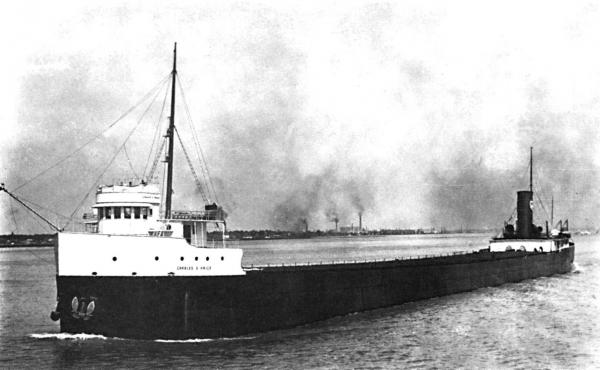
The Charles S. Price
Numerous other Price crewmembers were also found with Regina life jackets. The discovery of the Price’s cook with his apron still on seemed to suggest that the ship had gone down quickly and at some point, the Regina must have foundered as neither hull has ever been found. Did the two ships collide in the storm?
Meanwhile, William Livingstone, who was still eager to positively identify the “mystery ship,” received a call from Sarnia. The services of a professional diver and the tug Sport were available. Livingstone was overjoyed and cried, “For God’s sake, get them if you can.” The dive was set for Friday morning.
Unfortunately, because of rough seas the dive was called off until the following morning. As they waited, more bodies washed ashore near the Point Clark lighthouse, adding to the tension. Finally, on Saturday morning, six days after the discovery of the wrecked vessel, William Baker made his dive. He descended into the inky water and brought back the answer. “I d the name twice and then once more to be absolutely sure. The name was painted in black letters on white bulwarks – Charles S. Price.”
At Port Sanilac on Lake Huron a historical marker tells the story of the Great Storm of 1913:
Sudden tragedy struck the Great Lakes on November 9, 1913, when a storm whose equal veteran sailors could not recall left in its wake death and destruction. The grim toll was 235 seamen drowned, ten ships sunk, and more than twenty others driven ashore. Here on Lake Huron all 178 crewmen of the eight ships claimed by its waters were lost. For sixteen hours gales of a cyclonic fury made men and his machines helpless
Culled from: Disaster Great Lakes
Corpse Du Jour!
WHAT GOES AROUND COMES AROUND – 1949
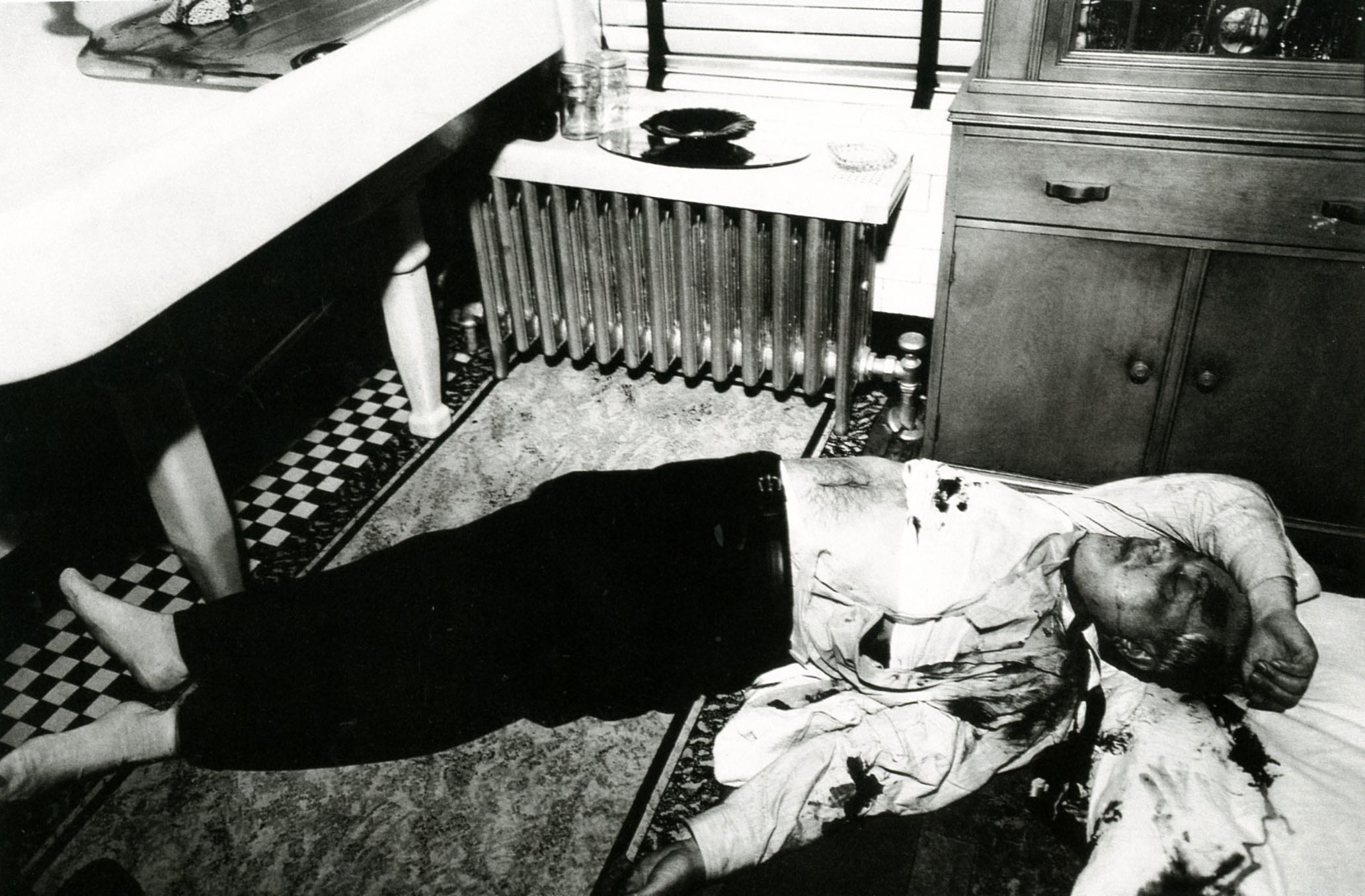
Forty-six-year-old longshoreman Joseph Castellano lies dead, March 10, 1949, on the floor of his kitchen at 409 First Street in the Park Slope section of Brooklyn. The next day, in bold letters, the front-page headline of the Brooklyn Eagle announced, “Dock Mobster Slain: Victim Beat the Chair in ’46 Death Trial.” Castellano, a known mobster, had 23 arrests dating back to 1922. He had two convictions, the first in 1923 for disorderly conduct and the second in 1946 for the murder of another dock worker, 47-year-old Louis Suarato. He was convicted of murder but after appeals and two new trials he was acquitted on November 12, 1948. When he was freed, Castellano was known on the docks as a “marked man.” This was four months before his murder. At first Louis Suarato’s two brothers were considered the prime murder suspects, but further investigation indicated that his murder resulted from a dispute among mobsters for control of the South Brooklyn waterfront. Castellano was to meet his 47-year-old wife, Susan, at eight o’clock that night at St. Francis Xavier Church at Sixth Avenue and Carroll Street for a Lenten Novena service to St. Joseph. When he didn’t show up, she went home and found him dead with three bullet wounds in the back and one in the stomach.
Culled from: Deadly Intent: Crime and Punishment Photographs from the Burns Archive
And everyone knew, as the captain did too, twas the witch of November come stealing.
and later that night as they lost their running lights, the waves rose and the temperature falling
and everyone knew, as the captain did too, twas the Witch of November come calling
“come calling” is a lot more ominous then “come stealing”!