Category Archives: Art

Morbid Fact Du Jour for June 21, 2015

Today’s Narrow Yet Truly Morbid Fact!

The narrow, brick chimney of a Louisiana bank became his tomb for 27 years and now Joseph Schexnider will be laid to rest Sunday, August 14, 2011 in a proper grave with a proper farewell by his family. Still, his brother Robert wonders, how did he wind up in that chimney? Didn’t anyone hear any cries for help? Was it a robbery attempt gone awry, an accident or something more sinister?

“At least we know where he is now,” Schexnider, 48, said, tears welling in his eyes ahead of his brother’s weekend funeral and burial. “At least he’s home.”

Nearly three decades after he disappeared, much mystery lingers about the case of Joseph Schexnider and involving a small town bank in the southern Louisiana city of Abbeville. Police say Schexnider became trapped and apparently died in the bank’s chimney in 1984. But beyond that, they know little more.

“Everybody has an opinion,” said Lt. David Hardy, chief of investigations for the Abbeville Police Department. “But no one has evidence to say one way or another.”

If Joseph Schexnider did cry out for help, no one heard his pleas. The stench of death was never detected.

The decades rolled on until last May (2011) when a construction worker helping turn the bank’s vacant second floor into offices tugged some fabric out of the chimney and was showered with old clothes and human bones.

Described as sweet-natured and relaxed by the few who remember him, Joseph Schexnider was 22 when his family last saw him in January 1984. He had no criminal record, but was wanted for possessing a stolen car.

A lanky, rambling man, Schexnider was prone to wandering at an early age.

In the years after they last saw them, his family, his mother, and two brothers and a sister, had not reported him missing — and no one searched for him.

“My mother worried about him, but I just said, ‘Mom, that’s just Joseph being Joseph,”‘ Robert Schexnider said. “He was always taking off for somewhere.”

Joseph first ran off around the age of 9 or 10, Robert recalled, adding his brother had dropped out of high school in the ninth grade.

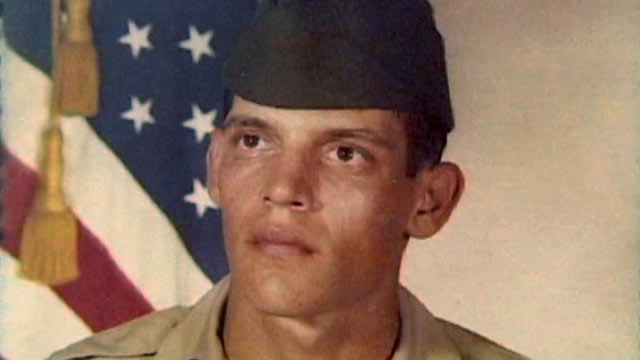
He worked now and then at this and that, quitting jobs when he became tired and moving on. He was briefly in the Louisiana National Guard, leaving with a medical discharge. One of the few pictures of him shows him in uniform, his dark eyes looking off into the distance.

“He was always going off somewhere,” Robert Schexnider said. “He told me he’d seen every state in the country.”

Schexnider followed carnivals and once traveled with a circus. He told his brother he hawked cotton candy and peanuts with the shows, traveling with the circus to New York where he was stranded when it left to go overseas.

“He didn’t have enough money to get home, so the church helped him out,” recalled Francis Plaisance, a city councilman and the pastor of the church the Schexniders attended. “I remember him as being a nice kid.”

Plaisance also remembers Joseph as a somewhat simple person. When the church sent a plane ticket to New York for him to come home, Schexnider was unable to navigate the airport.

“We ended up having a pastor up there walking him through it and put him on the plane,” Plaisance said.
Jason Hebert, now a detective with Abbeville Police, went to elementary school with Joseph Schexnider. He described him as quiet kid, on the fringe of a group of young boys that made mischief in the town.

“He was just another kid,” Hebert said. “Nothing really stood out about him.”

With the remains found in the chimney were a yellow long-sleeve shirt, a pair of jeans, blue tennis shoes, and jockey shorts with Schexnider’s name printed in the waistband. There also was a magazine and gloves.

He had a wallet with a copy of his birth certificate, a Social Security card and a few pictures.

“There was no sign of foul play,” Hardy said. But, he said, there is no way to determine the cause of death.

From the way the skeleton was recovered, Hardy said it appeared Schexnider went into the 14-inch-by-14-inch chimney feet first. Because the chimney narrowed sharply at the bottom, he then was apparently unable to maneuver his way back out.

There was no way out at the bottom of the chute, which ended in a 3-inch opening to a narrow fireplace on the second floor of the bank building.

“He was stuck with nowhere to go,” Hardy said. If he had called for help — Hardy points out — he would have been 20 feet above the street, and encased in bricks.

“His voice would have been carried up and away from the street,” Hardy added.

None of the people working on the floor below reported any strange sounds. No one ever went into the seldom-used second floor and reported any strange smells.

His brother won’t guess why Joseph went into the chimney, but acknowledged in his final days in town that Joseph had gotten in “with a bad crowd.” He was carrying no burglary tools when found or anything to carry away money if he had planned to rob the bank.

Plaisance said he could see it as a misconceived burglary plan on Schexnider’s part, however.

“He was the kind of guy who would do things without really thinking them through,” Plaisance said.  After so many decades and so few clues, Abbeville Police have declared the case closed.

Culled from: CBS News
Generously submitted by: Mike Marano

I don’t have claustrophobia, but I get incredibly claustrophobic just thinking about going down a chimney. Does anybody actually survive these attempts?


Atrocious Art: Road-Kill Edition!

Kimberly Witham collects roadkill and makes incredibly beautiful still life (er, death?) out of the deceased creatures.  I think the images are a wonderful tribute to the animals.  (Thanks to Michael for the link.)


Kimberly Witham

Morbid Fact Du Jour For June 5, 2015

Today’s Coincidental Yet Truly Morbid Fact!

An Ohio family is mourning for a toddler who drowned in a pond on the same day her mother gave birth to her brother. Authorities in Marion County, which is north of Columbus, say 18-month-old Jaylynn Adamson had been staying with a relative while her mom was at the hospital. Lt. Jason Dutton of the Marion County sheriff’s office says the little girl was found in the pond Friday morning (May 29, 2015). She was pronounced dead at Marion General Hospital, where her mother was in labor. David Adamson, an uncle of the children’s father, tells The Columbus Dispatch that the girl’s mother gave birth to a son later that day. The sheriff’s office isn’t saying who found the little girl in the pond or releasing other details about the drowning.

Culled from: the Associated Press
Submitted by: Aimee

Those poor people, and that poor boy, his birthday forever associated with the death of a sister he never knew. – Aimee


Morbid Art Du Jour!

Fasciolo de Medicina, drawing of an anatomy lecture, 1493. The professor read from the books of Galen, while his assistants performed the dissection.

Culled from: Body Worlds: The Anatomical Exhibition of Real Human Bodies

Morbid Fact Du Jour for May 16, 2015

Today’s Violently Tumbled Yet Truly Morbid Fact!

Monty Atwater was a veteran of the 10th Mountain Division which utilized explosives to create strategic avalanches during World War II.  After the war he was immediately hired to research and control avalanches at Alta, a ski resort in the middle of one of the most notoriously dangerous mountain chains in North America, Utah’s Wasatch, just east of Salt Lake City.  Needless to say, working with avalanches is dangerous business, and Atwater did not manage to retire unscathed. In January 1951, after a two-day blizzard that dropped 38 inches of snow, Atwater was out with his partner, Hans Jungster, checking the slopes before turning skiers loose. In those days, he figured the only way to test the stability of slopes was to ski them. If they didn’t slide under the feet of the snow rangers, presumably they wouldn’t slide under anyone else. As the two experts crossed a series of fields, one would watch from a safe position while the other advanced; at one point, however, the new and inexperienced Jungster came onto a steep, concave chute called Lone Pine Gully, before Atwater was off it, and triggered an avalanche that released the entire slope at once. Atwater fell though the cascading snow until his skis hit the hard base of old snow underneath.

“I was knee deep in boiling snow, then waist deep, then neck deep,” he wrote. “Through ankles and knees I felt my skis drift onto the fall line. But I was still erect, still on top of them. The books tell you, ‘If you’re caught in an avalanche, try to ski out of it.’ With mine trapped under six feet of snow I wasn’t skiing out of anything.

“Very fast and very suddenly I made two forward somersaults, like a pair of pants in a dryer. At the end of each revolution the avalanche smashed me hard against the base. It was like a man swinging a sack full of ice against a rock to break it into smaller pieces.”

Years of training and countless hours spent observing avalanches meant that Atwater knew exactly what he was in for. Tumbled violently beneath the snow and in utter darkness, he suddenly popped to the surface again, spat out a chunk of snow stuck in his mouth, and sucked in a breath of air. “I thought, ‘So that’s why avalanche victims are always found with their mouths full of snow. You’re fighting like a demon, mouth wide open to get more air, and the avalanche stuffs it with snow.” The next time he surfaced, Atwater took two lungfuls of air, and the cycle continued. “On top, take a breath, swim for the shore; underneath, cover up, curl into a ball. This seemed to go on for a long time, and I was beginning to black out again. Then I felt the snow cataract begin to slow down and squeeze. The squeezing was the result of the slowdown, with snow still pressing from behind. Whether from instinct or a last flicker of reason, I gave a tremendous heave, and the avalanche spat me onto the surface like a seed out of a grapefruit.”

Culled from: The White Death: Tragedy and Heroism in an Avalanche Zone

Morbid Fact Du Jour for April 7, 2015

Today’s Impaled Yet Truly Morbid Fact!

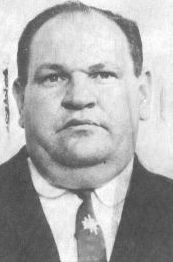
William Jackson, also known as Action Jackson (December 1920 Chicago, Illinois – August 11, 1961 Streeterville) was an enforcer and loan collector for the Chicago Outfit. He earned his nickname of “Action” because it was slang for “Juice Man”, which meant debt-collector. He was tortured to death by his fellow gangsters, allegedly on suspicion that he had become an informant for the Federal Bureau of Investigation (FBI).

Chicago police described him as a man with the body of a giant and the brain of a child, who was known in syndicate circles as a mob “juice” collector who specialized in pain for delinquent customers. In 1941 he was arrested in Green Bay, Wisconsin, for assault and robbery. In 1947, he was arrested and charged with rape; he went on to beat those charges. In 1949, he was arrested and sentenced to four to eight years in prison for robbery. In 1953, he was paroled and became a muscle man for gangsters in Chicago.

In 1961, Jackson was arrested, along with five others, at a warehouse as they were unloading $70,000 worth of electrical appliances from a stolen truck. While the others tried to escape, Jackson stood still because he was too fat to run. Agents learned that Jackson was a “juice” collector for Sam DeStefano.

In 1960, FBI agent Bill Roemer asked Jackson to become an informant for the FBI. Being a loyal member of the Outfit, Jackson declined.  Nonetheless, in 1961 Jackson was so accused. According to sources, he was kidnapped and taken to a meat-rendering plant on Chicago’s South Side, where he was tortured by gangster Sam DeStefano. It is suspected that DeStefano and his crew took Jackson at gunpoint and led him to the plant, where he was tortured and killed in what is known as one of the most brutal gangland killings in American history.

When police found the almost nude body of Jackson, he was face forward with rope marks on his wrists and feet. He had many cuts and burns all over his body, his chest had been crushed and he had a hole in his right ear from some type of sharp object.

Jackson was impaled, while hanging a foot in the air through his rectum with a meat hook while being questioned by mob enforcers. Jackson kept insisting he was not an informer but his torturers did not believe him. They stripped him naked, smashed his kneecaps with a bat, shot one of them with a gun, broke his ribs, stuck him with sharp objects, used a cattle prod on his penis and anus making him lose his bowels, burned parts of his body with a blow torch, and told him how they were going to kill his wife and children if he did not confess. Then they left him for three days until he finally succumbed to his wounds.

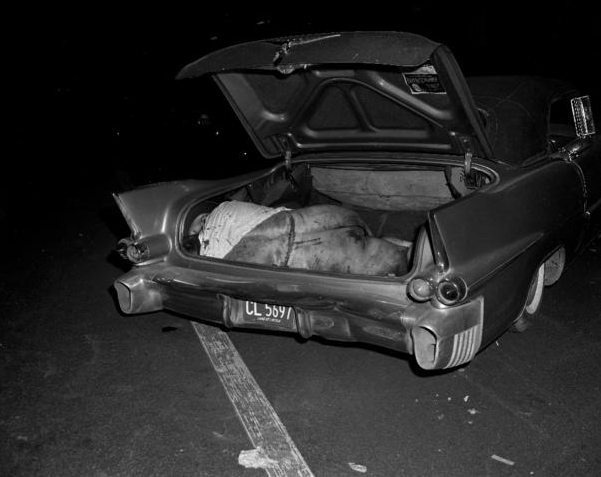
Jackson’s body was found on August 12, 1961 in the trunk of his own car, a green Cadillac convertible, which was abandoned on Lower Wacker Drive in Chicago.

Culled from: Wikipedia

Mourning Picture Du Jour!

The following is culled from Secure The Shadow: Death and Photography in America:

In the nineteenth century, itinerant and small-town painters flourished in America. These limners were seldom academically trained and consequently mixed conventions and genres with apparent ease. Here is an example of a mourning painting produced by one of these painters.

In Edwin Romanzo Elmer’s 1890 posthumous mourning painting, the artist combines elements of a mourning portrait with the photographic conventions of the view photograph, a type of photograph extremely popular at this time among rural and small-town homeowners. Mr. and Mrs. Elmer, in mourning dress, are seen seated in front of their home. At the left of the canvas stands Effie, their deceased daughter, with her toys and pet. The painting seems to serve a multitude of purposes. It is a portrait of the family. And at the same time, they mourn their dead child and celebrate their economic and social status by choosing to be portrayed in front of their home.

Morbid Fact Du Jour for March 3, 2015

Today’s Guano-Fueled Yet Truly Morbid Fact!

The Chincha Islands are a group of three small islands 21 kilometres (13 mi) off the southwest coast of Peru. In the 19th century they were of interest for their extensive guano deposits, since guano was the best fertilizer available at the time.  As other sources of good fertilizer shrank, global jockeying for guano became more intense.  When Daniel Webster, then U.S. secretary of state, made an ill-fated attempt in the 1850s to lay claim to a few guano-rich rocks off the Peruvian coast, the incident sparked anti-U.S. riots in Lima and the dispatching of Peruvian troops to the barren islands.  The United States backed down.

A real war started in 1863 when a Spanish naval squadron occupied the Chinchas in a move both ill advised and ill timed. The end of Chinchas guano was already in sight, and the Spanish occupation – made by an arrogant and hot-tempered admiral – kicked off declarations of war by both Peru and its neighbor Chile. The two former colonies combined their navies under the command of a talented former Confederate admiral from Virginia and succeeded in capturing a Spanish ship. The humiliated Spanish admiral committed suicide and his nation withdrew. The “Guano War” marked South America’s true independence from Spain and set off an exuberant two-nation celebration.

Toward the end of the guano trade “blackbirders” – pirates who kidnapped Polynesian and Melanesian tribesmen – raided the Easter Islands, shipping a thousand captured tribespeople to work digging guano. They included about a third of the islands’ total population, including its chief, crown prince, and most of the priests. It is estimated that nine hundred of the captured Easter Islanders died in captivity. When the raid became public, an international outcry led to the attempted return of the one hundred or so survivors. Eight-five of them died of disease on their way home. The remainder passed on the disease when they finally arrived home. By 1877 only 111 natives remained int he Easter Islands.

Culled from: The Alchemy of Air: A Jewish Genius, a Doomed Tycoon, and the Scientific Discovery That Fed the World but Fueled the Rise of Hitler


Post-Mortem Photo Du Jour!

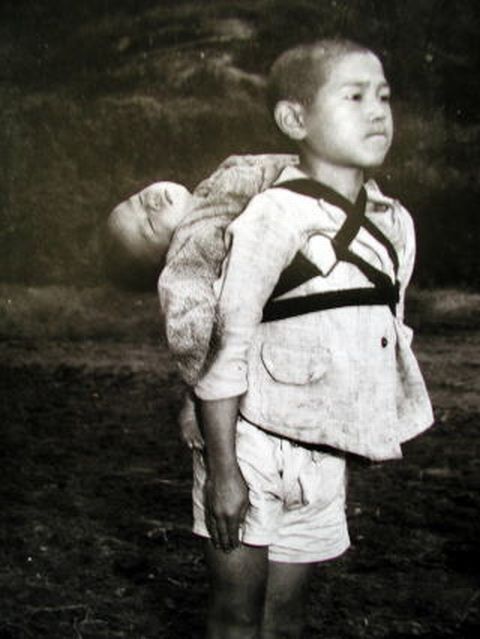
Confessions of a Funeral Director had an interesting article today about this picture.  The photographer’s comments are summarized below, but you can click the link to read the full article.


“I saw a boy about ten years old walking by. He was carrying a baby on his back. In those days in Japan, we often saw children playing with their little brothers or sisters on their backs, but this boy was clearly different. I could see that he had come to this place for a serious reason. He was wearing no shoes. His face was hard. The little head was tipped back as if the baby were fast asleep. The boy stood there for five or ten minutes.”

“The men in white masks walked over to him and quietly began to take off the rope that was holding the baby. That is when I saw that the baby was already dead. The men held the body by the hands and feet and placed it on the fire. The boy stood there straight without moving, watching the flames. He was biting his lower lip so hard that it shone with blood. The flame burned low like the sun going down. The boy turned around and walked silently away.”

– See more at: Confessions of a Funeral Director


Morbid Art Du Jour!

Julie Green is the latest artist to find inspiration in the last meals of executed prisoners.

Painter Immortalizes Last Meals of 600 Prisoners Put To Death

Thanks to Ear for the link.

Morbid Fact Du Jour for February 8, 2015

Today’s Nearly-Headless Yet Truly Morbid Fact!

Forthman Murff was a logger by trade, and in May of 1984 he was still going strong at the age of 74. On this particular day, Murff was cutting down a tree in Gattman, Mississippi when a branch eighty feet above him broke and fell, striking him in the shoulder and knocking him into a ten-foot-deep ditch. His bad luck didn’t end there, because on its way down, this branch knocked a branch off a nearby tree, which fell on Murff and broke his leg and foot. Murff passed out briefly but woke up to find that he’d fallen onto his chain saw, and the chain saw was still running. The saw sliced almost completely through Murff’s neck; literally the only things keeping his head attached to his body were his carotid arteries, his spine, and some skin and muscle at the back of his neck.

Murff managed to shut off the chain saw and get to his feet. Hobbling on a broken leg and foot, he made his way to his truck 150 feet away. As he struggled along, he could feel his blood pouring into his lungs and so was forced to bend over frequently and let the blood drain back out. This kept him from drowning in his own blood.

Once he’d made it to his truck, Murff drove a half mile to the home of a neighbor, who then drove him 17 miles to the nearest hospital. His injuries were too severe to be treated there so he was rushed by ambulance to a bigger hospital 30 miles away.

Miraculously, Forthman Murff made a full recovery after extensive surgery.

He continued to work cutting trees and lived another 19 years, dying in 2003 at the age of 92. He always said the three things he loved most in life were “Jesus, music and chain saws.”

Culled from: Mental Floss
Submitted by: Aimee


Morbid Art Du Jour!

Kathleen Sawyer is a fascinating South African artist who creates morbid masterpieces out of moleskine notebooks. Check out these beauties!  (Thanks to Anna for the link.)

Book Autopsy

The Little Book of Horrible Death

Necrophagous

Morbid Fact Du Jour for January 26, 2015

Today’s Gummy Yet Truly Morbid Fact!

21-year-old Shanice Clark was found unresponsive at three A.M. on Sunday, January 18, 2015, in her residence on the campus of California University of Pennsylvania. She was rushed to the hospital but was pronounced dead shortly after arrival. Preliminary autopsy results indicate she choked to death on chewing gum while asleep.

Culled from Associated Press
Submitted by: Aimee

I guess she didn’t want her chewing gum to lose its flavor on the bedpost overnight. Cause when you chew it in the morning, it gets much too hard to bite. So her chewing gum she kept a-chewin’ overnight. This story’s really crazy, won’t somebody set it right? – Aimee

Update 03/17/15: According to an Associated Press article I read today, her death has been determined to be as a result of sickle-cell anemia and not choking. – Aimee


Morbid Art Du Jour!

Project Facade is a fascinating art project by Paddy Hartley that attempts to tell the stories of the men who were grievously disfigured during World War I and who benefited from the groundbreaking work of pioneering facial surgeon Sir Harold Gillies.  Hartley’s website tells the tale of several of the men covered in the project.

Walter Fairweather: Lose His Nose at the Battle of the Somme.
Henry Ralph Lumley:  Severely Burned and Doomed Airman.
Arthur Frederick Soole: Chinless Canadian.
William Spreckley: Aged Well Into His Replaced Nose.
Victor Topping: Massively Burned Face.
William Vicarage: A Burned Sailor and a Turning Point in Surgical History.
Norman Eric Wallace: Severely Burned In France.
Walter Ernest O’Neil Yeo: Questionable Aesthetics.


Memorial Photograph Du Jour!

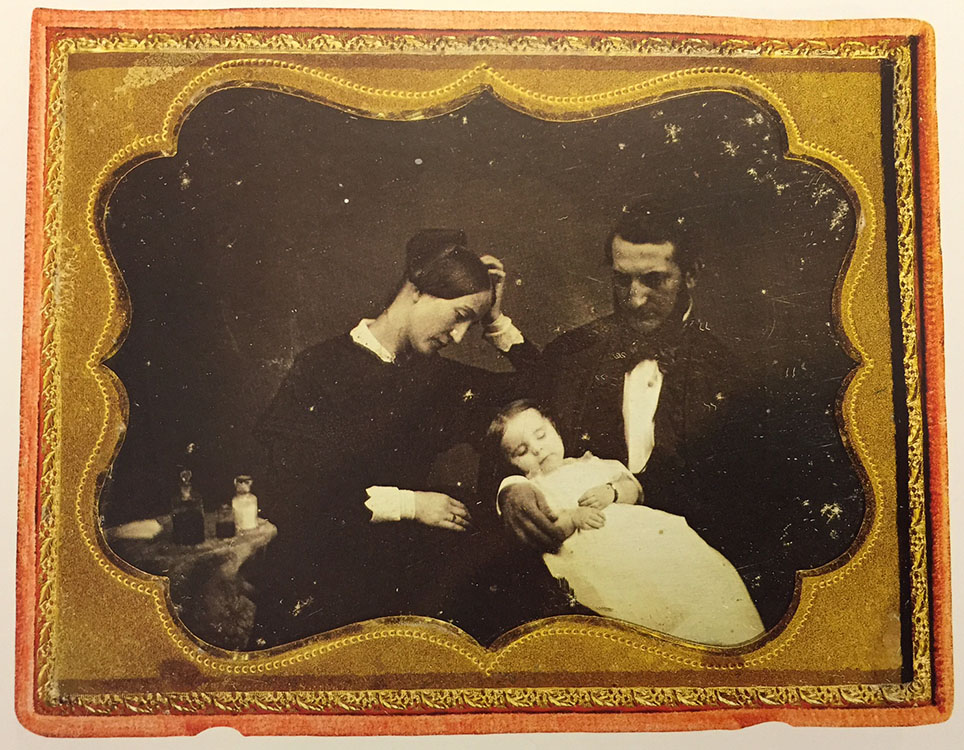
Here’s another memorial photograph culled from the classic of the genre, Sleeping Beauty: Memorial Photography in America.


Mother and Father with Dead Daughter,
Useless Medicine Bottles on Table
Anonymous
2 3/4″ x 3 1/4″ Daguerreotype
Circa 1848

Morbid Fact Du Jour for January 18, 2015

I apologize for not sending this out yesterday.  I suffered an unexpected attack of crippling ennui.  You know how life can be…

Today’s Incapacitated Yet Truly Morbid Fact!

In slang, a Mickey Finn (or simply Mickey) is a drink laced with a drug (especially chloral hydrate) given to someone without their knowledge in order to incapacitate them. The Mickey Finn is most likely named for the manager and bartender of a Chicago establishment, the Lone Star Saloon and Palm Garden Restaurant, which operated from 1896 to 1903 in the city’s South Loop neighborhood on South State Street. In December 1903, several Chicago newspapers document that a Michael “Mickey” Finn managed the Lone Star Saloon and was accused of using knockout drops to incapacitate and rob some of his customers.  Moreover, the first known written example (according to the Oxford English Dictionary) of the use of the term Mickey Finn is in 1915, twelve years after his trial, lending credence to this theory of the origination of the phrase.

The first popular account of Mickey Finn was given by Herbert Asbury in his 1940 book Gem of the Prairie: An Informal History of the Chicago Underworld. His cited sources are Chicago newspapers and the 1903 court testimony of Lone Star prostitute “Gold Tooth” Mary Thornton. Before his days as a saloon proprietor, Mickey Finn was known as a pickpocket and thief who often preyed on drunken bar patrons. The act of serving a Mickey Finn Special was a coordinated robbery orchestrated by Finn. First, Finn or one of his employees, which included “house girls”, would slip a drug (chloral hydrate) in the unsuspecting patron’s drink. The incapacitated patron would be escorted or carried into a back room by one of Finn’s associates who would then rob the victim and dump him in an alley. Upon awaking the next morning in a nearby alley, the victim would remember little or nothing of what had happened. Finn’s saloon was ordered closed on December 16, 1903.

Culled from: Wikipedia
Generously submitted by: Aaron 

And this is why I love Chicago.


Wretched Recommendations: Bejeweled Trinkets Edition!

Are you the type who dreams of finding a hidden lair filled not just with jewels and gold, but jewels and gold encrusting skeletal remains?  Of course you are!  But until you make that find of a lifetime, perhaps this book might suffice?

Heavenly Bodies: Cult Treasures and Spectacular Saints from the Catacombs

Here’s a great article about the book (thanks to Mike for the link):
Incredible skeletal remains of Catholic saints still dripping in gems and jewellery discovered by ‘Indiana Bones’ explorer


Morbid Fact Du Jour for January 13, 2015

Today’s Strife-Ridden Yet Truly Morbid Fact!

The opening salvo of what would become known as the Jackson County War was fired on February 27, 1869, in Marianna, Florida.  Late that evening, Dr. John Finlayson and his friend Willliam Purman, both Reconstruction sympathizers, were shot as they crossed the town square after attending a minstrel performance. Finlayson was struck in the head and died almost instantly. Purman barely survived the shot that passed through his neck and jaw. Although people in town knew the names of the assassins, no one was ever held accountable for the attack.

The shooting would trigger what was to become one of the bloodiest uprisings in the Reconstruction-era South, as gangs of whites and blacks went to war with teach other. In his account of the local strife, historian Dale Cox wrote: “Murders, political assassinations, assaults and bitter reprisals were the tactics of the day and over a period of several years, the Northwest Florida county literally became the scene of a bloodbath as bad as any in Missouri and Kansas during the years before the war.”

Culled from: The Boys of the Dark: A Story of Betrayal and Redemption in the Deep South


Morbid Link Du Jour!

Here’s a fascinating article sent to me by Eleanor which displays photographs of suitcases and the items within them that belonged to psychiatric institution patients.  The dehumanization of the patients once they entered these institutions is always emphasized to me by the fact that their suitcases, containing the things that really mattered to them – their last links to the lives they left behind (great title for a book!) – were taken from them and stored in anonymity.  They couldn’t even be granted a few token items from home.  So sad…

But as I read this article I thought, why isn’t this photographer mentioning the earlier book on the same collection of suitcases, The Lives They Left Behind: Suitcases from a State Hospital Attic? He obviously used that book as a stepping stone to photograph the full collection, so I’m left feeling a bit suspicious about his motives for leaving it out.  Sure enough, there’s a comment here from the book’s author, Darbey Penney:

“Unfortunately there is a good deal of misinformation in this article. Much of what is said about how and why the suitcases were kept, why they were not returned to families, etc., is completely inaccurate. Mr. Crispin says that a few of the suitcases were displayed by the NYS museum in 2004. In fact, there was a huge, 6,000 sq. foot exhibit- of which I was a co-curator – about the lives of more than a dozen of the suitcase owners, not just a display of a few suitcases. And that exhibit was the result of 6 years of research by myself and my colleague Peter Statsny, MD, and others as well as exquisite photographs by Lisa Rinzler, taken many years before Mr. Crispin’s. In 2006, we designed a traveling exhibit with The Exhibition Alliance, which is still touring, and a website, http://www.suitcaseexhibit.org. Dr. Stastny and I published a book, The Lives They Left Behind: Suitcases from a State Hospital Attic (Bellevue Literary Press, 2008), again, before Mr. Crispin took his photographs. It is disappointing that Mr. Crispin does not acknowledge our extensive previous work on this subject.”

In any event, the photographs are lovely and sad.  Thank you, Eleanor.


Ghastly! – Embalmed Leaders Edition

Thank goodness someone at the Washington Post has finally put together a photographic guide to the world’s embalmed leaders. The fact that the United States doesn’t do this sort of thing is a serious cultural flaw.  My favorite is Lenin. Still a handsome devil!

Morbid Fact Du Jour for January 9, 2015

Today’s Oxygenated Yet Truly Morbid Fact!

Eminent scientists in 1922 were by no means convinced that Mt. Everest could be climbed without the aid of supplemental oxygen. Balloonists had been known to collapse and die at lesser altitudes. “If you do succeed,” the Everest Committee was warned by Professor Dreyer, a consultant physiologist for the Royal Air Force, “you may not get down again.”  Accordingly, an oxygen subcommittee was set up by the Alpine Club, comprising Capt. Percy Farrar, George Finch, Howard Somervell, and another climber-scientist, P. J. H. Unna.  They were to study the problem and to order whatever equipment was necessary.  In Professor Dreyer’s pressure chamber in Oxford, Finch and Somervell underwent tests that took them to a simulated height of 23,000 feet. They were required to step on and off a chair with a 35-pound load. Finch managed with no apparent difficulty, but Somervell appeared to waver after his fifth step. He vigorously denied that he felt any ill effects, but his insistence was taken as a sign that he was exhibiting the quarrelsome characteristics known to be one symptom of hypoxia (oxygen deficiency ) and oxygen was forcibly administered.

It is not the proportion of oxygen in the air that diminishes as climbers gain elevation – this remains a constant 20.93 percent – but the atmospheric pressure that decreases. At 18,000 feet it is only half that at sea level and at the summit of Everest it falls to a third that at sea level. The body has trouble making the necessary gaseous exchanges in the lungs at diminished pressures like these. The first indication of oxygen deprivation will be an increased respiratory rate, as the climber strains after usable air. The heartbeat quickens to 140 beats per minute or more, making exercise extremely difficult; even rolling over in your sleeping bag leaves you breathless for many minutes afterward. The blood thickens, making you more susceptible to thrombosis and strokes, and it turns a very dark red, so that the face and hands appear bluish in color – especially the finger nails.  As unconsciousness approaches there may be mental confusion and irritability, and the blueness becomes even more marked.

Culled from: Last Climb: The Legendary Everest Expeditions of George Mallory


The last photo taken of George Mallory and Sandy Irvine, showing their oxygen apparatus.

Why, yes I am obsessed with Mt. Everest.  Why do you ask?


Menstruation Site Du Jour!

If you’re interested in perusing old advertisements about “woman’s most trying hygienic handicap” you’ll greatly enjoy the online Museum of Menstruation and Women’s Health.  Thanks to Rhiannon for the link.


Museum of Menstruation and Women’s Health


Let Them Eat Faces!

As Mike, who sent me the link, says, “Gruesome with a twist”.  A tasty twist!   Artwork by Ashkan Honarvar.