Today’s Blistered Yet Truly Morbid Fact!
On December 30, 1903, a fire broke out at the brand-new “absolutely fireproof” Iroquois Theater in Chicago as a packed, standing-room only audience, mostly women and children, were watching the popular comedian Eddie Foy perform in the musical fantasy Mr. Bluebeard. A short circuit in a single backstage spotlight touched off a small fire that, in minutes, erupted into an uncontrollable blaze. More than 600 people died.
One of the most devastating moments of the tragedy occurred when the stage doors were opened at the rear of the building. A fireproof asbestos curtain that was intended to protect the audience from onstage fires became hung up on equipment and did not reach the stage floor. Consequently, when the cold air from the opened doors reached the fire, it had a blowtorch effect, shooting super-heated flames into the standees in the upper balcony. This is where we pick up the action.
Emil Von Plachecki was a husky twenty-four-year-old civil engineering student and one of the standees in the gallery. As a fireball swept into his area, “everyone started to scream,” he said. “I felt my face burning. It felt like breathing a hot blast from a furnace.” He pursed his lips and held his breath, and when he found that stairways leading from the gallery were blocked, suddenly remembered the washroom he had visited before the performance. It had no exit but it did have a skylight. Using superhuman strength he hardly knew he possessed, the chunky young man pulled himself up, seventeen feet above the floor, hand over hand, on a stout window cord.
Grasping the cord in his left hand, Von Plachecki punched his way through a glass skylight reinforced with wire mesh and hauled himself onto the theatre’s snowy roof, where he bound his bleeding right hand with a tourniquet made from his clothing and waited in the cold until he was rescued by ladder. He had intended to find a ladder and lower it into the restroom so that others might escape, but he was too weak. Von Plachecki was rushed to a pharmacy where oil was poured on his blistered face, head and arms and his lacerated hand was treated.
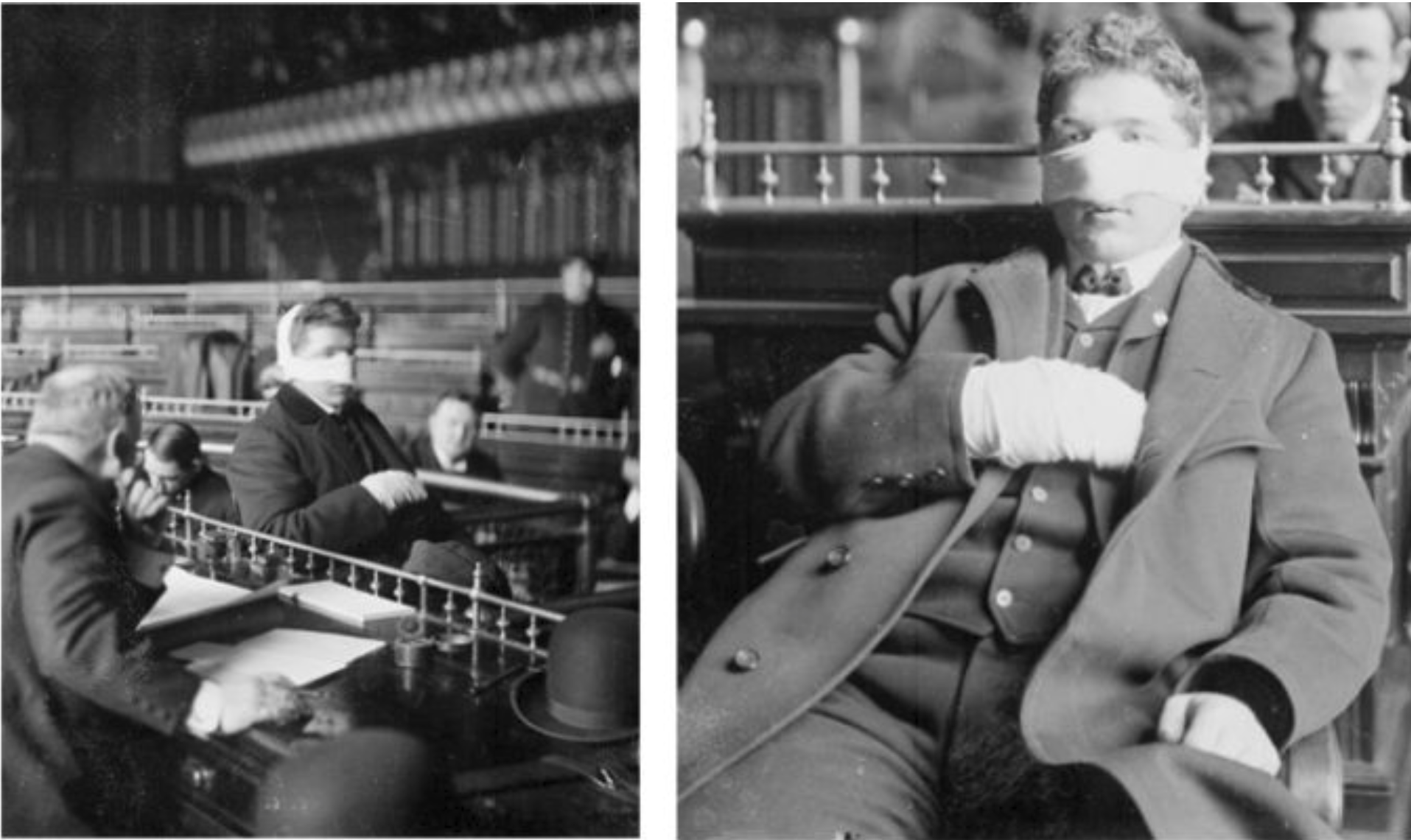
Emil Van Plachecki testifying at the post-fire trial
D. W. Dimmick, a plucky, bearded seventy-year-old Apple River man, found himself feeling his way along a wall toward an exit when “the whole front of the stage seemed to burst out in one mass of flame. From all over the house came shrieks and cries of ‘fire!’ I started at once hugging the wall on the outside of the stairway,” he said. “As we went down the platform where the first balcony opens, it seemed… that people were stacked up like cordwood. There were men, women and children in the lot. By crowding out to the wall we managed to squeeze past the mass of people who were writhing on the floor and… blocking the entrance. As we got by the mass on the floor, I turned and caught hold of the arms of a woman… pinned down by the weight resting on her feet. I managed to pull her out and I think she got down [safely]… I tried to rescue a man who was also caught by the feet, but, although I braced myself against the stairs, I was unable to move him.”
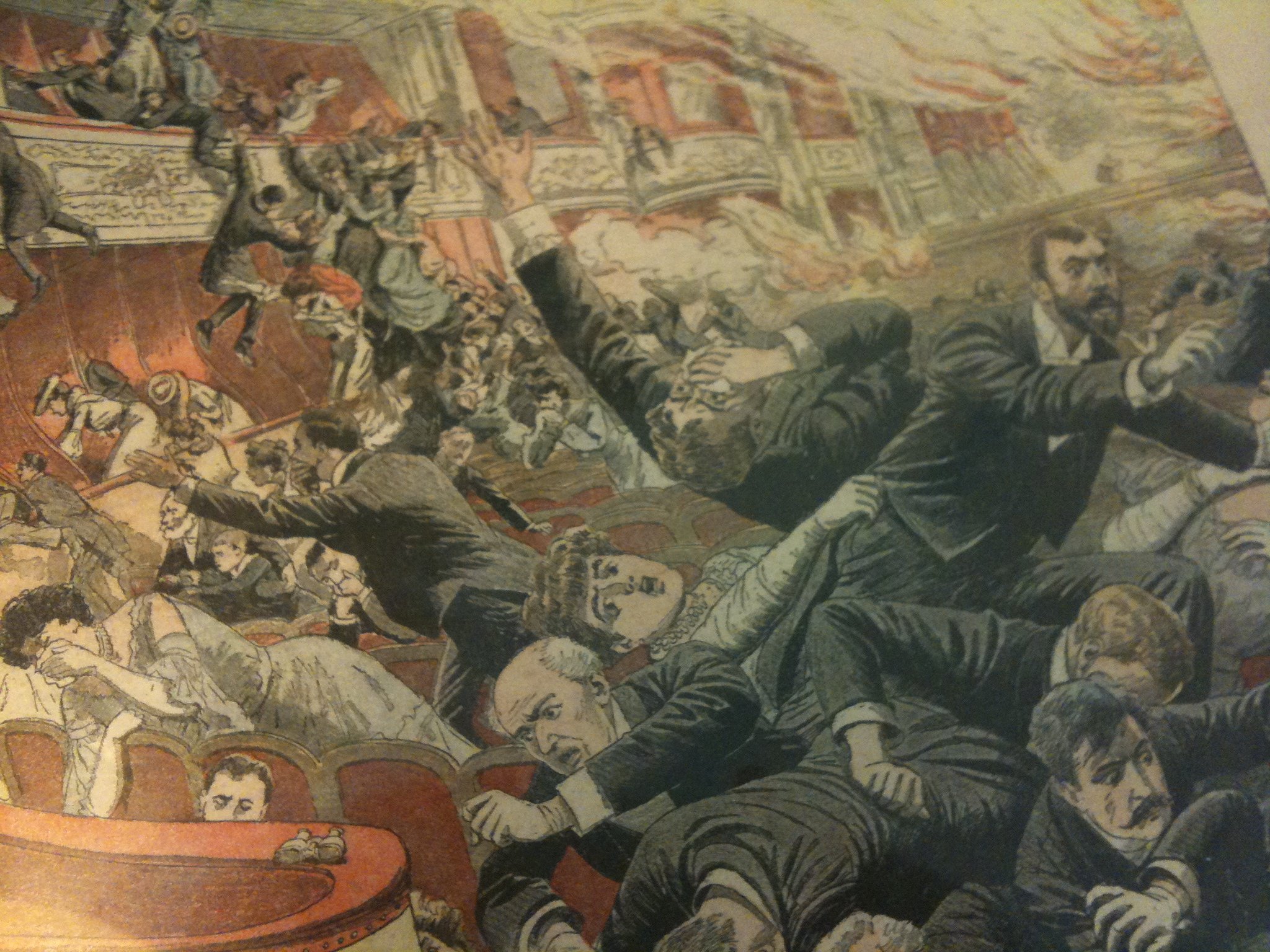
Panic in the Iroquois
There were many heroic acts that afternoon. Georgia Swift, a young society woman badly shaken and bruised, had been sitting in the orchestra section. “When I reached the back of the auditorium,” she said, “the aisle was choked with people who had fallen. I looked down to avoid stepping on them and as I did, my eyes were caught by those of a little boy about seven who was on the floor and unable to rise. He had large, brown eyes and was so neat he looked like a little gentleman. He fascinated me. It was all in a second, I know, but as he saw me looking at him he said, ‘Won’t you please help me, please do?’ I stooped to raise him if I could, but the crowd was too thick and the rush too strong. I seized him under the arms and was then knocked over to my knees in the aisle. I struggled to my feet but the weight of the crowd was such that I could not turn back, and I was carried on through the door. The little boy was unquestionably trampled to death, and the memory of those eyes will haunt me [forever].”
Culled from: Tinder Box: The Iroquois Theatre Disaster 1903
Post-Mortem Photo Du Jour!
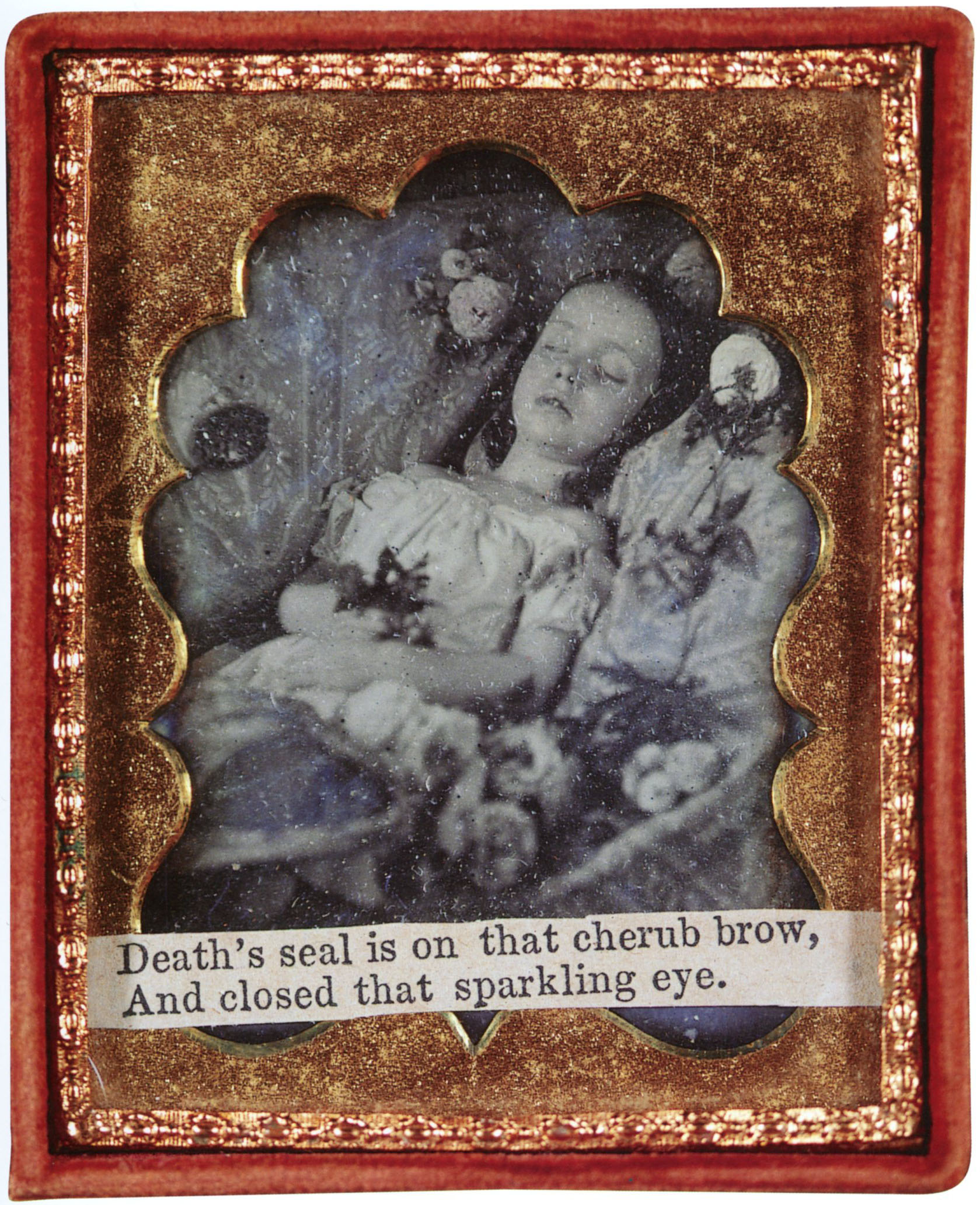
“DEATH’S SEAL IS ON THAT CHERUB BROW…”
Petite fille au poème
Dagerreotype 1/9/ Plate, Circa 1852
The death of a child is the most devastating of all losses. Parents often created beautiful, blissful visual scenes with flowers and other aesthetically pleasing objects for their child’s memorial portrait. As a further complement to cased postmortem images, poems were at times pinned to the mat. Here, the photographer sealed the poem within the frame.
Culled from: Sleeping Beauty II: Grief, Bereavement, and the Family in Memorial Photography