Today’s Secretive Yet Truly Morbid Fact!
Porcia (c. 70 BC – June 43 BC), occasionally spelled “Portia”, especially in 18th-century English literature, was a Roman woman who lived in the 1st century BC. She was the daughter of Marcus Porcius Cato Uticensis and his first wife Atilia. She is best known for being the second wife of Marcus Junius Brutus, the most famous of Julius Caesar’s assassins.
Brutus, Porcia’s first cousin, divorced his wife Claudia and married Porcia when she was still very young. The marriage was scandalous as Brutus did not state any reasons for divorce despite having been married to Claudia for many years. Claudia was very popular for being a woman of great virtue, and was the daughter of Appius Claudius Pulcher, who had been Brutus’ ally for many years. She was also related to Pompey by marriage through her younger sister. The divorce was not well received by some, including Brutus’ mother, Servilia, who despised her half-brother, and appears to have been jealous of Brutus’ affection for Porcia. Therefore, Servilia supported Claudia’s interests against those of Porcia.
On the other hand, Porcia was highly favored with the followers of both Pompey and Cato, so the marriage was favored by people such as Marcus Tullius Cicero and Titus Pomponius Atticus. The marriage was Brutus’ way of honoring his uncle. Nonetheless, it appears that Porcia deeply loved Brutus and was utterly devoted to him. She resolved not to inquire into Brutus’ secrets before she had made a trial of herself and that she would bid defiance to pain.
Brutus, along with many other co-conspirators, murdered Caesar in 44 BC. He promised to share the “heavy secrets” of his heart with his wife but it is unclear if he ever got the chance. Some historians believe Porcia may have known about the plot, and may have even been involved in the conspiracy itself. Plutarch claims that she happened upon Brutus while he was pondering over what to do about Caesar and asked him what was wrong. When he did not answer, she suspected that he distrusted her on account of her being a woman, for fear she might reveal something, however unwillingly, under torture. In order to prove herself to him, she secretly inflicted a wound upon her own thigh with a barber’s knife to see if she could endure the pain. As a result of the wound, she suffered from violent pains, chills and fever. Some believe that she endured the pain of her untreated wound for at least a day. As soon as she overcame her pain, she returned to Brutus and said:
You, my husband, though you trusted my spirit that it would not betray you, nevertheless were distrustful of my body, and your feeling was but human. But I found that my body also can keep silence… Therefore fear not, but tell me all you are concealing from me, for neither fire, nor lashes, nor goads will force me to divulge a word; I was not born to that extent a woman. Hence, if you still distrust me, it is better for me to die than to live; otherwise let no one think me longer the daughter of Cato or your wife.
Brutus marveled when he saw the gash on her thigh and after hearing this he no longer hid anything from her, but felt strengthened himself and promised to relate the whole plot. Lifting his hands above him, he is said to have prayed that he might succeed in his undertaking and thus show himself a worthy husband. Yet Brutus never got the chance as they were interrupted and never had a moment’s privacy before the conspiracy was carried out. On the day of Caesar’s assassination, Porcia was extremely disturbed with anxiety and sent messengers to the Senate to check that Brutus was still alive. She worked herself up to the point whereupon her fainting, her maids feared that she was dying.
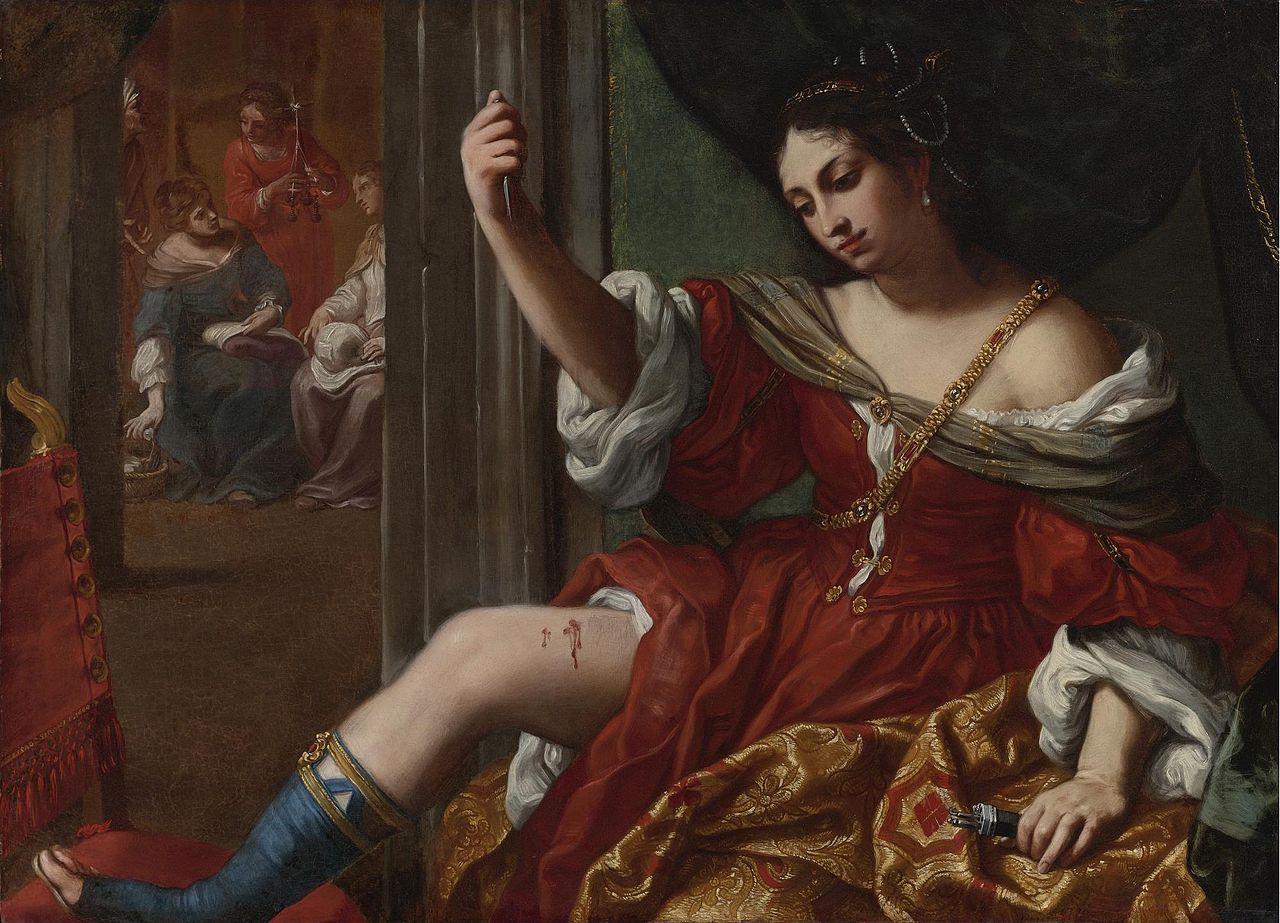
Painting by Elisabetta Sirani
When Brutus and the other assassins fled Rome to Athens, it was agreed that Porcia should stay in Italy. Porcia was overcome with grief to part from Brutus, but tried hard to conceal it. When she came across a painting depicting the parting of Hector from Andromache in the Iliad, however, she burst into tears. Brutus’ friend Acilius heard of this, and quoted Homer where Andromache speaks to Hector:
But Hector, you to me are father and are mother too, my brother, and my loving husband true.
Brutus smiled, saying he would never say to Porcia what Hector said to Andromache in return (Ply loom and distaff and give orders to thy maids), saying of Porcia:
…Though the natural weakness of her body hinders her from doing what only the strength of men can perform, she has a mind as valiant and as active for the good of her country as the best of us.
Porcia’s death has been a fixation for many historians and writers. It was believed by a majority of the contemporary historians that Porcia committed suicide in 42 BC, reputedly by swallowing hot coals. Modern historians find this tale implausible, however, and one popular speculation has Porcia taking her life by burning charcoal in an unventilated room and thus succumbing to carbon monoxide poisoning.
The exact timing of her death is also a problem. Most contemporary historians claim that she killed herself after hearing that Brutus had died following the second battle of Philippi. Nicolaus says it happened before Brutus’ death, however, saying she died following the first battle of Philippi, claiming that she only thought he was dead, and that Brutus wrote a letter to their friends in Rome, blaming them for Porcia’s suicide. Plutarch dismisses Nicolaus’ claims of a letter stating that too much was disclosed in the letter for it to be genuine. Plutarch also repeats the story of swallowing charcoal, but disbelieves it:
As for Porcia, the wife of Brutus, Nicolaüs the philosopher, as well as Valerius Maximus, relates that she now desired to die, but was opposed by all her friends, who kept strict watch upon her; whereupon she snatched up live coals from the fire, swallowed them, kept her mouth fast closed, and thus made away with herself. And yet there is extant a letter of Brutus to his friends in which he chides them with regard to Porcia and laments her fate, because she was neglected by them and therefore driven by illness to prefer death to life. It would seem, then, that Nicolaüs was mistaken in the time of her death, since her distemper, her love for Brutus, and the manner of her death, are also indicated in the letter, if, indeed, it is a genuine one.
According to the political journalist and classicist Garry Wills, although Shakespeare has Porcia die by the method Plutarch repeats, but rejects, “the historical Porcia died of illness (possibly of plague) a year before the battle of Philippi”..“but Valerius Maximus [mistakenly] wrote that she killed herself at news of Brutus’s death in that battle. This was the version of the story celebrated in works like Martial’s Epigram 1.42.” The claim that Porcia’s death occurred before that of Brutus is backed up by a letter sent by Cicero. This letter would have been sent in late June or early July 43 BC, before either battle of Philippi. It further suggests that Porcia did not commit suicide, but died of some lingering illness. As Plutarch states, if the letter was genuine Brutus lamented her death and blamed their friends for not looking after her. There is also an earlier letter from Brutus to Atticus, which hints at Porcia’s illness and compliments him for taking care of her. Cicero later wrote his surviving letter to Brutus, consoling him in his grief. This is probably the most accurate account of Porcia’s death.

The Suicide of Porcia by Pierre Mignard
Culled from: Wikipedia
Some thoughts: 1) Porcia really needed a life. I mean, cutting yourself to prove your love? That’s some pathetic Jodi Arias level of co-dependence. And 2) What a bummer that the “killed herself by swallowing red hot coals” thing probably isn’t true because, damn, bad ass way to die!
Wyoming Outlaw Du Jour!

Cell in the Wyoming Territorial Prison
Wyoming Territorial Prison, Prisoner #27:
Richard E. Pierce – May 27, 1874 – Manslaughter – Laramie County – 3 years – age 31 – Blacksmith, Machinist and Locksmith – Ireland and Pennsylvania. Remarks: A story is told in the Laramie Weekly Sentinel of February 5, 1877: “While serving in the Army in New York, Pierce killed a man who seduced, robbed and abandoned his only sister. He was sentenced to 10 years in Sing Sing Prison for this crime. After serving his term he came to Cheyenne and was working at the Blacksmith Shop when the brother of the killed approached him with intent to kill him, but Pierce was quicker and stabbed him to death.”
Culled from: Atlas of Wyoming Outlaws at the Territorial Prison