Today’s Drastic Yet Truly Morbid Fact!
I’m currently reading a book entitled “The Knife Man” which is about ground-breaking 18th century surgeon John Hunter. I have to share this delightful passage I read last night. Ah, the good old days of 18th century medicine….
The promise of the scientific revolution did little, if anything, to render medicine safer or more effective. Health care still waited for its enlightenment, and the eighteenth century became a free-for-all for mountebanks [Oooh, new word time! – DeSpair], cranks, and meddling medics. While learned physicians, flourishing doctorates from Oxford, Cambridge, and universities across Europe, paid lip service to scientific progress, in practice they clung like leeches to their classical doctrines. Apart from a few notable exceptions, most held firm to the teachings of the Greek father of medicine, Hippocrates, who taught in the fifth century B.C. that all illness was due to an imbalance of the four “humors” of the body: blood, phlegm, black bile, and choler, or yellow bile. An excess of one humor or a deficiency in another was diagnosed from patients’ eating, sleeping, and toiletry habits, inspecting their urine and stools, and occasionally by feeling the pulse, but rarely if ever by examining the site of the complaint. The remedies prescribed were designed to restore the “humoral balance,” whether through potions and pills made up by apothecaries, clysters – enemas – injected by syringe, or copious bloodletting.
Remedies were rarely anything less than drastic; that way, Georgian patients could at least feel they were getting value for their money. Patients happily submitted to being dosed with toxic elixirs, blistered by heated glass cups applied to their backs, and bled to the point of unconsciousness. Despite Harvey’s demonstration that the theory behind bloodletting – to extract blood from a specific site – was nonsense, since blood circulated through the entire body, phlebotomy only increased in popularity as a cure-all for every ill. If not recommended by physicians, it was often demanded by patients [Kind of the Ivermectin of the 18th century, eh? – DeSpair], being administered for almost every condition, from ailments in young children to prolonged childbirth. As much as thirty ounces might be removed at one sitting, often disastrously weakening the body’s natural defenses against disease.
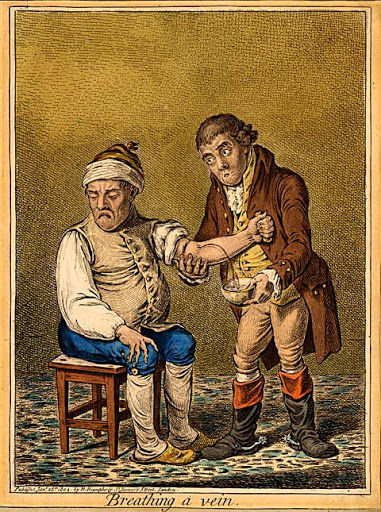
Yet while physicians prescribed bloodletting in every circumstance their taboo on touching the human body meant they never personally slit open a vein to let the blood flow. In the strict medical hierarchy that prevailed, all messy and distasteful jobs that involved touching or cutting flesh were left to surgeons, or to barbers and barber-surgeons, who offered bloodletting as a sideline to cutting hair and shaving beards. Far from being interlopers in the field of surgery, barbers were the first surgeons. The earliest organized medical care, in medieval times, had been centered on monasteries. But the church frowned on its devotees spilling blood, and so barbers – who were frequent visitors to the brethren in order to keep tonsures [another new word! – DeSpair] and beards in trim – assisted the monks in their medical work by excising warts, removing abscesses, and letting blood. The familiar red-and-white-striped poles outside barbershops are leftover reminders of their erstwhile professions. Originally, they signified the bandaged and bloodied stick gripped by patients during minor surgical procedures.
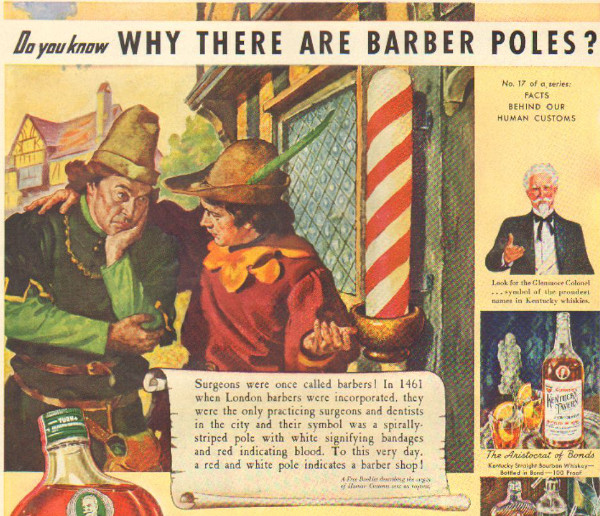
Culled from: The Knife Man: Blood, Body Snatching, adn the Birth of Modern Surgery
Ghastly!
BEWARE OF YOUR WORKMEN (1936)
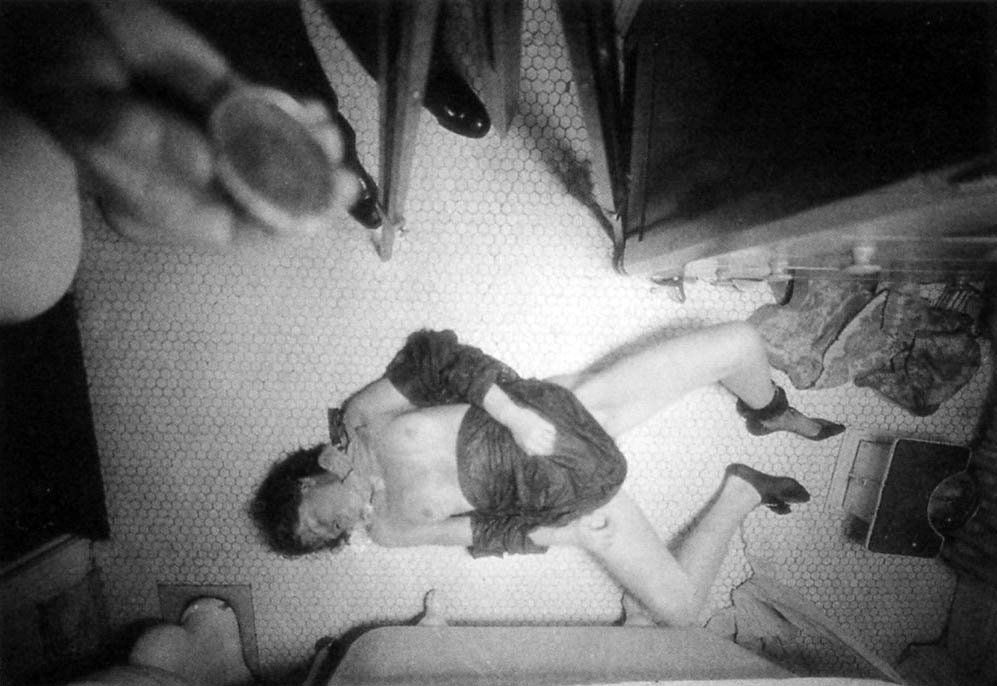
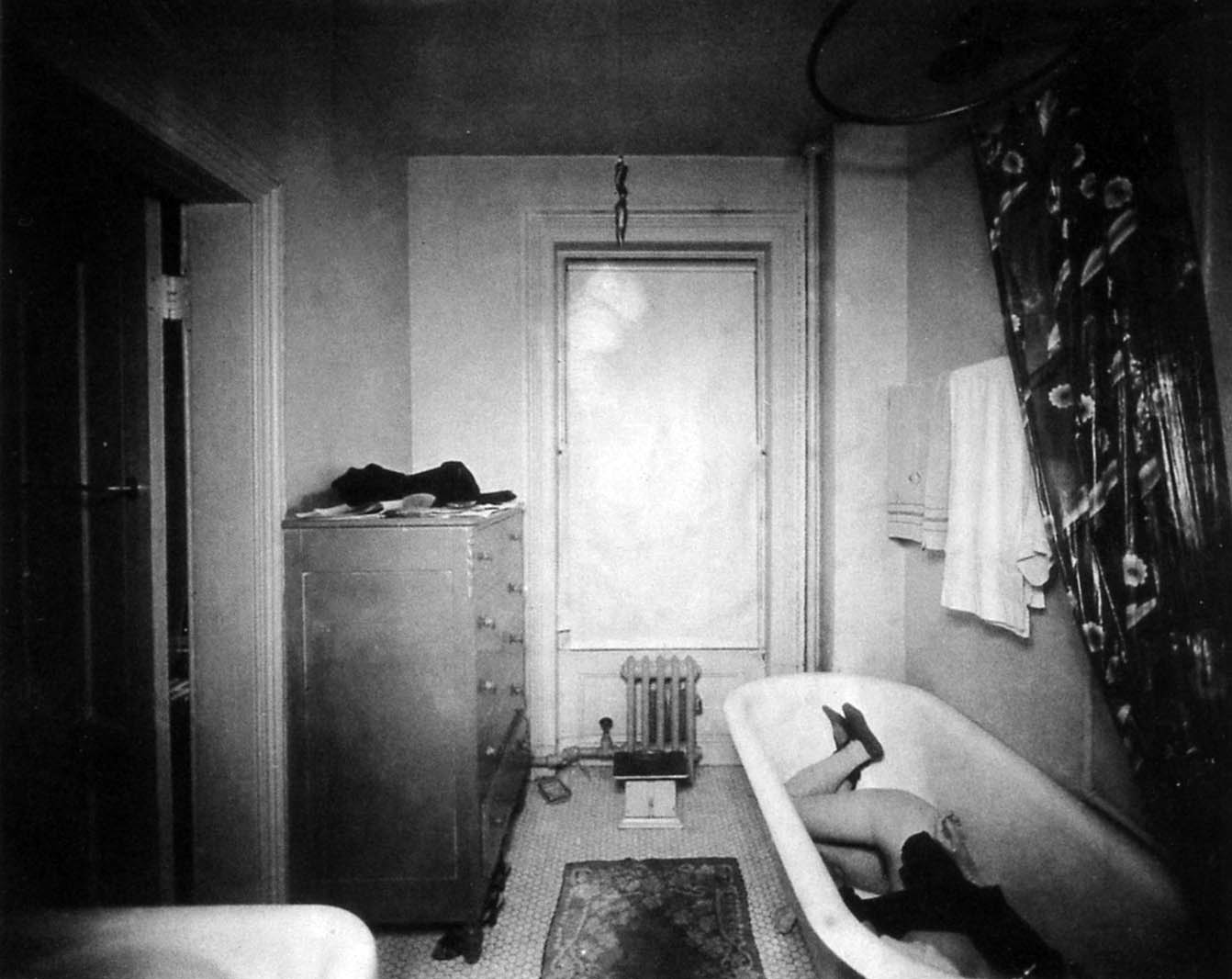
On April 10, 1936, the rape and murder of a 34-year-old novelist married to a book critic and NBC executive made the front page of New York City newspapers, including the New York Times. The attack at 22 Beekman Place in the fashionable, almost isolated Sutton Place neighborhood was out of character for the area. She lived on the fourth floor of a five-story apartment building. The forensic photographs, taken from overhead with a large tripod in a style developed at the turn of the century by French criminologist Alphonse Bertillon, dramatically illustrate the crime scene. Investigators found no sign of forced entry, suggesting the victim knew her attacker. At some point she had been taken to her bedroom, and her skirt ripped off her. When attacked, she put up a fierce struggle. She was subdued, raped, and strangled with her pajama and a thin white jacket. She was then carried to the bathroom and dumped into the tub. The perpetrator then filled the bathtub. At 11:30 AM, a tailor’s delivery boy rang the apartment bell but left when there was no answer. The body was discovered in the afternoon, about 4:30 PM, by two workmen delivering a couch – John Fiorenza and Ted Kruger. A wide police dragnet snagged several suspects, including random men arrested for various crimes. Friends and family were cleared. Delivery boys, salesmen, janitors, mailmen and others who worked in the area were questioned. Upon removing the body from the bathtub, a distinctive cord was found under her. It was analyzed and found to be a 1/8 five-ply, known throughout the trade as 60-size, made of low-grade Italian hemp containing a small amount of jute. Three lumps of mud and a single horsehair found on the bedspread were analyzed. Medical examiner Thomas Gonzales, MD, said the autopsy showed that the victim had water in her lungs, indicating she was alive but unconscious when put in the bathtub. He thought the murderer had tried to make it look as thought the victim had accidentally drowned, but had run out when the doorbell rang. Finally, twelve days later, after tracing the forensic evidence and interviewing the workmen in the building, 24-year old John Fiorenza, an upholsterer’s helper, was arrested for the crime. The distinctive cord had been identified as having been made by the Hanover Cordage Co. or York, PA, and shipped to Theodore Kruger’s upholstery shop. Both men denied being in the victim’s bedroom, and each vouched that they had just delivered the love seat. Fiorenza had been late for work on the day of the murder. When presented with the evidence, the horsehair in the bedsheet, he admitted to the crime. He had been let into the apartment when he told the victim he needed more information in order to repair her loveseat. He said he had nourished an unrequited, but undiscouraged, love for the victim – but she rejected his advances. Fiorenza had been previously convicted of robbery three times. He was found guilty of first-degree murder and executed on January 22, 1937. It was the first case in which a single hair had convicted a murderer.
In describing the case, a recent author noted that the rape was not mentioned in the New York Times‘ description of the case. That’s not true; every time period has its unique terminology, slang, and euphemisms. On April 15, 1936, the Times wrote that she was “criminally attacked.” The euphemism is still used by many for rape.

Culled from: Deadly Intent: Crime and Punishment Photographs from the Burns Archive