On the day when horrific Emmitt Till accuser Carolyn Bryant Donham finally died, it seemed appropriate to do a fact on the horrific history of lynching in this country. So here we have…
Today’s Irremediable Yet Truly Morbid Fact!
The degree to which whites came to accept lynching as justifiable homicide was best revealed in how they learned to differentiate between “good” lynchings and “bad” lynchings. A newspaper reported the execution of Elmo Curl, at Mastadon, Mississippi, as “a most orderly affair, conducted by the bankers, lawyers, farmers, and merchants of that county. The best people of the county, as good as there are anywhere, simply met there and hanged Curl without a sign of rowdyism. There was no drinking, no shooting, no yelling, and not even any loud talking.” What characterized a “good” lynching appeared to the quick dispatch of the victim “in a most orderly manner” without prolonging his or her agony for the crowd’s benefit. When a mob made up of “prominent citizens,” including a member of the South Carolina state legislature, lynched a black man near Charleston, the local newspaper thought it had been done in the “most approved and up-to-date fashion.”
No doubt the mob in Howard, Texas, thought itself orderly, even democratic in its ritualistic execution of a black man. Farmers in the surrounding neighborhood were notified to attend, and some two thousand spectators responded. The victim was given two hours for prayers, and the mob heeded his request to see his brother and sister before the execution. The question of how he should be executed was submitted to the crowd, and a majority voted for death by burning. Neither the orderliness of the proceedings nor the democratic proclivities of the mob in any way alleviated the agony of the victim. “The negro’s moans were pitiful,” a reporter noted. “He struggled, his great muscles swelling and throbbing in an effort to break the chains which bound him.” Five minutes after the mob applied the match, the victim was dead, and at last one newspaper found the “hellish deed” unjustifiable. “The deliberately planned and calmly-executed spectacle was over . The crowd dispersed.” But the legacy of this lynching, the editor insisted, would linger. “That five minutes of a return to primal savagery cannot be wiped out within the course of one brief life time. Five thousand Texans are irremediably debased.”
Culled from: Without Sanctuary: Lynching Photography in America
Lynching Photo Du Jour
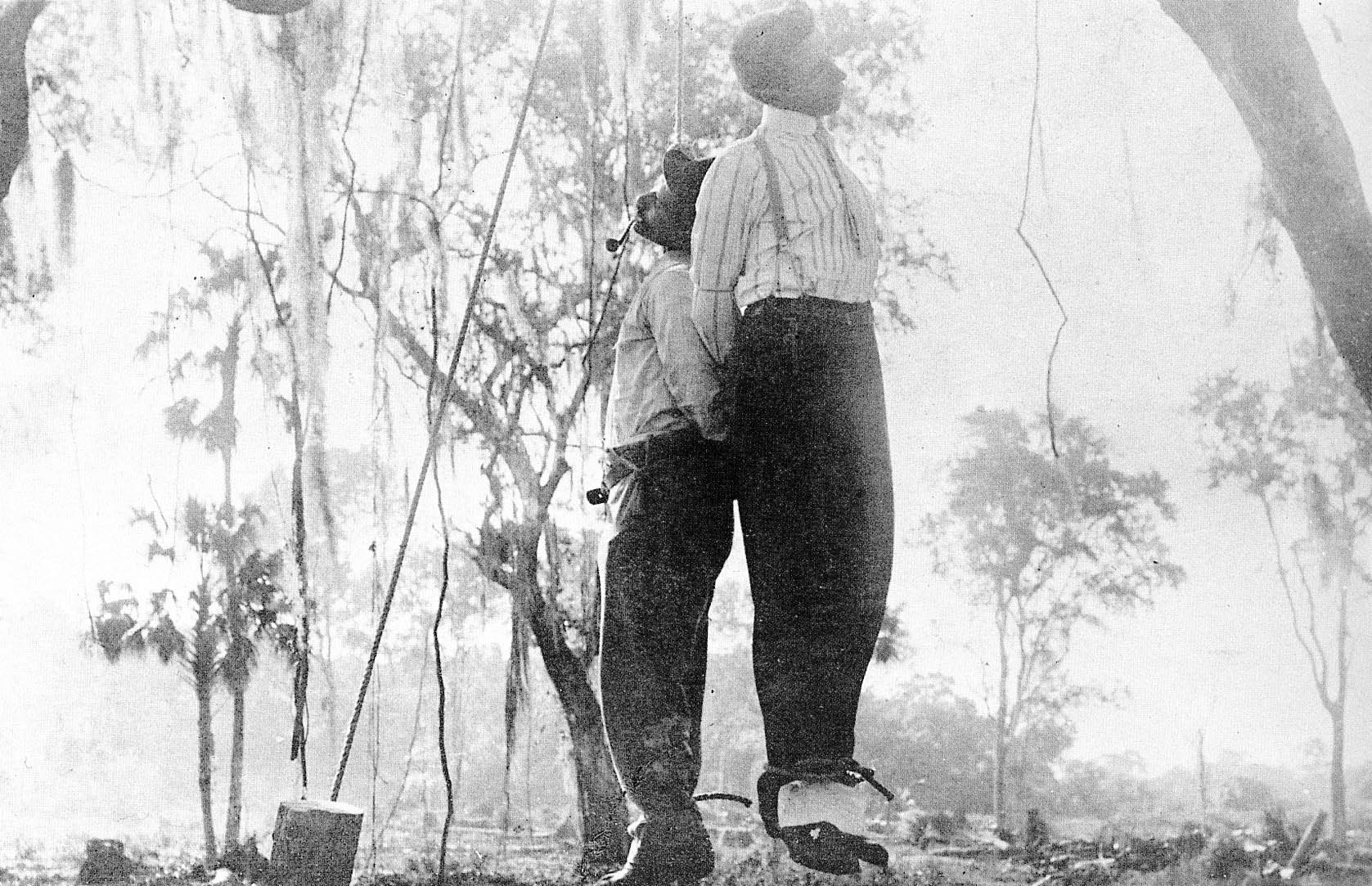
The Lynching of Castenego Ficcarotta and Angelo Albano, September 20, 1910, Florida.
Culled from: Without Sanctuary: Lynching Photography in America
Is that a pipe in his mouth?
Certainly appears to be!