Today’s Enterprising Yet Truly Morbid Fact!
John Hunter (February 13, 1728 – October 16, 1793) was a Scottish surgeon, one of the most distinguished scientists and surgeons of his day. He was an early advocate of careful observation and scientific method in medicine. He was a teacher of, and collaborator with, Edward Jenner, pioneer of the smallpox vaccine.
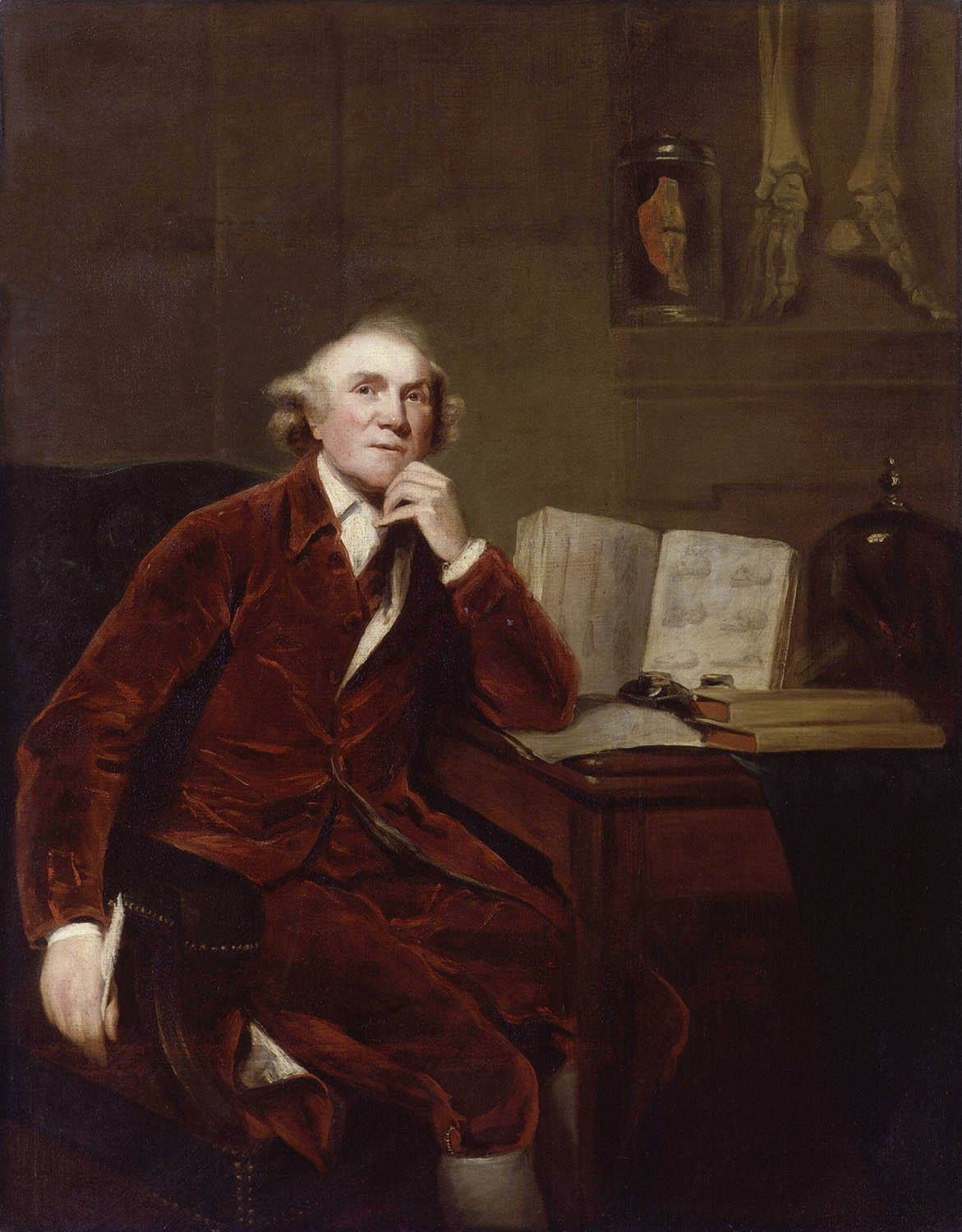
John Hunter, Distinguished Gentleman
Hunter’s early career, however, was much less glamorous. He learned anatomy by assisting his elder brother William with dissections in William’s anatomy school in Central London, starting in 1748, and quickly became an expert in anatomy. One of his most important early tasks was to procure the bodies needed for dissection.
There was no shortage of bodies. The first, and most obvious, source for an enterprising young man charged with obtaining corpses was the gallows. With hanging the penalty for nearly two hundred crimes, from filching a watch to cold-blooded murder, as many as fifty men, women, and even children were executed in a single year. And so, on October 28, 1748, the first hanging day after William’s school opened its doors for business, John Hunter would have been standing in the shadow of Tyburn Tree, the notorious triple-legged gibbet on London’s western edge, as nine men and one woman were hauled up in front of the jubilant crowds. Condemned for assorted acts of burglary, smuggling, horse stealing, and highway robbery, the ten prisoners had been drawn in an open cart through packed streets on the three-mile journey from Newgate Prison to Tyburn. Stopping for the convicted to imbibe quantities of beer at taverns along the route, the manic parade had become an uproarious melee by the time it arrived at the gallows. As the nooses were positioned around the necks of the felons, spectators crushed into a rickety stadium for a better view. But for Sarah Kinningham and her nine fellow condemned, there was no last-minute reprieve, and as the cart in which they stood lurched away from the gibbet, the frenzied onlookers roared with approval.
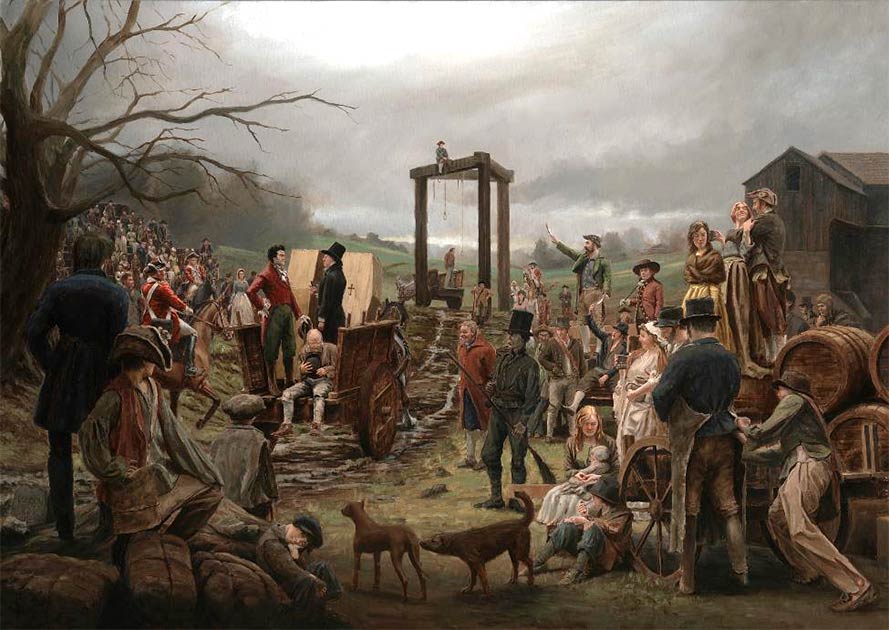
Tyburn Tree
Now the theater really began as waiting surgeons and their accomplices tussled with relatives of the convicted to wrest control of the bodies. The minute the jerking bodies swung above the crowd, John Hunter and his rival combatants rushed forward. Friends and family of the executed leapt up to grab the dangling corpses’ feet in an effort to shorten the agonizingly slow death by strangulation that usually ensued and to claim the bodies for a decent burial. At the same time, the beadles of the Company of Surgeons battled to seize their legitimate booty for the dissecting table, while fighting off private anatomists and their agents to the prize. The crowd loved it: It was all part of the festival atmosphere on the public holidays known as “Paddington fair day.” The novelist Samuel Richardson was less enthusiastic when he described a typical scene; “As soon as the poor creatures were half-dead, I was much surprised before such a number of peace-officers, to see the populace fall to hauling and pulling the carcasses with so much earnestness, as to occasion several warm rencounters, and broken heads. These were the friends of the persons executed… and some persons sent by private surgeons to obtain bodies for dissection. The contests between these were fierce and bloody, and frightful to look at.”
Although the right of the Company of Surgeons to six bodies annually was endorsed by royal authority, it was by no means accepted by the Georgian populace. Hanging days were a furious free-for-all, especially when some of the period’s most notorious villains went to their deaths. When the infamous burglar Jack Sheppard was hanged in 1724, the surgeons battled all day with his friends and well-wishers, who were anxious to give their hero a respectful burial. The mob prevailed and Sheppard was laid to rest. But when Jonathan Wild, the self-styled “Thief-Taker General,” who governed organized crime in London, went to the gallows the following year, the surgeons had their revenge. After htg body was buried by his devotees, it was secretly dug up and smuggled away to Surgeons’ Hall. His skeleton remains at the Royal College of Surgeons to this day.
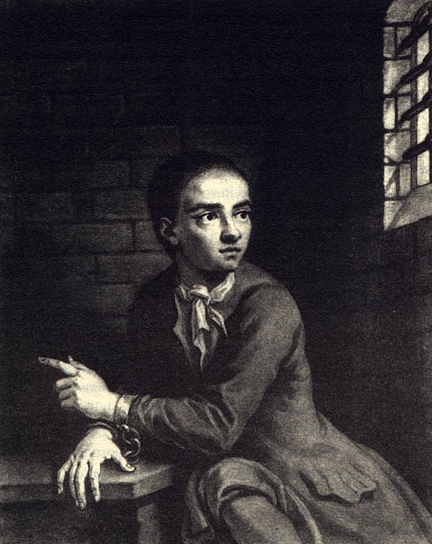
Jack Shepherd: Dandy Highwayman
Popular feeling ran high. The notion of being dissected after death, or consigning the body of a loved one to that fate, provoked intense horror. Desecrating a dead body offended deeply held religious convictions. Most God-fearing Georgians were convinced that if their bodies were mutilated by anatomists and their remains scattered far afield, they would never be resurrected whole on Judgment Day. Typically heartfelt emotions were expressed by Vincent Davis, a butcher at Smithfield market, who was sentenced to hang in 1725 for murdering his wife, when he declared, “I have killed the best wife in the world, and I am certain of being hanged, but for God’s sake, don’t let me be anatomized!”
But there was a more immediate reason why condemned Georgians feared the anatomist’s knife. With the hangman’s art far from scientific, criminals executed at Tyburn usually died from slow asphyxiation rather than from a swiftly broken neck. Consequently, it was not uncommon for such convicts to regain consciousness after being cut down from the scaffold, occasionally on a dissecting table.
Culled from: The Knife Man
A Word From The Good Book
My favorite book is Wisconsin Death Trip, a collection of 19th century newspaper articles from Black River Falls, Wisconsin accompanied by glass plate negatives taken by the town photographer in the same era. Here’s an excerpt from the book:
“Bernfid Krause, of Little Chute, left church, walked to the bridge upon which he placed his coat, hat, and prayer book, and drowned himself in the Fox River. He was 72 years of age.”
– Badger State Banner, July 23, 1891