Today’s Suffocating Yet Truly Morbid Fact!
The Battle of Wake Island started on December 8, 1941. The Japanese had to fight hard to take the island. After several unsuccessful attempts, and against fierce resistance by the force of U.S. Marines, construction workers, and Navy personnel, they finally took the island on December 23, capturing about 470 military and 1,146 civilian prisoners. There was no pretense of a written surrender agreement. Commander W.C. Cunningham, U.S. Navy, and Major James P. S. Devereux, U.S. Marine Corps, had to accept terms that were unwritten and simple—unconditional surrender.
All the officers were confined in one building and the Japanese treated them fairly well. For the enlisted men and civilians, it was another story. They were ordered to strip down to their underwear. Their hands were bound behind them with telephone wire and pulled high up on their backs. One end of the wire was tied around their necks so that they would choke if they tried to free themselves. In this condition they were crowded along with the sick and wounded into hospital dugouts. Packed to the point of suffocation, they were held in the dugouts for what to most of them seemed an eternity. Finally one of the men and a doctor prevailed on the Japanese to let some of the prisoners out, which helped to relieve the terrible conditions in the dugout. Later the whole group was moved to the airstrip on the island and put to work clearing it. The Japanese gave them little food, and the water they drank came from recently emptied gasoline drums. On the day after Christmas one of the enlisted men bringing food to the officers passed a note to Major Devereux informing him of the conditions at the airstrip. Major Devereux wrote a letter of protest to the Japanese commanding officer. He never received an answer to his letter, but it had its effect. Shortly thereafter the men were moved into barracks and were given more food.
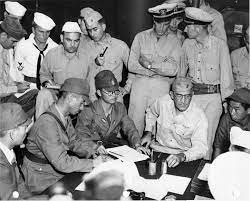
The Americans Surrender
Culled from: Surrender & Survival: The Experience of American POWs in the Pacific 1941-1945
Vintage Surgery Du Jour!
Here’s an except from Stanley Burns’ excellent collection of vintage medical photographs: A Morning’s Work.
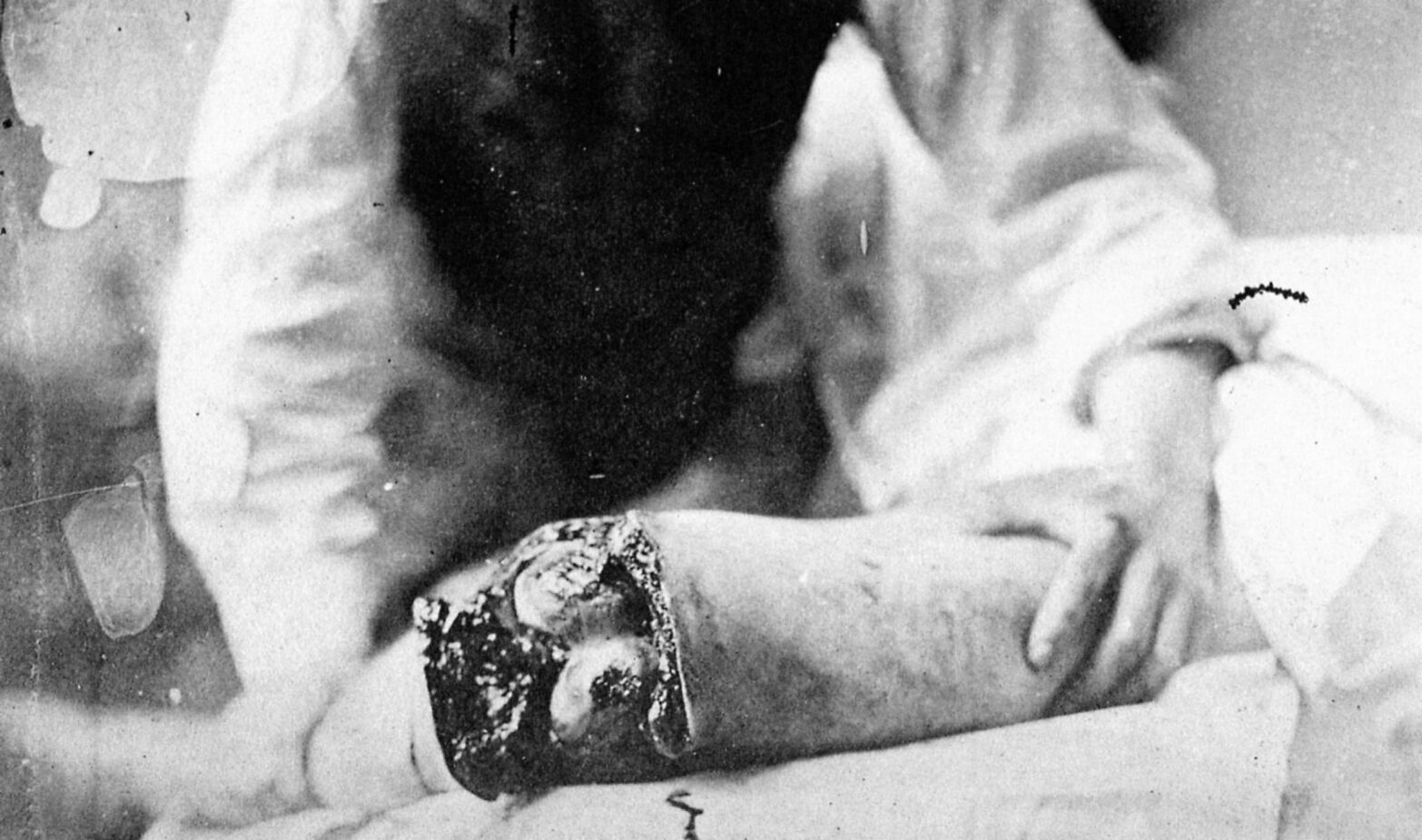
Civil War Knee Operation, April 8, 1865
Reed Brockway Bontecou, M.D. Washington, D.C.
Albumen print (carte-de-visite), 4 x 2 1/2 in.
During the first forty years of photography, only one surgeon recorded surgical operations being performed and closed up. Dr. Bontecou (1824-1907), Surgeon in Charge at Harewood United States Army General Hospital in Washington, D.C., was a photography buff who undertook the job of documenting his cases for the Surgeon General’s newly established Army Medical Museum. Bontecou hoped to help educate others by showing pathology, technique, and results. To this end he took pre- and postoperative as well as intraoperative photographs. He contributed more medical photographs to the Civil War effort than any other surgeon. Many images of wounded soldiers were taken by other photographers after the war as documentation of disability, but Bontecou’s are all wartime views.
This rare view of an operation was printed in a special limited edition as part of a series for use by the Army Medical Museum, but the surgical assistant, who was holding open the dissected knee, was cropped from the museum print. This photograph, from Bontecou’s original set of albums, (now in the Burns Collection) is the original view and depicts the full scene. It is published here for the first time. The assistant’s attire and the lack of sterility , both standard at the time, are evident.
Dr. Bontecou noted: “Hospital record #20,508. George W. Northard, Sargent, Co. G., 2d Ohio Cavalry. Age 23. Wounded April 1, 1865, at the battle of Petersburg. Admitted to Harewood U.S. General Hospital, with gun shot wound of the right knee. The ball entered just above the patella through which it passed, fracturing it into six fragments — passed downward and outward, fracturing the external condyle of femur, and escaped. On the 8th of April he was etheryzed, and Surgeon R.B. Bontecou, U.S.V., removed the fractured patella and a fragment of the external condyle. The constitutional state of the patient at the time of the operation was very good. After the operation the limb was placed in a box containing bran, and the patient put on a low diet. Subsequently the limb was placed upon a light open splint, extending from the tuberosity of the ischium to a point near the heel, and suspended by a cord, and the patient put on nutritious diet with wine and porter. On the 13th of April he was transferred to a tent ward. Up to this time he suffered considerable pain in the joint, and was very restless and irritable. His appetite became poor, hiccough and vomiting set in. Suppuration [discharge of pus] was profuse and the patient died April 22nd, from exhaustion.”
Yeah, I think he died from infection, not exhaustion, but that’s 19th century medicine for ya! – DeSpair