Today’s Eviscerating Yet Truly Morbid Fact!
|
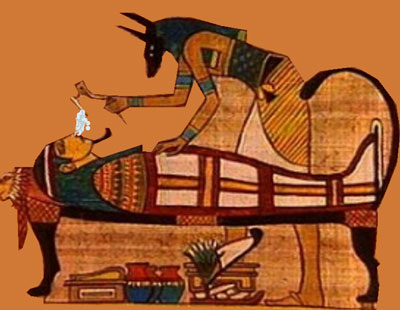
The Egyptians believed well-being was endangered by earthly and supernatural forces alike, in particular evil spirits stealing into the body through the orifices and consuming the victim’s vital substance. Health was associated with correct living, being at peace with the gods, spirits and the dead; illness was a matter of imbalance which could be restored to equilibrium by supplication, spells and rituals. Thus, someone struck blind might invoke a god: “Ptah, the lord of Truth, has turned his justice against me; he has rightly chastised me. Have pity on me, deign to regard me with merciful countenance.’ Handling burns, a magician would swab the wound with the milk of a mother of a baby boy, while appealing to Isis by repeating the words the goddess had supposedly used to rescue her son Horus from being burned: ‘There is water in my mouth and a Nile between my legs; I come to quench the fire.’ [Ooooh, I say! – DeSpair] |
Arcane Excerpts: Extrauterine Edition
| Here’s an excerpt from the fabulous Anomalies and Curiosities of Medicine by George M. Gould and Walter L. Pyle (1896) on the subject of Extrauterine Pregnancy: In most cases there is rupture of the fetal sac into the abdominal cavity or the uterus, and the fetus is ejected into this location, from thence to be removed or carried therein many years ; but there are instances in which the conception has been found in situ, as depicted in figure 2. 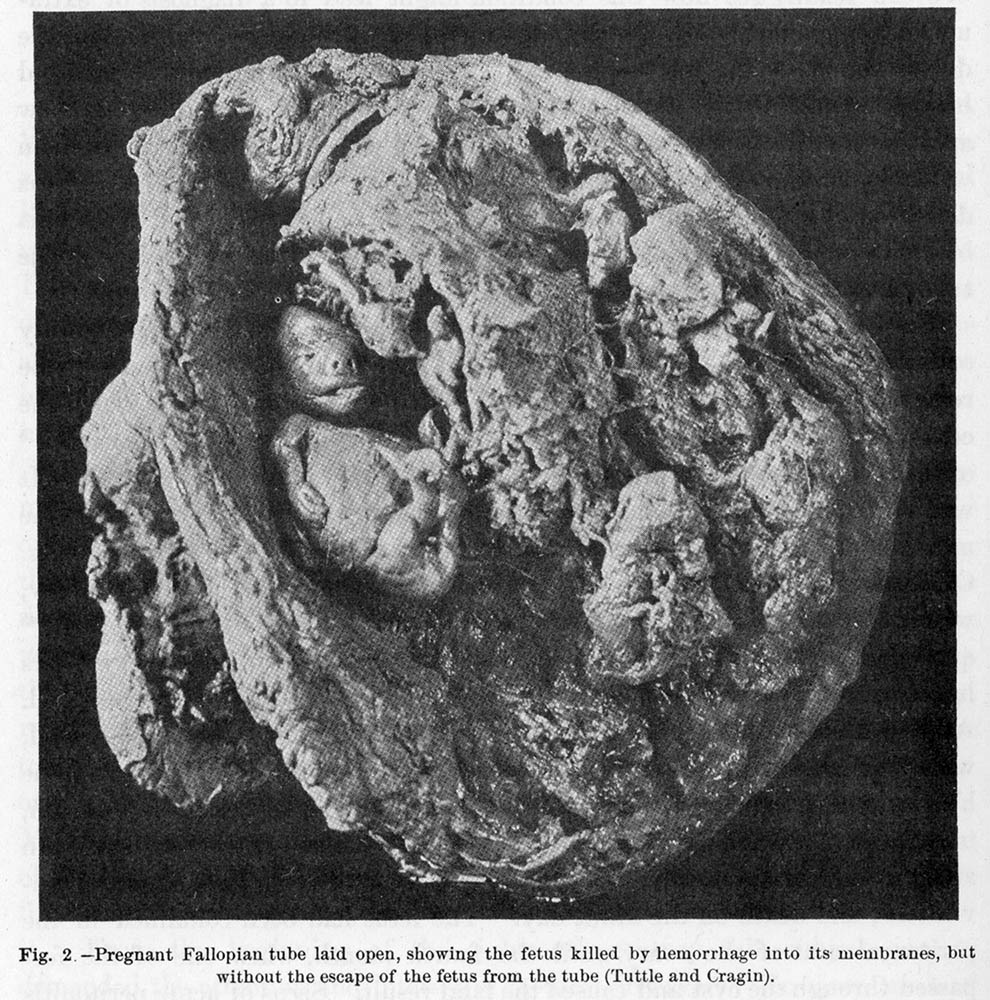 A sturdy woman of thirty was executed on January 16, 1735, for the murder of her child. It was ascertained that she had passed her catamenia about the first of the month, and thereafter had sexual intercourse with one of her fellow-prisoners. On dissection both Fallopian tubes were found distended, and the left ovary, which bore signs of conception, was twice as large as the right. Campbell quotes another such case in a woman of thirty-eight who for twenty years had practiced her vocation as a Cyprian, and who unexpectedly conceived. At the third month of pregnancy a hard extrauterine tumor was found, which was gradually increasing in size and extending to the left side of the hypogastrium, the associate symptoms of pregnancy, sense of pressure, pain, tormina, and dysuria, being unusually severe. There was subsequently an attack of inflammatory fever, followed by tumefaction of the abdomen, convulsions, and death on the ninth day. The fetus had been contained in the peritoneal coat of the ovary until the fourth month, when one of the feet passed through the cyst and caused the fatal result. Signs of acute peritonitis were seen postmortem, the abdominal cavity was full of blood, and the ovary much lacerated. |
The brain was removed through the nose by hooks
The only time I can remember listening to the NPR informational program Fresh Air, they had an Egyptologist talking about, among other things, this aspect of mummification. He said that you simply can’t get hold of a brain this way (for an analogy, imagine trying to serve jello with a crochet hook). Instead they used a sort of whisk to liquefy the brain so it could be drained out.
Did I mention that this program airs at lunchtime?