Category Archives: Sightseer

Morbid Fact Du Jour for June 8, 2015

Today’s Assembled Yet Truly Morbid Fact!

Famous anatomist Andreas Vesalius (1514-1564) was the first to have the courage to criticize publicly the practice of limiting anatomical dissections to animals. In his monumental work De fabrica humani corporis, Vesalius describes the anatomy of the human body according to what he had observed at recently introduced public dissections at the “Theater of Anatomy.” He is considered the founder of the science of anatomy. The drawings by his illustrator Kalkar were more exact than anything that had been previously produced. The sketches also introduced a new aesthetic quality, showing dissected bodies in nearly life-like poses, standing in nature and surrounded by everyday items. According to available evidence, Andreas Vesalius was also the first person to assemble real bones in to an upright structure. He called this a skeleton after ho skeletos, which means ‘dried up’ in Greek. This was revolutionary, as no one had ever before dared to do anything similar with cadavers; he more or less pulled the dead out of their graves and put them back into society. A skeleton assembled by Vesalius can still be found at the Institute of Anatomy of the University of Basel.

Culled from: Body Worlds: The Anatomical Exhibition of Real Human Bodies


Morbid Sightseeing: Vesalius Edition

And if you’d like to see Vesalius’ skeleton, along with many other bits and pieces of anatomy, why not visit the Anatomisches Museum at the University of Basel, Switzerland?

Anatomisches Museum

Morbid Fact Du Jour for May 13, 2015

Today’s Innocent Yet Truly Morbid Fact!

Personal tragedies can arise if unqualified people attempt to form their own Morals Squads, and this was emphasized in the tragic death of a retired shopkeeper in Flint, North Wales, in August, 1973. Two eight-year-old girls had been molested in the neighborhood and when the elderly shopkeeper was seen giving sweets to other little girls, a local vigilante squad made the grave error of thinking he was responsible for the sex attacks.

They beat him up, and the next day he was found dead in bed. Yet he was absolutely innocent of any sexual offense. The police were already interviewing another man in connection with the attacks on the little girls. “He was a kind but lonely man,” an observer said. “He was always glad to give sweets to the children.” That kindness cost him his life.

Culled from: Crimes and Punishment: The Illustrated Crime Encyclopedia, Volume 18


Lesser Known Photos From The Hindenburg Disaster

Teelo sent me a link to some lesser-known photos of the Hindenburg disaster – including photos of the pristine airship high above the New York skyline, photos of the wreckage, and Nazi-draped coffins of the German dead.

Lesser Known Photos of the Hindenburg Disaster 

Incidentally, I was recently at the Steven F. Udvar-Hazy Air and Space Museum in Chantilly, Virginia and I was excited to see a few little pieces of the doomed dirigible.


Look!  A girder from the Hindenburg!


Look!  A piece of Hindenburg skin!


And also, a cup and saucer from the Hindenburg!

Those were exciting to see but there were even bigger morbid highlights at this museum.  I’ll share a full travelogue soon!

Morbid Fact Du Jour for April 16, 2015

Today’s Brief and Brutal Yet Truly Morbid Fact!

Prior to the implementation of nitrogen production plants, Germany relied on shipments of nitrate from South America for fertilizer and for weapon production. This led to one of the stranger moments of World War I when, on November 1, 1914, the first major sea battle of the war began – halfway around the world from Germany and France, off the coast of Chile. It was brief and brutal. In heavy seas, with darkness falling, a squadron of Germany’s most modern warships led by Admiral Maximilian Graf von Spee engaged and sank several older, badly outgunned British warships. The battle continued by moonlight, with the Germans aiming at the fires that were burning on the British ships. The British lost two cruisers and sixteen hundred sailors and officers. The Germans did not lose a ship; their casuaties totaled two wounded. It was the Royal Navy’s first significant defeat since the days of Napoleon.

More important than the blow to British pride was the practical result: The Germans, during the critical early months of the war, cleared the British navy from west coast of South America. Germany, at least for the moment, controlled the shipment of nitrates from Chile. Spee’s success was so total, the German danger to British shipping so great, that insurers refused to extend coverage to British nitrate ships. The British depended on the Chile trade for their gunpowder and explosives too, and Spee’s imposition of what amounted to a German blockade started exerting a slow stranglehold on the United Kingdom’s war-making capability. As a U.S. military expert of the day said, “To strike at the source of the Allied nitrate supply was to paralyze the armies in France. The destruction of a nitrate carrier was a greater blow to the Allies than the loss of a battleship.”

It provided Germany a respite while the government raced to get its own nitrate plants started. But it did not last long. Within weeks the Allies dispatched a powerful squadron to hunt down Spee. Knowing that superior forces were en route and that any help from home would arrive too late, the admiral tried to make a dash back to Germany while he still could, leading his ships around Cape Horn, heading for the north Atlantic. On the way he needed fuel, which led to a raid the British coal bunkers in the Falklands. It was a move the British had foreseen. On December 8, 1914, the British opened fire and blew the Germans from the sea. Among the nearly two thousand dead were Spee and two of his sons.

Culled from: The Alchemy of Air: A Jewish Genius, a Doomed Tycoon, and the Scientific Discovery That Fed the World but Fueled the Rise of Hitler

Here’s the somewhat sinister looking Admiral Maximilian Graf von Spree himself:


The Worst Of Germany

And speaking of old Deutschland, I finally finished my travelogue on the Sachsenhausen Concentration Camp in Germany which I visited last July.  As I was putting the finishing touches on the travelogue, I stumbled across this photograph in a book:

This image depicts SA men publicly humiliating Hermann Weidemann, a local council member for the SPD (Social Democratic Party – i.e., enemies of the Nazis) who had been taken into “protective custody”, Hofgeismar, May 2, 1933.  Like many of his political co-horts, Hermann was sent to the Oranienburg Concentration Camp (which later evolved into the larger Sachsenhausen Camp) in 1933. Unlike many, he survived his incarceration – having endured over a decade (1933-1944) in unimaginable horror.  As someone who doubts I could survive even a week in such conditions, I am impressed by his strength and character – as well as the strength and character of every survivor of concentration camps. It’s to those resilient survivors that I dedicate this travelogue. “Enjoy.”


European DeSpair, Day Four, Part Two: Nineteen Thirty-Sick! 16

Morbid Fact Du Jour for March 30, 2015

I apologize for the unexpected hiatus. I was away on a photography excursion and thought I’d have a reliable connection to send the MFDJ but I did not, and then life and depression conspired to rob me of all energy over the course of the following weak [sic]. I’m still very much a somnambulistic corpse but now that I’m back home at the Castle DeSpair, I’ll attempt to get the newsletter going again.

Today’s Trigger-Pulling Yet Truly Morbid Fact!

The Japanese army atrocities during the invasion of Nanking, China in December, 1937 shocked many of the Japanese correspondents who had followed the troops. This account is from the Japanese military correspondent Omata Yukio, who saw Chinese prisoners brought to Hsiakwan and lined up along the river:

“Those in the first row were beheaded, those in the second row were forced to dump the severed bodies into the river before they themselves were beheaded. The killing went on non-stop from morning until night, but they were only able to kill 2,000 persons in this way. The next day, tired of killing in this fashion, they set up machine guns. Two of them raked a cross-fire at the lined-up prisoners. Rat-tat-tat-tat. Triggers were pulled. The prisoners fled into the water, but no one was able to make it to the other shore.”

Culled from: The Rape Of Nanking


Lost Morbidity!

Atlas Obscura has a great series entitled “Places You Can No Longer Go”.  Howard sent me the link to a distinctly morbid one: The Tyburn Tree.  (I should do a Chicago series like this!)

Places You Can No Longer Go: The Tyburn Tree

Morbid Fact Du Jour for February 25, 2015

Today’s Hairy yet Truly Morbid Fact!

Hair can provide crime investigators with important clues. Apart from burning, hair is virtually indestructible. It remains identifiable even on bodies in an advanced state of decomposition or attached to objects after a crime has been committed.  The forensic scientist using a microscope can make even a single head hair yield information about the race, sex, an age of its owner, and while hair does not have the same individual character as a fingerprint, it can provide vital evidence.

For example, in August 1951, a woman’s body was found in a rural spot near Nottingham. The victim, Mabel Tattershaw, a 48-year-old housewife, had been strangled. Minute inspection of her clothing revealed some hairs which were immediately sent to the forensic laboratory, where microscopic examination showed them to be identical with the head hair of Leonard Mills, an 18-year-old clerk and the chief suspect. Together with other damning evidence, these hairs helped to take a murderer to the scaffold.

Culled from: Crimes and Punishment, the Illustrated Crime Encyclopedia, Volume 11


Morbid Sightseeing: Taphophile Edition!

Here’s a fascinating bit of cemetery lore from Edinburgh, Scotland:

“Amid the cracked, moss-covered gravestones of Greyfriars Kirkyard, an Edinburgh church cemetery established in the mid-16th century, sit two large iron cages. Each covers a grave, and each is secured with a chain and padlock. These cages are known as mortsafes, and they were installed in the early 19th century to deter resurrectionists—otherwise known as body snatchers.”

Grave Cages and Medical Murder: The Body-Snatching Era in Scotland

Thanks to Teelo for the link.

Morbid Fact Du Jour for January 31, 2015

Today’s Overcrowded Yet Truly Morbid Fact!

Trapped between the sea and steep hills, Hong Kong is one of the most overcrowded cities in the world, and its murder rate has always been high. After World War II, the population quickly rocketed from half a million to more than two and a half million. Consequently, there was a terrifying wave of gang murders – murders so atrocious that the police speak of them as the work of “horror cults”.

In 1958, there were more than 900 murders – five times the American murder rate, and 150 times the English. These “horror cults” are, in fact, Chinese “tongs”, or “Triad Societies”. (The earliest tongs were called “Three Harmonies Societies”.) Like their American counterpart, the Mafia, they operate prostitution, drugs rackets, protection, and extortion. But their methods of ensuring obedience depend upon terrorism.

For example, in 1958, a rich merchant named Ko Sun Wei, together with four of his family, were horribly murdered in his house in Kowloon. The victims were staked out, with their arms and legs spreadeagled. Three women – the merchant’s two daughters and his daughter-in-law – were raped repeatedly, then tortured to death with knives. One woman was still alive when the police arrived, but was unable to speak – her tongue had been cut out. These were only five among 350 murders that took place in Hong Kong in September 1958. The interesting point here is the verification of observations about overcrowding. It produces true gangsters – men who are adepts in cruelty and violence, because they are unable to experience ordinary human emotions.

Culled from: Crimes and Punishment: The Illustrated Crime Encyclopedia, Volume 10

So, do you buy that?  Does overcrowding result in increased crime due to men being unable to experience ordinary human emotions?


Morbid Sightseeing News!

Howard sent me a link with some potential good news for morbid sightseers.  Let’s keep our fingers crossed!

“Hart Island, which just east of the Bronx in the mouth of the Long Island Sound, boasts breathtaking views of the water, fascinating examples of Victorian architecture, 100 acres of open space and…the bodies of almost one million dead New Yorkers.
“The largest publicly funded cemetery in the world, Hart Island has served as a potter’s field for New York City since 1869. Since then, it’s housed a prison, a workhouse for the poor, an insane asylum, a tuberculosis sanatorium and a missile base. Currently, around 1,500 bodies are buried there annually.

“And in a few years, you might be able to picnic there. City Councilwoman Elizabeth Crowley, who represents Ridgewood, Maspeth and Glendale in Queens, has introduced a bill that would transfer control of the half-mile-long island to the Parks Department. The goal would be to open the island to the public, transforming it into a space similar toGovernor’s Island.”

New York’s Newest Park Could Be Built Atop Nearly a Million Unmarked Graves


Decayed Daguerreotypes!

With yesterday’s newsletter, I shared the fascinating glass negative photographs of Costică Acsinte.  One of the things I love about the photos are the atmospheric cracks that cover many of them.  Now, here’s a collection of decayed daguerreotypes, courtesyMichael M. who sent me the link.

“Daguerreotype portraits were made by the model posing (often with head fixed in place with a clamp to keep it still the few minutes required) before an exposed light-sensitive silvered copper plate, which was then developed by mercury fumes and fixed with salts. This fixing however was far from permanent – like the people they captured the images too were subject to change and decay. They were extremely sensitive to scratches, dust, hair, etc, and particularly the rubbing of the glass cover if the glue holding it in place deteriorated. As well as rubbing, the glass itself can also deteriorate and bubbles of solvent explode upon the image.”

Fascinating effects!

Decayed Daguerreotypes

Morbid Fact Du Jour for January 27, 2015

Today’s Hastily Summoned Yet Truly Morbid Fact!

One afternoon at the San Francisco Zoo in 1968, drunken 59-year-old Amos Watson climbed the low fence that surrounded the lion grotto and tumbled to the bottom of the dry moat. Fully caught up in his perceived role as the mighty bwana, he issued his challenge to Tommy, a 5-year-old African lion: “Come here, come here!”

Before a crowd of stunned onlookers, Tommy came. Watson, preparing to do battle as he knew best, waved his wine bottle several times and assumed the classic boxing stance. Tommy, somewhat puzzled, merely sniffed around. Watson seized the opportunity and took several ineffective swings. Then, with a ferocious roar, Tommy retaliated and quickly demonstrated that the sweet science, even when backed up by a wine bottle, is no match for keen claws and sharp fangs.

Unfortunately, triumph would not be Tommy’s on this day. A hastily summoned keeper managed to drop Tommy with a single bullet between the eyes even as he had Watson by the neck. Watson would survive, but with an unforgettable lesson about the perils of mixing alcohol with animals. His souvenirs included two broken legs, numerous slash and puncture wounds, and a deep gash to the chest.

Culled from: Murder Can Be Fun #16 by John Marr

Poor Tommy.  🙁


My Brush With Morbidity

“My Near-Drowning Experience” by Brooke

“This incident occurred in St. Augustine, Florida, during late August of 2014.

“I had a waveboard with me and had been riding the waves that were breaking closer to shore, but my legs were getting a little tired from constantly walking back to the point where the waves broke, so I decided I was going to go out just beyond that point and just float on the waveboard for a little while to give my muscles a rest. My mom went back to shore as I walked farther out to that point, where I floated peacefully by myself for a while, letting my mind drift, until I noticed that I was quite far away from any of the other swimmers and had floated out farther than I intended to, so I decided it was time to head back to shore.

“I kicked my legs downwards, intending to tread water, only to find that my feet could no longer touch the bottom at all. I was a little worried by this, but I thought I would just swim to shore so I wasn’t too worried. I started trying to swim back, but I wasn’t making any progress, so I decided to use the board to try to ride the waves back closer to shore. This worked a little, in that each wave pulled me a bit closer to shore, but then the tide would pull me back twice as far.

“By now I was quite worried. I got off of my board and swam with all my might diagonally like they tell you to do to break out of a riptide, but I was making no progress whatsoever. My board was still attached to me by the wrist strap, and I was beginning to think the reason why I wasn’t moving forward was that the board was catching the tide and pulling me back, so I unfastened the wrist strap and let the board drift away. I realized how stupid this was within moments, as it turned out the board had been the main thing keeping me afloat – with it, I hadn’t had to worry about keeping my head above water at all, but now I was not only trying to swim to shore, I was also having to concentrate on keeping myself afloat as well. I think I had also overestimated my swimming skills, because while the last time I had been in the ocean, I considered myself a very good swimmer, that had been several years ago.

“At this point, I was expending all my energy just keeping myself in place. I would take short breaks to float on my back in order to rest, but when I did this, I would find myself being pulled back out into the ocean, so I realized quickly this was not feasible. By now, I was trying extremely hard not to panic, because I knew panicking could only make things worse, but I couldn’t hold it back because at this point I was almost positive I was going to die. It was so surreal, because I was looking at all the swimmers close to the shore and my family on the beach, and I just kept thinking how I was going to die with all these people completely unaware, how I couldn’t swim much longer and how I was going to be pulled out into the ocean, how my body would probably never be found and how my family would spend the rest of their lives feeling guilty because of my stupid mistake.

“There was a group of people almost directly in front of me in the water, but very close to shore, and I started to scream for help. I screamed ‘HELP’ four or five times but nobody was turning in my direction at all, so I knew they couldn’t hear me – in fact, I didn’t see how anyone could possibly hear me over the waves, as they were the only thing I could hear. Half in desperation, half as a last attempt at drawing someone’s attention, I started to scream – no words, just screaming as loud as I could. I screamed several times and finally the group of people in front of me turned their heads toward me, and at first they were just looking – I realized they were trying to figure out if I was actually drowning or not, so I screamed again, and then they turned to shore and were waving their arms for help. I was thinking about how there probably weren’t any lifeguards around because I had never seen any on our previous trips in the days before, and how no one could possibly get to me before I went under – my muscles were very tired, and I was having serious trouble staying afloat.

“Then I saw one of the women start to swim out towards me, and I was somewhat relieved, though not entirely, because I was thinking that if she didn’t know what she was doing, or if the tide caught her too, we would both just drown – but she was my only chance. She swam closer to me, and when she was about five to six feet away she shouted for me to turn my back to her and float on my back. I didn’t stop to think about it at all, just did as I was told; I knew by the way she commanded me and her instructions that she knew what she was doing. I felt her grab onto my hair which was floating in the water, then the around the back of my neck, and when she was close enough, she held onto my upper arms and started to swim us backwards to safety. I was completely overwhelmed with relief, once I could tell we were getting back to shore and not staying still or being swept further out. I remember I kept babbling things like ‘thank you, thank you’ and ‘I’m sorry’ to her; she kept telling me not to apologize, but I felt I needed to, for potentially putting her into danger with my idiotic mistakes.

“At some point before we got to shore, she handed me off to a lifeguard, but I don’t remember this happening at all. Then our feet were touching the ocean floor again, and the lifeguard told me to grab onto the flotation device he had – I think mainly to keep me from just falling down in the water, as I was shaking very badly and I thought my knees were going to give out from the effort I’d expended and just being overwhelmed.  In addition to ‘thank you’ and ‘I’m sorry’, I told him I just wanted to sit down and he assured me I would be able to very soon.

“He walked me to shore, then to his patrol truck where my family was standing – they knew what was going on at this point. My mom gave my shoulder a squeeze, I could tell she was very frightened but definitely not as much as I still was. The lifeguard sat me on the bed of the truck and just let me calm down for a few moments, encouraged deep breathing, etc. Then he asked me what had happened, if I had swallowed any water or felt like I needed to go to the hospital, got my info, and took my vitals. By the time he took my pulse it was almost back to normal – apparently he had taken it when we were walking out of the ocean and it was extremely high, but again, I have no memory of this at all. I didn’t remember swallowing any water, but my mouth felt like it had been scrubbed with salt all the same – I think possibly some water may have splashed into my mouth while I was screaming. The lifeguard was very nice, and I owe my life to him and especially the woman who swam out after me; I have no doubt about that. He told my family to watch for any changes in my behavior or condition, just in case, then he left.

“Before he left he told us, for future reference, to always go into the ocean with some kind of board or other flotation device and never to let go of it, especially in an emergency, because it can easily be the difference between life and death. He also said there was a very strong undertow that day and the days before, and that it and the very strong waves were due to the storm they had received a few days prior, a consequence of Hurricane Cristobal. (Apparently, two people drowned on the East Coast, where my incident occured, as a result of riptides caused by this hurricane.) He told us the week before the ocean had been flat as glass (so I guess I picked a prime week to nearly drown).

“Before this incident, I shared the widespread belief that drowning would be a relatively peaceful death – but now I can tell you it’s not. I really can’t stress enough the sheer terror and overwhelming feeling of helplessness and despair I experienced. I will always be in debt to the people who helped rescue me. My thoughts are with, and will always be with, the two who shared my experience that week, but didn’t make it back to shore. Rest in peace, Sarmad Rizvi and Jose Maudiel Hernandez.

“As for my waveboard – one of the other women in the group that helped rescue me retrieved it and gave it back to me. It had made it nearly back to shore without me, ironically enough.”

Thanks for sharing this frightening story, Brooke!  As someone who is a weak swimmer and who spent her childhood blowing up a couple of “falling into water” incidences into “near-drownings” of my own, I can completely relate to the fear.

Past brushes can be found at the Asylum Eclectica My Brush With Morbidity page.

Do you have a morbid experience you’d like to share?  Please write the Comtesse!


International Holocaust Remembrance Day

As you may have heard, today is the International Holocaust Remembrance Day.  Today marks the 70th anniversary of the liberation of Auschwitz.  Although I haven’t managed to make a trip to Auschwitz yet, I was able to visit two concentration camps in Germany over the summer: Sachsenhausen and Bergen-Belsen.  I’m currently working on a full travelogue of my visit to Sachsenhausen but I thought that for today, I’d share a few photos I took with my phone camera at that harrowing location.

Sachsenhausen

This is the front gate of Sachsenhausen prison camp.  This was a Nazi camp – mainly for political prisoners but also homosexuals, jews and gypsies – that existed from 1936 to 1945. About 30,000 people walked through these gates and never walked back out again.


The infamous false promise emblazoned upon the front gate: “Work makes you free”.


Inside the walls of Sachsenhausen concentration camp. The gravel represents the off-limit area. Walking into that area meant the prisoner could be shot. Electric fence lined the walls. Sometimes prisoners would deliberately throw themselves onto the fence in despair to end their suffering.  (I know I would.)


This track was used to test boots at Sachsenhausen. Prisoners were forced to wear a variety of boots and walk between 16-25 miles a day over a variety of surfaces to test boots that soldiers would wear. Some developed severe foot problems. Since I had three awful blisters on my feet and every step caused a great deal of pain, I felt like I could relate in a small way.


In the barrack at Sachsenhausen. “This is where in the morning prisoners would wash themselves. At times up to 400 prisoners would be squeezed into a barracks like this and they only had 30 minutes for rations and bathing. Consequently, 8 to 10 men would be standing at a time at these basins with only cold water running. SS men were known to have drowned prisoners in the basins for washing feet on the right.”


Sachsenhausen toilets. Prisoners were only allowed to use the toilets twice a day and in the rush, older, sick, and weakened prisoners would be trampled and lay on the floor covered in excrement. Prisoners who were unable to work had to stand, without moving a muscle, all day long in this unaired space. SS guards were known to have drowned prisoners in the toilets.


The clothing of a homosexual prisoner. Notice the pink triangle. I think I would have qualified for imprisonment on many criteria: socialist, anti-fascist, gay, history of mental illness, and just being different.


Firing range at Sachsenhausen.  This is the view that the victims would have (if they weren’t blindfolded). The guns would point out of those holes in the door.


The autopsy table at Sachsenhausen. Of course, the only time autopsies were performed was to verify medical experiments or if there was something about the corpse that interested the research doctors.


The morgue.


Hereditary Health Court records. The Nazis had a court where they would debate whether individuals with supposed hereditary disorders should be allowed to procreate. If they decided no you would be taken to a public hospital and sterilized.


Faces of some of the victims of Sachsenhausen.  Never forget.

Morbid Fact Du Jour for January 23, 2015

Today’s Surging Yet Truly Morbid Fact!

On Saturday, January 2, 1971, more than 80,000 fans attended an Old Firm (the collective name for the Glasgow association football clubs Celtic and Rangers) match at Ibrox Stadium in Glasgow, Scotland. In the 90th minute, Celtic took a 1–0 lead and some Rangers supporters started to leave the stadium. However, in the final moments of the match, Colin Stein scored an equalizer for the Rangers.

As thousands of spectators were leaving the ground by stairway 13 [of course! they should have skipped 13 and then this wouldn’t have happened! – DeSpair], something happened to cause a massive chain-reaction pile-up of people. Like so many similar mishaps, exactly how it started remains unclear. Most popular accounts place the blame on those less than loyal fans who’d left after Celtic scored. Supposedly, when they heard their fellow Billys roaring over the Rangers’ goal, they’d reversed field, only to run headlong into the exiting mass.  However, this scenario contradicts eyewitness testimony.

One witness claimed to see a young man carrying a raincoat trip halfway down the stairs. Another blamed a small boy taking a tumble. A third said the first to fall was a man carrying a small boy on his shoulders. Whatever the case may be, all agreed on what happened next. The surge of humanity that had all but filled the stairway to the bursting point was suddenly transformed into a raging torrent of people tumbling and pouring down the stairs. “I saw them falling just as if a hole appeared in the ground,” said one witness.

One fellow, at 190 lbs no lightweight, told the inquiry:

“There were bodies to the front of me and to the back of me and bodies on top of me… we were all pressing down and you could feel yourself getting lifted off your feet. I felt myself going and I got my arm up, then the next minute there was a bang and a banister to my left went. Everyone flew forward. I seemed to fly through the air and I landed on top of the bodies. I went 15 feet through the air.”

Another described the chaotic scene as “… like a river that burst its banks.”  According to yet another survivor, “The pile of human beings was four people deep, bursting the sides of the railing.” The pressure of the cascading bodies had twisted the heavy metal handrails like spaghetti and torn and uprooted them from the concrete. 53 people, mostly men in their 20’s and 30’s, were dead at the scene. Another thirteen would be DOA at the hospital, bringing the total of what would be the worst UK soccer disaster for 19 years to 66 dead, and 145 injured. [Yes, I know – it’s crazy to think this record was actually BROKEN!  But never doubt the insanity of British football fans! – DeSpair] Rangers supporters all, they had died of suffocation and/or asphyxiation. Many of the bodies were so battered and bruised they were identified by their tattoos.

Culled from: Murder Can Be Fun, Issue #18 by John Marr

Can you believe this is actually the SECOND disaster at Ibrox?  Of course you can!  The first was documented in the March 16, 2012 Morbid Fact Du Jour.

Here’s a documentary about the disaster.  It’s a bit long, but has lots of eyewitness accounts (if you can decipher the brogue, that is).


Wretched Recommendations: The Faithful Executioner

The ever-helpful Mike M. wrote to tell me about a book:

“Of interest: a book book about capital punishment, drawing heavily from the life experiences of one Meister Frantz Schmidt, an executioner from 16th Century Nuremberg.”

Indeed, it does look fascinating and I’ve put it on my reading list!

The Faithful Executioner: Life and Death, Honor and Shame in the Turbulent Sixteenth Century

Here’s the Amazon blurb:

THE EXTRAORDINARY STORY OF A RENAISSANCE-ERA EXECUTIONER AND HIS WORLD, BASED ON A RARE AND OVERLOOKED JOURNAL.

In a dusty German bookshop, the noted historian Joel F. Harrington stumbled upon a remarkable document: the journal of a sixteenth-century executioner. The journal gave an account of the 394 people Meister Frantz Schmidt executed, and the hundreds more he tortured, flogged, or disfigured for more than forty-five years in the city of Nuremberg. But the portrait of Schmidt that gradually emerged was not that of a monster. Could a man who practiced such cruelty also be insightful, compassionate—even progressive?

In The Faithful Executioner, Harrington teases out the hidden meanings and drama of Schmidt’s journal. Deemed an official outcast, Meister Frantz sought to prove himself worthy of honor and free his children from the stigma of his profession. Harrington uncovers details of Schmidt’s life and work: the shocking, but often familiar, crimes of the day; the medical practice that he felt was his true calling; and his lifelong struggle to reconcile his craft with his religious faith.

In this groundbreaking and intimate portrait, Harrington shows us that our thinking about justice and punishment, and our sense of our own humanity, are not so remote from the world of The Faithful Executioner.

(More books about Execution and Torture can be found at the Library Eclectica.)

Morbid Fact Du Jour for January 21, 2015

Today’s Good-Looking Yet Truly Morbid Fact!

Ruth Ellis (9 October 1926 – 13 July 1955) was the last woman to be executed in the United Kingdom, after being convicted of the murder of her lover, David Blakely.

From a humble background, Ellis was drawn into the world of London nightclub hostessing, which led to a chaotic life of brief relationships, some of them with upper-class nightclubbers and celebrities. Two of these were Blakely, a racing driver already engaged to another woman, and Desmond Cussen, a retail company director.

On Easter Sunday 1955, Ellis shot Blakely dead outside the Magdala public house in Hampstead, and immediately gave herself up to the police. At her trial, she took full responsibility for the murder and her courtesy and composure, both in court and in the cells, was noted in the press. She was hanged at Holloway Prison.

The following is the excellent first chapter of the long article about Ellis at Crime Library (the entirety of which I highly recommend reading):

“To the living we owe our respect, to the dead we owe nothing but the truth.” – Voltaire.

Like all statistics, they serve a purpose of sorts. Like most statistics, they only hint at a deeper, unseen truth, hidden from view behind the dry, formal and dialectic structure of numbers.

  • She was 28 years old. Her height was five feet two inches and she weighed 103 pounds. She was well nourished and her body showed evidence of proper care and attention.
  • She was also very dead with a fracture-dislocation of the spine and a two-inch gap and transverse separation of the spinal cord. Just to make sure, there was also a fracture of both wings of the hyoid and the right wing of the thyroid cartilage. The larynx was also fractured.

She had died of injuries to the central nervous system, consequent to judicial hanging. She was a healthy subject at the time of her death. So said Doctor Keith Simpson, pathologist of 146 Harley Street and Guys Hospital. He was a reader in forensic medicine at London University, so he would know all about the statistics of death, especially as he had carried out the post-mortem examination on her, just one hour after she had been executed.

He knew nothing of the menage a trios that had brought her to the pathologist table. He could not know that her death would result in two people killing themselves and one dying of a broken heart. Or of the lawyer, so despairing of his faith in the law and the way it treated her that he would give up his career. Or the man who travelled half way around the world to escape from the certainty that he was partly to blame for her being here on this cold, metal table.

The small, slight cadaver stretched out before him was all that remained of a true tragedy of British justice. She was a statistic, one that would haunt the conscience of the British judiciary system for the next forty-five years.

Ruth Ellis was the fifteenth, and the last woman hanged in England in the twentieth century. She was also the unluckiest. She did not kill for gain and, had the judge allowed her defense to be put to her jury, they may well have found her guilty only of manslaughter. She, however, never thought so. She never doubted in her own mind that she deserved to die for killing the man she loved.

Her death would be the final exclamation mark in a sad and tortured tale.

Culled from: Wikipedia and Crime Library

Of course, the excellent film Dance with a Stranger is about the life of Ellis, and it’s rumored that the  Morrissey song “The Boy Racer” (“We’re gonna kill this pretty thing”) is about Blakely.

Here’s a photo of the doomed couple themselves.  I dunno – I don’t think Blakely was all that good-looking! I think he’d be flattered that Rupert Everett played him in the movie!


Sideshow “Freak” Du Jour!

FANNY MILLS
The Ohio Big Foot Girl (1880s)

Fanny Mills came from Sandusky, Ohio, where her father was a farmer. Active on the circuit in the ’80s, she was advertised as having the largest feet on earth. Her “size thirty shoes” were almost twenty inches in length and required three goatskins to manufacture. The promotional material accompanying her appearances used a rather cruel come-on directed at single young men of little means. The copy claimed that her father, desperate to marry off his blonde, fat-footed daughter would hand over $5,000 cash and a “well stocked farm” to any respectable man who’d take her away.

In spite of her big feet Fanny was actually quite small and weighed only 115 pounds. She had Milroy Disease, a hereditary lymphedema and enlargement of her legs and feet resulting from the non-development of the lymph vessels of the lower extremities. Poor lymphatic drainage of body fluids led to swelling as the fluids pooled in her limbs. Although Fanny would most probably have had other associated abnormalities such as spinal cysts, asthma and double eyelashes, she was otherwise physically and mentally normal. Eisenmann made a considerable number of plates at this session, including an unbearably pathetic nude portrait that destroyed the calm dignity she maintained through the rest of the sitting.

Culled from: Monsters: Human Freaks in America’s Gilded Age: The Photographs of Chas Eisenmann


Morbid Sightseeing: Lucerne, Switzerland

A chapel with a mural that has real skulls laid into the plaster?  What a fantastic idea!  And as you can see, the execution is very nice as well!

WOLHUSEN MORTUARY CHAPEL: WHERE REAL SKULLS JOIN A DANCE OF DEATH

(Thanks to Howard for the link.)

Morbid Fact Du Jour for January 3, 2015

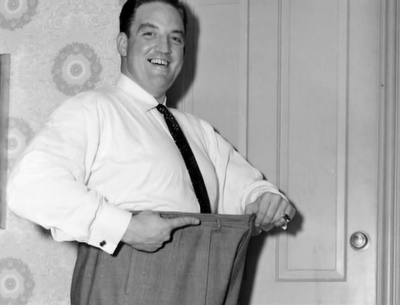
Today’s Corpulent Yet Truly Morbid Fact!

For an actor it was a terrible way to go; the perpetual villain, the forever superhero, the eternal comedian, the tired out sidekick. If you contracted the disease there was usually no cure. Actors would pull out all the stops to insure that they were not infected with the typecasting virus.

Laird Cregar was born in 1916 in Philadelphia and educated in England. Shortly thereafter, he won a scholarship to California’s Pasadena Playhouse which produced so many great stars during that era including George Reeves. His major break was when he was invited to a Hollywood party and started reading the part of Oscar Wilde, forcing everyone in the room to take notice. When he signed on with 20th Century fox, they assured him that he would not be typecast, something Cregar feared intensely. And it seemed initially that was the case. Cast in a hodgepodge of dramatic roles from the flamboyant Natalio Curro in Blood and Sand with Tyrone Power and Rita Hayworth, to the whimsical Gooseberry in Hudson’s Bay, it seemed this rotund actor would find a well balanced cinematic career that would showcase his acting range.

But things began to change in 1944.  Although he did not receive top billing, Cregar was cast as Jack the Ripper in The Lodger with Merle Oberon. Weighing over 325 pounds, Cregar takes over the screen both with his body and his face leaving you unable to take your eyes off him.  Coupling this performance with other villainous roles he had already played in films such as I Wake up Screaming and This Gun for Hire, Cregar began to worry that he was being typed as a villain. He longed for the opportunity to play a leading man. Merle Oberon told Cregar during the filming of The Lodger that he had a handsome face and could land leading man roles if he only lost the weight.

Cregar pushed for the lead role of Hangover Square. The novel centers on contemporary England where a mentally ill classical composer murders a woman he has fallen in love with after learning that she has taken advantage of him. Cregar, an accomplished pianist, was also told he could play some of his own musical pieces in the film. But a year went by and while Cregar was off appearing in a play that year, the producers of Hangover Square had reworked the screenplay so that it would take place in Victorian England, with the gaslights and mystery that made filming of that era so appealing. In short the story was made to look and sound very much like the previously successful film The Lodger. Compounding the disappointment, the promise to perform some of his own piano compositions fell to the wayside when Bernard Hermann was contracted to score the Concerto Macabre. One of the more spectacular aspects of this film is that Cregar’s hands are actually shown moving over the piano keyboard mimicking the actual movements that would match the music being played.

In preparation for the role of composer George Harvey Bone, Cregar lost over 100 pounds.  Hangover Square was subject to reshoots after the film was completed so there are times in watching the film that Cregar seems heavier then curiously slimmer. His body appears to be almost as schizophrenic as his mind, making his performance all the more extraordinary. Cregar gets top billing in this film for the first time, playing opposite Linda Darnell, and clearly seems to break the leading man ceiling despite the fact that he still weighs a hefty 225 pounds. Hangover Square was a big box office hit for 20th Century Fox and it seemed that Cregar was on his way to becoming a major star for the studio. The reshoots of Hangover Square were completed at the end of November 1944. Two weeks later, Laird Cregar prepared his last will and testament and was admitted into the hospital to undergo surgery. There are conflicting stories as to whether the surgery was an elective one to undergo a procedure on his stomach to limit his consumption of food so as to lose more weight OR whether the procedure was to correct severe stomach problems, brought on as a result of the massive weight loss Cregar had sustained in such a short period of time, fueled by the use of amphetamines. Five days after the surgery, Cregar died of a heart attack at the age of 31.

Although Laird Cregar’s list of movie credits is short, consisting of only 16 films, his performances are absolutely mesmerizing. If you are a film noir fans, his body of work is a must see. While heart attack is the official cause of death, there is no doubt, knowing his story that he was yet one more victim of an era where too many Hollywood hopefuls died from an infected career for which no antibiotic or vaccine had ever been developed. Seeing his work today, we can only close our eyes as we do with George Reeves and wonder what could have been.

Culled from: Mid-Atlantic Nostalgia Convention


Morbid Treat Du Jour!

The other day I decided to treat myself to a yearly membership ($25) to the most fantastic collection of mourning photography on the web.  I thought I’d mention it in case any of you are unfamiliar with the Thanatos Archive.  It’s a great place for morbid souls.

http://thanatos.net/


The Morbid Sightseeing Moment We’ve All Been Waiting For!

Well, okay, maybe just me.  But talk about an Ooh!  Oooh!!   Oooooh!!!!  moment!  I simply HAVE to get to England when this opens!

The Black Museum: fter 150 years, public set to see exhibits from police’s grisly crime museum