Category Archives: Trinkets

Morbid Fact Du Jour For February 2, 2016

Today’s Misleading Yet Truly Morbid Fact!

Although smallpox was a uniquely human disease, its causative agent, variola virus, belongs to the genus of orthopoxviruses (“true pox” viruses), whose members include buffalopox, camelpox, cowpox, monkeypox, mousepox, rabbitpox, and raccoonpox. These viruses are generally named after their primary host, but some have turned out to be misnomers: Cowpox and monkeypox are actually carried by rodents and only occasionally infect cows or monkeys. The name “chickenpox” is also misleading: The virus infects only humans and is not a poxvirus at all but a member of the unrelated class of herpesviruses. (The word “chicken” in chickenpox may have been derived from the French word chiche, meaning chickpea, referring to the size of the lesion, or from the Old English word gicans, meaning itch; “pox” refers to any rash consisting of pustules, or skin lesions filled with pus.)

The dastardly, yet beautiful, variola virus:

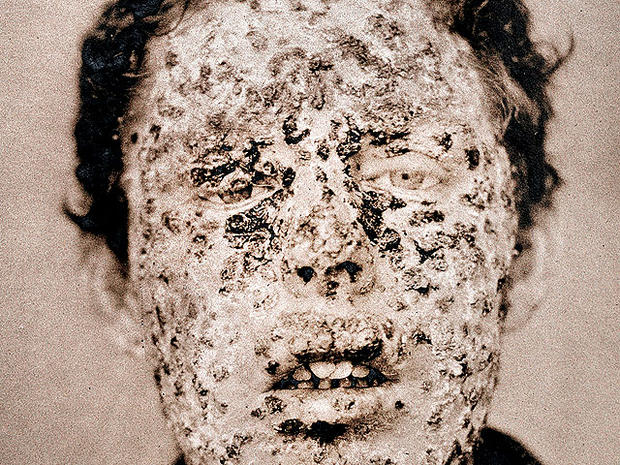
And a man suffering from the dreadful disease circa 1881:

Culled from: Scourge: The Once and Future Threat of Smallpox


Morbid Trinket… of the Future!

For those of you who are taking advantage of sudden and unexpected acceptability of adult coloring, the Mütter Museum has good news for you: a morbid coloring book will soon be on its way! They released a taste on their Facebook page.

Mütter Museum Coloring Book

Morbid Fact Du Jour for January 24, 2016

Today’s Freezing Yet Truly Morbid Fact!

On March 16, 1945, the Nazis liquidated the death camp at Spaichingen, located in southwestern Germany, about twenty miles north of the Swiss border. Joseph Freeman and thousands of other inmates began a six-week death march ordeal that ended in the city of Fussen in southern Germany. Joseph’s story is documented in the book The Road To Hell: Recollections of the Nazi Death March. This particular excerpt reminded me that even the “minor” ordeals that the survivors had to endure were awful. 

Early on March 16, 1945, the doors to our barracks had been forced open and the SS rushed in shouting in German, “Raus, Raus!” (“Out, Out!”) Frightened, we jumped quickly from our bunks, hurriedly putting on our clothes. My friend, Chaim, was already out of bed, almost completely dressed. In seconds, we straightened out our beds and covered them with blankets. We ran outside and waited for our orders. What next? Afraid, we stood around in front of the barracks, surrounded by SS men. Some of them had dogs on leashes. It was frightening. The SS started to push us toward the middle of the camp, forcing us to run fast. The combination of the barking of the dogs and the voices of the SS hollering for us to move quickly made us feel that our end was near. This would be the last moment before they killed us… It took a while to get all of us in the center of the camp. The SS surrounded us and started to push, to squeeze us close together in one place.

We stood, afraid to move. I started to cry. At that moment I was reliving the liquidation of my ghetto in Radom, the selection of my loved ones to the Death Camp, as the SS with their dogs forced our people onto the cattle trains. The voices calling for help were ringing in my ears. I closed my eyes. A push from Chaim brought me back to the horrifying present. Chaim, trying to cheer me up, assured me this was not Radom. We stood and waited… The Kapos [inmates assigned by the SS to supervise their area], following orders, began to organize prisoners into groups of one hundred, with a Kapo at the head of each column. This was something new for us. This was not the ordinary routine. The SS started to move in from the sides, surrounding each group. It was quiet. Only the voices of the SS shouting “Macht schnell” (“hurry up!”) interrupted the silence.

We followed the orders without talking. It took an hour to completely form the columns. As we looked around, some of us raised our eyes to the sky, praying silently. We were standing, afraid to move, not knowing what was coming next. Seconds turned to minutes, the minutes turned to hours. So long was the wait – an eternity, waiting for the unknown. It was winter. A cold wind started to blow, then, after awhile, it started to snow. The snow covered our tattered clothes. Then the sun came out and snow started to melt. Under our feet the snow turned to water. When the sun went down the water turned to ice. Our wet clothes started to freeze and stick to our bodies. It was terrible. We had been standing in one place for so long. It was getting colder and colder. Those who could not take it any longer fell to the frozen ground, shaking from the cold. The Kapos started to hit them with their short sticks, trying to force them to stand up. Most of us had been standing, quietly, trying not to move. Only waiting and shivering. What else could we do?

Then a noise. From far away, we saw the camp commander with a group of SS coming out of the office building with a paper in hand… The orders required us to go back to our barracks and get our blankets. Also, we had to take our utensils with us, one spoon and one pot. We could take only one blanket with us. We were leaving the camp. This had to be done in a short time. We were given only twenty minutes to return from the barracks to be ready to move out. we ran as fast as possible, grabbing our blankets and utensils. We quickly returned to our groups. Breathing loudly, we stood in one place, waiting to move out. Chaim and I looked at each other. We both shook our heads and started to silently sob. I don’t know why we cried. We were not allowed to talk. We did not have any other way to express our relief. There was so much tension. This was the only way to react. At least we knew what was going on. A Kapo stood at the front of each group of one hundred. Chaim and I were in the first group of one hundred, ready to start our journey into the unknown.

Culled from: The Road To Hell: Recollections of the Nazi Death March


Morbid Trinket Du Jour!

Isn’t this the most adorable necklace ever?  I wish it weren’t so expensive. And it occurs to me that if Jesus had been guillotined, Christians would be wearing this around their necks and it would probably be a lot cheaper.  But then the crucifix would be expensive, so there’s just no winning that battle.


Available from Gorey Details

Morbid Fact Du Jour for January 2, 2016

Today’s Famished Yet Truly Morbid Fact!

Nearly half of Ireland’s eight million people were small tenant farmers who depended on the potato crop for their food. A one-acre plot of potatoes was enough to feed a family of four; grain and other crops had to be exported to pay the rent on the farm. But in 1845 a strange new blight caused the potatoes to rot in the ground. Four years of terrible famine had begun.

Millions went hungry as the blight devastated the 1845 crop. In 1846 hopes for a good harvest that would save the people suddenly ended when the plants blackened and withered to the ground overnight. The smell of rotting potatoes spread despair throughout Ireland. Women sobbed in the fields as they realized another year of hunger lay before them.

With the spring harvest completely destroyed, the poor farmers were left with nothing to eat. Millions wasted away from hunger and disease. To make matters worse, the winter of 1846-47 turned out to be brutally cold. Gaunt, starving women wandered through the streets, begging for food. Families with nothing else to eat gnawed on weeds. Landlords evicted thousands of starving families who could not afford to pay their rent.

In Skibbereen, one witness described looking into a hovel where “six famished and ghastly skeletons, to all appearances dead, were huddled in a corner on some filthy straw, their sole covering what seems a ragged horsecloth, their wretched legs hanging about, naked above the knees. I approached in horror, and found by a low moaning they were alive.”

The nation was so ravaged by hunger, disease, and cold that only about one-eighth of the usual crop was sown in 1847. The harvest of 1848 again was disastrous. Weakened by starvation, the people succumbed to epidemics of cholera and typhus. One witness described Ireland as “one mass of famine, disease, and death.” Emaciated women wandered through the streets, carrying corpses of children in their arms, begging for the money to buy a coffin.

Help from the British government was slow in coming, and what arrived was not nearly enough. Rather than subsidize food supplies for the  starving, the government enacted a scheme to put the hungry to work building roads and canals. But the pay was too little; food prices were generally high because of bad harvests throughout Europe. Meanwhile, exports of grain continued throughout the crisis; the peasants needed the sales of grain to pay their rents.

Scattered rebellions broke out across Ireland. Some looted corn storage bins or broke into bakeries. A few of the starving got themselves arrested so that they could be fed in jail. All who could afford passage left Ireland for Canada or the United States, but the squalid conditions aboard emigrant ships killed thousands en route. Altogether a million and a half people fled Ireland during the famine.

By the time the potato harvest recovered in 1849, Ireland had lost more than a quarter of its population to emigration or death. An estimated one and a half million people had died from starvation, exposure following eviction, or disease caused by the famine.

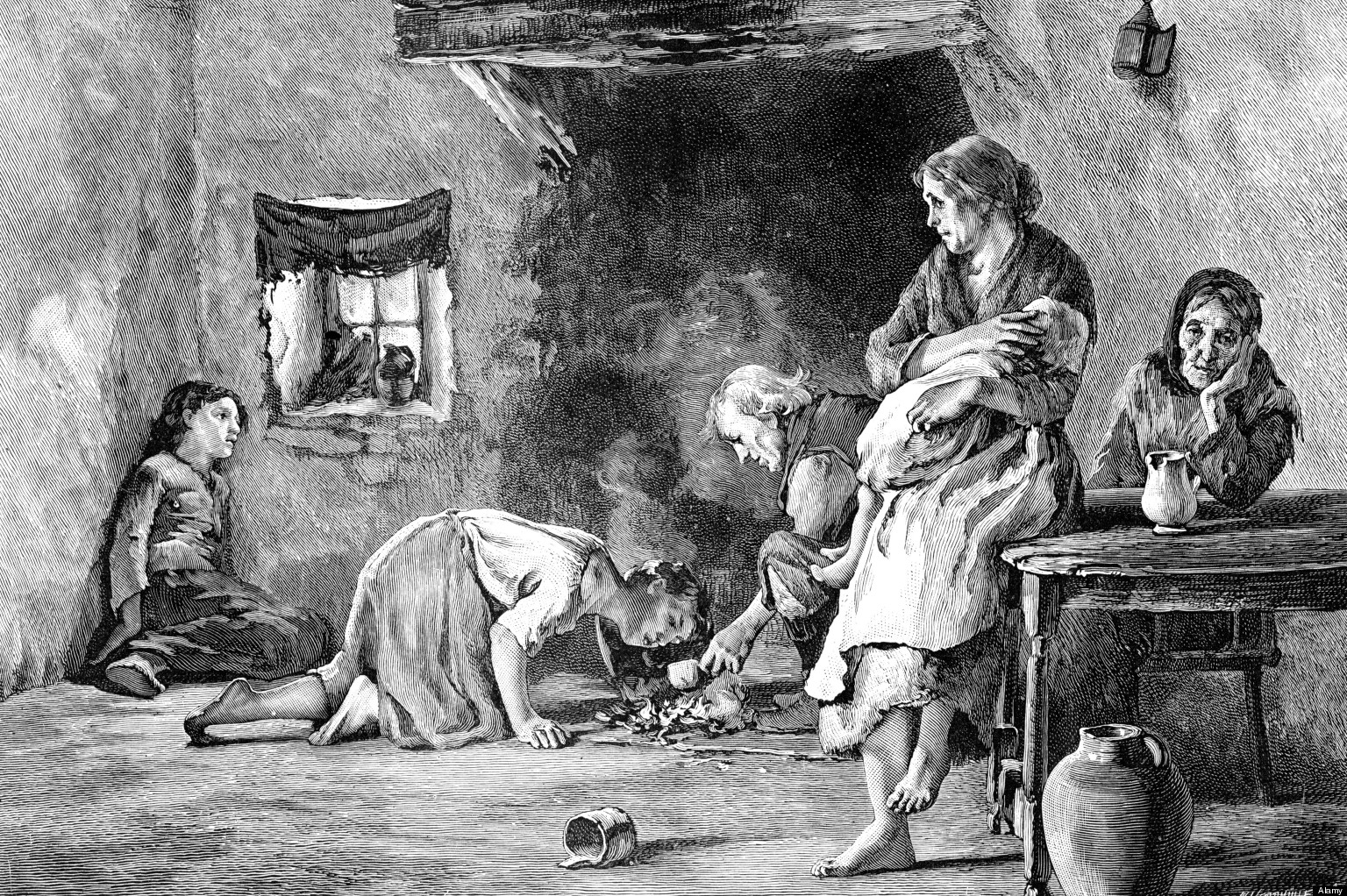
B0KH45 The Irish Famine, 1845-1849, (1900). Artist: Unknown

Them Was Rotten Days!
Culled from: The Pessimist’s Guide To History


Morbid Trinket Du Jour!

Things I would buy if I were rich #3523. (Thanks to Mike Marano for the link.)

This morbid automaton sold for $13,035.  A wee bit out of my price range.  Alas…

Morbid Fact Du Jour for December 14, 2015

Today’s Covert Yet Truly Morbid Fact!

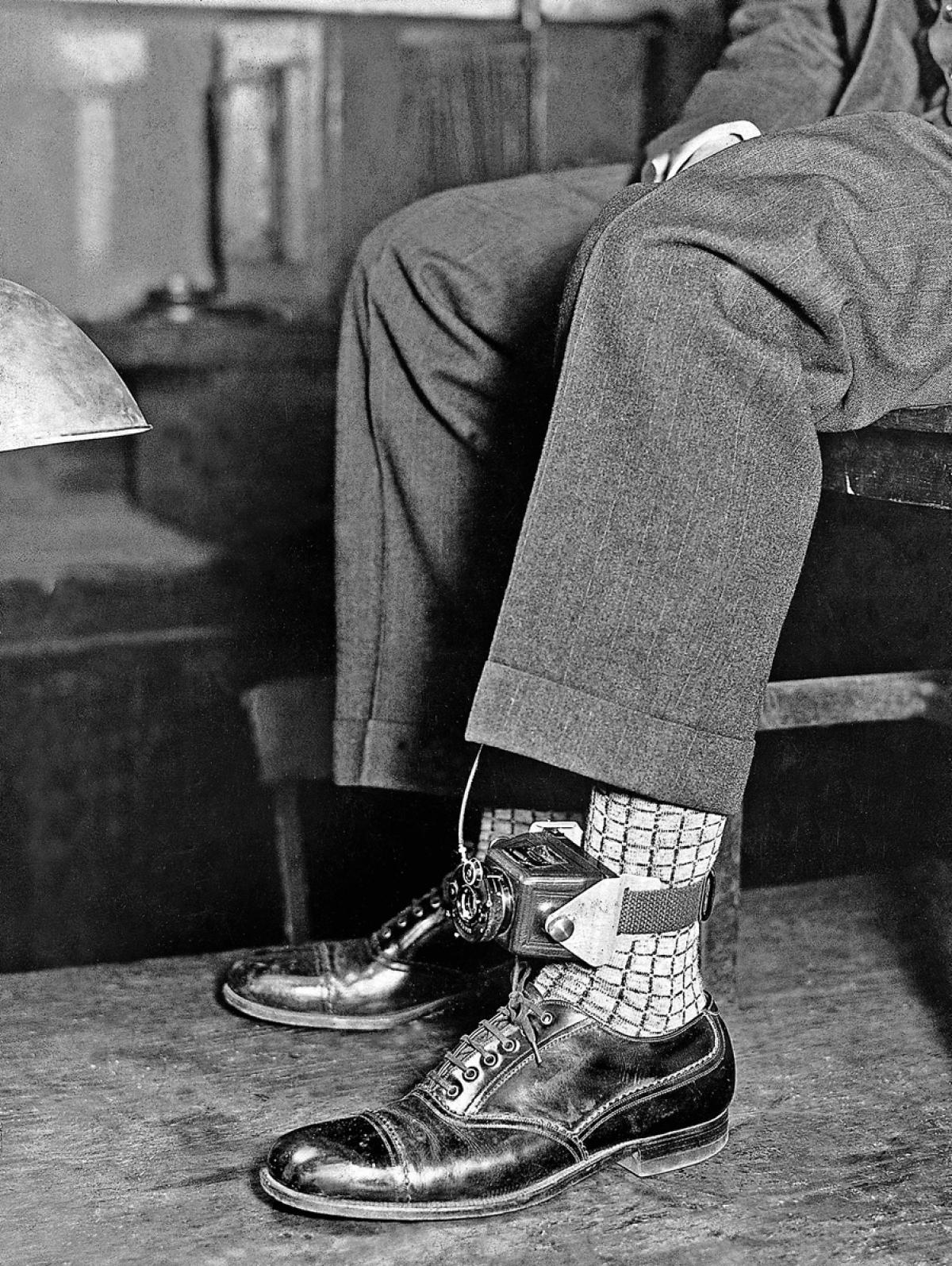
Shortly after 11 p.m. on the night of January 12, 1928, the convicted murderess Ruth Snyder was led into the death house at Sing Sing Prison, the first woman ever to face the electric chair. A small crowd of prison officials and reporters who had been gathered to witness the historic execution watched in silence while an ominous black hood was lowered over her head. Her eyes still peering out, she was bound and shackled, and the electrodes were set. This was society’s price for the calculated bludgeoning, poisoning, and strangulation of a husband she no longer cared for. At 11:06 the executioner threw the switch, sending the retribution coursing through her body. At precisely the same moment, however, another device was activated, one that would forever capture the moment and blanket it in controversy. Unbeknownst to prison officials, Tom Howard, a photographer from the Daily News, had covertly raised his pant cuff to uncover a miniature camera linked to a shutter release that snaked up his leg and into his pocket. “DEAD!” was the single word that accompanied the picture he made, which ran on the paper’s front page for the next two days, selling a sensational half million extra copies.

Here’s Ruth as she looked without a black hood over her head:

Here’s a photo of the camera strapped to Tom Howard’s ankle:

Here’s the original photo that he captured, which isn’t very clear:

Here’s the image all gussied-up with contrast for publication:

And here’s the final product:

Culled from: New York Noir: Crime Photos from the Daily News Archive

Morbid Fact Du Jour for August 30, 2015

Today’s Unidentified Yet Truly Morbid Fact!

On September 1, 1894 a huge firestorm, fed by drought conditions and dry debris left behind by lumber companies, destroyed the town of Hinckley, Minnesota, killing over 418 people. After the fire, in outlying areas, the bodies found near railroad tracks were laid along side the tracks to await transportation on handcars or relief trains to the nearest towns. St. Paul mortician O’Halloran came to Hinckley on a work train Sunday evening with a load of 32 caskets. On the way he filled all of them with bodies found beside the tracks. O’Halloran kept descriptions of each of the deceased, saving fragments of clothing and items of jewelry for later identification. The coffins were brought back to Pine City to await burial.

On Sunday James Sargent of the Limited No. 3, which had been stopped at Pine City Saturday afternoon, organized a burial crew that went on handcars north on the St. Paul and Duluth tracks from Hinckley to Skunk Lake. Along the way they recovered thirty-one bodies which were wrapped in blankets and whatever available cloth could be found. They brought them to Hinckley and laid them beside the tracks for burial.

When rescue teams found bodies in remote areas, they buried them where they were found, marking the graves with plain wooden stakes bearing the names of the victims if they were known. Personal effects were collected and marked for later identification.

Culled from: From the Ashes: The Story of the Hinckley Fire of 1894


Morbid Trinkets Du Jour!

I’ve honestly never really seen the appeal of pearls.  Until now!  (Thanks to Erika H. for the link.)

Morbid Fact Du Jour for August 3, 2015

Today’s Suicidal Yet Truly Morbid Fact!

In 1823 British Parliament decided to do away with crossroads burial (the burial of suicides at a crossroads outside of consecrated ground, with a stake through the heart) and permit suicides to be interred in graveyards. Such burials were frequently confined to ‘suicides’ corner and were conducted at night, between the hours of nine and midnight, without religious ceremony. It took another half a century before forfeiture of a suicide’s property and lands was finally abolished and for the corpse not to be automatically given over to the medical schools for dissection. In acts passed in 1879 and 1882 suicide ceased to be legally regarded as homicide, and day-time burial was finally allowed.

Culled from: Death: A History of Man’s Obsessions and Fears 

Personal note: when I attempted suicide in 1994, after I awoke in the hospital, a police officer made a point to tell me that I had committed the crime of attempted murder upon myself and that they were keeping me confined to the hospital for 72 hours. I always thought that was A) rude and B) rather melodramatic of the officer. He was probably quite proud of himself for that “scared sane” line.

Morbid Fact Du Jour for June 6, 2015

Today’s Leaping Yet Truly Morbid Fact!

In 1958, millions of people in China began to starve.  Their revolutionary communist leader Mao Zedong was instituting the Great Leap Forward, a grand scheme to remake Chinese society by, among other things, uprooting traditional habits and lifestyles, moving millions of people from farm to city to work in factories, outlawing private garden plots, and creating enormous agricultural communes – reforming agriculture to conform to Maoist politics. His timing was inauspicious. The Great Leap Forward was launched just when drought, floods, and enormous population growth combined to tighten belts around China. When, on top of it all, Mao started enforcing his new policies, the agricultural system in some areas collapsed. Starvation began to spread. Hungry peasants began eating their livestock. When the animals were gone, they turned to wild vegetables, made grass soup, and in some places stripped the bark from trees and ate it. Cannibalism was reported. Despite everything, by 1961 an estimated thirty million Chinese had died from malnutrition. Instead of a great leap forward, Mao had triggered China’s great famine, the worst mass starvation in recorded history.

Culled from: The Alchemy of Air: A Jewish Genius, a Doomed Tycoon, and the Scientific Discovery That Fed the World but Fueled the Rise of Hitler


Morbid Fact Du Jour for May 29, 2015

Today’s Voyeuristic Yet Truly Morbid Fact!

A kind of dark tourism was commonplace in the nineteenth century, with a variety of different spectacles and events associated with violence, death and deformity often becoming framed or experienced as macabre and sensational forms of entertainment. Every fight or brawl, anonymous suicide, railway accident, murder or infanticide became not just an event to be reported in itself, but also a story of the community’s engagement with trauma, death and violence. News reports of the large crowds that flocked to the sites related to notorious crimes such as cemeteries, court houses, prisons and murder scenes confirmed the sensational nature of a case and, in turn, helped to draw increasing numbers of onlookers. [What perfectly HORRIBLE people! – DeSpair]
The Paris morgue was one of the most famous international sites for this kind of macabre voyeurism in the nineteenth century. From 1864 until 1921 the morgue was located on the quai de l’Archevêché near Notre Dame, nearly within jumping distance of the Seine (from the waters of which many of its subjects were retrieved). The bodies of the anonymous dead were displayed on black marble slabs behind a large glass window for members of the public to view, day or night, seven days a week. Green curtains were hung at either end so that authorities were able to obscure the public’s view when changing the exhibits, intensifying its resemblance to a stage show. Comparisons to waxworks, the theatre and even department store windows were made regularly in sensational newspaper commentaries, which always accompanied the appearance of a new corpse, while the morgue itself was included along with the city’s other tourist attractions in all the guidebooks of Paris.

The Morgue at Paris. The Last Scene of a Tragedy. — Image by © CORBIS

Vanessa R. Schwartz has written extensively on the Paris morgue in Spectacular Realities: Early Mass Culture in Fin-de-Siecle Paris (1998), and describes the way that ‘behind each corpse’s mysterious identity lay an untold story that readers searched out in a press that offered them up for wide-scale consumption’. As Schwartz points out, the thousands of people who visited the morgue every day were able to justify their desire to view the dead in the name of civic duty—on the remote chance that they may assist in identifying one of the bodies—all the while satisfying (or at least titillating) a range of darker sensibilities.

Culled from: Meanjin
Generously submitted by: Mike Marano

Aw, man!  Why can’t we have nice things like this anymore?  Now we just have websites with photos to provide our morbid entertainment.  It’s just not the same…


Morbid Trinket Du Jour!

And I see that our beloved Madame Talbot has a poster dedicated to the glorious thing that was the Paris Morgue!

And while you’re there check out Madame Talbot’s entire site.  It’s brilliant.  I wish I had her talent…

Madame Talbot’s Victorian Lowbrow

Morbid Fact Du Jour for May 15, 2015

Today’s Astrological Yet Truly Morbid Fact!

Things were tense in the Covell household of Bandon, Oregon. Fred Covell was a successful chiropractor, but his first wife had died and left behind two children, Lucille and Alton, who were both mentally deficient, Alton more so than his sister. Alton had in fact been institutionalized for a time, but returned home after his father remarried. Dr. Covell and his new wife Ebba had three more children together.

Also living in the home was the doctor’s brother Arthur. Arthur had been working on a truck when it fell on him and crushed his spine, leaving him paralyzed and bedridden. He could barely sit up and was completely dependent on his brother and sister-in-law for care.

Despite his injury, Arthur managed to make himself useful after a fashion. He studied astrology and soon was running a profitable mail-order astrology business with many Hollywood clients.

Ebba and Arthur did not get along; 14-year-old Lucille later said that her stepmother never went upstairs to see Arthur and was always complaining about how much he ate. But Lucille and 16-year-old Alton were apparently very fond of him.

So when Arthur hatched a plan, aided by his astrological calculations, to murder his disliked sister-in-law, Alton was willing to carry it out. Not only did Arthur plan to kill Ebba, he also had designs on at least 27 other Bandon residents whom he wanted murdered for financial gain. He kept meticulous encrypted notes about his deadly plans, and had decided, with the help of the stars, that Ebba must die on September 3, 1923, at eleven A.M. He and Alton discussed the plans in detail, and even included Lucille in their discussions; Lucille later admitted that she had not warned Ebba or her father about the plans because she was afraid of what they might do to Uncle Arthur.

On the appointed day, after Fred Covell had left for work, Alton, following the plan concocted by Arthur, soaked a rag in ammonia and sneaked up behind Ebba, pressing the rag to her nose with one hand and pinning her arms with the other. After a desperate, three-minute struggle, Ebba was dead, and Alton carefully laid her on her bed and told his uncle that the deed was done.

There were no signs of injury on Ebba except a red rash on her cheek from the ammonia. The police were suspicious from the get-go and at first focused their attention on Fred Covell. However, Lucille quickly confessed her knowledge of what had happened, and confronted with his sister’s admissions, Alton cracked and gave a full confession.

Arthur Covell refused to admit anything beyond knowing that September would be a bad month for Ebba, but his journals, when deciphered, sealed his fate. Arthur and Alton Covell went on trial and were convicted. Alton received a life sentence, and Arthur, who’d attended the trail on a cot, was sentenced to hang. He was carried to the gallows by prison guards on May 28, 1925, and Alton was released after about eight years.

Culled From The Malefactors Register
Submitted by Aimee

Morbid Fact Du Jour for May 3, 2015

Today’s Scalding Yet Truly Morbid Fact!

Let’s have another jolly story of  Christian Martyrdom from the classic of the genre, Fox’s Book of Martyrs (1848).  This allegedly occurred during the Third Persecution, under Trajan, in A.D. 108:

Phocas, bishop of Pontus, refusing to sacrifice to Neptune, was, by the immediate order of Trajan, cast first into a hot lime-kiln, and then thrown into a scalding bath till he expired.

Culled from: Fox’s Book of Martyrs
Generously suggested by: Louise


Morbid Trinket Du Jour!

Howard sent me this lovely trinket by way of the Irish Archaeology Facebook page.

“18th century ivory carving depicting ‘The tooth worm as Hell’s demon’. Before dental decay was fully understood people often blamed ‘tooth worms’ for toothaches. These were believed to bore holes inside the tooth and caused a pain by wriggling around. Ouch……”

P.S. I’m glad that tooth worms don’t really exist…