Today’s Famished Yet Truly Morbid Fact!
Nearly half of Ireland’s eight million people were small tenant farmers who depended on the potato crop for their food. A one-acre plot of potatoes was enough to feed a family of four; grain and other crops had to be exported to pay the rent on the farm. But in 1845 a strange new blight caused the potatoes to rot in the ground. Four years of terrible famine had begun.
Millions went hungry as the blight devastated the 1845 crop. In 1846 hopes for a good harvest that would save the people suddenly ended when the plants blackened and withered to the ground overnight. The smell of rotting potatoes spread despair throughout Ireland. Women sobbed in the fields as they realized another year of hunger lay before them.
With the spring harvest completely destroyed, the poor farmers were left with nothing to eat. Millions wasted away from hunger and disease. To make matters worse, the winter of 1846-47 turned out to be brutally cold. Gaunt, starving women wandered through the streets, begging for food. Families with nothing else to eat gnawed on weeds. Landlords evicted thousands of starving families who could not afford to pay their rent.
In Skibbereen, one witness described looking into a hovel where “six famished and ghastly skeletons, to all appearances dead, were huddled in a corner on some filthy straw, their sole covering what seems a ragged horsecloth, their wretched legs hanging about, naked above the knees. I approached in horror, and found by a low moaning they were alive.”
The nation was so ravaged by hunger, disease, and cold that only about one-eighth of the usual crop was sown in 1847. The harvest of 1848 again was disastrous. Weakened by starvation, the people succumbed to epidemics of cholera and typhus. One witness described Ireland as “one mass of famine, disease, and death.” Emaciated women wandered through the streets, carrying corpses of children in their arms, begging for the money to buy a coffin.
Help from the British government was slow in coming, and what arrived was not nearly enough. Rather than subsidize food supplies for the starving, the government enacted a scheme to put the hungry to work building roads and canals. But the pay was too little; food prices were generally high because of bad harvests throughout Europe. Meanwhile, exports of grain continued throughout the crisis; the peasants needed the sales of grain to pay their rents.
Scattered rebellions broke out across Ireland. Some looted corn storage bins or broke into bakeries. A few of the starving got themselves arrested so that they could be fed in jail. All who could afford passage left Ireland for Canada or the United States, but the squalid conditions aboard emigrant ships killed thousands en route. Altogether a million and a half people fled Ireland during the famine.
By the time the potato harvest recovered in 1849, Ireland had lost more than a quarter of its population to emigration or death. An estimated one and a half million people had died from starvation, exposure following eviction, or disease caused by the famine.
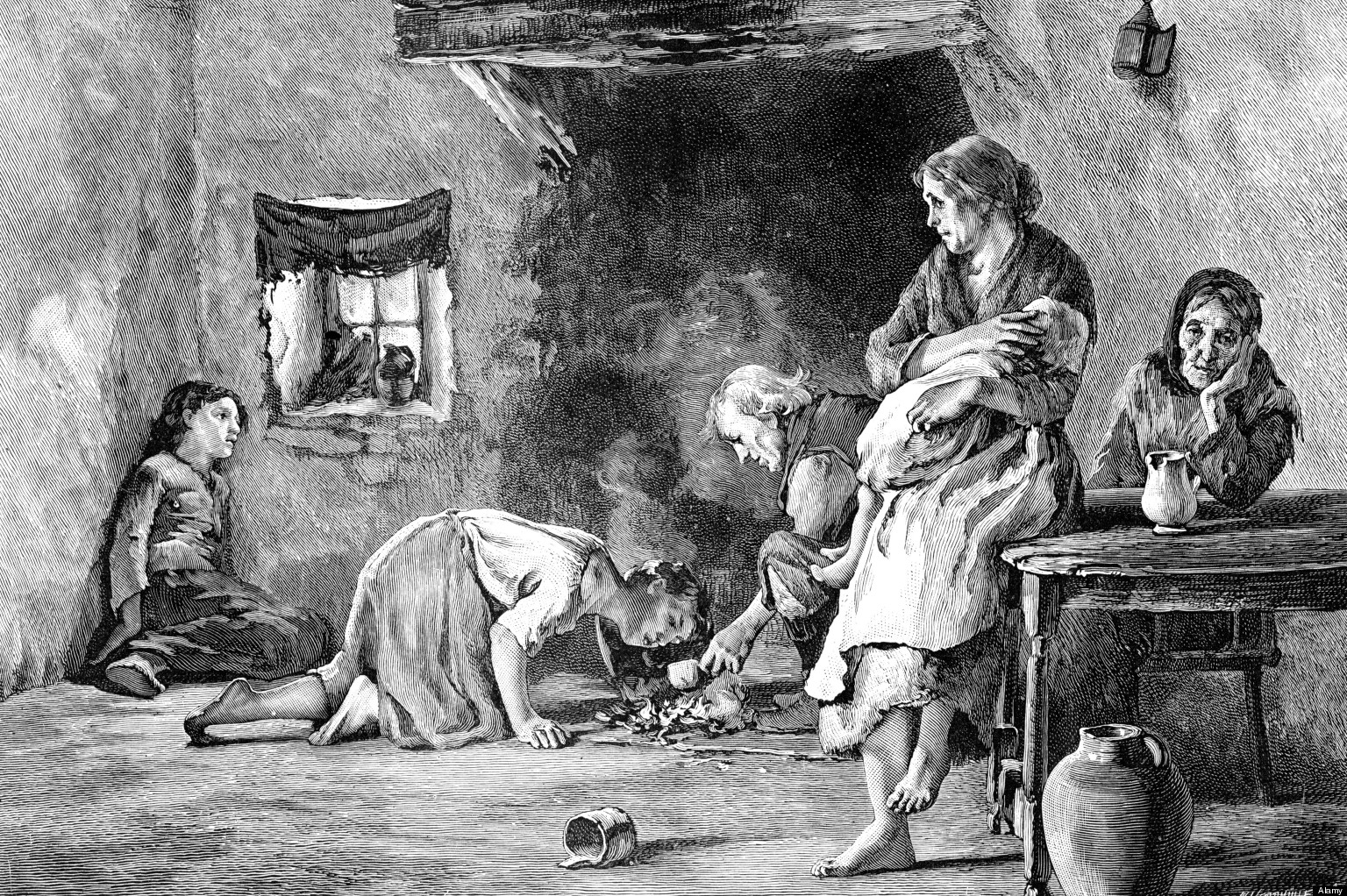
B0KH45 The Irish Famine, 1845-1849, (1900). Artist: Unknown
Them Was Rotten Days!
Culled from: The Pessimist’s Guide To History
Morbid Trinket Du Jour!
Things I would buy if I were rich #3523. (Thanks to Mike Marano for the link.)
|
|
|

The British were exporting food from Ireland during the famine. They eventually sent in supplies of cornmeal, (maize) but because the Irish hadn’t a clue about nixtamalization, it wasn’t processed properly, and in addition to other illnesses, the Irish developed pellagra.