Today’s Dehumanizing Yet Truly Morbid Fact
To Jews arriving at the ramp at Auschwitz, nothing medical seemed to be occurring—though much of their experience there was orchestrated by Nazi doctors. It was a terrifying scene of vast confusion, in many ways an extension of a journey of persecution that had begun when they were driven from their homes, and continued through the days or weeks of the slow, cruel, dehumanizing train journey to the camp in brutally overcrowded railroad boxcars. Arriving Jews usually saw the SS doctor standing on the ramp as just another SS officer with absolute power over them. Many had little sense that a selection process of any kind was taking place. The experience of Marianne F., who arrived at Auschwitz from Czechoslovakia in early 1943 as a seventeen-year-old girl, is typical. First, the bizarre reception:
We arrived at night…. Because you arrived at night, you saw miles of lights—and the fire from the… crematoria. And then screaming and the whistles and the “Out, out!” [now she shouted] “Raus! raus! raus! raus!” [colloquial German for “Out!”], and the uniformed men and the SS with the dogs, and the striped prisoners—we, of course, at that time didn’t know who they were and they said, “Throw everything out. Line up—immediately!”
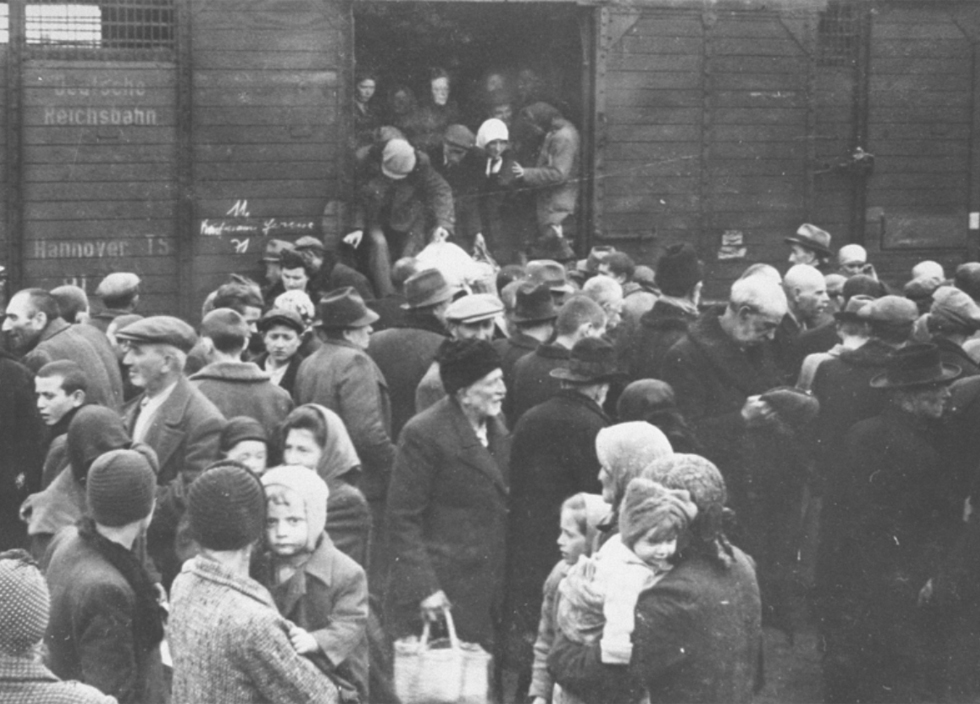
Arriving at Auschwitz
And then the confusing, rapid-fire selections:
They separated you and then lined up everybody in fives…. and there were two men standing…. On one side, was the doctor, one was Mengele…. and on the other side was the … Arbeitsführer, which was the… man in charge of the work Commando. And it was…. “You go, you go by truck. You walk, you go by truck.” … A pattern pretty soon developed that you could see—under fourteen about and over thirty-five were assigned to the trucks. And not until we actually marched into the camps did you know exactly where the trucks had gone…. and this was done, I mean, very fast, very efficient.
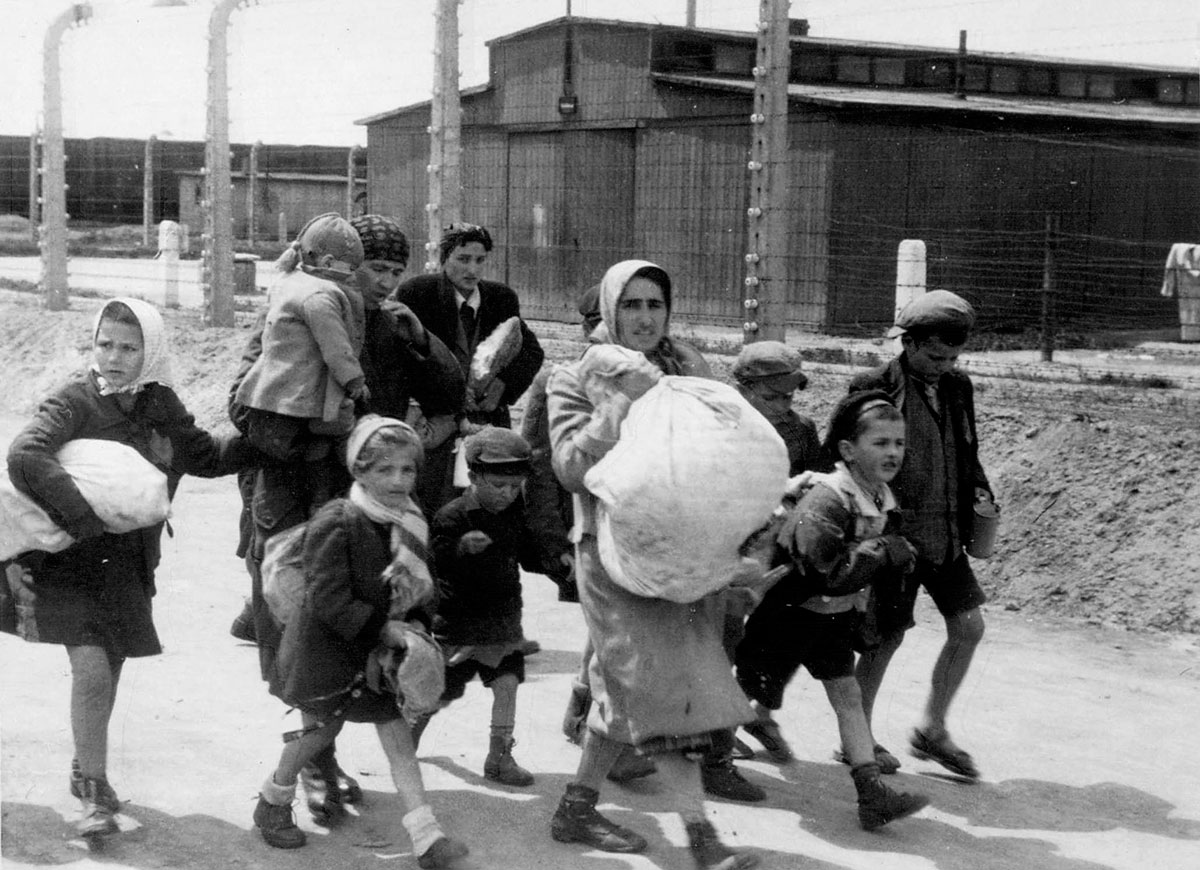
Beautiful people on their way to the gas chamber
Next was a ritual reception by old inmates:
[We went] directly on foot to the camp…. and… the minute you came into the camp….[there was] a so-called welcome committee of prisoners that would watch you until you could be processed into the sauna [shower]. Those were prisoners—Slovakian girls who had already been there since about one year before…. The only thing they were interested in first of all was to get everything they could get before the SS would get it from us—jewelry or watches, what have you—because they already were in the inner circle knowing how to manipulate and organize for food and things. And secondly, to immediately tell us what was waiting for you and what has happened—somehow [they thought]: “We’ve been [here] so long, you might as well know.”
That knowledge, attained within hours or even minutes, called forth and maintained the extreme numbing that characterized all life in the camp:
And then of course immediately you realized what the unbelievable smell was… that you have been smelling….Somehow or other they… were already so inured…. You come to the point that if you were in there long enough, you had absolutely no emotions left—and all you were concerned [with] was survival.
But most did not survive. The terrible knowledge imposed on this Czechoslovakian girl was recorded by Dr. Otto Wolken, an Austrian-Jewish prisoner physician, who observed closely what went on in the camp, especially the behavior of SS doctors:
Over time, five crematoria were built in which the gas chambers were also located. People from all nations, of both sexes, of all ages were gassed….Gassings of unthinkable dimensions took place at the arrival of prisoner transports from France, Belgium, Italy, Hungary, Greece, Czechoslovakia, and Germany, as well as from the Polish camps and from Norway. When the transport trains came in, the arrivals had to pass before the camp doctor… on duty. He pointed his thumb either to the right or to the left. Left meant death by gas. From a transport consisting of about 1,500 people, about 1,200 to 1,300 went to the gas chambers. Very seldom was the percentage greater of those who were permitted to live. At these selections Mengele and [Dr. Heinz] Thilo made their selections while whistling a melody. Those elected for the gas chambers had to undress in front of the gas chambers and were then chased into them with whip lashes, then the doors were closed and the gassing took place. After about eight minutes (death occurred after about four minutes) the chambers were opened and a special Kommando for this purpose had to take the corpses for cremation to the furnaces, which were burning day and night. There were not enough ovens at the time of the Hungarian transports [beginning in late May 1944] so that large trenches had to be dug to burn the corpses. Here the wood was sprayed with petroleum. Into these trenches the corpses were thrown. Often living children and adults were thrown into the burning trenches. These poor ones died a terrible death by burning. The necessary oils and fats for the burning were obtained partly from the corpses of the gassed in order to save petroleum.”
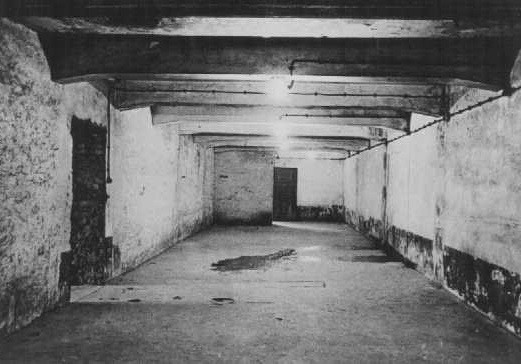
Inside the gas chamber at Auschwitz
For those entering the camp, as Marianne F. went on to describe, there were a series of initiatory humiliations: undressing completely in front of SS men when entering the shower or “sauna”; having all of one’s bodily hair shaved (“I grant you, good for… preventing all the lice, which of course were there, but psychologically…. it was unbelievably degrading…”); the issuing of minimal, ill-fitting clothing, mostly old Russian prisoners’ uniforms; and the tattooing (“I remember when… that thing [the number tattooed on each prisoner’s forearm] was put on,….it got infected and everything, and I suppose swollen and what have you—I never felt any pain—you were really numb”). She spoke of the psychological effectiveness of the whole process:
[There was] this fiendish insight that whoever organized… it had. And the fact that if you do something that is totally unbelievable and… you are incapable of believing, you don’t believe it. And the things that went on in Auschwitz… the gas chambers—nobody would have believed that. And then the houses that the crematoria had—you know, brick houses, windows, curtains, white picket fences around the front. And people never thought of anything—regardless of chimneys smoking. They could not believe it….There was a touch of diabolic genius.
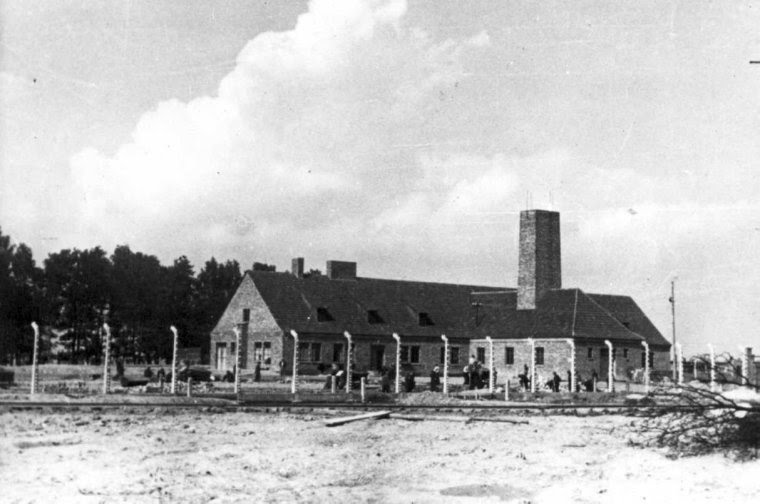
Crematorium III at Auschwitz (1943)
Culled from: The Nazi Doctors
Crime Scene Du Jour!

Homicide victim, bedroom, female Mable [sic] Hodges 4/14/16
Culled from: Murder in the City: New York 1910-1920
This book is full of photos but short on information, so I tried to look this one up myself, but despite the abundant clues, I came up empty. I can only guess that something in this information is incorrect. If anyone can find out anything, please let me know!
Andersonville Prisoner Diary Entry Du Jour!
This is the continuation of the 1864 diary of Andersonville prisoner Private George A. Hitchcock (see the archived version for all entries up until now).
Here’s today’s entry:
September 23d. Shower in the afternoon. A lively trade between the guard and prisoners: the prisoners’ articles of traffic being military buttons, and the rebs’ sweet potatoes. Some rebel officers visiting here rode around the dead-line to view the human menagerie.
Culled from: Andersonville: Giving Up the Ghost