Today’s Unsanitary Yet Truly Morbid Fact!
During the Battle of Gettysburg (July 1-3, 1863) in the American Civil War, wounded men knew to look for the nearest aid station for their initial treatment. The sheer number of wounded often made this impractical, however, and many either made their own way or were carried by comrades directly to a field hospital, which was designated by a red or yellow flag. Others, desperate for help, stopped at the first farm or house they encountered, forcing many homes to become unwilling aid stations. Dozens of private homes thus became small hospitals where citizens nursed the wounded.
The sites for field hospitals were left up to the medical staff, who looked for places somewhat distant from the actual fighting while still accessible by ambulance. Often this had to be nothing more than an old barn or a small grove of trees.
Arriving at a field hospital did not mean a soldier’s problems were over. Understaffing and overcrowding meant that an individual may not receive rapid care, or even so much as a blanket. Set up quickly under less than ideal conditions, field hospitals were often disorganized and underequipped. Operations and amputations were carried out in near-primitive conditions, with little or no concern for those wounded who lay in the immediate area. A constant cacophony of groaning, crying men begging for help or calling for their mother assaulted the senses of those unable to avoid the din. The sights were no less offensive, as attested to by H. S. Peltz, who wrote in the Gettysburg Compiler several years after the war. Time had not diminished the impact, as Peltz recalled, “I noticed with horror, as I assisted the dressing of a bleeding wound, that the blood of the patient (on the floor) above filtered through the cracks… and dripped upon the sufferers below.”
Wounded soldiers lay on the bare ground in the open, with no shelter from the weather or the thousands of biting blowflies that seemed to appear out of nowhere. Regarding this, Nurse Jane Boswell Moore wrote of the Union’s Second Corps hospital, “Scarcely had one man out of a thousand anything more than the ground, covered with an old blanket or oil cloth, to lay on, and hundreds had undergone amputation since the battle. Miserable little shelter-tents alone protected them from the rain, whilst numbers of the poor wretched Rebels had not even these, but were exposed through all the heavy rain of Tuesday night, with scarcely covering enough to keep warm in dry weather.”
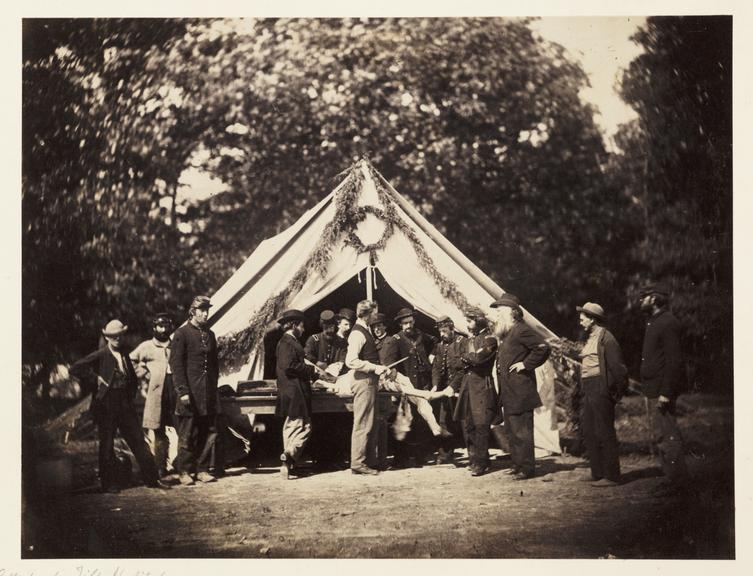
Gettysburg Field Hospital
Lack of sanitation cannot be overemphasized. Most of the hospitals outside town lacked clean water. Rain began on July 4 and continued almost daily. Runoff carried the detritus of the battlefield: human waste from the thousands of soldiers, the blood of the wounded that had pooled and then soaked into the ground, and the products of decomposition of human remains hastily buried in shallow, inadequate graves.
More than seventy thousand horses and mules had arrived with the two armies, producing several hundred gallons of urine and nearly two thousand tons of manure. Runoff carried all this material through camps where wounded and dying men lay on the bare ground, ending up in creeks that were used for drinking water and for what passed as scrubbing and cleaning water.
The air surrounding these hospitals was similarly foul, not only from the camps themselves but also from the surrounding area. In addition to the odor of corpses decomposing in the summer, heat, the remains of some five thousand horses that had also been killed added to the unpleasantness, a smell that changed to the odor of burning horseflesh when the unfortunate animals were dragged into piles and burned. Overall, the air in Gettysburg and its surrounds became so sickening that many citizens carried bottles of pennyroyal and peppermint to apply under their nostrils to block out the stench.
Confederate hospitals were more spread out than the Union’s because so many were established as the Southerners retreated. Logistically, this compounded an already difficult situation for the Southern army. The wounded now had to be cared for while the army was on the move, and obtaining supplies became even more challenging. Many of the wounded Confederates were in no condition to be moved, leaving the responsibility for their treatment to a Union army already struggling under the load of treating its own, or the put-upon citizens of Gettysburg.
Hospitals in town were subject to being hit by artillery, as they were the first established while the fighting was at its peak. Union artillery fire badly wounded an attendant for Dr. James L. Farley, taking off his thumb. The rear of the Washington House Hotel was also struck, blowing out an entire wall and showering patients with dust and debris.
The phrase “every house a hospital” was often used to describe the conditions in the aftermath of the battle. Although this is an exaggeration, the point is well taken that the hospital system as it had been planned quickly became overwhelmed, leading to untold suffering and needless deaths.
Culled from: Bullets & Bandages: The Aid Stations and Field Hospitals at Gettysburg
Wyoming Territorial Prisoner Du Jour!
The Wyoming Territorial Prison is a former federal government prison near Laramie, Wyoming. Built in 1872, it is one of the oldest buildings in Wyoming. It operated as a federal penitentiary from 1872 to 1890, and as a state prison from 1890 to 1901.
Today we feature prisoner #35, from the Warden’s record book:

Richard DeBois
June 6, 1875 — Murder In Second Degree — Laramie County — Life — age 23 — Hotel waiter — Georgia — family in Prattville, Alabama. Good conduct. Taken to Nebraska State Prison on June 24, 1878, Wyoming Convict #35. On December 17, 1884, Governor William Hale commuted the sentence to 15 years to June 4, 1890, but Governor Francis E. Warren issued a pardon on April 29, 1886, Convict served 10 years and 10 1/2 months.
Culled from: Atlas of Wyoming Outlaws at the Territorial Penitentiary
Andersonville Prisoner Diary Entry Du Jour!
This is the continuation of the 1864 diary of Andersonville prisoner Private George A. Hitchcock (see the archived version for all entries up until now).
Here’s today’s entry:
October 18th. I went outside the stockade for wood; and oh how like a new life it seemed to see the green grass and leaves, and breathe the fresh air, and be surrounded by sights and smells which no one can ever appreciate as fully as those who live as we do. It gives me a new longing to live, and also a new torture in the doubt and hopeless look of the future. Shep. and I have been writing letters home, sending for boxes. Several convalescents tried to escape into the hospitals, but the hounds caught them.
Culled from: Andersonville: Giving Up the Ghost