Today’s Diseased Yet Truly Morbid Fact!
Here’s an excerpt from “The Butchering Art” about groundbreaking Victorian surgeon Joseph Lister:
As 19th century medical students became desensitized, they also became irreverent—much to the public’s horror. Pranks in the deadhouse were so common that by the time Joseph Lister entered medical school, they had become a mark of the profession. Harper’s New Monthly Magazine condemned the jet-black humor and indifference toward the dead that pervaded the dissection room. Some students completely over-stepped the bounds of decency and used the rotting body parts of their allotted cadavers as weapons, fighting mock duels with the severed legs and arms. Others smuggled entrails out of the room and secreted them in places where they would shock and horrify the uninitiated when discovered. One surgeon remembered curious spectators visiting the dissection room when he was a student. These outsiders wore double-breasted jackets and often received in their tail pockets free donations of available appendages.
It wasn’t all frivolity. Cutting open dead bodies also carried with it many physical risks, some of which were fatal. William Tennant Gairdner, a professor at the University of Glasgow, addressed an incoming class with this dire message: “Not a single session has passed over our heads since I was appointed to my office among you, that has not paid its tax of life to the great Reaper, whose harvest is always ready, whose sickle is never weary.”
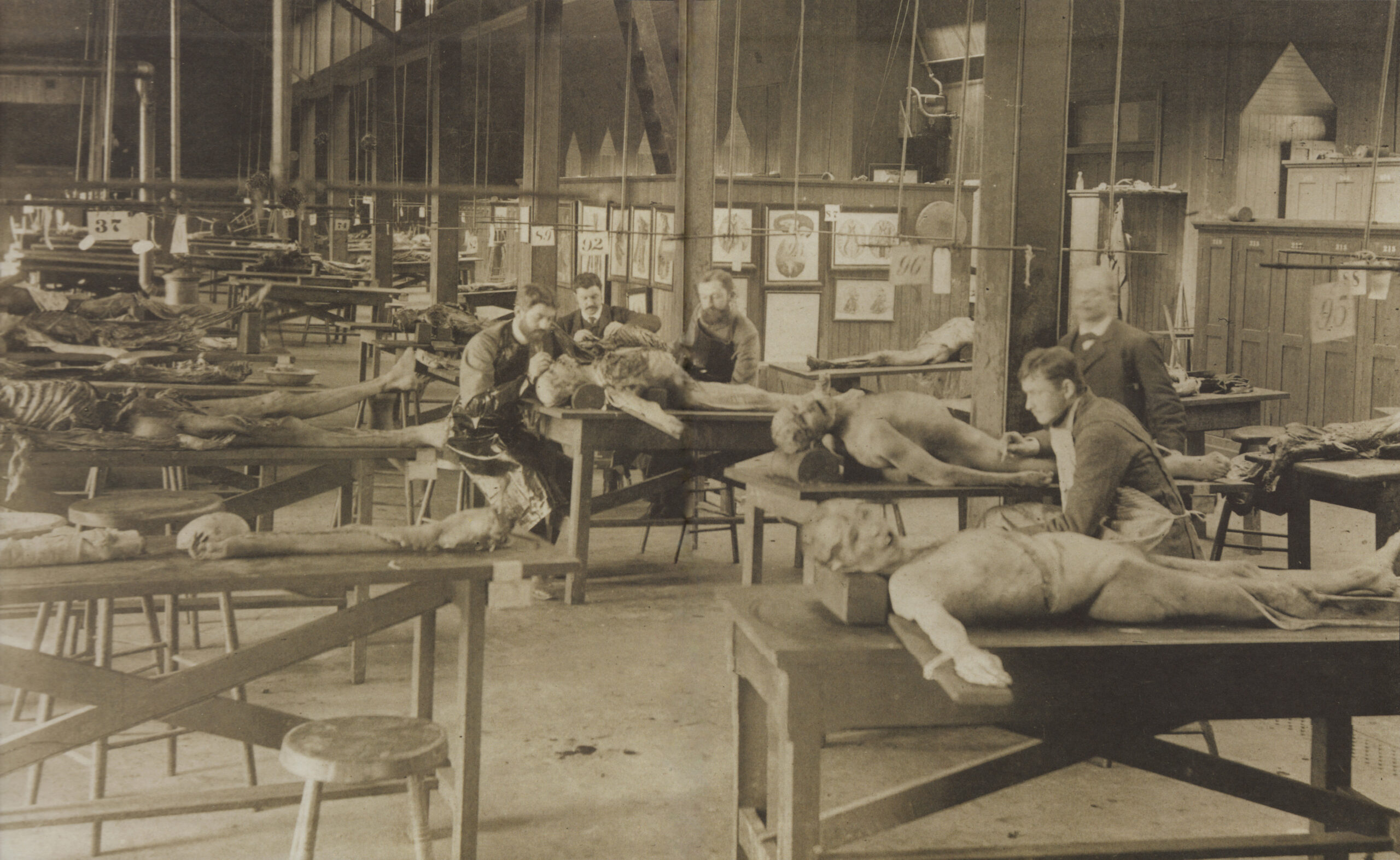
University of Pennsylvania dissecting room, 1885
Jacob Bigelow—professor of surgery at Harvard University and father of Henry Jacob Bigelow, who later witnessed William T. G. Morton’s operation with ether—also warned future medical students about the poisonous effects of a slight wound or crack in the skin made by the dissecting knife. These so-called pinprick cuts were a fast way to an early grave. The dangers were always present, even for the most experienced anatomists. Death was often inescapable for those trying their hardest to prevent it.
The living, in the form of diseased patients, were also taking a toll on those on the front line of medicine. Mortality rates among medical students and young doctors were high. Between 1843 and 1859, forty-one young men died after contracting fatal infections at St. Bartholomew’s Hospital, before ever qualifying as doctors. Those who succumbed in this manner were often eulogized as martyrs who had made the ultimate sacrifice in order to advance anatomical knowledge. Even those who survived often suffered some sort of illness during their hospital residencies. Indeed, the challenges were so great for those entering the profession that the surgeon John Abernethy frequently concluded his lectures by uttering bleakly, “God help you all. What will become of you?” [My kind of instructor. – DeSpair]
Culled from: The Butchering Art
Arcane Excerpts: Perverted Appetites Edition!
Here’s another bizarre excerpt from the fabulous Anomalies and Curiosities of Medicine by George M. Gould and Walter L. Pyle (1896):
The perverted appetites and peculiar longings of pregnant women furnish curious matter for discussion. From the earliest times there are many such records. Borellus cites an instance, and there are many others, of pregnant women eating excrement with apparent relish. Tulpius, Sennert, Langius, van Swieten, à Castro, and several others report depraved appetites. Several writers have seen avidity for human flesh in such females. Fournier knew a woman with an appetite for the blood of her husband. She gently cut him while he law asleep by her side and sucked blood from the wounds—a modern “Succubus.” Paré mentions the perverted appetites of pregnant women, and says that they have been known to eat plaster, ashes, dirt, charcoal, flour, salt, spices, to drink pure vinegar, and to indulge in all forms of debauchery. Plot gives the case of a woman who would gnaw and eat all the linen off her bed. Hufeland’s Journal records the history of a case of a woman of thirty-two, who had been married ten years, who acquired a strong taste for charcoal, and was ravenous for it. It seemed to cheer her and to cure a supposed dyspepsia. She devoured enormous quantities, preferring hard-wood charcoal. Bruyesinus speaks of a woman who had a most perverted appetite for her own milk, and constantly drained her breasts; Krafft-Ebing cites a similar case. Another case is that of a pregnant woman who had a desire for hot and pungent articles of food, and who in a short time devoured a pound of pepper. Scheidemantel cites a case in which the perverted appetite, originating in pregnancy, became permanent, but this is not the experience of most observers. The pregnant wife of a farmer in Hassfort-on-the-Main ate the excrement of her husband.
Andersonville Prisoner Diary Entry Du Jour!
This is the continuation of the 1864 diary of Andersonville prisoner Private George A. Hitchcock (see the archived version for all entries up until now).
Here’s today’s entry:
October 20th. Warmer last night. Went out for wood again, so we have a fire to sit by this evening. Beans and beef for to-day’s rations.
Culled from: Andersonville: Giving Up the Ghost